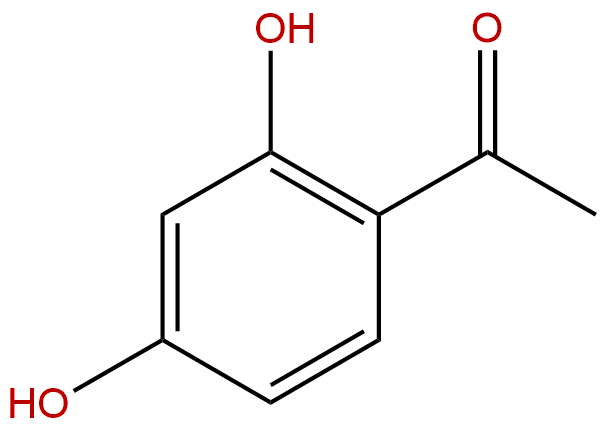


Product name: 2,4-Dihydroxyacetophenone
Synonym name:
Catalogue No.: SBP00273
Cas No.: 89-84-9
Formula: C8H8O3
Mol Weight: 152.149
Botanical Source:
Physical Description: Powder
Type of Compound: Phenols
Purity: 95%~99%
Analysis Method: HPLC-DAD or/and HPLC-ELSD
Identification Method: Mass, NMR
Packing: Brown vial or HDPE plastic bottle
The product could be supplied from milligrams to grams. Inquire for bulk scale.
We provide solution to improve the water-solubility of compounds, thereby facilitating the variety of activity tests and clinic uses.
For Reference Standard and R&D, Not for Human Use Directly.
Storage conditions:Short-term storage at 2~8℃, long-term storage at -20 ~ -80℃
57.5300
1.4250
1.1864
3.6812
3.9812
22.0008
Low
65.6163
1.8876
Yes
No
Yes
No
Yes
No
0.6
Yes
No
Yes
No
2,4-dihydroxyacetophenone (2,4-DHAP) is an important natural product belonging to acetophenone compounds, with hydroxyl substituents at the 2 'and 4' positions of the benzene ring. As a derivative of resorcinol, 2,4-DHAP has received widespread attention in the field of natural product pharmacology due to its unique chemical structure and biological activity. In recent years, with the increasingly severe problem of antimicrobial resistance, natural products as potential resources for new antibiotics have been re examined. 2,4-DHAP has gradually become a research hotspot due to its significant antibacterial activity and good safety.
This review aims to systematically summarize the chemical structure and physicochemical properties, plant sources and extraction methods, pharmacological activity and mechanism of action, pharmacological evaluation and pharmacokinetic characteristics of 2,4-dihydroxyacetophenone. Combining current research progress, it explores its clinical application prospects and development directions, providing theoretical basis and research references for subsequent drug development and clinical translation.
The chemical formula of 2,4-dihydroxyacetophenone is C8H8O3, with a molecular weight of 152.1490. Its structural characteristics are that hydroxyl groups are connected to the benzene ring at positions 2 'and 4', and the benzene ring is connected to the acetone group through the acetone side chain, presenting a typical dihydroxyacetophenone skeleton. This structure endows it with strong polarity and a certain degree of hydrophilicity, while the presence of hydroxyl groups gives it good hydrogen bond donor and acceptor abilities, which is conducive to binding with biomolecules.
In terms of physical and chemical properties, the LogP value of 2,4-DHAP is 1.4250, indicating its moderate lipophilicity, which facilitates membrane penetration but does not excessively affect solubility due to hydrophobicity. The topological polar surface area (TPSA) is 57.53 Å ², indicating moderate polarity that may support good bioavailability. The water solubility is 3.6812, indicating that it has a certain solubility in the aqueous phase, making it easy to absorb and distribute in vivo. The low permeability of the blood-brain barrier suggests that the compound is difficult to enter the central nervous system, reducing the risk of central toxicity. The hERG channel inhibition experiment showed a negative result, indicating a low risk of cardiac toxicity. The Ames test score is 0.6, indicating that its genetic toxicity risk is low and has a good safety basis.
2,4-dihydroxyacetophenone is widely present in various plants, especially as a secondary metabolite in certain medicinal plants. Its natural sources mainly include the roots, stems, leaves, and other parts of the Rutaceae family, legumes, and certain woody plants. Plants synthesize this compound through the phenylalanine metabolic pathway as part of their defense mechanisms, exerting biological functions such as antibacterial and antioxidant effects.
In terms of extraction methods, commonly used techniques include solvent extraction, ultrasound assisted extraction, microwave-assisted extraction, etc. Generally, polar organic solvents such as methanol, ethanol, or ethyl acetate are used for extraction, combined with liquid-liquid distribution and chromatographic purification steps (such as column chromatography, preparative high-performance liquid chromatography) to obtain high-purity 2,4-DHAP. In recent years, the application of green extraction technologies, such as supercritical CO2 extraction and natural deep co solvent extraction, has gradually been introduced to improve extraction efficiency and environmental friendliness.
The pharmacological activity research of 2,4-dihydroxyacetophenone mainly focuses on its antibacterial effect, but its antioxidant, anti-inflammatory, and potential anti-tumor activities are gradually being revealed.
2,4-DHAP exhibits inhibitory effects on various bacteria and fungi, particularly on Gram positive bacteria and some Gram negative bacteria. Its antibacterial spectrum covers Staphylococcus aureus, Streptococcus, Streptococcus pneumoniae, and some drug-resistant strains. Research has shown that this compound can act on key enzyme targets such as bacterial DNA gyrase (GYRA), fatty acid synthase (FABI), and dihydrofolate reductase (DHFR), interfering with bacterial DNA replication, lipid synthesis, and nucleic acid metabolism, leading to bacterial growth inhibition.
In addition, 2,4-DHAP also has a certain inhibitory effect on enzyme targets such as ERG11 (encoding 14 α - demethylase) and CYP51A1 in fungi, demonstrating its antifungal potential. The impact of drug efflux pump CDR1 on fungi suggests that it may overcome the resistance mechanism of fungi.
Some studies have shown that 2,4-DHAP has antioxidant capacity, can clear free radicals, alleviate oxidative stress damage, and thus play a protective role in cells. Its anti-inflammatory activity may be related to inhibiting the release of inflammatory mediators and regulating signaling pathways. Preliminary in vitro experiments have also revealed its potential to inhibit proliferation and induce apoptosis in certain tumor cell lines, but the mechanism still needs further investigation.
The antibacterial mechanism of 2,4-dihydroxyacetophenone involves multi-target and multi pathway synergistic effects. Its main targets include:
The multiple effects of these targets make 2,4-DHAP broad-spectrum and low risk of drug resistance in the antibacterial field.
According to existing data, 2,4-dihydroxyacetophenone exhibits good pharmacological parameters:
In terms of pharmacokinetics, although the relevant in vivo metabolism and kinetics research is not yet sufficient, its physicochemical properties indicate that it has good absorption and distribution characteristics in vivo. Expected to be metabolized by the liver and excreted through urine and bile. In the future, systematic ADME (absorption, distribution, metabolism, excretion) research and toxicological evaluation are needed to improve its pharmacokinetic characteristics.
2,4-dihydroxyacetophenone, as a naturally occurring multi-target antibacterial agent, exhibits broad-spectrum antibacterial activity and good safety, demonstrating its potential as a novel anti infective drug. Its inhibitory effect on drug-resistant strains is particularly important and is expected to play a key role in combating drug-resistant bacterial infections. In addition, its antifungal activity provides a new approach for treating fungal infections.
Future research should focus on:
In addition, the application of 2,4-DHAP in antioxidant, anti-inflammatory, and potential anti-tumor fields is also worth further exploration to broaden its medicinal value.
2,4-dihydroxyacetophenone, as a natural product with a simple structure but diverse functions, has shown broad prospects for drug development due to its excellent antibacterial activity and good drug properties. The pharmacological mechanism research and drug evaluation of the system have laid a solid foundation for its clinical application. In the future, through interdisciplinary collaboration, combined with modern medicinal chemistry, molecular biology, and pharmacokinetic techniques, it is expected to promote 2,4-DHAP as an important new drug in the field of anti infection, meeting the urgent demand for safe and effective antibacterial drugs in clinical practice.
