Introduction/Overview
Natural products, as an important source of drug discovery, play an irreplaceable role in the long history of human struggle against diseases. Flavonoids, as the most widely distributed class of polyphenolic secondary metabolites in nature, have always been a hot topic in medicinal chemistry and pharmacology research due to their structural diversity and extensive biological activity. In recent years, with the acceleration of population aging, neurodegenerative diseases represented by Alzheimer's disease (AD) have brought a heavy burden to the global public health system. The pathological mechanism of AD is complex, involving multiple links such as β - amyloid beta (A β) deposition, excessive phosphorylation of Tau protein, oxidative stress, neuroinflammation, and synaptic dysfunction. Despite repeated setbacks in drug development targeting a single target, natural compounds with the potential for multi-target regulation, especially those with both neuroprotective and endocrine regulatory activities, are receiving increasing attention from the academic community.
Pratensein 7-O-β - D-glucopyranoside (P7G) is a natural flavonoid glycoside with unique research value. As a glycosylated derivative of Pratensein, a type of isoflavone, P7G not only inherits the antioxidant and estrogenic activities of the flavonoid parent nucleus, but also possesses unique pharmacokinetic characteristics due to the introduction of glucose groups in its molecule. Existing studies have shown that P7G can significantly improve A β - induced cognitive dysfunction in rats by reducing oxidative damage, restoring levels of synaptic plasticity related proteins such as synaptophysin, and brain-derived neurotrophic factor (BDNF). This discovery opens up new application prospects for P7G in the prevention and treatment of neurodegenerative diseases, especially AD. In addition, the potential regulatory effects of P7G on targets such as estrogen receptor (ER), sex hormone binding globulin (SHBG), and aromatase (CYP19A1) suggest its potential value in menopausal syndrome, osteoporosis, and hormone related tumors. This article will provide a systematic review of the research progress of P7G from the aspects of chemical structure, plant origin, pharmacological activity, mechanism of action, and medicinal properties, in order to provide reference for the further development and utilization of this compound.
Chemical structure and physicochemical properties
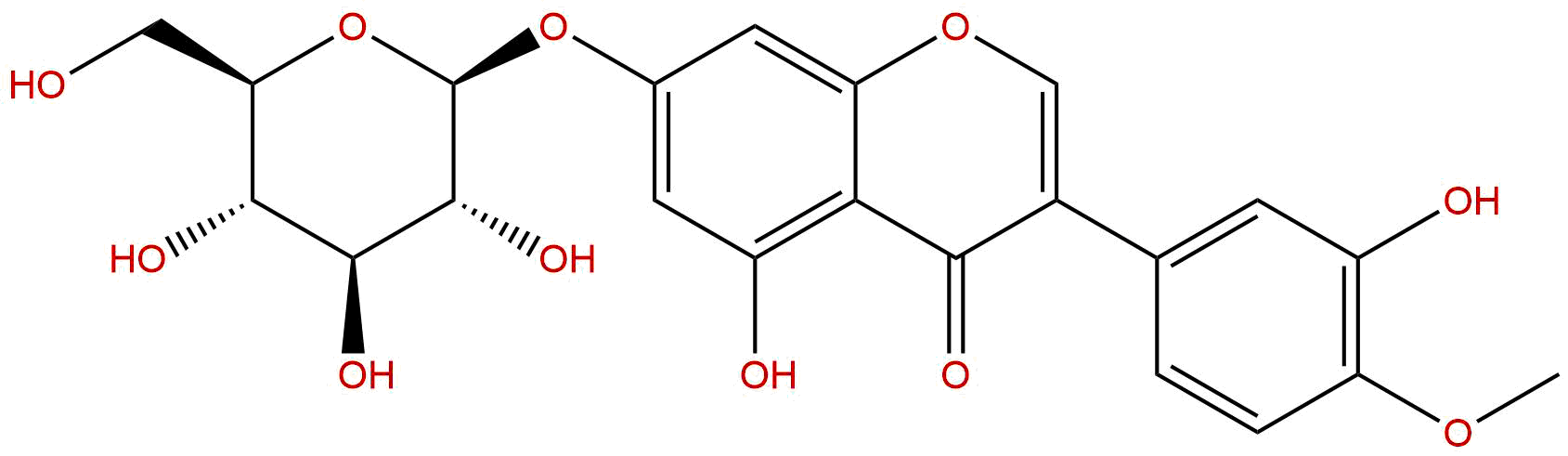
The chemical structure of Rhodiola rose-7-O - β - D-glucopyranose has typical isoflavone skeleton characteristics. The chemical name of its parent compound, Pratensein, is 5,7,3 '- trihydroxy-4' - methoxyflavone, which belongs to the flavonoid class. The difference between isoflavones and flavonoids is that the B ring is connected to the C3 position of the chromone ring instead of the C2 position. The structural feature of P7G is that a molecule of D-glucopyranose is connected to the C7 hydroxyl group of the mother nucleus through a β - glycosidic bond. This glycosylation modification not only increases the water solubility of the molecule, but also significantly affects its absorption, distribution, metabolism, and excretion (ADME) processes in vivo.
From the perspective of physical and chemical properties, the molecular formula of P7G is C ₂₂ H ₂ O ₁₁, with a molecular weight of 462.4070 g/mol. Its lipid water partition coefficient (LogP) is 0.1647, indicating that the compound has low fat solubility and strong hydrophilicity. The topologically polar surface area (TPSA) is as high as 179.2800 Å ², mainly attributed to the large number of hydroxyl and glycosidic oxygen atoms in the molecule. A high TPSA value usually means that compounds have difficulty passively diffusing through cell membranes, especially the blood-brain barrier (BBB). Computational chemistry prediction shows that the blood-brain barrier penetration ability of P7G is "low", which is consistent with its high polarity and large molecular weight. However, this does not mean that P7G cannot function in the central nervous system (CNS). Previous studies have confirmed that certain highly polar flavonoid glycosides can enter brain tissue in the form of aglycones through carrier mediated active transport (such as glucose transporter GLUT1) or deglycosylation by gut microbiota. The water solubility parameter of P7G is 1.7592, indicating that it has a certain solubility ability in water, which provides convenience for the development of its oral formulation. In addition, computer toxicology predictions show that P7G has no inhibitory risk on hERG potassium channels (hERG inhibition: No), and the Ames test result is 0.6, indicating a low genetic toxicity risk and preliminary good safety.
Plant sources and extraction methods
P7G, as a naturally occurring flavonoid glycoside, is mainly derived from Fabaceae plants. The "red clover" in its name refers to Trifolium pratense L., also known as red clover, which is the most famous source plant of P7G. Red clover, as a traditional medicinal and forage plant, is widely distributed in temperate regions around the world. Its inflorescence and aboveground parts are rich in various isoflavone components, including genistein, daidzein, biochanin A, as well as resveratrol and its glycosides. In addition to red clover, P7G is also present in other leguminous plants, such as certain Astragalus spp. plants and Spatholobus suberectus. These plants are often used in traditional medical systems to supplement blood, regulate menstruation, strengthen muscles and bones, and improve menopausal symptoms.
The extraction of P7G usually follows the classic extraction process of natural flavonoid glycosides. Due to the high polarity of P7G, commonly used extraction solvents are methanol, ethanol, or their aqueous solutions. In order to improve extraction efficiency, heating reflux extraction, ultrasound assisted extraction, or microwave-assisted extraction techniques are often used. For example, using dried inflorescences of red clover as raw material, a 70% ethanol aqueous solution is refluxed and extracted 2-3 times at 60 ℃. The extracted solutions are combined and concentrated under reduced pressure to obtain the crude extract. Subsequently, the crude extract was preliminarily separated using liquid-liquid extraction method (such as sequentially using petroleum ether, ethyl acetate, and n-butanol for extraction), and P7G is usually enriched in the n-butanol extraction layer. Further purification relies on various chromatographic techniques. Traditional column chromatography, such as silica gel columns, polyamide columns, and macroporous adsorption resin columns, is an effective method for separating flavonoid glycosides. Among them, macroporous adsorption resins (such as HPD-100 and D101) combined with gradient ethanol elution can efficiently separate P7G from monosaccharides, oligosaccharides, and some pigments. For higher purity requirements, preparative high-performance liquid chromatography (Pre HPLC) is required, using a reverse phase C18 column and isocratic or gradient elution with methanol water or acetonitrile water systems. The identification of P7G usually relies on ultraviolet spectroscopy (UV, with characteristic absorption around 260 nm and 330 nm), mass spectrometry (MS, giving the peak m/z 461 [M-H] ⁻ of the excimer ion), and nuclear magnetic resonance spectroscopy (NMR, confirming the connection position and configuration of glycosidic bonds through hydrogen and carbon spectra).
Pharmacological activity research
The pharmacological activity research of P7G is currently mainly focused on the field of neuroprotection, especially in the study of Alzheimer's disease models. At the same time, its potential in endocrine regulation has also attracted attention.
1. Neuroprotective and cognitive improvement effects
The most notable pharmacological activity of P7G is its ability to improve cognitive impairment induced by β - amyloid protein (A β). The abnormal aggregation and deposition of A β is one of the core pathological features of AD, which can trigger a series of downstream neurotoxic cascade reactions. In the classic A β - ₁₋₄₂ oligomer lateral ventricle injection induced cognitive impairment model in rats, P7G intervention showed significant protective effects. Behavioral experiments, such as the Morris water maze test, have shown that P7G can significantly shorten the escape latency of model rats, increase their stay time in the target quadrant and the number of times they cross the platform, indicating that it effectively improves spatial learning and memory abilities. At the molecular level, P7G treatment can significantly reduce the levels of oxidative stress markers such as malondialdehyde (MDA) and reactive oxygen species (ROS) in hippocampal tissue, while increasing the activity of antioxidant enzymes such as superoxide dismutase (SOD) and glutathione peroxidase (GSH Px). This indicates that P7G alleviates oxidative damage caused by A β deposition through its inherent antioxidant capacity.
More importantly, P7G can restore synaptic plasticity. Synaptic loss is the most closely related pathological change to cognitive decline in AD patients. Research has found that P7G can upregulate the expression levels of presynaptic markers synaptophysin and postsynaptic dense protein 95 (PSD95) in the hippocampus. Meanwhile, P7G significantly restored the levels of brain-derived neurotrophic factor (BDNF) in the hippocampus of A β model rats. BDNF is a key neurotrophic factor that promotes neuronal survival, differentiation, synaptic formation, and plasticity, and its downregulation is considered an important driving factor for cognitive decline in AD. Therefore, P7G exerts multi-level neuroprotective effects through the axis pathway of "antioxidant restoration BDNF synaptic protection".
2. Estrogen like activity and endocrine regulation
As an isoflavone compound, the parent nucleus of P7G, resveratrol, has a phenolic hydroxyl structure similar to estradiol, allowing it to interact with estrogen receptors (ER). Although the direct estrogenic activity research on P7G itself is not as in-depth as its aglycone, based on structure-activity relationship analysis, P7G may exert phytoestrogenic effects after being hydrolyzed into aglycone by gut microbiota in vivo. Its related targets include ESR1 (ER α) and ESR2 (ER β). Usually, isoflavones have a higher affinity for ER β than for ER α, and the activation of ER β is closely related to neuroprotection, anti-inflammatory effects, and inhibition of cell proliferation. In addition, P7G is predicted to interact with sex hormone binding globulin (SHBG) and may regulate the activity of aromatase (CYP19A1), which is a key enzyme in the conversion of androgens to estrogens. This comprehensive regulation of the sex hormone metabolism network makes P7G potentially valuable in alleviating menopausal syndrome, preventing osteoporosis, and regulating reproductive system function.
3. Other potential activities
Based on its antioxidant and anti-inflammatory properties, P7G may also have activities such as cardiovascular protection, anti-aging, and anti-tumor. For example, inhibition of low-density lipoprotein (LDL) oxidation and vascular endothelial inflammation may help prevent atherosclerosis. However, pharmacological evidence in these fields is currently insufficient and requires further research.
Mechanism of action and molecular targets
The pharmacological mechanism of P7G is multi-target and multi pathway, with its core being the synergistic effect of antioxidant, neurotrophic support, and endocrine regulation.
1. Antioxidant and anti apoptotic mechanisms
The multiple phenolic hydroxyl groups in the P7G molecular structure are highly efficient free radical scavengers. They can directly neutralize ROS and reactive nitrogen species (RNS), blocking the chain reaction of lipid peroxidation. In addition, P7G can activate the nuclear factor E2 related factor 2 (Nrf2)/antioxidant response element (ARE) signaling pathway. Nrf2 is the main transcriptional regulator for cells to cope with oxidative stress, and its activation can upregulate the expression of a series of phase II detoxifying enzymes and antioxidant enzymes (such as HO-1, NQO1, SOD, GSH Px), thereby enhancing the intrinsic antioxidant defense ability of cells. By inhibiting oxidative stress, P7G can further block A β - induced mitochondrial dysfunction and cytochrome c release, thereby inhibiting Caspase-3 activation and reducing neuronal apoptosis.
2. Neuronutrition and synaptic protection mechanisms
The regulation of BDNF by P7G is a key link in its cognitive improvement effect. Research has shown that P7G may promote BDNF transcription by activating cyclic adenosine monophosphate response element binding protein (CREB). CREB is a key transcription factor in the process of learning and memory, and its phosphorylation level is positively correlated with BDNF expression. After binding to the high affinity receptor TrkB, BDNF can activate downstream phosphatidylinositol 3-kinase (PI3K)/Akt and mitogen activated protein kinase (MAPK)/ERK signaling pathways. These two pathways not only promote neuronal survival, but also enhance long-term potentiation (LTP) by regulating the synthesis and transport of synaptic related proteins such as PSD95 and Synapsin I, thereby consolidating synaptic plasticity and memory formation. P7G restores BDNF levels, which is equivalent to reactivating this crucial signaling network for cognitive function.
3. Mechanisms mediated by estrogen receptors
P7G (or its glycoside Pratensein), as a plant estrogen, can bind to ER α and ER β. In CNS, the activation of ER β is believed to have neuroprotective effects. After ER β activation, it can: 1) rapidly activate the MAPK and PI3K/Akt pathways through non genomic effects, exerting neuroprotective effects; 2) Through genomic effects, it binds to estrogen response elements (ERE) to regulate the transcription of genes such as BDNF, anti apoptotic protein Bcl-2, and antioxidant enzymes. In addition, the regulation of SHBG by P7G may affect the bioavailability of free sex hormones in the body, while the regulation of CYP19A1 may alter the synthesis level of estrogen locally (such as in the brain). This precise regulation of the endocrine network may indirectly affect the survival microenvironment of neurons.
4. Anti inflammatory mechanism
Although there are not many reports on the direct anti-inflammatory effects of P7G in existing literature, based on the study of its structural analogues, it can be speculated that P7G may exert anti-inflammatory effects by inhibiting the nuclear factor kappa B (NF - κ B) signaling pathway. NF - κ B is the core transcription factor of inflammatory response, and A β deposition can activate microglia and astrocytes, leading to the activation of NF - κ B and the release of a large number of pro-inflammatory factors (such as TNF - α, IL-1 β, IL-6). The antioxidant activity of P7G can inhibit A β - induced ROS production, which is an upstream activation signal of NF - κ B. Therefore, P7G may alleviate neuroinflammation and indirectly protect neurons through a cascade reaction of "antioxidant inhibition of NF - κ B".
Evaluation of drug properties and pharmacokinetics
To push P7G from the laboratory to clinical applications, a systematic evaluation of its pharmacological properties is necessary. Based on computational predictions and preliminary experimental data, P7G shows certain potential for drug development, but also faces challenges.
1. Analysis of pharmacological parameters
According to Lipinski's "Rule of Five", the molecular weight of P7G (462.4) is slightly greater than 500, LogP (0.16) is less than 5, hydrogen bond donor (8 hydroxyl groups) is greater than 5, and hydrogen bond acceptor (11 oxygen atoms) is greater than 10, violating two of the "Five Rules" (molecular weight>500, hydrogen bond donor>5). This indicates that the oral bioavailability of P7G may be poor and belongs to the category of "non class drug" molecules. However, many active ingredients in natural products, such as paclitaxel and rapamycin, violate the "five rules", but this does not prevent them from becoming heavyweight drugs. A high TPSA value (179.28) and a low LogP value indicate poor membrane permeability and difficulty in passive diffusion. But as mentioned earlier, it may be absorbed through active transport mechanisms. HERG inhibition negative (no) and Ames test negative (0.6, indicating no mutagenicity) are important safety advantages of it.
2. Pharmacokinetic characteristics
The pharmacokinetic study of P7G is still in its early stages. Based on the commonality of flavonoid glycosides, it can be inferred that their main metabolic pathways after oral administration are as follows:
- absorb P7G is difficult to be directly absorbed in the small intestine. Most P7G enters the colon and, under the action of β - glucosidase produced by the gut microbiota, hydrolyzes glycosidic bonds, releasing the aglycone Pratensein. Glycosides are more easily absorbed by colonic epithelial cells due to their reduced polarity. Therefore, the bioavailability of P7G largely depends on the composition and activity of individual gut microbiota.
- Metabolism The absorbed aglycones undergo phase II metabolism in the liver and intestinal wall, mainly undergoing glucuronidation and sulfation binding reactions, generating more water-soluble complexes that are excreted with bile or urine. Partial complexes can re-enter the intestine through the enterohepatic circulation.
- distribution P7G itself is difficult to penetrate the blood-brain barrier. However, its glycoside Pratensein may have certain brain permeability due to its small molecular weight and high lipid solubility. Therefore, the CNS effect of P7G may be mainly attributed to the role of its aglycone in the brain. In addition, P7G and its metabolites may bind to plasma proteins (such as SHBG), affecting their distribution and activity.
- excretion Mainly excreted through urine and feces in the form of a combination of glucuronic acid and sulfuric acid.
3. Optimization strategy for drug properties
Given the low oral bioavailability of P7G, future optimization of its drug properties can be approached from the following aspects: 1) Prodrug design Modify the phenolic hydroxyl groups in the molecule, such as introducing phosphate or amino acid ester groups, to improve water solubility and intestinal stability, and release the original drug after enzymatic hydrolysis in vivo; 2) Formulation development Using technologies such as nanoliposomes, phospholipid complexes, or solid dispersions to improve their oral absorption rate; 3) Simplified structure Explore the active fragments of P7G and search for analogs with simpler structures and better oral activity.
Clinical application prospects and prospects
The unique pharmacological activity spectrum of P7G provides possibilities for its application in multiple disease fields, but there is still a long way to go before clinical application.
1. Prevention and treatment of neurodegenerative diseases
P7G improves the activity of A β - induced cognitive impairment, making it a potential candidate drug for AD treatment. Its multi-target effects (antioxidant, BDNF restoration, synaptic protection) meet the therapeutic needs of the complex pathological mechanism of AD. The future research focus should include: validating its long-term efficacy in transgenic AD animal models (such as 3xTg AD or APP/PS1 mice); Evaluate its impact on Tau protein pathology; Explore its synergistic effect with existing AD drugs such as cholinesterase inhibitors. In addition, given its low BBB penetration, developing nasal delivery or brain targeted delivery systems may be key to improving its CNS efficacy.
2. Menopausal syndrome and osteoporosis
As a plant estrogen, P7G has the potential to alleviate symptoms such as menopausal hot flashes, night sweats, and emotional fluctuations. Compared with traditional hormone replacement therapy (HRT), phytoestrogens usually have a lower risk of breast cancer and endometrial cancer, especially the selective activation of ER β. The regulatory effect of P7G on SHBG and CYP19A1 may also play a role in maintaining bone metabolism balance and preventing postmenopausal osteoporosis. Conducting randomized, double-blind, placebo-controlled clinical trials to evaluate their safety and efficacy in perimenopausal women is an important step in promoting their clinical application.
3. Security considerations
Although the preliminary toxicological predictions of P7G are good, a comprehensive safety evaluation is still needed. Research on long-term toxicity, reproductive toxicity, carcinogenicity, and drug interactions (especially with anticoagulants and antidepressants) is essential. For phytoestrogens, their safety to patients with hormone sensitive cancers (such as breast cancer and endometrial cancer) needs special attention, although P7G's preference for ER β may bring about safer characteristics.
4. Future research directions
- In depth mechanism research Using gene knockout animal models or specific inhibitors, clarify whether P7G exerts neuroprotective effects through ER α or ER β; Elucidate its precise regulatory relationship with the BDNF TrkB signaling pathway.
- Metabolomics research Analyze the metabolic profile of P7G in vivo and identify metabolites with higher activity.
- Study on Structure Activity Relationship Systematically synthesize P7G and its analogues, investigate the effects of glycosylation position, sugar type, and B-ring substitution mode on activity, and provide a basis for structural optimization.
- Combination therapy research Explore the synergistic effects of P7G with other natural antioxidants such as curcumin and resveratrol.
Conclusion
As a natural glycoside with an isoflavone core, Red Caryophyllin-7-O - β - D-glucopyranose combines antioxidant, neurotrophic support, and endocrine regulatory activities. Its significant effect in improving cognitive impairment induced by β - amyloid protein provides new ideas for drug intervention in Alzheimer's disease. Although its low oral bioavailability and poor blood-brain barrier penetration are key bottlenecks restricting its drug development, these obstacles are expected to be overcome through strategies such as prodrug design, novel delivery systems, and structural optimization. In the future, with the in-depth analysis of its mechanism of action, comprehensive elucidation of pharmacokinetic characteristics, and improvement of preclinical safety evaluation, P7G is expected to gradually move from a hot molecule in natural product research to a clinical candidate drug for the treatment of neurodegenerative diseases and menopausal related diseases. The in-depth study of P7G not only helps to explore the modern medicinal value of this ancient plant component, but also provides useful reference for searching for multi-target and low toxicity new lead compounds from the treasure trove of natural products.