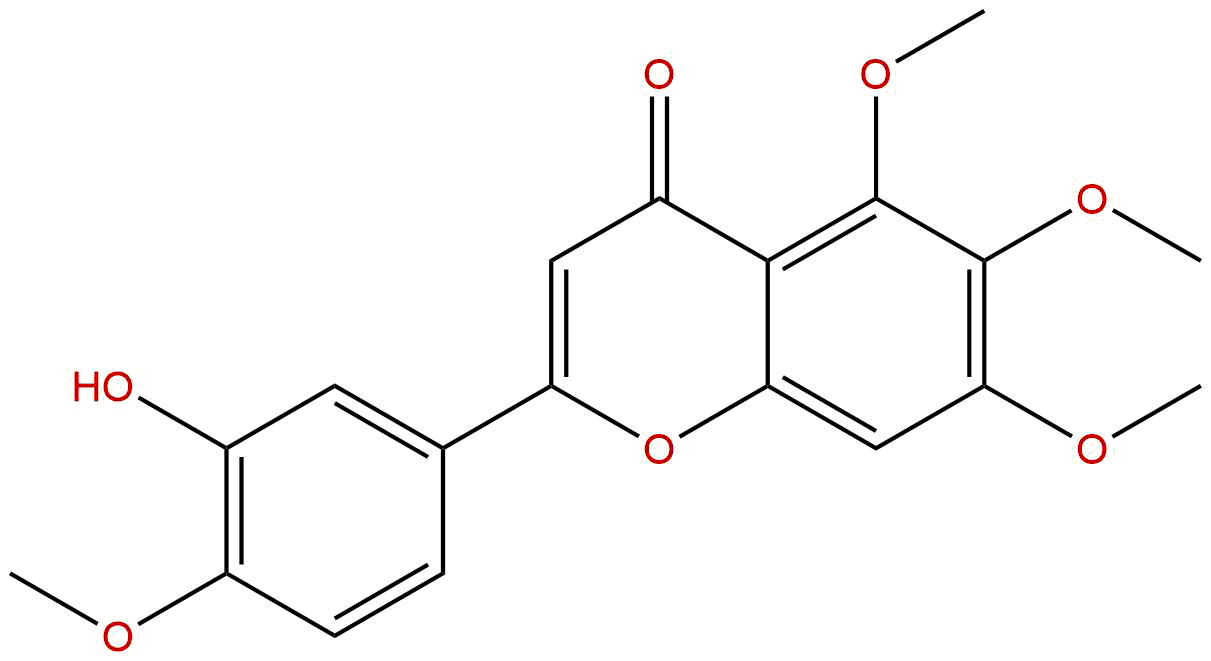


Product name: Eupatorin-5-methyl ether
Synonym name: 3'-Demethylsinensetin; 3'-Desmethylsinensetin;3'-Hydroxy-4',5,6,7-tetramethoxyflavone
Catalogue No.: BP5055
Cas No.: 21764-09-0
Formula: C19H18O7
Mol Weight: 358.346
Botanical Source:
Type of Compound: Flavonoids
Purity: 95%~99%
Analysis Method: HPLC-DAD or/and HPLC-ELSD
Identification Method: Mass, NMR
Packing: Brown vial or HDPE plastic bottle
Storage: Store in a well closed container, protected from air and light. Put into refrigerate or freeze for long term storage.
Whenever possible, you should prepare and use solutions on the same day. However, if you need to make up stock solutions in advance, we recommend that you store the solution as aliquots in tightly sealed vials at -20℃. Generally, these will be useable for up to two weeks.
The product could be supplied from milligrams to grams
Inquire for bulk scale.
For Reference Standard and R&D, Not for Human Use Directly.
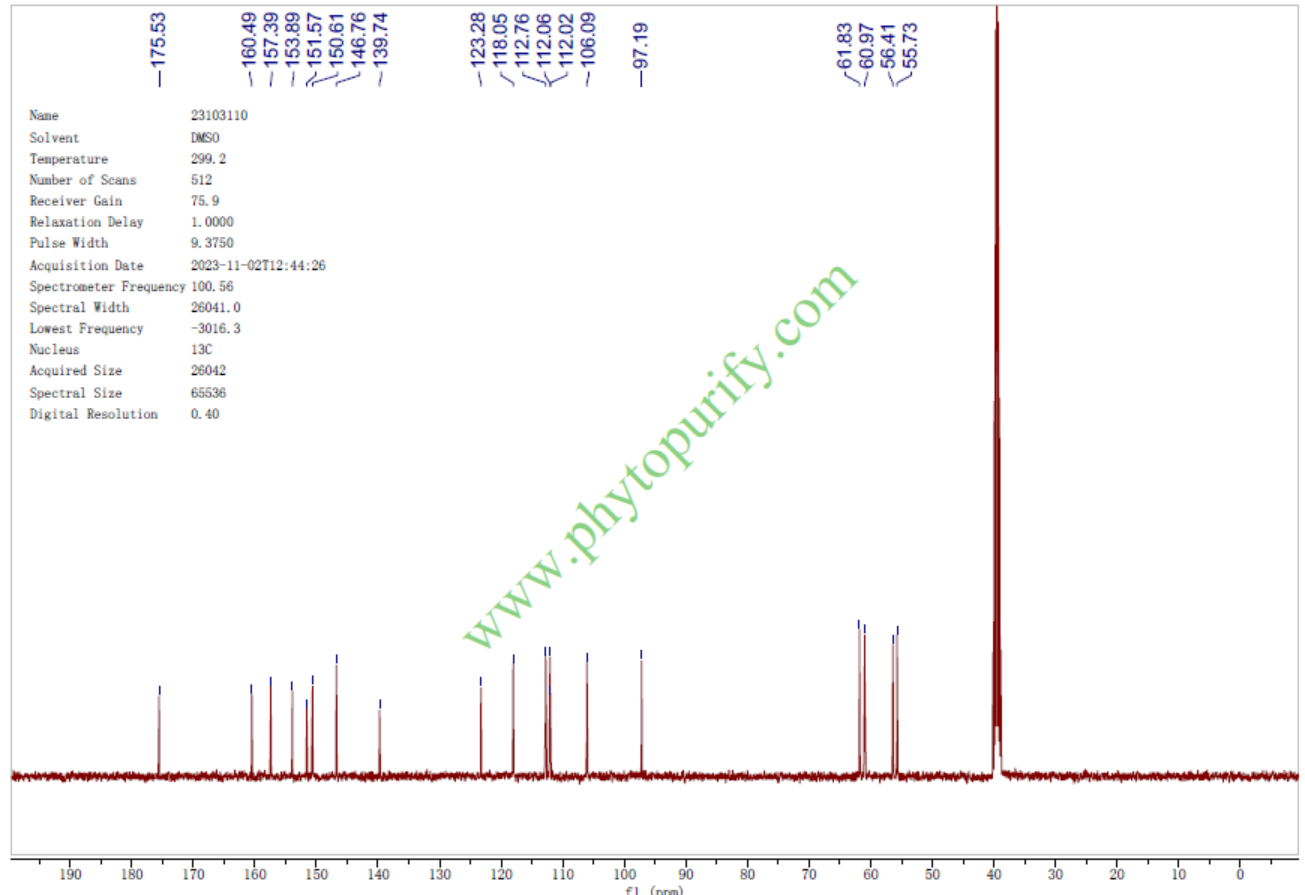
CNMR of Eupatorin-5-methyl ether
Storage conditions:Short-term storage at 2~8℃, long-term storage at -20 ~ -80℃
Natural products, as an important source of drug discovery, occupy an irreplaceable position in modern pharmacological research. Flavonoids have become a hot topic in the pharmacological research of natural products due to their diverse biological activities and good safety. Eupatorin-5-methyl ether (TMF) is a flavonoid compound isolated from the traditional Chinese medicine Orthosiphon stamineus. In recent years, it has attracted widespread attention due to its significant anti-inflammatory activity and potential pharmacological effects. TMF can effectively inhibit the production of nitric oxide (NO), with an IC50 value of 5.5 μ M, demonstrating strong anti-inflammatory potential. In addition, TMF has good drug compatibility and pharmacological parameters, demonstrating high clinical development potential.
This article aims to systematically review the chemical structure and physicochemical properties, plant sources and extraction methods, pharmacological activity and mechanism of action, drug evaluation and pharmacokinetic characteristics of TMF, and explore its prospects and challenges in clinical applications, providing theoretical basis and reference for subsequent drug development and mechanism research.
Half toothed Zeelanin-5-methylether (CAS number: 21764-09-0) belongs to the flavonoid class, with a molecular formula of C20H18O6 and a molecular weight of 358.3460. Its structural characteristics are typical flavonoid skeleton, containing multiple hydroxyl and methoxy substituents, especially methyl etherification modification at position 5, which endows it with unique physicochemical properties and biological activity.
In terms of physical and chemical properties, the LogP value of TMF is 2.5174, indicating that it has moderate lipid solubility, which is beneficial for membrane penetration and in vivo distribution. The polar surface area (TPSA) is 87.36 Å ², indicating that its molecular polarity is moderate and can balance water solubility and lipid solubility, which helps to improve bioavailability. Low water solubility (0.0051 mg/mL) may limit its oral absorption, but its dissolution performance can be improved through appropriate formulation techniques. TMF also exhibits high blood-brain barrier penetration ability, suggesting its potential role in central nervous system diseases. The hERG channel inhibition test was negative, indicating a low risk of cardiac toxicity. The Ames test result is 0.6, indicating a low risk of genotoxicity and relatively good safety.
Half toothed Zealandin-5-methylether is mainly isolated from the plant Orthosiphon stamineus in the family Lamiaceae. Half toothed Zelan is widely distributed in Southeast Asia and is a commonly used medicinal herb in traditional Chinese medicine. It has multiple effects such as diuresis, anti-inflammatory, antibacterial, and antioxidant. The leaves and stems of this plant are the main sites of TMF enrichment.
The common methods for extracting TMF include solvent extraction and chromatographic separation. Generally, methanol or ethanol is used as the extraction solvent to obtain crude extracts through reflux extraction or ultrasound assisted extraction. Subsequently, separation and purification were carried out using techniques such as silica gel column chromatography and reverse phase high-performance liquid chromatography (RP-HPLC). The purified TMF was structurally identified by means of nuclear magnetic resonance (NMR), mass spectrometry (MS), and infrared spectroscopy (IR). In recent years, supercritical fluid extraction and membrane separation technologies have also been used to improve extraction efficiency and purity, providing technical support for the large-scale preparation of TMF.
The pharmacological activity research of TMF mainly focuses on its anti-inflammatory, antioxidant, anti-tumor, and neuroprotective aspects.
TMF exerts anti-inflammatory effects by significantly inhibiting the production of NO. As an important mediator in inflammatory response, excessive production of NO can lead to tissue damage and chronic inflammation. The IC50 of TMF is 5.5 μ M, indicating strong inhibitory ability. In vitro studies have shown that TMF can inhibit the expression of inducible nitric oxide synthase (iNOS) in macrophages and alleviate the release of inflammatory mediators. In addition, TMF can also inhibit the secretion of prostaglandin E2 (PGE2) and tumor necrosis factor alpha (TNF - α), further exerting anti-inflammatory effects.
TMF has the ability to scavenge free radicals and reduce oxidative stress levels. The flavonoid skeleton structure endows it with strong electron donor ability, enabling it to effectively capture reactive oxygen species (ROS) and nitrogen free radicals, protecting cells from oxidative damage. Multiple in vitro antioxidant experiments, such as DPPH radical scavenging assay and ABTS method, have confirmed the antioxidant potential of TMF.
Preliminary studies have shown that TMF has inhibitory effects on various tumor cells. The mechanism may involve inducing cell apoptosis, blocking the cell cycle, and inhibiting tumor related signaling pathways. TMF can regulate the NF - κ B and MAPK signaling pathways, inhibiting the proliferation and migration of tumor cells. Although current research is still in the in vitro stage, its anti-tumor potential deserves further in-depth exploration.
Given the high blood-brain barrier penetration ability of TMF, researchers are concerned about its potential application in neurological diseases. TMF can alleviate neuronal damage and protect neurological function through antioxidant and anti-inflammatory mechanisms. Partial in vitro and animal model studies have shown that TMF has a certain protective effect on ischemic brain injury and neurodegenerative diseases, but the relevant mechanisms and clinical value still need further verification.
The main mechanism of action of TMF involves the regulation of inflammatory mediators and intervention in signaling pathways.
TMF can downregulate the expression of iNOS, reduce the excessive production of NO, and alleviate inflammatory reactions. INOS is an inducible enzyme in inflammatory cells, and excessive activation can lead to a large release of NO, causing tissue damage. TMF exerts anti-inflammatory effects by inhibiting the transcription and translation processes of iNOS, reducing NO levels.
NF - κ B is the core transcription factor of inflammatory response, regulating the expression of various inflammatory factors. TMF can inhibit the activation of NF - κ B, prevent its transfer from cytoplasm to nucleus, reduce the expression of inflammatory genes such as TNF - α, IL-1 β, and IL-6, and alleviate inflammatory response.
TMF can also regulate the phosphorylation status of members of the mitogen activated protein kinase (MAPK) family, such as ERK, JNK, and p38, inhibit the transmission of inflammatory signals, and reduce the release of inflammatory mediators.
TMF enhances cellular antioxidant capacity, reduces ROS accumulation, and protects cells from oxidative damage by activating intracellular antioxidant enzyme systems such as superoxide dismutase (SOD) and glutathione peroxidase (GPx).
The pharmacological parameters of TMF indicate that it has good potential for drug development.
The molecular weight of TMF is 358.3460, which meets the requirements of Lipinski rule. The LogP value is 2.5174, indicating moderate lipid solubility, which is beneficial for oral absorption and cell membrane penetration. The TPSA is 87.36 Å ², suitable for crossing cell membranes and the blood-brain barrier. Low water solubility (0.0051 mg/mL) may affect oral bioavailability, but it can be improved through modern formulation technologies such as nanocarriers and solid dispersions.
TMF does not inhibit hERG channels and has a low risk of cardiac toxicity. The Ames test result is 0.6, indicating a low risk of genotoxicity and good safety.
At present, there are relatively few systematic pharmacokinetic studies on TMF. Previous studies have suggested that it has good oral absorption and high blood-brain barrier penetration ability, which may play a role in the central nervous system. The metabolic pathways in the body may involve the CYP450 enzyme system in the liver, but further research is needed on the specific metabolites and clearance mechanisms.
TMF, as a natural flavonoid compound, has shown broad clinical application prospects due to its significant anti-inflammatory, antioxidant, potential neuroprotective, and anti-tumor activities.
TMF can be used as a candidate molecule for novel anti-inflammatory drugs in the treatment of chronic inflammatory diseases such as rheumatoid arthritis and inflammatory bowel disease. Its low toxicity and multi-target mechanism of action are expected to overcome the side effects of traditional anti-inflammatory drugs.
The blood-brain barrier penetration ability of TMF makes it potentially valuable in the treatment of neurodegenerative diseases such as Alzheimer's disease, Parkinson's disease, and ischemic brain injury. More animal models and preclinical studies are needed in the future to validate its neuroprotective mechanisms and therapeutic effects.
The inhibitory effect of TMF on tumor cells suggests that it may become an adjuvant anti-tumor drug. Combining modern drug design and targeted delivery systems is expected to enhance its anti-tumor activity and selectivity.
As a flavonoid natural product derived from traditional medicinal plants, sesquiterperazin-5-methylether has become a hot topic in pharmacological research and new drug development due to its significant anti-inflammatory activity and good pharmacological parameters. Its multi-target and multi mechanism mode of action provides new ideas for the treatment of inflammation and related diseases. In the future, through systematic pharmacokinetic, toxicological studies, and clinical validation, TMF is expected to become a natural drug or drug lead compound with clinical application value. Continued in-depth basic and applied research will drive the scientific progress and clinical translation of TMF in the field of natural product pharmacology.
