| Catalog No | Package | Original Price | Price | Inventory | Quantity | Operating |
|---|---|---|---|---|---|---|
| BP1670-100mg | 100mg | $30.00 | Sign in |
|


Product name: 4-Hydroxybenzoic acid
Synonym name: Catalpinic acid
Catalogue No.: BP1670
Cas No.: 99-96-7
Formula: C7H6O3
Mol Weight: 138.122
Botanical Source: " Isol. from many plants, free and combined. First isol. from fruits of Catalpa bignonioides"
Physical Description: Powder
Type of Compound: Phenols
Purity: 95%~99%
Analysis Method: HPLC-DAD or/and HPLC-ELSD
Identification Method: Mass, NMR
Packing: Brown vial or HDPE plastic bottle
The product could be supplied from milligrams to grams. Inquire for bulk scale.
We provide solution to improve the water-solubility of compounds, thereby facilitating the variety of activity tests and clinic uses.
For Reference Standard and R&D, Not for Human Use Directly.
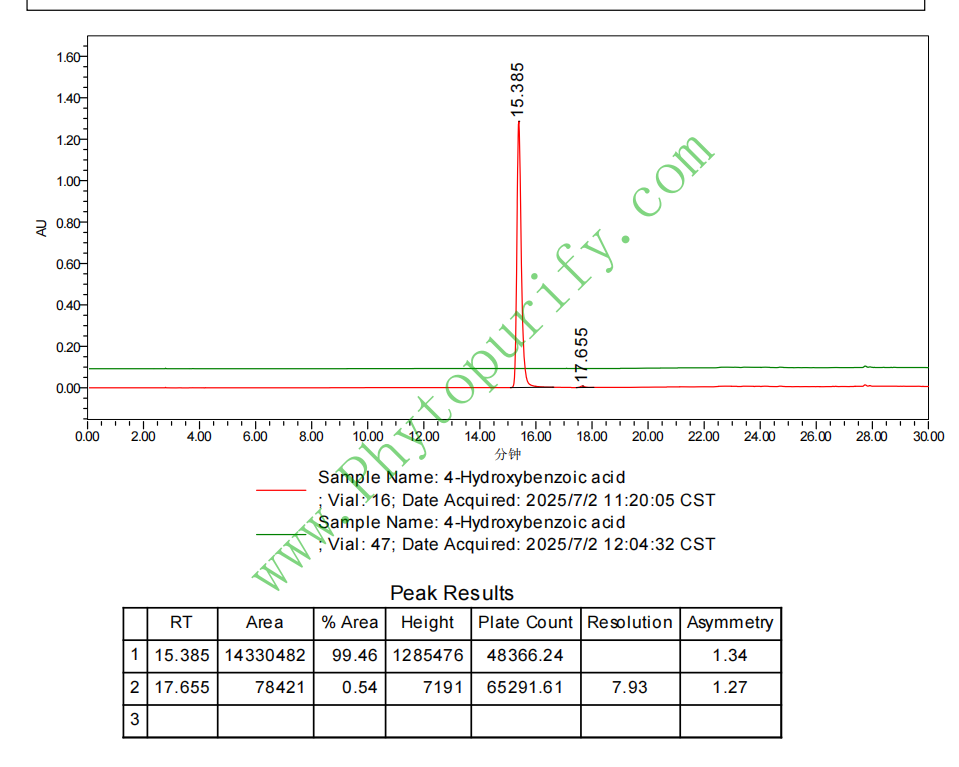
HPLC of 4-Hydroxybenzoic acid
Storage conditions:Short-term storage at 2~8℃, long-term storage at -20 ~ -80℃
57.5300
1.4396
-1.1827
2.0134
1.6409
6.5347
Low
81.0478
1.3805
Yes
No
No
No
Yes
No
0.0
Yes
Yes
Yes
Yes
4-Hydroxybenzoic acid (4-HBA), CAS number 99-96-7, is a simple phenolic acid widely found in nature and a phenolic derivative of benzoic acid. Since its discovery, this compound has received continuous attention due to its broad-spectrum biological activity. Early research mainly focused on its use as a precursor substance for commonly used preservatives (nipagin esters) in food and cosmetics. However, with the deepening of pharmacological research on natural products, the significant antibacterial, antioxidant, anti-inflammatory and other biological activities exhibited by hydroxybenzoic acid itself have gradually transformed it from a simple metabolic intermediate or precursor to a lead compound with important research value. Especially its inhibitory ability against the vast majority of Gram positive bacteria and some Gram negative bacteria (IC50 value of 160 μ g/mL) suggests its potential value in addressing the increasingly severe problem of bacterial resistance. This article aims to systematically review the chemical properties, natural sources, pharmacological activities, mechanisms of action, pharmacological properties, and clinical application prospects of hydroxybenzoic acid, in order to provide comprehensive scientific references for the deep development and utilization of this natural product.
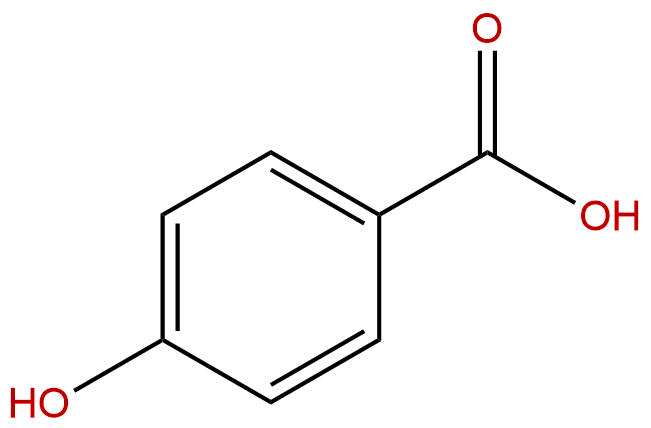
The chemical name of 4-hydroxybenzoic acid is 4-hydroxybenzoic acid, with a molecular formula of C7H6O3 and a molecular weight of 138.1220. Its structural feature is that a hydroxyl group (- OH) is connected to the para (4-position) of the benzene ring, while a carboxyl group (- COOH) is directly connected to the benzene ring. This para substituted phenolic acid structure is the chemical basis for many of its biological activities. The presence of hydroxyl and carboxyl groups allows them to act as both hydrogen bond donors and acceptors, making them easy to interact with biomolecules such as enzymes and acceptors.
In terms of physical and chemical properties, p-hydroxybenzoic acid is a white to off white crystalline powder. Its lipophilic water partition coefficient (LogP) is 1.4396, indicating that the compound has a certain degree of lipophilicity, but overall it still leans towards hydrophilicity. The theoretical polar surface area (TPSA) is 57.5300 Å ², reflecting its molecular polarity. Its water solubility is 2.0134 mg/mL, which is slightly soluble in water but easily soluble in organic solvents such as ethanol and ether, as well as alkaline aqueous solutions (forming salts). These basic physicochemical parameters provide preliminary predictive basis for its absorption, distribution, and metabolic behavior in organisms.
Hydroxybenzoic acid is widely distributed in nature and is an important product of plant secondary metabolism, especially playing a key intermediate role in phenylpropane metabolic pathways. It is commonly found in various fruits (such as grapes, kiwifruit), vegetables (such as onions, cucumbers), grains, and medicinal plants. Many traditional herbs, such as peony bark, white peony, Eucommia ulmoides, etc., have also been proven to contain hydroxybenzoic acid or its derivatives, which may partially explain some of the pharmacological effects of these herbs.
Solvent extraction method is commonly used to extract p-hydroxybenzoic acid from plant materials. Due to its good solubility in polar solvents, methanol, ethanol, acetone, or their mixed solutions with water are commonly used extraction solvents. In order to improve extraction efficiency, modern technologies such as ultrasound assisted extraction, microwave-assisted extraction, and supercritical fluid extraction have been successfully applied. The crude extract after extraction usually needs to undergo further separation and purification steps, such as liquid-liquid extraction (utilizing its distribution characteristics in alkaline aqueous and organic phases), column chromatography (silica gel, macroporous adsorption resin, etc.), and recrystallization, to obtain high-purity p-hydroxybenzoic acid. High performance liquid chromatography is the standard method for qualitative and quantitative analysis of this compound.
Hydroxybenzoic acid exhibits diverse pharmacological activities, among which antibacterial activity is the most prominent and classic.
Antibacterial activity Hydroxybenzoic acid has inhibitory effects on various microorganisms. Research has shown that it has a significant inhibitory effect on Gram positive bacteria such as Staphylococcus aureus and Bacillus subtilis, and also exhibits certain inhibitory ability on some Gram negative bacteria such as Escherichia coli and Salmonella. Its half maximal inhibitory concentration (IC50) is about 160 μ g/mL. Its antibacterial spectrum and efficacy make it an ideal model molecule for studying antibacterial mechanisms and developing new antibacterial agents.
antioxidant activity As a phenolic compound, hydroxybenzoic acid has the ability to scavenge free radicals. The phenolic hydroxyl group on its benzene ring can provide hydrogen atoms, neutralize reactive oxygen species such as DPPH radicals and hydroxyl radicals, thereby reducing oxidative stress damage to cells. This activity is closely related to its potential anti-inflammatory, anti-aging, and preventive effects on certain chronic diseases.
anti-inflammatory activity In vitro and in vivo studies have shown that hydroxybenzoic acid can inhibit the production of pro-inflammatory mediators such as tumor necrosis factor alpha, interleukin-6, and nitric oxide, and exert anti-inflammatory effects by regulating inflammation related signaling pathways such as nuclear factor kappa B.
Other activities In addition, the study also reported that hydroxybenzoic acid has mild analgesic, antipyretic, antifungal, and plant growth regulating activities. In recent years, its potential in neuroprotection, anti-tumor adjuvant therapy, and other areas has also begun to be explored.
The pharmacological effects of hydroxybenzoic acid, especially its antibacterial activity, are achieved by acting on multiple key targets of microorganisms, reflecting the characteristics of multi-target action. Research on Escherichia coli has revealed its possible mechanism of action:
Inhibition of DNA gyrase (target: GYRA)DNA gyrase is a type II topoisomerase essential for bacterial DNA replication, transcription, and repair, composed of GyrA and GyrB subunits. Hydroxybenzoic acid may inhibit the activity of GyrA subunit by interfering with its function, thereby hindering the supercoiling and unrolling processes of bacterial DNA, ultimately leading to hindered DNA replication and bacterial death.
Inhibition of dihydrofolate reductase (target: DHFR)DHFR is a key enzyme in the bacterial folate synthesis pathway, catalyzing the reduction of dihydrofolate to tetrahydrofolate. Tetrahydrofolate is an essential cofactor for the synthesis of nucleic acid precursors such as purine and thymine. Hydroxybenzoic acid may competitively inhibit the activity of DHFR, block bacterial nucleic acid synthesis, and inhibit its growth and reproduction.
Interference with folate synthesis (target: FOLA)The enzyme encoded by the FOLA gene is involved in the early steps of folate biosynthesis. The structure of hydroxybenzoic acid is similar to some intermediates in the folate synthesis pathway, which may interfere with bacterial folate de novo synthesis by feedback inhibition or competitive inhibition of enzymes in this pathway (such as dihydropteroate synthase).
Combined with penicillin binding protein 2 (target: PBP2)PBP2 is a key transpeptidase involved in the synthesis of peptidoglycans in bacterial cell walls. Hydroxybenzoic acid may bind to PBP2 in a non covalent manner, interfering with its normal transpeptidase function, thereby disrupting cell wall integrity and synthesis, leading to bacterial lysis.
Affects ergosterol synthesis (target: ERG)Although the ERG pathway mainly exists in fungal and mammalian cells, some studies suggest that phenolic compounds may have non-specific effects on bacterial membrane lipid metabolism. Hydroxybenzoic acid may indirectly interfere with lipid metabolism processes related to membrane integrity.
This multi-target mechanism makes it difficult for bacteria to develop high-level drug resistance through a single gene mutation, providing ideas for developing new antibacterial strategies. In addition, its antioxidant and anti-inflammatory activities are mainly related to regulating intracellular signaling pathways such as Nrf2/ARE, NF - κ B, MAPK, etc.
Based on the provided pharmacological parameters and existing research, a preliminary evaluation of the potential of p-hydroxybenzoic acid as a drug candidate molecule can be conducted.
In summary, the direct development of hydroxybenzoic acid as a single drug faces limitations in terms of efficacy and pharmacokinetic properties. But its simple structure and preliminary good safety make it excellent lead compound Improving its lipid solubility and metabolic stability through structural modification, such as preparing ester, ether derivatives or prodrugs, is a key direction to enhance its potential as a drug.
The clinical application prospects of hydroxybenzoic acid are broad, but exploration and breakthroughs are needed from different levels.
Direct application and combination therapy As a natural antibacterial and antioxidant, it has been applied in functional foods, health products, cosmetics, and medical dressings. In the field of medicine, its value as a topical antibacterial agent (such as for treating skin infections and oral inflammation) can be explored. More importantly, studying its synergistic effect with existing antibiotics may reduce the dosage of antibiotics used and delay the development of drug resistance.
Structural optimization and new drug development As mentioned earlier, p-hydroxybenzoic acid is an excellent starting point for medicinal chemistry. Through rational drug design, a series of derivatives were synthesized by modifying the phenolic hydroxyl and carboxyl groups, and their antibacterial activity, drug properties, and toxicity were systematically evaluated. It is expected to discover new antibacterial candidate molecules with stronger activity and better pharmacokinetic properties. Its multi-target mechanism of action is particularly noteworthy.
As a natural product compound ingredient In traditional Chinese medicine formulas or herbal preparations, hydroxybenzoic acid often coexists with other active ingredients. Studying its contribution in complex systems and its interactions with other components (additive, synergistic, or antagonistic) is of great significance for elucidating the scientific connotation of traditional drugs and developing modern compound new drugs.
Application in Agriculture and Food Industry Its natural antibacterial and anti-corrosion properties can be further developed into green and safe food preservatives or animal feed additives, replacing some chemical synthetic products. In agriculture, its potential as a plant-based antibacterial agent or growth regulator can also be studied.
Future research should focus on: ① utilizing structural biology and computer-aided drug design techniques to thoroughly elucidate their precise binding patterns with various molecular targets; ② Conduct systematic structure-activity relationship studies and in-depth preclinical pharmacokinetic/toxicological evaluations; ③ Explore its application value in emerging fields such as anti biofilm infection and regulation of gut microbiota.
Hydroxybenzoic acid, as a natural phenolic acid with a simple structure, wide sources, and diverse biological activities, occupies a unique position in the pharmacological research of natural products. Its significant antibacterial activity and multi-target mechanism of action provide new ideas and lead structures for addressing the global health challenge of bacterial resistance. Although it has limitations in terms of drug efficacy and pharmacokinetics, which restrict its direct development as a single drug, these characteristics precisely highlight its enormous value as a lead compound for structural optimization. By combining modern medicinal chemistry and pharmacology methods, we can deeply explore their potential and potentially derive new antibacterial drugs or other therapeutic agents with independent intellectual property rights. At the same time, a deeper understanding of its role in traditional medicinal plants and compound systems will also promote the modernization and internationalization of traditional Chinese medicine. In short, the research on hydroxybenzoic acid is a bridge connecting traditional natural products with modern innovative drug development, and its future is worth looking forward to.
