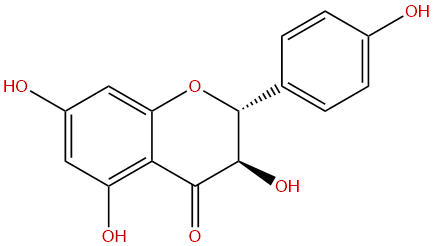


Product name: Dihydrokaempferol
Synonym name: Aromadendrin; Aromadendrine; Aromadendrol; (+)-Dihydrokaempferol; (2R,3R)-3,4',5,7-Tetrahydroxyflavanone
Catalogue No.: SBP00122
Cas No.: 480-20-6
Formula: C15H12O6
Mol Weight: 288.255
Botanical Source:
Physical Description:
Type of Compound: Flavonoids
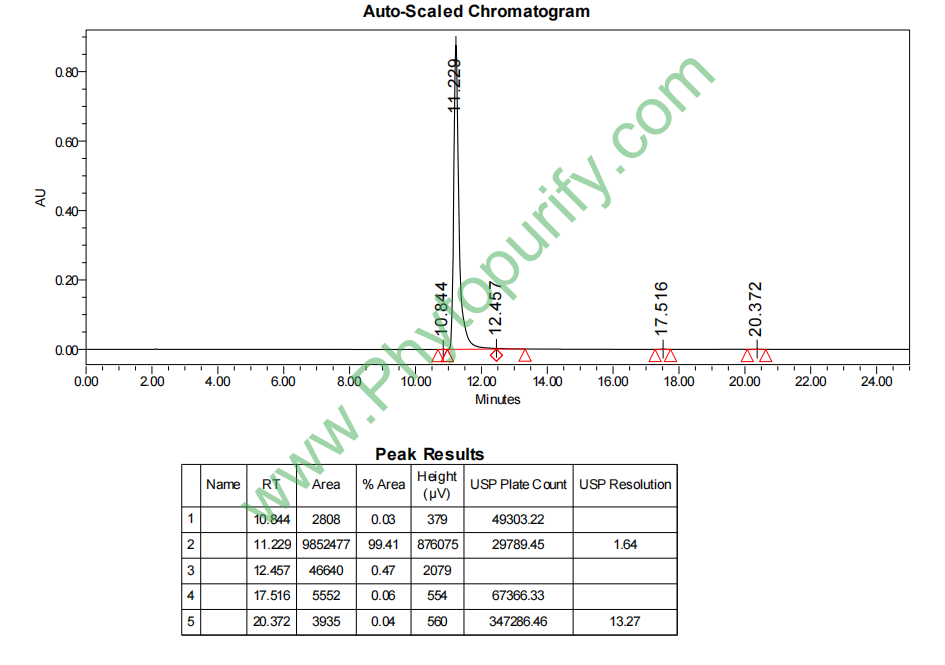
Purity: 95%~99%
Analysis Method: HPLC-DAD or/and HPLC-ELSD
Identification Method: Mass, NMR
Packing: Brown vial or HDPE plastic bottle
Storage: Store in a well closed container, protected from air and light. Put into refrigerate or freeze for long term storage.
Whenever possible, you should prepare and use solutions on the same day. However, if you need to make up stock solutions in advance, we recommend that you store the solution as aliquots in tightly sealed vials at -20℃. Generally, these will be useable for up to two weeks.
The product could be supplied from milligrams to grams
Inquire for bulk scale.
For Reference Standard and R&D, Not for Human Use Directly.
HPLC of Dihydrokaempferol
Storage conditions:Short-term storage at 2~8℃, long-term storage at -20 ~ -80℃
107.2200
1.4369
1.2528
.6352
1.3791
1.6715
Low
80.4480
3.2059
Yes
No
Yes
No
Yes
No
1.2
Yes
No
Yes
No
Dihydrokaempferol (CAS number: 480-20-6) is a natural flavonoid compound widely present in various plants, especially successfully isolated from the traditional Chinese medicine Bauhinia champion ii. As an important branch of flavonoids, dihydrokaempferol has attracted widespread attention in the field of natural product pharmacology in recent years due to its unique chemical structure and diverse biological activities. Numerous studies have shown that dihydrokaempferol not only has significant antioxidant capacity, but also exhibits potential anti-inflammatory and anti arthritis activities by regulating the expression of apoptosis related proteins. Its inhibitory effect on Bcl-2 and Bcl xL proteins provides a molecular basis for inducing cell apoptosis, demonstrating great potential as a candidate molecule for novel anti arthritis drugs.
This article will provide a systematic review of the chemical structure and physicochemical properties, plant sources and extraction methods, pharmacological activity and mechanism of action of dihydrokaempferol, and comprehensively evaluate its pharmacological parameters. It will also explore its clinical application prospects and future research directions, aiming to provide theoretical basis and research references for the pharmaceutical development of this natural product.
Dihydrokaempferol belongs to the flavanone subclass of flavonoids, with a chemical formula of C15H12O6 and a molecular weight of 288.2550. Its structural features include a typical flavanone skeleton containing three hydroxyl substituents located at positions 3, 5, and 7, endowing it with strong hydrophilicity and antioxidant activity. The topological polar surface area (TPSA) of dihydrokaempferol is 107.22 Å ², indicating its good polarity distribution, which is conducive to binding with biomolecules such as enzymes and receptors.
In terms of physicochemical properties, the LogP value of dihydrokaempferol is 1.4369, indicating that it has moderate lipid solubility and a certain degree of water solubility (0.6352), which is beneficial for its absorption and distribution in the body. In addition, the compound has low blood-brain barrier permeability, indicating its limited role in the central nervous system. The hERG channel inhibition experiment result was negative, indicating that dihydrokaempferol has good safety in terms of cardiac toxicity. The Ames mutagenicity test value is 1.2, which basically eliminates its potential genotoxicity risk.
Dihydrokaempferol was first isolated from the traditional Chinese medicine Bauhinia champion ii. This plant is an important medicinal plant of the Bauhinia genus in the legume family, traditionally used to treat rheumatoid arthritis and muscle pain. In addition to Bauhinia champion, dihydrokaempferol is also present in various other plants, such as certain vegetables, fruits, and medicinal plants, demonstrating its widespread natural distribution.
The extraction method often uses solvent extraction combined with chromatographic separation technology. Common extraction solvents include ethanol, methanol, and their aqueous solutions. Ultrasonic assisted extraction or reflux extraction can be used to improve extraction efficiency. The extract was purified by liquid-liquid partitioning, column chromatography (such as silica gel column, C18 reverse phase column), and high performance liquid chromatography (HPLC) to obtain high-purity dihydrokaempferol. In recent years, the application of supercritical CO2 extraction and membrane separation technology has further optimized the extraction process, improved yield and purity, while reducing the use of organic solvents, in line with the concept of green chemistry.
Dihydrokaempferol, as a natural flavonoid product, exhibits strong antioxidant capacity. It significantly reduces oxidative stress damage by clearing free radicals, inhibiting lipid peroxidation, and activating the endogenous antioxidant enzyme system. In vitro studies have shown that dihydrokaempferol can enhance the activity of antioxidant enzymes such as superoxide dismutase (SOD1, SOD2), catalase (CAT), and glutathione peroxidase (GPX1), promoting the activation of intracellular antioxidant defense mechanisms. In addition, dihydrokaempferol induces activation of the NFE2L2/NRF2 signaling pathway, enhances downstream antioxidant enzyme gene expression, such as HMOX1 (heme oxygenase 1), and further enhances the cell's ability to resist oxidative damage.
Inflammatory response is the core pathological process of arthritis. Dihydrokaempferol exhibits significant anti-inflammatory effects by inhibiting the production and release of inflammatory mediators. It can downregulate the expression of matrix metalloproteinases (MMP1, MMP3), alleviate the degradation of articular cartilage, and protect the integrity of joint structure. Studies on in vivo arthritis models have shown that dihydrokaempferol significantly reduces joint swelling and inflammatory cell infiltration, improves joint function, and suggests its potential as a new anti arthritis drug.
Dihydrokaempferol exhibits the ability to induce apoptosis in various tumor cell lines. The mechanism mainly involves inhibiting the expression of anti apoptotic proteins Bcl-2 and Bcl xL, disrupting mitochondrial membrane potential, activating intracellular apoptotic signaling pathways, and promoting programmed cell death. This effect not only contributes to anti-tumor therapy, but also provides theoretical support for regulating abnormal cell proliferation.
The multi-target mechanism of action of dihydrokaempferol is the basis of its multiple pharmacological effects. Its main targets include:
Antioxidant related targets By activating the NFE2L2/NRF2 signaling pathway, regulating the expression of downstream antioxidant enzyme genes (SOD1, SOD2, CAT, GPX1, HMOX1), enhancing cellular antioxidant defense capabilities, and reducing oxidative stress damage.
Matrix metalloproteinases (MMP1, MMP3)Inhibiting the expression of MMPs, preventing extracellular matrix degradation, protecting cartilage tissue, and slowing down the progression of arthritis.
Apoptosis regulatory proteins (Bcl-2, Bcl xL)Downregulate the expression of anti apoptotic proteins, promote mitochondrial mediated cell apoptosis, and regulate the balance between cell proliferation and death.
Tyrosinase (TYR)Although mainly related to melanin synthesis, its regulation may indirectly affect the cellular redox state.
The synergistic regulation of these targets enables dihydrokaempferol to exhibit pleiotropy in antioxidant, anti-inflammatory, and apoptosis regulation, demonstrating its unique advantages as a natural drug candidate molecule.
The pharmacological parameters of dihydrokaempferol show that it has good potential for drug development. The moderate molecular weight (288.2550) and LogP (1.4369) comply with Lipinski's rule and are beneficial for oral absorption. The TPSA value is 107.22, indicating that it has a certain polarity that may affect membrane permeability, but overall it is still suitable for in vivo distribution. Moderate water solubility (0.6352), helpful for formulation development and in vivo dissolution.
In terms of safety, the hERG channel inhibition test was negative, indicating a low risk of cardiac toxicity. The Ames test result is 1.2, which basically eliminates the risk of genotoxicity. The low permeability of the blood-brain barrier suggests a lower risk of side effects in the central nervous system, but also limits its application in neurological diseases.
At present, there is limited research on the pharmacokinetics of dihydrokaempferol. Preliminary data indicate that its oral bioavailability is moderate, and its metabolism in vivo is mainly carried out through the liver enzyme system. Metabolites still need further identification. In the future, it is necessary to strengthen systematic research on its in vivo absorption, distribution, metabolism, and excretion (ADME) characteristics to optimize dosage form design and administration regimens.
Based on the multiple pharmacological activities of dihydrokaempferol, especially its significant effects in antioxidant and anti arthritis fields, it has broad prospects as a candidate molecule for new drugs. Arthritis, as a common chronic inflammatory disease, currently has limited clinical treatment options and side effects. Dihydrokaempferol provides a natural, safe, and mechanistic new treatment strategy.
Future research should focus on the following directions:
Pharmacokinetic and toxicological evaluation of the system Improve the in vivo behavior and safety data of dihydrokaempferol to provide scientific basis for clinical trials.
Optimization of dosage form and exploration of administration route Develop oral, topical, or injectable formulations to improve bioavailability and targeting.
Preclinical multi model validation Using various animal models of arthritis and other inflammatory disease models, systematically evaluate their efficacy and mechanism of action.
Combination therapy research Exploring synergistic effects with existing anti-inflammatory drugs or immunomodulators to enhance therapeutic efficacy and reduce adverse reactions.
Structural modification and derivative development Design new derivatives based on dihydrokaempferol skeleton, optimize drug efficacy and pharmacokinetic properties.
In addition, the potential applications of dihydrokaempferol in anti-tumor, neuroprotective and other fields are also worth further exploration to expand its clinical indications.
Dihydrokaempferol, as a natural flavonoid compound derived from Bauhinia champions, has shown great potential as a candidate for anti arthritis drugs due to its significant antioxidant, anti-inflammatory, and apoptosis inducing activities. Its multi-target mechanism of action and good pharmacological parameters have laid a solid foundation for its drug development. Although research on its pharmacokinetics and clinical applications is still in its infancy, with the development of modern medicinal chemistry and biotechnology, dihydrokaempferol is expected to become an important breakthrough in the field of natural product pharmacology, providing new solutions for the treatment of related diseases. Future systematic research and clinical validation will be key to driving its translational applications.
