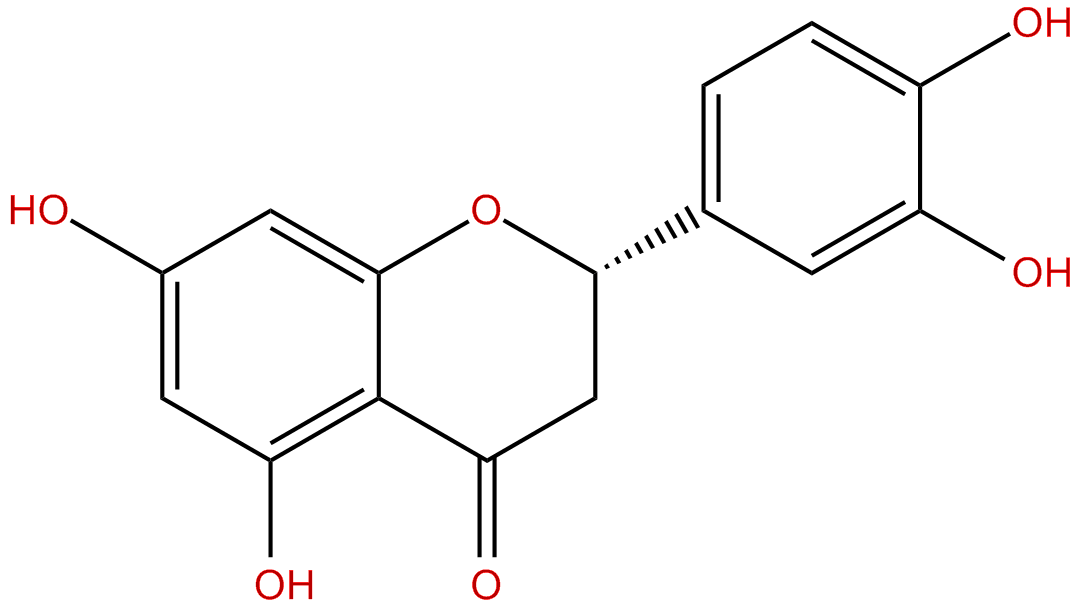


Product name: Eriodictyol
Synonym name:
Catalogue No.: BP0555
Cas No.: 552-58-9
Formula: C15H12O6
Mol Weight: 288.255
Physical Description:
Type of Compound: Flavonoids
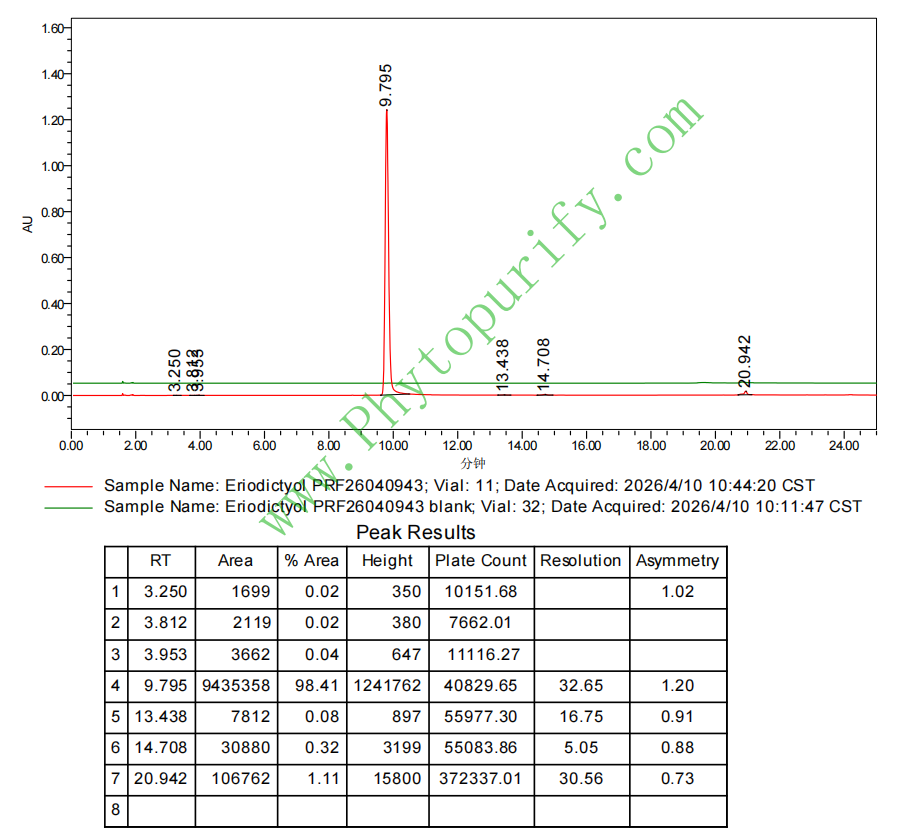
Purity: 95%~99%
Analysis Method: HPLC-DAD or/and HPLC-ELSD
Identification Method: Mass, NMR
Packing: Brown vial or HDPE plastic bottle
The product could be supplied from milligrams to grams, upto kilograms.
Inquire for bulk scale.
Description:
Eriodictyol is a flavanone characteristic of lime, found mainly in juice. The glycosylated forms are eriocitrin (bound to a rutinoside) and neoeriocitrin (bound to a neohesperidose).
Eriodictyol prevents some secondary effects of diabetes, such as diabetic retinopathy and biochemical changes in plasma (study in rats) (Bucolo et al., 2012). In addition, it has been reported that in in vitro studies, eriodictyol decreases insulin resistance and glucose absorption.
HPLC of Eriodictyol
Storage conditions:Short-term storage at 2~8℃, long-term storage at -20 ~ -80℃
Eriodictyol, CAS number 552-58-9, is a flavonoid natural product widely found in various Chinese herbs and edible plants. As an important member of flavonoids, resveratrol has attracted widespread attention in the fields of pharmacology and natural product chemistry due to its significant antioxidant, anti-inflammatory, and antiviral activities. In recent years, with the in-depth study of its molecular mechanism of action, the potential value of resveratrol in the treatment of various diseases such as anti-tumor and antiviral has gradually emerged, especially its induction of Nrf2 signaling pathway and efficient inhibition of influenza dependent RNA polymerase, providing a solid theoretical basis for its clinical development.
This article aims to systematically review the chemical structure and physicochemical properties, plant sources, and extraction methods of salvianolic acid, explore its pharmacological activity and mechanism of action, evaluate its pharmacological parameters and pharmacokinetic characteristics, and prospect its potential and development direction in clinical applications, providing reference for subsequent related research and drug development.
Shengcao phenol belongs to the flavonoid class, with a specific structure of 3 ', 4', 5,7-tetrahydroxyflavanone. Its molecular formula is C15H12O6 and its molecular weight is 288.2550. The chemical structure of Shengcao phenol contains a typical flavanone skeleton with multiple hydroxyl substituents, which endows it with excellent antioxidant activity. Its LogP value is 1.8614, indicating moderate lipid solubility, which is beneficial for membrane penetration. The topological polar surface area (TPSA) is 107.22 Å ², indicating moderate polarity that may affect its bioavailability and pharmacokinetic properties.
In terms of water solubility, the water solubility of resveratrol is 0.3033 mg/mL, which is a low solubility compound, posing certain challenges for its oral absorption and formulation development. The low penetration ability of the blood-brain barrier suggests that its role in the central nervous system may be limited. In the safety evaluation, Shengcao phenol did not exhibit hERG channel inhibition, and the Ames mutagenicity test result was 0.6, indicating a low genetic toxicity risk and a good safety basis.
Shengcao phenol is widely present in various Chinese herbal medicines and edible plants, with Eriodictyon plants being the main source. Common plants containing resveratrol include Eriodictyon californicum, citrus fruits and their skins, and certain traditional Chinese medicinal herbs such as Scutellaria baicalensis. Its content is greatly influenced by factors such as plant species, harvesting time, geographical environment, and processing technology.
The extraction method mainly adopts organic solvent extraction combined with chromatographic separation technology. Traditional extraction often uses ethanol or methanol aqueous solutions as extractants, and improves extraction efficiency through ultrasound assisted extraction or reflux extraction. Subsequently, purification was carried out using methods such as silica gel column chromatography and reverse phase high-performance liquid chromatography (RP-HPLC). In recent years, new technologies such as supercritical CO2 extraction and microwave-assisted extraction have been introduced, significantly improving extraction efficiency and purity, and are more in line with green environmental requirements.
Shengcao phenol exhibits various significant pharmacological activities, covering antioxidant, anti-inflammatory, antiviral, and anti-tumor aspects.
As a type of polyhydroxyflavonoid, coumarin has strong free radical scavenging ability. In vitro studies have shown that resveratrol can effectively scavenge hydroxyl radicals, superoxide anions, and hydrogen peroxide, reducing oxidative stress damage to cells. Its antioxidant effect is partially attributed to the activation of the nuclear factor E2 related factor 2 (Nrf2) signaling pathway, which promotes the expression of antioxidant enzymes such as glutathione peroxidase (GPx) and superoxide dismutase (SOD), enhancing intracellular antioxidant defense capabilities.
Shengcao phenol can significantly inhibit the release of inflammatory mediators, including tumor necrosis factor - α (TNF - α), interleukin-6 (IL-6), and nitric oxide (NO). The mechanism involves inhibiting the activation of the nuclear factor kappa B (NF - κ B) signaling pathway, reducing the transcriptional expression of pro-inflammatory factors, and thus alleviating the inflammatory response. Animal model studies have shown that resveratrol has a protective effect on various inflammatory diseases such as arthritis and inflammatory bowel disease.
As an RNA polymerase inhibitor for influenza dependent RNA, Shengcao phenol exhibits extremely high inhibitory activity, with an IC50 value of only 18 nM. This mechanism of action directly inhibits the activity of viral RNA polymerase, blocks the virus replication process, and demonstrates good anti influenza virus potential. In addition, there have been preliminary reports on the inhibitory effects of resveratrol on other viruses such as respiratory syncytial virus (RSV) and certain coronaviruses, but the mechanism still needs further clarification.
Shengcao phenol has shown inhibitory effects on proliferation, induction of apoptosis, and inhibition of migration and invasion in various tumor cell lines. Its anti-tumor activity involves multiple signaling pathways and molecular targets, including MCL1, BCL2, STAT3, MMP2, TOP1, HIF1A, TOP2A, MAPK1, ESR1, and CYP19A1. By regulating these targets, resveratrol can promote tumor cell apoptosis, inhibit tumor angiogenesis and metastasis, demonstrating multi-target and multi mechanism anti-tumor potential.
The mechanism of action of Shengcao phenol is diverse, covering multiple aspects such as antioxidant, anti-inflammatory, antiviral, and anti-tumor effects, mainly achieved by regulating key molecular targets and signaling pathways.
Nrf2 is a core regulatory factor for intracellular antioxidant defense. Shengcao phenol can promote the release and translocation of Nrf2 from the cytoplasm to the nucleus, bind to antioxidant response elements (ARE), activate the expression of downstream antioxidant enzyme genes, and enhance the cell's ability to resist oxidative stress. This mechanism not only explains its antioxidant activity, but also provides a molecular basis for its anti-inflammatory and cell protective effects.
Shengcao phenol binds to influenza virus dependent RNA polymerase with high affinity, inhibits its enzymatic activity, blocks virus RNA synthesis, and thus inhibits virus replication. This target has strong specificity, with an IC50 value as low as 18 nM, demonstrating excellent antiviral efficacy.
Shengcao phenol has ideal pharmacological parameters. Its molecular weight (288.2550) and LogP (1.8614) comply with Lipinski's rules, indicating good oral bioavailability potential. The TPSA is 107.22 Å ², which is slightly higher than the ideal range, but it is still expected to optimize the absorption characteristics through structural modification. The low water solubility (0.3033 mg/mL) is the main bottleneck in the development of formulations, which can be improved through technologies such as nanocarriers and solid dispersions.
The low permeability of the blood-brain barrier limits its application in central nervous system diseases, but it helps to reduce central side effects. In terms of safety, no hERG channel inhibition was observed, and the risk of genetic toxicity is low, which meets the clinical drug safety standards.
Pharmacokinetic studies have shown that Shengcao phenol is rapidly absorbed orally, with a moderate plasma half-life. It is mainly metabolized through the liver, and the metabolites are mostly glucuronic acid conjugates. Renal excretion is the main pathway for clearance. Further research on in vivo pharmacokinetics and toxicology systems is needed in the future to clarify their metabolic stability and potential drug interactions.
Shengcao phenol has shown broad clinical application prospects in the fields of anti-tumor, antiviral, and anti-inflammatory due to its multi-target and multi mechanism pharmacological activities. Especially as a highly efficient inhibitor of influenza virus RNA polymerase, it provides a new molecular framework and mechanism of action for the development of anti influenza drugs. In terms of anti-tumor effects, Shengcao phenol may become a new candidate drug for adjuvant chemotherapy or targeted therapy by regulating multiple key targets.
However, the low water solubility and limited bioavailability of resveratrol are the main obstacles to its clinical translation. Future research should focus on structural optimization, dosage form innovation, and combination therapy strategies to enhance its efficacy and safety. In addition, in-depth analysis of its molecular mechanism of action and metabolic pathways in vivo can help accurately locate indications and develop reasonable clinical development plans.
With the continuous advancement of natural product pharmacology and medicinal chemistry technology, sage grass phenol is expected to become an important representative of natural flavonoid drug development, providing new ideas and means for the treatment of various diseases.
Shengcao phenol, as a natural flavonoid compound with significant antioxidant, anti-inflammatory, antiviral, and anti-tumor activities, exhibits multi-target, multi mechanism pharmacological properties and a good safety foundation. It exerts a wide range of biological effects by inducing the Nrf2 signaling pathway and inhibiting key targets such as influenza virus RNA polymerase. Despite challenges in terms of water solubility and bioavailability, its excellent pharmacological activity and pharmacological parameters have laid a solid foundation for clinical applications.
In the future, with the combination of modern drug design and formulation technology, Shengcao phenol is expected to achieve successful transformation from a natural product to a clinical drug, becoming an effective candidate drug for treating various diseases. Continuous basic and applied research will promote its in-depth development in the field of natural product pharmacology, and facilitate the innovation and application of natural flavonoid drugs.
