Introduction/Overview
Natural products have always been an important source of innovative drug discovery, among which flavonoids have attracted much attention due to their broad biological activity and low toxicity. Artemitin, also known as 5-hydroxy-3,6,7,3 ', 4' - pentamethoxyflavone, is a multi methoxyflavone isolated from various plants of the Artemisia genus in the Asteraceae family. Since its discovery, researchers have gradually revealed its pharmacological potential in various aspects such as cytotoxicity, anti-inflammatory, neuroprotective, and analgesic effects. Early studies have indicated that berberine exhibits selective inhibitory activity against Meth-A sarcoma cells, while its effect on LLC lung cancer cells is not significant, suggesting that it may have a unique anti-tumor spectrum. In addition, its activity in nerve anesthesia and analgesia, especially its strong anti nociceptive effect demonstrated in mouse hot plate experiments, provides clues for its application in the field of pain management. In recent years, with the development of molecular biology technology, the mechanism of action of berberine has been continuously studied, involving multiple key signaling pathways and targets closely related to tumors, inflammation, and neurodegenerative diseases such as AMPK, STAT3, BCL2, etc. The purpose of this article is to systematically review the chemical properties, plant sources, pharmacological activities, mechanisms of action, pharmacological evaluation, and clinical application prospects of Artemisia argyi, in order to provide comprehensive scientific references for the in-depth research and potential drug development of this compound.
Chemical structure and physicochemical properties
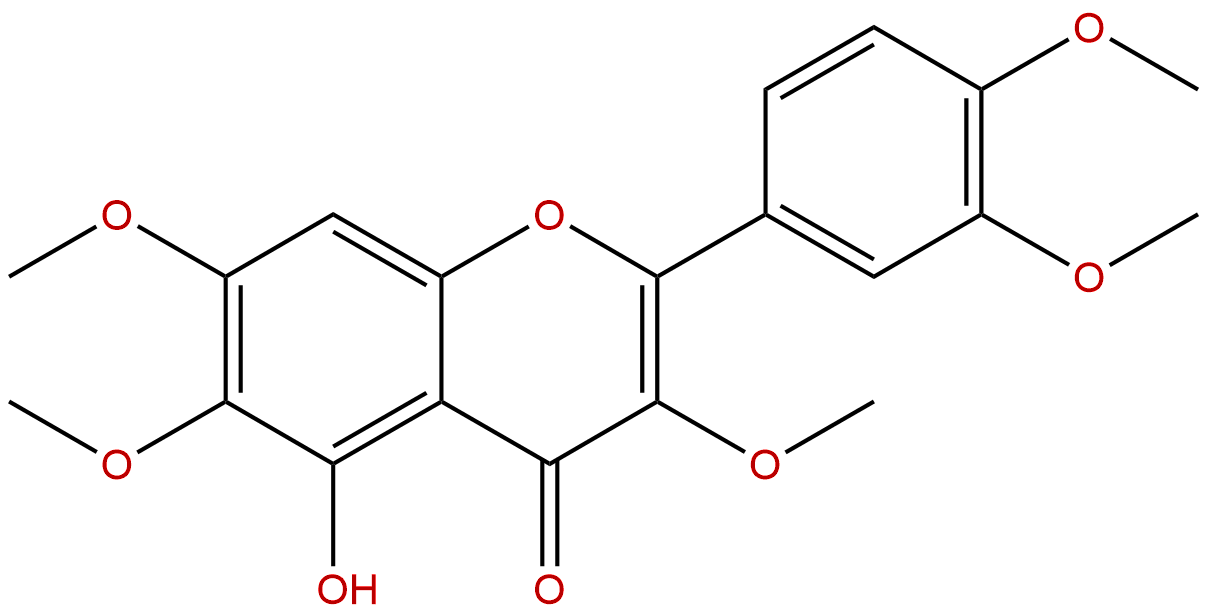
The chemical structure of Yangaisu (CAS number: 479-90-3) belongs to the flavonoid class, specifically a flavonoid skeleton substituted with multiple methoxy groups. Its molecular formula is C20H20O8 and its molecular weight is 388.3720. Its structural feature is the substitution of methoxy (- OCH3) at positions 3, 6, 7, 3 ', and 4' of the flavonoid nucleus, while retaining a hydroxyl (- OH) group at position 5. This highly methoxylated structure is the key that distinguishes it from other flavonoids and profoundly affects its physicochemical properties and biological activity.
From the analysis of physical and chemical properties, the lipid water partition coefficient (LogP) of berberine is 2.6515, indicating its moderate lipophilicity, which is beneficial for its penetration of cell membranes but may also affect its water solubility. Its topological polar surface area (TPSA) is 96.5900 Å ², which is relatively high and reflects the presence of multiple oxygen atoms (from methoxy and carbonyl groups) in the molecule. The measured water solubility is relatively low, about 0.0195 mg/mL, indicating that structural modification or the use of solubilizers may be necessary to improve its solubility in formulation development. In pharmacokinetic predictions, the ability of paclitaxel to cross the blood-brain barrier is evaluated as' low ', which poses a challenge for its application as a central nervous system drug but may also reduce potential central side effects. Importantly, the preliminary pharmacological risk assessment showed that Yangaisu was negative in the hERG channel inhibition test, indicating a low risk of inducing QT interval prolongation in the heart; The Ames test result is 1.2, indicating a low risk of mutagenicity, laying the foundation for further safety evaluation.
Plant sources and extraction methods
Artemisia is mainly found in various plants of the Asteraceae genus, Artemisia. These plants are widely distributed worldwide, and many species have a long history of application in traditional medicine. Common species rich in Artemisia argyi include Artemisia argyi, Artemisia capillaris, Artemisia annua, and some other species of the Artemisia genus. It is worth noting that Artemisia argyi is not a derivative of artemisinin, the antimalarial component in Artemisia annua, but an independent flavonoid compound.
The extraction of artemisinin from plant materials usually follows the conventional process of natural product chemistry. Firstly, crush the dried aboveground parts of the plant, such as leaves and inflorescences. Common extraction solvents include methanol, ethanol, acetone, or their mixed solutions with water. Polar components are dissolved using methods such as impregnation, reflux, or ultrasound assisted extraction. Subsequently, crude extract was obtained by vacuum concentration. The separation and purification of berberine are often carried out using chromatographic techniques. The crude extract is often initially separated by silica gel column chromatography and developed using gradient elution systems such as petroleum ether ethyl acetate or chloroform methanol. The flavonoid rich fraction is further separated and purified by high performance liquid chromatography (HPLC), especially preparative or semi preparative HPLC, using a reverse phase C18 column and methanol water or acetonitrile water as the mobile phase. The identification of Yangaisu relies on modern spectroscopic techniques, including nuclear magnetic resonance (NMR, especially 1H-NMR and 13C-NMR), mass spectrometry (MS), and ultraviolet spectroscopy (UV), to confirm its structure by comparing it with literature data or standard samples. In recent years, green extraction techniques such as supercritical fluid extraction have also been explored to improve extraction efficiency and selectivity.
Pharmacological activity research
Yangaisu exhibits diverse pharmacological activities, mainly focused on anti-tumor, anti-inflammatory, neuroprotective, and analgesic aspects.
1. Antitumor activity:
One of the most significant characteristics of moxa is its selective cytotoxicity. Early research reports showed that it exhibited moderate inhibitory activity against Meth-A sarcoma cells with a half maximal inhibitory concentration (ED50) in the range of 5-10 μ g/mL. However, under the same research conditions, it had no significant effect on LLC lung cancer cells, and this selective inhibition mechanism has aroused the interest of researchers. Subsequent studies expanded its anti-tumor spectrum, and found that absinthe also showed growth inhibition and apoptosis promoting effects on a variety of cancer cell lines, including melanoma, breast cancer, liver cancer, etc. Its anti-tumor activity is believed to be closely related to its ability to interfere with cell cycle progression, induce cell apoptosis, and inhibit cell migration and invasion.
2. Anti inflammatory and immune regulatory activity:
Flavonoids generally have anti-inflammatory potential, and moxa is no exception. Research has shown that berberine can inhibit the production of nitric oxide (NO) and prostaglandin E2 (PGE2) in macrophages induced by inflammatory stimuli such as lipopolysaccharide (LPS), which is related to its downregulation of inducible nitric oxide synthase (iNOS) and cyclooxygenase-2 (COX-2) expression. In addition, it can also inhibit the release of pro-inflammatory cytokines such as tumor necrosis factor - α (TNF - α) and interleukin-6 (IL-6). These effects suggest that berberine may alleviate excessive inflammation by regulating the response of immune cells.
3. Neuroprotective and analgesic activity:
Yangaisu exhibits a protective effect in models of neurological related diseases. The description of its' nerve anesthetic agent 'stems from its ability to affect neuronal excitability. In the field of pain research, Yangaisu has shown dose-dependent anti nociceptive effects in mouse hot plate experiments, with an ED50 as low as 1.6 μ g/kg, demonstrating potent analgesic activity. This activity may be independent of traditional opioid pathways, involving regulation of ion channels or inflammatory mediators. In addition, in models of neuronal damage induced by oxidative stress or toxic substances, berberine exhibits protective effects, suggesting its potential neuroprotective value and its potential application in the intervention of neurodegenerative diseases.
4. Other activities:
Some studies also suggest that berberine may have auxiliary pharmacological effects such as antioxidant, antibacterial, and anti angiogenesis, which may have synergistic effects with its core anti-tumor and anti-inflammatory activities.
Mechanism of action and molecular targets
The various pharmacological activities of Yangaisu stem from its regulation of multiple key signaling pathways and molecular targets within cells. Especially in tumor models such as melanoma, research has revealed the characteristics of its multi-target effects.
1. Regulating cell proliferation and apoptosis pathways:
* AMPK signaling pathway: AMP activated protein kinase (AMPK) is a core regulatory factor for cellular energy metabolism and growth. Yangaisu can activate AMPK (encoded by PRKAA1), thereby inhibiting its downstream mammalian target protein (mTOR) pathway, leading to reduced protein synthesis, enhanced autophagy, and cell cycle arrest, thereby inhibiting tumor cell proliferation.
* STAT3 signaling pathway: Signal transducer and activator of transcription factor 3 (STAT3) is an important oncogenic transcription factor, and sustained activation of STAT3 promotes cell survival, proliferation, and immune escape. Yangaisu has been proven to inhibit the phosphorylation (activation) of STAT3 and the expression of downstream target genes such as BCL2 and Cyclin D1. BCL2 is a key anti apoptotic protein, and its downregulation helps promote tumor cell apoptosis.
* Protein kinase C (PKC) family: The interaction between berberine and PKC subtypes (such as PRKCA, PRKCE) may affect cell signal transduction, differentiation, and apoptosis. PKC plays a complex role in the occurrence and development of tumors, and the regulation of its activity by berberine may be one of the mechanisms underlying its cytotoxic effects.
2. Impact on tumor invasion and metastasis:
* Matrix metalloproteinases (MMPs): MMP2 is a key enzyme that degrades extracellular matrix and promotes tumor invasion and metastasis. Yangaisu can inhibit the expression and activity of MMP2, thereby reducing the migration and invasion ability of cancer cells.
* Hypoxia inducible factor-1 alpha (HIF-1 alpha): In the hypoxic microenvironment of tumors, HIF-1 α is stabilized and activated, promoting angiogenesis and metabolic adaptation. Yangaisu may interfere with tumor adaptation and progression by inhibiting the accumulation or activity of HIF-1 α.
3. Regulating oxidative stress and cellular defense:
* Nuclear factor E2 related factor 2 (Nrf2): Nrf2 (encoded by NFE2L2) is the main regulatory factor of antioxidant response elements (ARE), which upregulates the expression of a series of antioxidant and detoxifying enzymes upon activation. Yangaisu may enhance the antioxidant defense ability of cells by activating the Nrf2 pathway, which is related to its neuroprotective and potential chemopreventive effects.
4. Affects melanin synthesis and neuronal function:
* Tyrosinase (TYR): In melanoma, TYR is the rate limiting enzyme for melanin synthesis and is also associated with tumor progression. The inhibition of TYR by berberine may affect the phenotype and survival of melanoma cells.
* Microtubule associated protein Tau (MAPT): The abnormal excessive phosphorylation of Tau protein is associated with the formation of neurofibrillary tangles and is a hallmark of tau protein diseases such as Alzheimer's disease. Yangaisu may affect the phosphorylation status of Tau protein by regulating the kinase/phosphatase system, providing a possible molecular explanation for its neuroprotective effect.
In summary, Yangaisu forms a complex network by acting on multiple targets such as AMPK, STAT3, BCL2, MMP2, Nrf2, HIF-1 α, TYR, PKC, and MAPT, collectively mediating its multiple biological effects including anti-tumor, anti-inflammatory, and neuroprotective effects.
Evaluation of drug properties and pharmacokinetics
Although Yangaisu has shown good pharmacological activity in vitro and some animal models, its development into a clinical drug depends on systematic pharmacological evaluation and pharmacokinetic studies.
Analysis of pharmacological parameters:
As mentioned earlier, the molecular weight of berberine (388.37) falls within the range of the "five rules" for drug properties. Its LogP value (2.65) is moderate, which is beneficial for oral absorption and cell infiltration, but its low water solubility (0.0195 mg/mL) is its main drawback, which may lead to low oral bioavailability. The high TPSA (96.59 Å ²) and predicted low blood-brain barrier permeability limit its direct application as a central nervous system drug, but have relatively little impact on its peripheral effects such as anti-tumor and anti-inflammatory effects. Encouragingly, its lack of hERG inhibition and low risk of Ames mutagenicity provide positive signals for preliminary safety assessment.
Pharmacokinetic challenges and exploration:
At present, there are relatively limited reports on the pharmacokinetic research of the Yangaisu system, which is a key shortcoming in its development process. Based on the characteristics of its flavonoids, it can be foreseen that it may face the following challenges:
1. Absorption: After oral administration, its low water solubility may limit its dissolution and absorption in the gastrointestinal tract. Flavonoids often bind to glycosides, but berberine is in the form of glycosides, and its absorption mechanism needs to be clarified.
2. Distribution: Moderate lipophilicity may lead to a wider distribution in tissues, but the predicted low blood-brain barrier permeability means that special strategies (such as nano delivery) are needed to achieve effective concentrations in the central nervous system.
3. Metabolism: Flavonoids are easily metabolized by the liver and gut microbiota in the body, undergoing reactions such as demethylation, hydroxylation, glucuronidation, and sulfation. The multiple methoxy groups of Yangaisu may be metabolic sites, and its metabolites, activity, and half-life need to be further studied.
4. Excretion: Metabolites are mainly excreted through urine and bile.
In order to improve its medicinal properties, researchers are exploring various strategies:(1) Structural modification: Optimize its solubility, metabolic stability, and targeting by chemically synthesizing its derivatives or prodrugs.(2) New drug delivery system: Using nanotechnology, such as liposomes, polymer nanoparticles, solid dispersions, etc., to encapsulate berberine significantly improves its solubility and bioavailability, and may achieve passive or active targeting of tumor tissues.(3) Combination therapy: Consider combining Yangaisu with existing chemotherapy drugs or targeted drugs to enhance efficacy, reduce dosage, and minimize side effects.
Clinical application prospects and prospects
Yangaisu, as a natural small molecule with multiple targets and activities, has broad clinical application prospects, but also faces many challenges.
Potential application directions:
1. Antitumor adjuvant therapy: Given its selective inhibition, induction of apoptosis, and inhibition of metastasis on various cancer cells, Yangaisu is expected to be developed as a novel anti-tumor drug, especially suitable for sensitive tumor types such as melanoma and sarcoma. Its multi-target characteristics may help overcome the resistance problem of single target drugs. A more realistic approach may be to use it as a sensitizer or adjuvant drug for chemotherapy or radiotherapy, reducing the conventional treatment dose and alleviating toxic side effects.
2. Pain management: Its potent analgesic activity (ED50 1.6 μ g/kg) suggests its potential in the treatment of acute and chronic pain. If the non opioid analgesic mechanism can be elucidated, it may lead to the development of novel analgesics with low addictive properties.
3. Neurodegenerative disease intervention: Its neuroprotective effect and potential impact on targets such as MAPT make it worth exploring in the prevention or delay of progression of diseases such as Alzheimer's disease and Parkinson's disease.
4. Inflammatory related diseases: Can be used to treat chronic inflammatory diseases such as rheumatoid arthritis and inflammatory bowel disease.
Challenges and future research directions:
1. In depth mechanism research: The currently known target networks still need to be validated in more disease models, and the precise regulatory relationships of their upstream and downstream signaling pathways need to be clarified. It is necessary to determine the primary target or synergistic network that exerts different activities.
2. Systematic pharmacokinetic and toxicological studies: This is of utmost importance in advancing its preclinical research. Comprehensive animal in vivo ADME (absorption, distribution, metabolism, excretion) research and long-term toxicity, reproductive toxicity, and other safety evaluations must be conducted.
3. Formulation development: Solving the problems of poor water solubility and low bioavailability is the key technology to achieve its clinical application. Advanced drug delivery technology will be the focus of research.
4. Clinical translation: After completing sufficient preclinical research, rigorous clinical trials need to be designed to evaluate its safety, efficacy, and optimal dosing regimen in humans.
In the future, by combining computational chemistry, structural biology, and synthetic biology methods, rational design and modification of berberine can be carried out to obtain derivatives with stronger activity and better drug properties. Meanwhile, utilizing systems pharmacology methods to comprehensively analyze its "compound target pathway disease" network will help to accurately locate its optimal clinical application scenarios.
Conclusion
As a multi methoxy flavonoid derived from traditional medicinal plants, Artemisia argyi has become a promising candidate molecule in natural product pharmacology research due to its unique chemical structure and diverse pharmacological activities. From selective inhibition of tumor cells to potent analgesia, from regulating key oncogenic pathways such as AMPK and STAT3 to affecting cell defense systems such as Nrf2, its multi-target mode of action demonstrates the advantages of natural products in complex disease interventions. Despite challenges in drug formulation, particularly in terms of water solubility and pharmacokinetic properties, these obstacles are expected to be overcome through the empowerment of modern medicinal chemistry and pharmaceutical technology. The current research has provided a preliminary biological blueprint for its action, and future work should focus on in-depth mechanism validation, systematic drug efficacy optimization, and rigorous preclinical development. The research process of Yangaisu not only provides clues for the development of new anti-tumor, analgesic or neuroprotective drugs, but also once again confirms the eternal value of exploring drug lead compounds from natural treasure trove. With the continuous deepening of research, Yangaisu is expected to move from the laboratory to clinical practice, contributing a natural force to the cause of human health.