


Product name: Docosahexaenoic acid
Synonym name: DHA; cis-4,7,10,13,16,19-Docosahexaenoic acid
Catalogue No.: BP4144
Cas No.: 6217-54-5
Formula: C22H32O2
Mol Weight: 328.496
Botanical Source:
Physical Description:
Type of Compound: Aliphatics
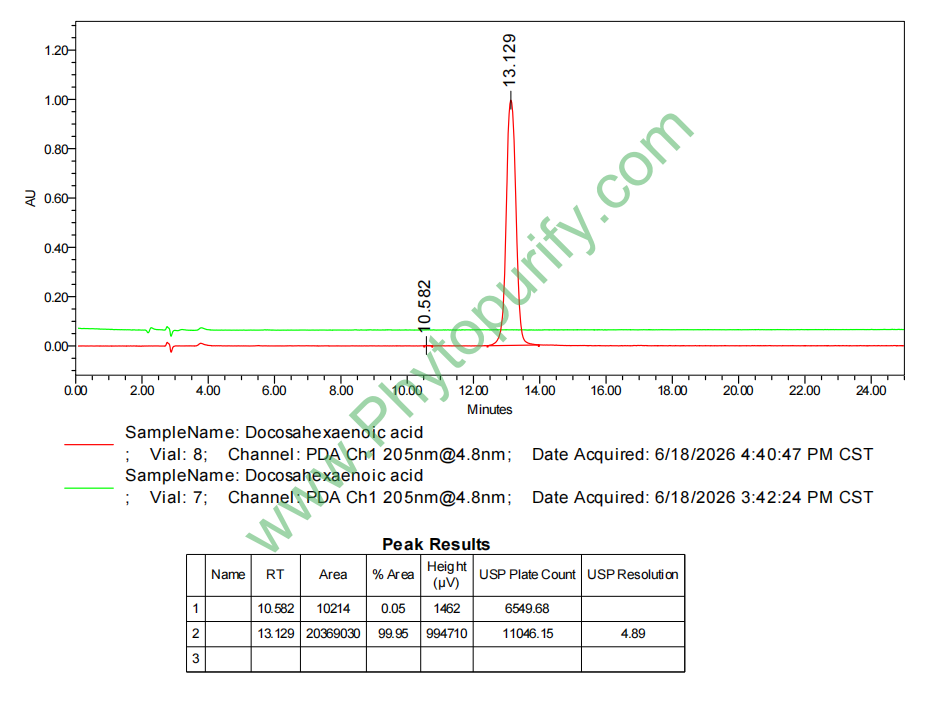
Purity: 95%~99%
Analysis Method: HPLC-DAD or/and HPLC-ELSD
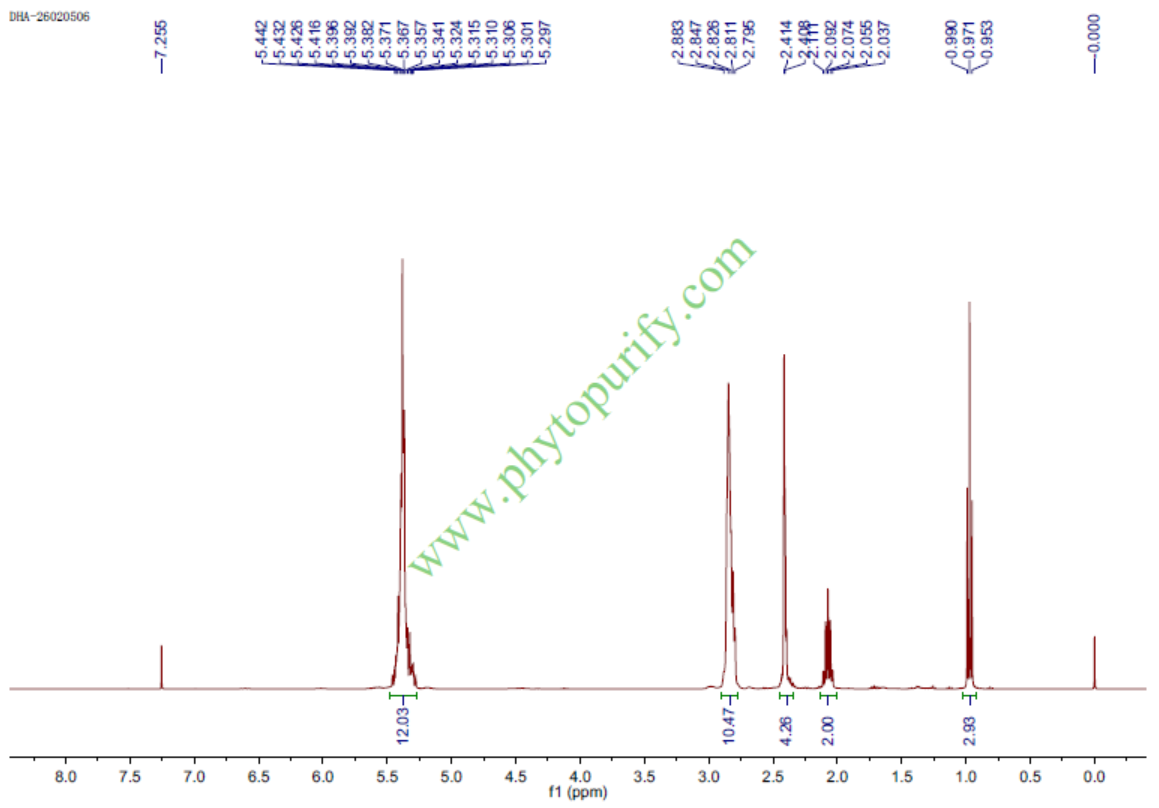
Identification Method: Mass, NMR
Packing: Brown vial or HDPE plastic bottle
Storage: Store in a well closed container, protected from air and light. Put into refrigerate or freeze for long term storage.
Whenever possible, you should prepare and use solutions on the same day. However, if you need to make up stock solutions in advance, we recommend that you store the solution as aliquots in tightly sealed vials at -20℃. Generally, these will be useable for up to two weeks.
The product could be supplied from milligrams to grams
Inquire for bulk scale.
For Reference Standard and R&D, Not for Human Use Directly.
HPLC of Docosahexaenoic acid
HNMR of Docosahexaenoic acid
Storage conditions:Short-term storage at 2~8℃, long-term storage at -20 ~ -80℃
37.3000
6.3354
3.9331
.0063
4.8735
4.1959
High
96.1161
3.1986
Yes
Yes
No
No
No
No
0.0
No
Yes
Yes
Yes
Docosahexaenoic acid (DHA) is a long-chain omega-3 polyunsaturated fatty acid with the molecular formula C22H32O2, molecular weight 328.4960, and CAS number 6217-54-5. DHA has become an important research object in the field of natural product pharmacology due to its unique biological functions and extensive physiological activities. As the most abundant fatty acid in the brain and retina, DHA plays a crucial role in the development, functional maintenance, and disease prevention of the nervous system. Its main sources include fish oil, breast milk, and certain algae. Due to its contributions to multiple biological activities such as neuroprotection, anti-inflammatory, and anti-tumor effects, DHA has become a hot topic in the development of nutritional supplements and drugs.
This article systematically reviews the chemical structure and physicochemical properties, natural sources and extraction methods, pharmacological activity and mechanism of action, pharmacological evaluation and pharmacokinetic characteristics of DHA, and explores its clinical application prospects and future development directions, aiming to provide theoretical basis and reference for natural product pharmacology research and related drug development.
The chemical name of DHA is All cis docosa-4,7,10,13,16,19-hexaenoic acid. Its structural characteristics include 22 carbon atoms and 6 cis double bonds, located at positions 4, 7, 10, 13, 16, and 19 of the carbon chain, respectively. In its molecular structure, all six double bonds are cis (Z-type), giving the molecule a high degree of flexibility and unsaturation, greatly affecting its biological activity and membrane lipid properties.
In terms of physical and chemical properties, DHA has a molecular weight of 328.4960 and a LogP value of 6.3354, indicating strong lipid solubility. Its polar surface area (TPSA) is 37.3 Å ², and its water solubility is extremely low (0.0063 mg/mL), which is consistent with the hydrophobicity of its long-chain fatty acids. DHA has good ability to penetrate the blood-brain barrier and is suitable for the development of drugs related to the nervous system. The hERG channel inhibition test result is negative, indicating a low risk of cardiac toxicity; The Ames mutagenicity test showed a value of 0.0, indicating a low risk of genetic toxicity.
Although DHA is mainly present in marine fish oils, its initial source is certain microalgae. Algae generate DHA through biosynthetic pathways, and fish become rich in DHA after feeding on algae. The DHA content in breast milk is also relatively high, especially in the early stages of lactation, which is crucial for the neurological development of infants.
The main raw materials for industrial extraction of DHA include deep-sea fish oil (such as salmon and cod liver oil) and algal oil. Extraction methods often use solvent extraction, supercritical CO2 extraction, and enzymatic purification techniques. Supercritical CO2 extraction has become the mainstream technology for extracting DHA in recent years due to its environmental friendliness, high efficiency, and strong selectivity. Algae fermentation culture combined with membrane separation technology has also been widely studied for the production of high-purity DHA.
The pharmacological activities of DHA cover multiple aspects such as neuroprotection, anti-inflammatory, anti-tumor, and metabolic regulation.
Neuroprotective effect
DHA is the main omega-3 fatty acid in brain tissue, involved in the construction and functional regulation of neuronal membranes. Numerous animal and cellular experiments have shown that DHA can promote neuronal survival, inhibit neuroinflammation, and slow down the progression of neurodegenerative diseases. It exhibits significant protective effects in neurological disease models such as Alzheimer's disease and Parkinson's disease.
anti-inflammatory effect
DHA regulates the inflammatory signaling pathway, inhibits the release of pro-inflammatory factors, promotes the generation of anti-inflammatory mediators, and exerts immune regulatory functions. Its metabolites such as neuroprotectins derived from DHA and resolvins play an important role in inflammation relief.
Anti-tumor effect
Research has found that DHA can inhibit the proliferation and migration of various tumor cells, induce tumor cell apoptosis, and enhance the sensitivity of chemotherapy drugs. The mechanism involves cell membrane lipid remodeling, oxidative stress regulation, and intervention in signal transduction pathways.
metabolic regulation
DHA participates in lipid metabolism and energy balance, improves insulin sensitivity, reduces blood lipid level, and has potential prevention and treatment value for metabolic syndrome and diabetes.
The multiple pharmacological effects of DHA are mainly achieved by regulating a series of key molecular targets, especially in the field of neuroprotection.
The regulation of these targets together constructs a multi-layered and multi pathway neuroprotective network of DHA.
The pharmacological evaluation of DHA shows that it has good potential for drug development. Its high lipid solubility (LogP=6.3354) and low polarity surface area make it easy to penetrate the blood-brain barrier, making it suitable for the treatment of neurological diseases. One of the challenges in the development of its formulation is its low water solubility, which requires improvement in bioavailability through technologies such as liposomes and nanocarriers.
Toxicological evaluation shows that DHA has no significant hERG channel inhibitory effect and has good cardiac safety; Ames test negative, low genetic toxicity risk, high safety. Pharmacokinetic studies have shown that after oral intake, DHA can be effectively absorbed by the intestine and preferentially distributed in brain tissue and retina, with a long half-life and suitable for long-term supplementation.
DHA, as a natural omega-3 fatty acid, has been widely used in the field of nutritional supplements, especially in infant formula and brain health products. Its clinical research in neurodegenerative diseases, depression, retinal diseases, and other areas continues to deepen, demonstrating good therapeutic potential.
In the future, with the development of nanomedicine carriers and targeted delivery technologies, the bioavailability and targeting of DHA will be further enhanced, which is expected to expand its applications in neurological diseases, tumors, and metabolic diseases. In addition, the combination strategy of DHA with other drugs is also worth exploring in depth to exert synergistic therapeutic effects.
Meanwhile, research based on DHA metabolites will provide new ideas for the design of novel neuroprotective agents. Developing efficient and safe DHA derived drugs through structural modification and pharmacological optimization will become a future research focus.
Docosahexaenoic acid (DHA), as a key omega-3 fatty acid, has shown broad application prospects in neuroprotection, anti-inflammatory, anti-tumor, and metabolic regulation fields due to its unique chemical structure and rich biological activity. Its mechanism of action involves multiple molecular targets, forming a complex regulatory network that supports its multi-target and multi pathway pharmacological effects. The pharmacological evaluation shows that DHA has good safety and blood-brain barrier penetration ability, but poor water solubility and low bioavailability remain challenges in the development of formulations.
In the future, combining modern drug delivery technology and molecular design, DHA and its derivatives are expected to become important natural drug resources for the treatment of neurological diseases and other chronic diseases. Continuous and in-depth basic and clinical research will promote the application of DHA in precision medicine and personalized treatment, facilitate its transformation from nutritional supplementation to drug therapy, and benefit more patients.
