Introduction/Overview
L-Cysteine hydrochloride monohydrate (CAS number: 7048-04-6) is a stable salt form of the natural amino acid L-cysteine, widely present in organisms and a key intermediate in protein synthesis and various metabolic pathways. As an important member of the sulfur-containing amino acid family, L-cysteine plays an irreplaceable role in maintaining cellular redox balance, detoxification, immune regulation, and signal transduction through its unique thiol (- SH) structure. Its hydrochloride monohydrate form has been widely used in the fields of medicine, food, cosmetics, and biotechnology due to its higher chemical stability and water solubility.
From the perspective of natural product pharmacology, although L-cysteine is not a traditional "secondary metabolite", it exhibits significant pleiotropy in disease prevention and treatment as an endogenous metabolite and dietary supplement. In recent years, with the confirmation of the core position of oxidative stress in pathological mechanisms such as aging, neurodegenerative diseases, cardiovascular diseases, and cancer, the antioxidant activity of L-cysteine and its derivatives has become a research hotspot. It demonstrates the potential to protect cells from oxidative damage by directly scavenging free radicals, chelating metal ions, regulating glutathione (GSH) synthesis, and modulating multiple antioxidant signaling pathways. In addition, the role of L-cysteine in regulating melanin synthesis, collagen metabolism, and inflammatory response has also received increasing attention, making it a candidate molecule for developing novel therapeutic strategies.
This review aims to systematically summarize the chemical properties, sources, pharmacological activities, mechanisms of action, and pharmacological characteristics of L-cysteine hydrochloride monohydrate, and evaluate its application prospects in the field of natural product pharmacology by combining its interactions with antioxidant related targets such as TYR, MMP1, NFE2L2/NRF2, SOD, CAT, GPX, HMOX1, etc., in order to provide theoretical basis for the in-depth research and clinical translation of this compound.
Chemical structure and physicochemical properties
chemical structure
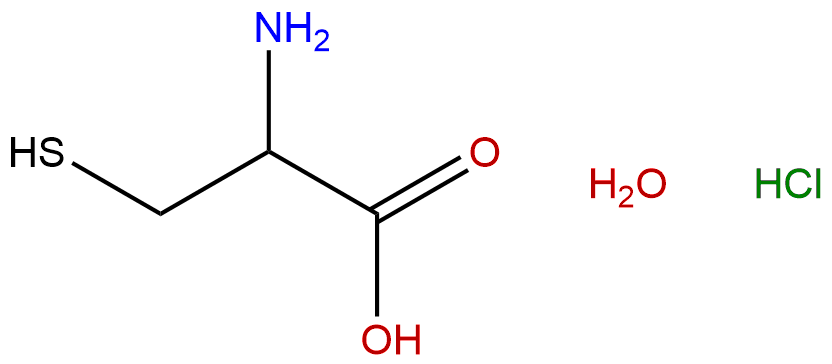
The molecular formula of L-cysteine hydrochloride monohydrate is C ∝ H ₇ NO ₂ S · HCl · H ₂ O, with a molecular weight of 121.16 (calculated as free amino acids). Its core structure is L-cysteine, which belongs to alpha amino acids and contains an amino group (- NH ₂), a carboxyl group (- COOH), and a characteristic thiol (- SH) side chain. In the monohydrate form of hydrochloric acid, the amino group of cysteine forms a salt with hydrochloric acid and combines with a crystalline water molecule to form a stable crystal structure. The IUPAC name of this compound is (2R) -2-amino-3-mercaptopropionic acid hydrochloride hydrate.
From a stereochemical perspective, L-cysteine has a chiral center (C2 position), and its naturally occurring configuration is the L-type (S configuration). Its specific rotation [α] ² ⁰ D is approximately+6.5 ° (c=5,1 M HCl). The presence of thiol groups endows the molecule with unique nucleophilicity and reducibility, enabling it to participate in various redox reactions and form disulfide bonds (- S-S -), which are key to protein tertiary structure stability and enzyme activity regulation.
Physicochemical properties
L-Cysteine hydrochloride monohydrate is a white crystalline powder with a characteristic sour taste. Its melting point is about 175-180 ° C (decomposition). This compound is highly soluble in water (with a water solubility of approximately 48.3 mg/mL and a high LogS value), slightly soluble in ethanol, and almost insoluble in ether. Its aqueous solution is acidic (pH about 1.5-2.5) due to the free movement of the hydrochloride salt. Its high water solubility gives it significant advantages in bioavailability and formulation development.
In terms of stability, L-cysteine hydrochloride monohydrate is relatively stable under dry and dark conditions, but it is easily oxidized to L-cysteine (disulfide form) when exposed to air or alkaline environments. Its LogP value is -1.98 (extremely hydrophilic), indicating that it is almost insoluble in lipids and difficult to passively diffuse through biofilms. The topological polar surface area (TPSA) is 63.32 Å ², which falls within the general range of small molecule drugs. It is worth noting that the compound has no inhibitory activity on hERG potassium channels (hERG inhibition: no), and the Ames test result is 0.6 (indicating low genetic toxicity risk), providing favorable evidence for its safety evaluation.
Plant sources and extraction methods
natural source
L-Cysteine is not a traditional plant secondary metabolite, but a primary metabolic amino acid widely present in all organisms. In the plant kingdom, L-cysteine is a component of proteins and a key node in sulfur metabolism. Plant protein sources rich in cysteine include beans (such as soybeans and peas), grains (such as wheat germ and oats), nuts (such as almonds and walnuts) and cruciferous vegetables (such as broccoli and cabbage). However, extracting free L-cysteine directly from it is inefficient and costly.
Industrial production methods
At present, the industrial production of L-cysteine hydrochloride monohydrate mainly relies on microbial fermentation and enzymatic conversion methods, rather than direct plant extraction.
-
Microbial fermentation method Escherichia coli modified through genetic engineering(Escherichia coli)Or Corynebacterium glutamicum(Corynebacterium glutamicum)By optimizing metabolic pathways such as enhancing sulfate assimilation, cysteine synthase expression, and feedback inhibition relief, efficient fermentation of L-cysteine can be achieved by waiting for strains. The fermentation broth undergoes ion exchange, activated carbon decolorization, concentration, crystallization, and hydrochloric acid treatment to ultimately obtain high-purity L-cysteine hydrochloride monohydrate.
-
Enzymatic conversion method Using L-serine and methyl mercaptan or hydrogen sulfide as substrates, L-cysteine is synthesized using cysteine synthase (O-acetylserine thiol lyase) catalysis. This method has the advantages of mild reaction conditions, high stereoselectivity, and fewer by-products.
-
Hair hydrolysis extraction method (traditional method)In history, L-cysteine can be extracted from human hair, pig hair, or feather keratin. Keratin is degraded into an amino acid mixture through acid hydrolysis (such as 6 M HCl, 110 ° C, 24 hours), and then purified by ion exchange chromatography, copper salt precipitation, or electrodialysis techniques. However, this method suffers from environmental pollution, limited resources, and product purity issues, and has gradually been replaced by fermentation methods.
Extraction and purification process
Regardless of the production method used, the final purification of L-cysteine hydrochloride monohydrate involves the following key steps:
- decolorization Use activated carbon to remove pigments and pyrogens.
- ion exchange Selective adsorption of L-cysteine using cation exchange resin, followed by elution to obtain an enriched solution.
- Crystallization By adjusting pH, temperature, and adding hydrochloric acid, L-cysteine crystallizes and precipitates in the form of hydrochloride monohydrate.
- dry Dry under low temperature (<40 ° C) vacuum conditions to avoid oxidation.
The final product must meet pharmacopoeial standards (such as USP, EP, ChP), with a purity typically ≥ 98.5% and heavy metal residues (such as lead and arsenic) below 10 ppm.
Pharmacological activity research
antioxidant activity
The antioxidant activity of L-cysteine is one of its core pharmacological effects, mainly achieved through the following pathways:
-
Direct free radical scavenging Thiol (- SH) can be used as a nucleophile to directly neutralize reactive oxygen species (ROS) and reactive nitrogen species (RNS), such as hydroxyl radicals (• OH), peroxynitrite (ONOO ⁻), etc. The reaction generates cysteine sulfur free radicals (Cys-S •), which can further dimerize into cysteine or work synergistically with other antioxidants such as vitamin C and vitamin E.
-
Precursor of glutathione (GSH) synthesis L-cysteine is the rate limiting substrate for GSH synthesis. GSH is the most important non enzymatic antioxidant in cells, which works in synergy with glutathione peroxidase (GPX) and glutathione S-transferase (GST) to remove hydrogen peroxide (H ₂ O ₂) and lipid peroxides. Supplementing with L-cysteine can significantly increase intracellular GSH levels and enhance cellular antioxidant defense capabilities.
-
Metal ion chelation Thiol groups can form stable complexes with transition metal ions such as Cu ² ⁺ and Fe ² ⁺, inhibiting Fenton and Haber Weiss reactions and reducing the production of • OH.
-
Regulating antioxidant enzyme activity L-cysteine can upregulate the expression of superoxide dismutase (SOD1, SOD2), catalase (CAT), and heme oxygenase-1 (HMOX1), enhancing the adaptive response of cells to oxidative stress.
The impact on melanin synthesis and skin photoaging
L-cysteine plays a dual role in skin biology. On the one hand, as an inhibitor of tyrosinase (TYR), it can reduce melanin synthesis by chelating copper ions in the active center of tyrosinase or competing with substrates. Research has shown that L-cysteine can inhibit tyrosinase activity and melanin production in B16 melanoma cells in a dose-dependent manner. On the other hand, L-cysteine reduces collagen degradation induced by ultraviolet (UV) radiation by inhibiting the expression of matrix metalloproteinases (MMP1, MMP3), thereby delaying skin photoaging. The mechanism involves blocking the activation of the MAPK/AP-1 signaling pathway induced by UVB.
Anti inflammatory and immune regulation
L-cysteine can exert anti-inflammatory effects by regulating the nuclear factor E2 related factor 2 (NFE2L2/NRF2) signaling pathway. NRF2 is the main regulator of cellular oxidative stress and inflammatory response, which can induce the expression of a series of antioxidant and detoxifying enzyme genes (such as HMOX1, NQO1, GCL) upon activation. L-cysteine promotes NRF2 nuclear translocation by increasing GSH levels or directly modifying the thiol group of KEAP1 protein, thereby inhibiting the NF - κ B pathway and the production of pro-inflammatory cytokines such as TNF - α, IL-6, IL-1 β. In addition, L-cysteine can regulate the function of T cells and macrophages, showing protective effects in autoimmune disease models.
Other pharmacological activities
- Liver protection In models of alcoholic liver injury, acetaminophen poisoning, and non-alcoholic fatty liver disease, L-cysteine alleviates liver cell damage by antioxidant, anti apoptotic, and promoting GSH synthesis.
- neuroprotection L-Cysteine can cross the blood-brain barrier (although with lower efficiency), showing neuroprotective effects in Alzheimer's disease, Parkinson's disease, and cerebral ischemia models by increasing GSH levels in the brain, inhibiting glutamate excitotoxicity, and reducing β - amyloid protein aggregation.
- Detoxification effect L-Cysteine can directly bind with heavy metals (such as mercury, lead, cadmium) and certain toxins (such as acrylamide, formaldehyde) to promote their excretion.
Mechanism of action and molecular targets
The pharmacological mechanism of L-cysteine involves multiple levels, with the core being the chemical reactivity of thiol groups and their regulation of cellular signaling networks.
Direct target and chemical interaction
-
Tyrosinase (TYR)L-cysteine competitively inhibits the catalytic activity of tyrosinase by forming a coordination bond with the Cu ² ⁺ ion in the active center of tyrosinase through its thiol group. In addition, its reducibility can maintain tyrosinase in a reduced state (Cu ⁺), reducing its catalytic efficiency. This inhibitory effect has practical value in the treatment of whitening cosmetics and pigmentation diseases.
-
Matrix metalloproteinases (MMP1, MMP3)L-cysteine can reduce extracellular matrix (ECM) degradation by inhibiting MMP transcription and activity. The mechanism may involve: ① clearing ROS and blocking the MAPK/AP-1 signaling pathway for transcriptional activation of MMP genes; ② Directly chelate with Zn ² ⁺ ions in the MMP active center to inhibit its enzymatic activity.
-
Glutathione peroxidase 1 (GPX1)L-cysteine, as a precursor for the synthesis of GSH, a substrate of GPX1, indirectly enhances the ability of GPX1 to clear H ₂ O ₂. GPX1 is a selenium dependent enzyme, and its activity depends on sufficient supply of GSH.
Signal pathway regulation
-
NRF2/KEAP1 pathway This is the core pathway through which L-cysteine exerts antioxidant and anti-inflammatory effects. At rest, NRF2 binds to KEAP1 and is degraded by ubiquitination. Oxidative stress or electrophilic agents (including L-cysteine itself or its oxidation products) can modify the thiol groups (Cys151, Cys273, Cys288) of KEAP1, causing conformational changes in KEAP1. NRF2 is released and translocated to the nucleus, where it binds to antioxidant response elements (ARE) and initiates transcription of downstream target genes (such as HMOX1, NQO1, GCL, SOD1, CAT). L-cysteine enhances NRF2 activity by increasing GSH levels (indirectly activating NRF2) or directly modifying KEAP1.
-
NF - κ B pathway L-cysteine inhibits pro-inflammatory gene expression by inhibiting the activity of I κ B kinase (IKK) or reducing ROS mediated I κ B phosphorylation, preventing NF - κ B nuclear translocation. There is cross regulation between NRF2 and NF - κ B, and activation of NRF2 can inhibit NF - κ B activity.
-
SOD/CAT/GPX antioxidant enzyme system L-cysteine upregulates the expression of SOD1 (cytoplasmic), SOD2 (mitochondrial), CAT (peroxisome), and GPX1 through the NRF2 pathway or direct transcriptional regulation, forming a synergistic antioxidant network. SOD dismutates superoxide anion (O ₂⁻) into H ₂ O ₂, while CAT and GPX are responsible for clearing H ₂ O ₂.
Metabolism and Epigenetic Regulation
The metabolites of L-cysteine, such as hydrogen sulfide, taurine, and sulfate, also participate in various physiological processes. For example, hydrogen sulfide (H ₂ S), as a gas signaling molecule, has antioxidant, anti-inflammatory, and vasodilatory effects. L-cysteine is catalyzed by cystathionine beta synthase (CBS) and cystathionine gamma lyase (CSE) to generate H ₂ S, which can modify protein cysteine residues (S-thiolation), regulate ion channels, transcription factors, and mitochondrial function.
Evaluation of drug properties and pharmacokinetics
Analysis of drug properties parameters
Based on computational predictions and experimental data, the pharmacological characteristics of L-cysteine hydrochloride monohydrate are as follows:
- molecular weight:121.16 Da, Far below the upper limit of the "Five Rules" of 500 Da, it conforms to the characteristics of small molecule drugs.
- fat-soluble:LogP = -1.98, Highly hydrophilic, resulting in poor membrane permeability and limited oral bioavailability.
- Water solubility:48.3 mg/mL, The extremely high water solubility is beneficial for the development of injectable and oral liquid formulations.
- Blood-brain barrier penetrability Low, mainly attributed to its high polarity and low fat solubility. However, brain delivery can be improved through carrier mediated transport (such as amino acid transporters) or prodrug strategies.
- HERG inhibition None, indicating low risk of cardiac toxicity.
- Genotoxicity The Ames test result was 0.6, indicating no significant mutagenicity at the tested concentration.
Pharmacokinetic characteristics
-
absorb After oral administration, L-cysteine is mainly absorbed through amino acid transporters (such as ASCT1, ASCT2, LAT2) in small intestinal epithelial cells. Due to first pass metabolism (liver metabolism) and utilization of gut microbiota, its oral bioavailability is relatively low (about 10-20%). Intravenous injection can be fully bioavailable.
-
distribution L-Cysteine is widely distributed in tissues throughout the body and has a low plasma protein binding rate. Its distribution volume is about 0.3-0.5 L/kg. Due to the limitations of the blood-brain barrier, the concentration in cerebrospinal fluid is only 10-20% of that in plasma.
-
Metabolism L-cysteine is mainly metabolized through the following pathways: ① oxidation to cysteine; ② Participate in GSH synthesis; ③ Generate H ₂ S, taurine, and sulfate through the sulfur conversion pathway; ④ Decarboxylation generates cysteamine. The liver and kidneys are the main metabolic organs.
-
excretion L-Cysteine and its metabolites are mainly excreted through the kidneys. The renal tubules can reabsorb most of the filtered L-cysteine, with urinary excretion accounting for only 2-5% of the intake. When overconsumption occurs, urinary excretion increases.
Formulation and stability
L-Cysteine hydrochloride monohydrate is relatively stable in solid state, but its aqueous solution is prone to oxidation. Therefore, injections are often supplemented with antioxidants (such as sodium bisulfite, EDTA) and protected with nitrogen gas. Oral preparations often use enteric coating or sustained-release technology to reduce gastric acid destruction and first pass metabolism. In addition, N-acetylcysteine (NAC), as a prodrug of L-cysteine, has higher oral bioavailability and stability, and is more commonly used in clinical practice.
Clinical application prospects and prospects
Current clinical applications
L-Cysteine hydrochloride monohydrate is mainly used clinically for:
- nutritional support As an amino acid component of parenteral nutrition (TPN) and enteral nutrition preparations, it is used for protein supplementation in patients with liver disease, burns, trauma, and postoperative conditions.
- antidote Used as an adjuvant therapy for acetaminophen overdose poisoning (usually in the form of NAC).
- expectorant NAC is used as a mucolytic agent for respiratory diseases such as chronic bronchitis and emphysema.
Potential application areas
Based on its pharmacological activity, L-cysteine and its derivatives have broad prospects in the following fields:
-
Anti aging and skin care As a tyrosinase inhibitor and antioxidant, L-cysteine can be used to develop whitening, anti wrinkle, and sunscreen products. Its synergistic effect with MMP inhibitors is expected to delay skin photoaging.
-
Neurodegenerative diseases Although the blood-brain barrier penetration is low, the delivery efficiency within the brain can be improved through nanocarrier or prodrug design (such as L-cysteine ethyl ester). In Alzheimer's disease, Parkinson's disease, and amyotrophic lateral sclerosis (ALS) models, L-cysteine has shown potential to improve cognitive function and reduce neuronal loss.
-
Metabolic diseases: L-cysteine may play a protective role in type 2 diabetes, non-alcoholic fatty liver disease (NAFLD) and obesity by regulating oxidative stress and inflammation. Preclinical studies have shown that supplementing with L-cysteine can improve insulin sensitivity and alleviate liver steatosis.
-
cardiovascular disease The antioxidant and anti-inflammatory effects of L-cysteine are helpful to inhibit the formation of atherosclerotic plaque and improve the function of vascular endothelium. In addition, its metabolite H ₂ S has vasodilatory and cardioprotective effects.
-
Cancer adjuvant therapy L-cysteine can alleviate oxidative damage and nephrotoxicity of chemotherapy drugs such as cisplatin and doxorubicin by increasing GSH levels. However, caution should be exercised that it may reduce the efficacy of certain chemotherapy drugs (such as alkylating agents), and individualized application is necessary.
Challenges and Prospects
Although L-cysteine hydrochloride monohydrate has multiple pharmacological activities, its clinical application still faces challenges:
- Low bioavailability Poor oral absorption requires the development of new delivery systems (such as liposomes, nanoparticles, prodrugs).
- Oxidative instability The preparation needs to strictly avoid light and oxygen, which increases production costs.
- Dose-dependent toxicity High doses of L-cysteine may cause neurotoxicity (such as excitotoxicity) or pro oxidative effects, and the optimal treatment window needs to be determined.
Future research directions should focus on:
1. Structural modification Develop L-cysteine derivatives (such as NAC, S-allyl cysteine, S-methylcysteine) to improve stability and targeting.
2. combination therapy Explore the synergistic effects of L-cysteine with other antioxidants (such as vitamin C, E, selenium) or targeted drugs (such as NRF2 agonists).
3. Precision Medicine Develop individualized supplementation plans based on the patient's oxidative stress status and genetic polymorphisms (such as NRF2, GPX1, SOD2).
Conclusion
L-cysteine hydrochloride monohydrate, as a stable salt form of natural amino acids, occupies an important position in the field of natural product pharmacology due to its unique thiol structure and multiple pharmacological activities. Its antioxidant, anti-inflammatory, melanin synthesis inhibiting, and MMP/NRF2 signaling pathway regulating effects have shown great potential in anti-aging, neuroprotection, metabolic diseases, and skin care. Despite challenges such as low bioavailability and poor stability, these obstacles can be overcome through prodrug design, nano delivery systems, and combination therapy strategies. With a deeper understanding of the mechanisms of oxidative stress and inflammation in the occurrence and development of diseases, L-cysteine and its derivatives are expected to become important candidate molecules for the development of novel therapeutic drugs and functional foods. Future research should further elucidate its molecular target network, optimize drug delivery regimens, and promote clinical translation to fully leverage the value of this ancient amino acid in modern medicine.