

Storage conditions:Short-term storage at 2~8℃, long-term storage at -20 ~ -80℃
52.6000
1.7600
1.7600
High
null
No
No
No
No
No
No
null
5,7-dimethoxycoumarin (Citropten, CAS number: 487-06-9), as an important coumarin derivative, has attracted widespread attention in the field of natural product pharmacology in recent years. Coumarin compounds have been widely studied for the treatment of various diseases such as anti-inflammatory, anticancer, antidepressant, and anticoagulant due to their diverse biological activities and good pharmacological properties. 5,7-dimethoxycoumarin, as a representative molecule, exhibits significant pharmacological activities such as anti melanoma cell proliferation, anti-inflammatory, and antidepressant effects. Its mechanism of action involves multiple signaling pathways and molecular targets, including NF - κ B, MAPK, heat shock protein-70 (HSP70), monoamine oxidase A (MAOA), etc., demonstrating its potential therapeutic value in various diseases.
This article aims to systematically review the chemical structure and physicochemical properties, plant sources and extraction methods, pharmacological activity and mechanism of action, pharmacological evaluation and pharmacokinetic characteristics of 5,7-dimethoxycoumarin. At the same time, it explores its clinical application prospects and development trends, providing theoretical basis and reference for the in-depth research and drug development of this natural product.
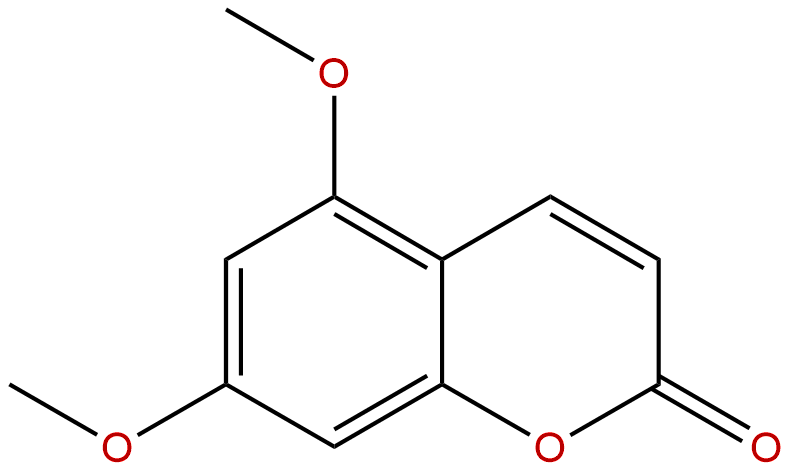
5,7-dimethoxycoumarin is a typical coumarin derivative with a molecular formula of C11H10O4 and a molecular weight of 206.19. Its structural feature is that two methoxy (- OCH3) substituents are connected to the 5th and 7th positions of the coumarin core skeleton, respectively. This structure endows it with certain hydrophobicity and electron cloud distribution, affecting its biological activity and pharmacokinetic properties.
In terms of physicochemical properties, the LogP value of 5,7-dimethoxycoumarin is 1.76, indicating its moderate lipid solubility, which is beneficial for membrane penetration and bioavailability. Its topological polar surface area (TPSA) is 52.6 Å ² and the number of hydrogen bond acceptors is 4, indicating that its molecule has moderate polarity, which may affect its binding ability with biomolecules. This compound can efficiently penetrate the blood-brain barrier (BBB), providing the possibility for its application in central nervous system diseases. In addition, 5,7-dimethoxycoumarin has no hepatotoxicity, cardiotoxicity, or hERG channel inhibition effect, and the Ames mutagenicity test result is negative, indicating its high safety and good potential for drug development.
5,7-dimethoxycoumarin is widely present in the peel and leaves of citrus plants (Citrus spp.), especially in common fruits such as lemons, oranges, and grapefruits where its content is relatively high. Its natural form is mostly in the free or bound state, often coexisting with other coumarins and flavonoids.
The traditional extraction method mainly uses organic solvents for extraction, and commonly used solvents include ethanol, methanol, ethyl acetate, etc. The extraction process usually includes drying and crushing of plant materials, solvent soaking, ultrasound assisted extraction or reflux extraction, followed by purification through liquid-liquid distribution, column chromatography and other methods. In recent years, supercritical CO2 extraction and microwave-assisted extraction technologies have also been applied to improve extraction efficiency and purity, reduce solvent usage, and conform to the concept of green chemistry.
The purified 5,7-dimethoxycoumarin can be structurally identified and its content determined by techniques such as high-performance liquid chromatography (HPLC), mass spectrometry (MS), and nuclear magnetic resonance (NMR) to ensure its quality and stability of active ingredients.
5,7-dimethoxycoumarin has shown significant anti proliferative effects on various cancer cells, particularly exhibiting good cytotoxicity in melanoma cell lines A2058 and B16. Its anti-cancer mechanism is mainly achieved through inducing cell cycle arrest, promoting cell apoptosis, and inhibiting tumor cell migration and invasion. Related studies have shown that this compound can regulate BRAF protein and downstream MAPK signaling pathway, inhibiting the proliferation and survival of tumor cells.
5,7-dimethoxycoumarin exhibits significant anti-inflammatory activity in various inflammatory models. Its mechanism of action involves inhibiting the nuclear factor kappa B (NF - κ B) and mitogen activated protein kinase (MAPK) signaling pathways, reducing the expression of pro-inflammatory factors such as tumor necrosis factor alpha (TNF - α), interleukin-6 (IL-6), and cyclooxygenase-2 (COX-2/PTGS2), thereby alleviating the inflammatory response. This compound has also shown good therapeutic effects in models of pulmonary inflammatory diseases, indicating its potential application value in respiratory inflammatory diseases.
5,7-dimethoxycoumarin exerts antidepressant effects by regulating key targets such as heat shock protein-70 (HSP70), monoamine oxidase A (MAOA), and serotonin transporter 4 (SLC6A4). The mechanism may involve neuroprotection, regulation of neurotransmitter metabolism, inhibition of cell apoptosis, promotion of brain-derived neurotrophic factor (BDNF) expression, and enhancement of neural plasticity. In addition, the compound also has a certain regulatory effect on glutamate receptor (GRIN1), further supporting its antidepressant potential.
Although there is relatively little research on the anticoagulant effects of 5,7-dimethoxycoumarin, its potential interactions with coagulation factors F2, F7, F9, F10, and vitamin K oxidoreductase complex 1 (VKORC1) suggest that it may have the ability to regulate blood clotting, providing a theoretical basis for adjuvant therapy of thrombotic diseases.
The multiple pharmacological activities of 5,7-dimethoxycoumarin depend on its regulation of multiple signaling pathways and key targets:
NF - κ B signaling pathway As an important regulatory factor in inflammation and tumorigenesis, the inhibition of NF - κ B is one of the core mechanisms underlying the anti-inflammatory and anticancer effects of 5,7-dimethoxycoumarin. This compound inhibits the activity of I κ B kinase, blocks NF - κ B nuclear translocation, and reduces the expression of pro-inflammatory genes.
MAPK signaling pathway 5,7-dimethoxycoumarin regulates the activity of ERK, JNK, and p38 MAPK subtypes, affecting cell proliferation, apoptosis, and inflammatory response, particularly in melanoma cells and inflammatory models.
Heat shock protein-70 (HSP70)This protein plays a critical role in cellular stress response and neuroprotection. 5,7-dimethoxycoumarin enhances cellular stress resistance, exerts antidepressant and cell protective effects by upregulating HSP70 expression.
Monoamine oxidase A (MAOA)As a key enzyme in neurotransmitter metabolism, inhibition of MAOA helps to increase levels of monoamine neurotransmitters in the brain and improve symptoms of depression. The regulation of MAOA by 5,7-dimethoxycoumarin provides a molecular basis for its antidepressant effect.
BRAF protein 5,7-dimethoxycoumarin can intervene in BRAF kinase activity, block its downstream MAPK signaling pathway, and inhibit abnormal proliferation of melanoma cells.
Other targets Including cytochrome P450 1A1 (CYP1A1), serotonin transporter protein (SLC6A4), brain-derived neurotrophic factor (BDNF), and glutamate receptor (GRIN1), all of which are involved in its multidimensional pharmacological regulation.
5,7-dimethoxycoumarin has good pharmacological properties. Its molecular weight is moderate, the LogP value is suitable for cell membrane permeation, and the number of TPSA and hydrogen bond receptors is within the ideal range for oral drug absorption. The high blood-brain barrier penetration gives it an advantage in the treatment of central nervous system diseases. In terms of safety, there is no hepatotoxicity, cardiotoxicity, or hERG channel inhibition, and the Ames test is negative, reducing the risk of potential toxic side effects.
Pharmacokinetic studies have shown that 5,7-dimethoxycoumarin is well absorbed after oral administration and widely distributed in the body, especially enriched in brain tissue. Its metabolic pathway is mainly carried out through the liver cytochrome P450 enzyme system, and the metabolites are relatively stable. The main excretion pathways are urine and bile. Moderate half-life supports its development as an oral medication.
Based on the diverse activities of 5,7-dimethoxycoumarin in anti-cancer, anti-inflammatory, antidepressant, and anticoagulant fields, its clinical application prospects are broad. Especially in the adjuvant therapy of malignant tumors such as melanoma, 5,7-dimethoxycoumarin is expected to serve as a novel small molecule drug or combination drug ingredient, enhancing treatment efficacy and reducing chemotherapy side effects. The inhibition of key inflammatory signaling pathways in inflammatory diseases and pulmonary inflammatory diseases provides a new strategy for intervention in chronic and acute inflammation.
In addition, the excellent blood-brain barrier penetration and neuroprotective effects of 5,7-dimethoxycoumarin make it potentially valuable for the treatment of depression and other neurological and psychiatric disorders. In the future, its bioavailability and targeting can be enhanced through structural optimization and formulation improvement.
However, the clinical research on 5,7-dimethoxycoumarin is still in its infancy, and there is an urgent need for systematic pharmacological, safety, and pharmacokinetic clinical trials to verify its efficacy and safety. Meanwhile, in-depth analysis of its molecular mechanism and optimization of extraction and purification processes will lay a solid foundation for its drug development.
5,7-dimethoxycoumarin, as a natural coumarin derivative with multiple pharmacological activities, exhibits potential applications in various fields such as anti-cancer, anti-inflammatory, antidepressant, and anticoagulant. Its good pharmaceutical properties and safety provide strong guarantees for clinical translation. In the future, through interdisciplinary research, combined with modern medicinal chemistry, molecular biology, and clinical medicine methods, we will deeply explore the mechanism of action of 5,7-dimethoxycoumarin and optimize its drug properties, which will promote it to become an important representative of new natural medicines and benefit the vast number of patients.
