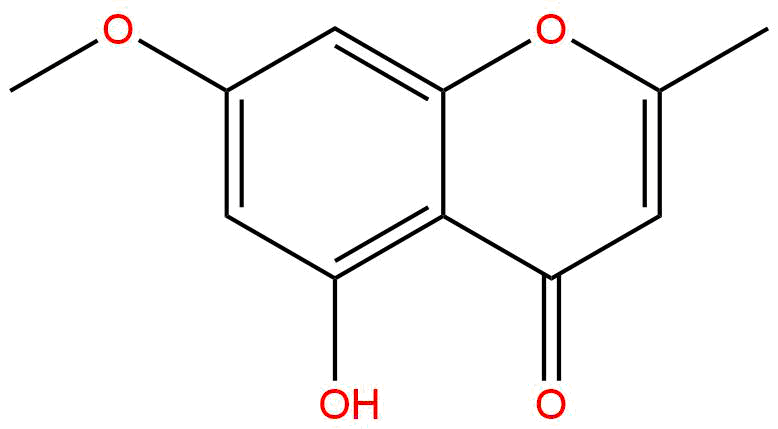


Product name: Eugenin
Synonym name:
Catalogue No.: BP4075
Cas No.: 480-34-2
Formula: C11H10O4
Mol Weight: 206.197
Botanical Source: 5-Hydroxy-7-methoxy-2-methylchromone
Physical Description:
Type of Compound: Flavonoids
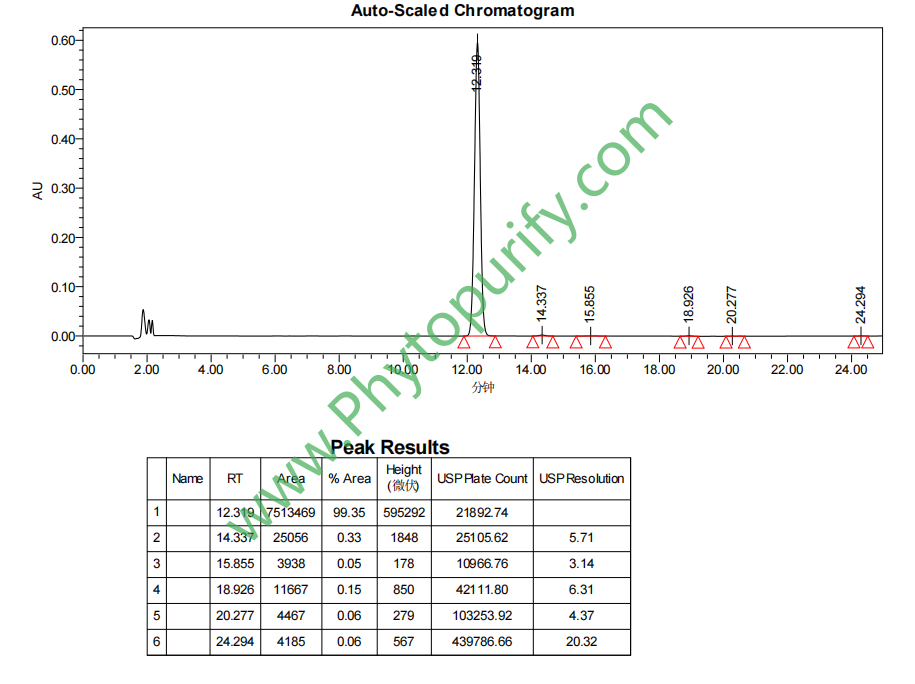
Purity: 95%~99%
Analysis Method: HPLC-DAD or/and HPLC-ELSD
Identification Method: Mass, NMR
Packing: Brown vial or HDPE plastic bottle
Storage: Store in a well closed container, protected from air and light. Put into refrigerate or freeze for long term storage.
Whenever possible, you should prepare and use solutions on the same day. However, if you need to make up stock solutions in advance, we recommend that you store the solution as aliquots in tightly sealed vials at -20℃. Generally, these will be useable for up to two weeks.
The product could be supplied from milligrams to grams
Inquire for bulk scale.
For Reference Standard and R&D, Not for Human Use Directly.
HPLC of Eugenin
Storage conditions:Short-term storage at 2~8℃, long-term storage at -20 ~ -80℃
Eugenin (CAS number: 480-34-2) is a naturally occurring chromone compound, originally isolated from the Taiwan endemic plant Formosan Peucedanum japonicum. As a natural product with multiple biological activities, syringol ketone has shown significant pharmacological potential in areas such as antiplatelet aggregation, anti-tumor, and anti-inflammatory effects. In recent years, with the in-depth research on the molecular mechanisms of major diseases such as cardiovascular disease, neurodegenerative disease, thrombotic disease, and tumors, syringol ketone has received widespread attention due to its multi-target properties. This article provides a systematic review of the chemical structure and physicochemical properties, plant sources and extraction methods, pharmacological activity, mechanism of action, pharmacological evaluation, and clinical application prospects of syringol ketone. The aim is to provide theoretical basis and research direction for its subsequent drug development and clinical translation.
Lilac chromone belongs to the class of chromone compounds, with a molecular formula of C11H10O4 and a molecular weight of 206.1970. Structurally, syringol ketone contains a typical flavonoid skeleton with hydroxyl and methoxy substituents, endowing it with certain polarity and biological activity. Its LogP value is 1.82, indicating that it has moderate hydrophobicity, which is beneficial for membrane penetration but not excessively hydrophobic and affects solubility. The topological polar surface area (TPSA) is 59.67 Å ², indicating its good potential in cellular absorption. The water solubility is 0.3342, which belongs to moderate to low water solubility and may affect its oral bioavailability. The low penetration ability of the blood-brain barrier suggests that its efficacy in the central nervous system may be limited. The negative result of hERG channel inhibition experiment indicates a low risk of cardiac toxicity. The Ames test value is 1.2, indicating that its genotoxicity risk is relatively low and has a certain safety basis.
Lilac chromone was first isolated from Formosan Peucedanum japonicum, a plant belonging to the Umbelliferae family and widely distributed in Taiwan and East Asia. Traditionally, Formosan Peucedanum japonicum has been used as a folk herb with anti-inflammatory and circulatory promoting effects. Clove chromone, as one of its main active ingredients, has been purified and identified in recent years through modern separation techniques.
The common methods for extracting vanillin include solvent extraction and column chromatography separation. Ethanol or methanol are usually used as extraction solvents, combined with ultrasound assisted extraction to improve extraction efficiency. After vacuum concentration, the extract is purified using silica gel column chromatography or high-performance liquid chromatography (HPLC). During the purification process, the identification of syringol ketone mainly relies on techniques such as nuclear magnetic resonance (NMR), mass spectrometry (MS), and ultraviolet visible spectroscopy (UV Vis) to confirm its structure and purity. In recent years, with the development of chromatographic technology, ultra-high performance liquid chromatography (UPLC) and mass spectrometry (LC-MS/MS) have been widely used for the qualitative and quantitative analysis of vanillin.
One of the most significant pharmacological activities of vanillin is its anti platelet aggregation effect. Platelet aggregation is a critical step in thrombus formation, and excessive activation can lead to cardiovascular and cerebrovascular events. In vitro experiments have shown that vanillin can significantly inhibit platelet aggregation induced by various inducers such as ADP and collagen, reduce the expression of platelet activation markers, and decrease the risk of thrombosis. Its antiplatelet effect provides potential natural drug candidates for the prevention and treatment of cardiovascular diseases.
Lilac chromogen ketone exhibits cytotoxic effects on various tumor cell lines. Research has shown that it can induce apoptosis of tumor cells, inhibit cell proliferation and migration. Mechanistically, syringol ketone exerts anti-tumor effects by regulating the expression of BCL2 family proteins, activating apoptosis related signaling pathways. In addition, syringol ketone has a regulatory effect on tumor related signaling pathways such as STAT3 and MAPK1, further enhancing its anti-cancer activity.
Lilac chromone also exhibits good activity in the field of anti-inflammatory. It can inhibit the expression of inflammatory factors such as IL-6 and TNF - α, block the activation of NF - κ B signaling pathway, and alleviate inflammatory response. By inhibiting the activity of PTGS1/PTGS2 (COX-1/COX-2) enzymes, syringol ketone reduces prostaglandin synthesis and alleviates inflammatory symptoms. In addition, its regulation of inflammation related ion channels such as TRPV1 and TRPA1 suggests its potential application value in pain and inflammation related diseases.
Although syringol ketone has a low blood-brain barrier penetration ability, its role in neurodegenerative disease models is gradually receiving attention. Lilac chromogen ketone can regulate neuroprotective targets such as BCL2, APP, BACE1, reduce neuronal apoptosis and amyloid accumulation, and has potential neuroprotective effects. It activates the NFE2L2 (Nrf2) antioxidant pathway, enhances cellular antioxidant capacity, and may have adjuvant therapeutic significance for neurodegenerative diseases such as Parkinson's disease and Alzheimer's disease.
Lilac chromone exerts antithrombotic effects by regulating thrombus formation related targets such as SERPINE1, F3, F2, F10, TBXA2R, etc. It inhibits the activity of blood clotting factors, reduces the risk of thrombosis, and, combined with its antiplatelet aggregation properties, provides a multi-target intervention strategy for the prevention and treatment of thrombotic diseases.
The multiple pharmacological activities of vanillin are attributed to its regulation of multiple key molecular targets. The following are the main related targets and their mechanisms of action:
AMPK(PRKAA1)As a regulatory enzyme of cellular energy metabolism, the activation of AMPK helps improve cardiovascular function and inhibit tumor cell metabolism. Lilac chromogen ketone may exert a protective effect by activating the AMPK pathway, regulating cellular metabolic homeostasis.
BCL2 Anti apoptotic proteins regulate cell survival and death. Lilac chromogen ketone induces tumor cell apoptosis and promotes programmed cell death by regulating BCL2 expression.
BACE1β - secretase, involved in the production of β - amyloid protein in Alzheimer's disease. The inhibitory effect of vanillin on BACE1 helps to slow down neurodegenerative diseases.
TLR4 Inflammatory signaling receptors mediate immune responses. Lilac chromogen ketone reduces inflammation by inhibiting TLR4 mediated inflammatory signaling.
PTGS1/PTGS2(COX-1/COX-2)Catalyze prostaglandin synthesis, participate in inflammation and platelet function. Lilac chromone inhibits its activity and exerts anti-inflammatory and antiplatelet effects.
STAT3 Transcription factors regulate cell proliferation and immune response. Lilac chromone inhibits STAT3 signaling, which contributes to anti-tumor and anti-inflammatory effects.
NFE2L2(Nrf2)Key factors regulating antioxidant response. Lilac chromogen ketone activates the Nrf2 pathway, enhances cellular antioxidant capacity, and reduces oxidative stress damage.
Thrombosis related targets (SERPINE1, F3, F2, F10, TBXA2R, etc.)Clove chromogen ketone inhibits thrombosis and improves hemorheological properties through multi-target synergistic effects.
In addition, vanillin also affects various signaling molecules such as PRKCA, AKR1B1, ESR2, APEX1, ADORA3, PPARG, PIK3CA, LGALS3, EGFR, indicating its broad biological regulatory ability.
The pharmacological parameters of syringol ketone indicate that it has certain potential for drug development. Medium molecular weight and moderate LogP value are beneficial for its bioavailability. The moderate TPSA value indicates good cell membrane penetration, but the blood-brain barrier penetration ability is low, which limits its direct application in central nervous system diseases.
Low water solubility may affect oral absorption and needs to be improved through formulation optimization or structural modification. The hERG channel has no inhibitory effect and reduces the risk of cardiac toxicity. The Ames test results show that its genotoxicity risk is low and its safety is good.
At present, the pharmacokinetic studies of syringol ketone are not yet complete, and the in vivo absorption, distribution, metabolism, and excretion (ADME) characteristics need further systematic evaluation. Preliminary data suggests that its metabolism in the body may involve enzymatic conversion in the liver, and the activity and toxicity of metabolites need to be further studied.
As a multi-target and multifunctional natural product, syringol ketone has shown great potential for applications in cardiovascular diseases, tumors, inflammation, and neurodegenerative diseases. Its antiplatelet aggregation and antithrombotic effects provide new ideas for the prevention and adjuvant treatment of cardiovascular and cerebrovascular diseases. The anti-tumor cytotoxicity and anti-inflammatory activity provide possibilities for the treatment of tumors and chronic inflammatory diseases.
However, the clinical translation of vanillin still faces many challenges. Firstly, the limitations of water solubility and bioavailability need to be overcome through drug design and formulation technology. Secondly, there is a lack of pharmacokinetic and toxicological studies on the system, and it is necessary to clarify its in vivo metabolic pathways and long-term safety. Again, in-depth analysis of its multi-target mechanism of action can help optimize treatment plans and precision medication.
In the future, vanillin can be combined with nanocarriers, drug co crystallization, and structural modification strategies to enhance its drug properties and targeting. At the same time, conducting systematic research on its mechanism of action based on modern molecular biology and omics technologies will promote its clinical application. The implementation of multicenter clinical trials is also a key step in verifying its efficacy and safety.
As a natural chromone compound derived from Formosan Peucedanum japonicum, syringol ketone exhibits significant anti platelet aggregation, anti-tumor, and anti-inflammatory activities, demonstrating broad prospects for drug development. Its multi-target mechanism of action provides new ideas for the treatment of cardiovascular diseases, tumors, inflammation, and neurodegenerative diseases. Although there are still certain limitations in the development of drug properties and pharmacokinetics, with the deepening of research and advances in technology, syringol ketone is expected to become an important drug candidate in the field of natural product pharmacology. Future research should focus on mechanism analysis, drug optimization, and clinical validation to promote its early clinical application and benefit patients.
