


Synonym name: 7-Methylaxillarin; Chrysosplenol D; Quercetagetin 3,6,7-trimethyl ether
Catalogue No.: BP0057
Cas No.: 14965-20-9
Formula: C18H16O8
Mol Weight: 360.318
Botanical Source:
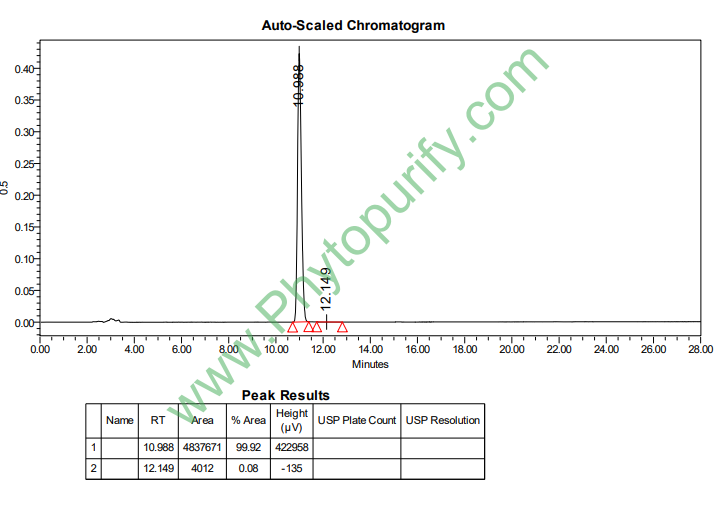
Purity: 95%~99%
Analysis Method: HPLC-DAD or/and HPLC-ELSD
Identification Method: Mass, NMR
Packing: Brown vial or HDPE plastic bottle
Can be supplied from milligrams to grams.
For Reference Standard and R&D, Not for Human Use Directly.
Inquire for bulk scale.
HPLC of 3,6,7-Trimethylquercetagetin
Storage conditions:Short-term storage at 2~8℃, long-term storage at -20 ~ -80℃
131.3900
2.5000
2.0000
Low
No
No
No
No
No
No
No
3,6,7-Trimethylquercetin (CAS number: 14965-20-9) is a naturally occurring trimethoxyflavonoid with significant biological activity. As a 3,6,7-trimethyl ether derivative of quercetin, its structural modification endows it with unique pharmacological properties. In recent years, with the deepening development of natural product pharmacology, 3,6,7-trimethylquercetin has gradually become a research hotspot due to its multi-target and multi mechanism mode of action, especially its potential application value in anti-tumor and endometriosis diseases.
This review aims to systematically summarize the chemical structure and physicochemical properties, plant sources and extraction methods, pharmacological activity and mechanism of action of 3,6,7-trimethylquercetin, and explore its prospects and challenges in clinical application based on its pharmacological parameters, providing theoretical basis and research direction for subsequent drug development and clinical translation.
3,6,7-Trimethylquercetin belongs to the flavonoid class, specifically trimethoxyflavone. Its chemical structure is based on the quercetin skeleton, and the hydroxyl groups at positions 3, 6, and 7 are methylated to form methyl ether, which significantly affects its physicochemical properties and biological activity. The molecular formula is C18H16O8, with a molecular weight of 360.32 and a LogP value of approximately 2.5, indicating moderate lipophilicity that facilitates membrane penetration.
The polar surface area (TPSA) of this compound is 131.39 Å ², with 8 hydrogen bond acceptors, indicating its strong ability to form hydrogen bonds when binding to protein targets. Its blood-brain barrier permeability is low, suggesting limited distribution in the central nervous system. Toxicological indicators showed no hepatotoxicity, cardiotoxicity, or hERG channel inhibition. The Ames mutagenicity test was negative, indicating high safety and good potential for drug development.
3,6,7-Trimethylquercetin is mainly found in the Tagetes spp. of the Asteraceae family, especially in the flowers and leaves of certain wild and cultivated varieties. This type of plant is widely distributed in parts of the Americas and Asia, and has a long history as a traditional herb and ornamental plant.
The extraction process usually uses organic solvent extraction combined with column chromatography separation technology. Common solvents include methanol, ethanol, and ethyl acetate, and their polarity differences are utilized to achieve effective separation. Modern extraction methods such as ultrasound assisted extraction (UAE) and microwave-assisted extraction (MAE) have been applied to improve extraction efficiency and purity. During the purification process, reverse phase high performance liquid chromatography (RP-HPLC) and preparative thin layer chromatography (Prep TLC) are common separation methods.
In addition, the identification methods mainly rely on mass spectrometry (MS), nuclear magnetic resonance (NMR), and ultraviolet visible spectroscopy (UV Vis) analysis to ensure the structural accuracy and purity of the compounds.
3,6,7-Trimethylquercetin exhibits various pharmacological activities, with the most significant effects being anti-tumor and anti endometriosis.
In vitro cell experiments showed that the compound could inhibit the proliferation of many tumor cell lines, including breast cancer, lung cancer and cervical cancer cells. Its mechanism of action involves inducing cell cycle arrest, promoting apoptosis, and inhibiting tumor cell migration and invasion. Related studies have shown that 3,6,7-trimethylquercetin exerts anti-tumor effects by regulating multiple signaling pathways, such as PI3K/Akt, MAPK, and NF - κ B.
Endometriosis is a gynecological disease characterized by ectopic growth of endometrial tissue, with a complex pathological mechanism. 3,6,7-Trimethylquercetin participates in inflammatory response, hormone signaling regulation, and cell apoptosis by regulating various molecular targets such as MAOA, ESR1/2, ABCB1, APEX1, ABCG2, ALOX5, XDH, ADORA3, and TERT, thereby inhibiting abnormal proliferation and inflammatory response in diseased tissues.
In addition, the compound has antioxidant and anti-inflammatory properties, which help alleviate symptoms related to endometriosis and improve patients' quality of life.
Some studies have also found that 3,6,7-trimethylquercetin has certain neuroprotective and immunomodulatory effects, but the relevant mechanisms still need to be further explored.
The multi-target mechanism of action of 3,6,7-trimethylquercetin is the basis for its complex pharmacological effects. Its main targets and mechanisms of action include:
By regulating the above targets, 3,6,7-trimethylquercetin can intervene in cell signaling, metabolism, and gene expression, exerting multiple effects such as anti-inflammatory, antioxidant, anti proliferative, and pro apoptotic effects.
Based on the pharmacological parameters, 3,6,7-trimethylquercetin exhibits good pharmacokinetic and safety characteristics.
Pharmacokinetic studies are still in the preliminary stage, and the metabolic pathways in vivo may involve the liver CYP450 enzyme system, but specific metabolites and kinetic parameters need further systematic research.
Based on its multi-target and multi mechanism pharmacological activity, 3,6,7-trimethylquercetin has shown broad application prospects in anti-tumor and endometriosis treatment. Its good safety and pharmacological properties provide a solid foundation for clinical translation.
Future research should focus on:
In addition, based on its structural characteristics, chemical modification and derivative design are also important directions for future drug development.
3,6,7-Trimethylquercetin, as a natural product of trimethoxyflavonoids with significant biological activity, has shown great potential in the treatment of anti-tumor and endometriosis diseases due to its unique chemical structure and multi-target pharmacological effects. Its good medicinal properties and safety have laid the foundation for subsequent clinical applications.
In the future, through systematic pharmacokinetic studies, mechanism analysis, and clinical validation, 3,6,7-trimethylquercetin is expected to become a model for natural product drug development, promoting the application and development of natural flavonoids in modern medicine.
