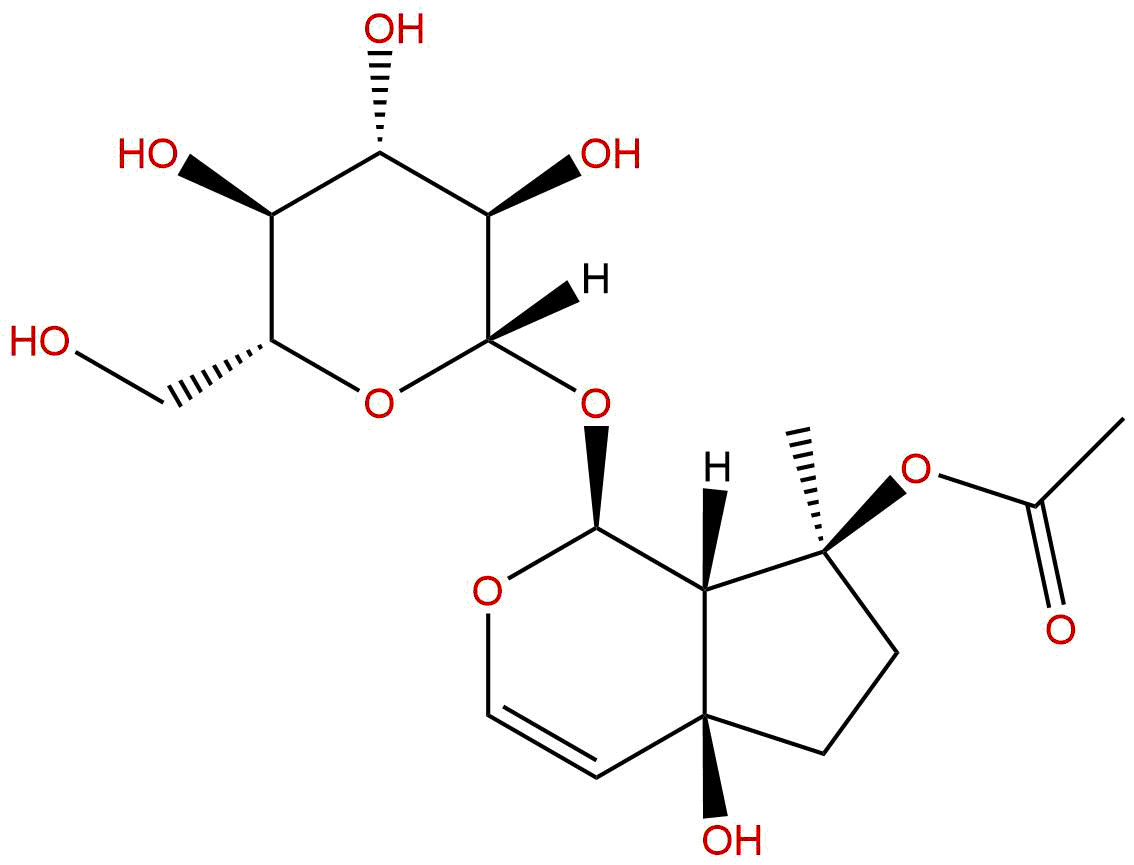


Product name: Reptoside
Synonym name:
Catalogue No.: BP5203
Cas No.: 53839-03-5
Formula: C17H26O10
Mol Weight: 390.385
Botanical Source:
Type of Compound: Iridoids
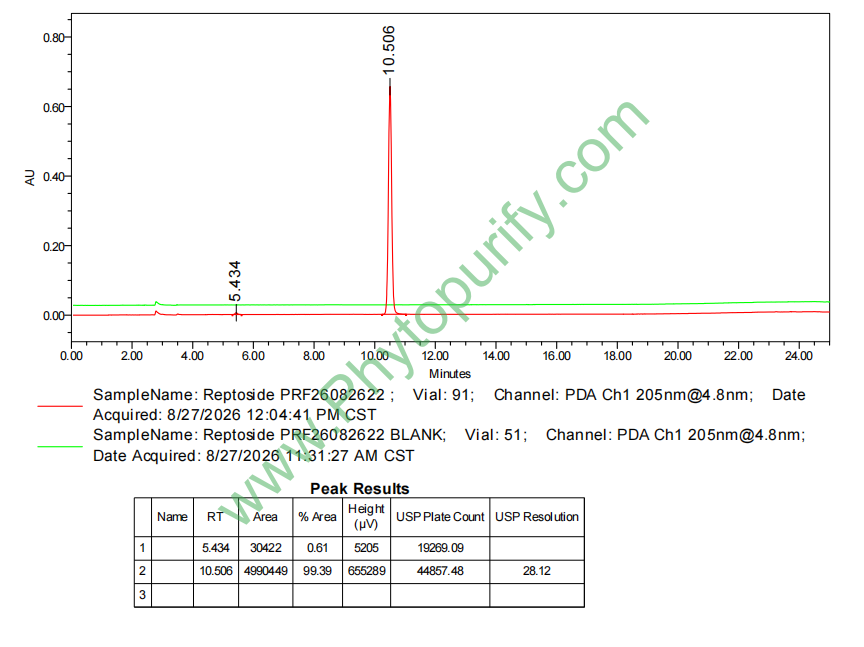
Purity: 95%~99%
Analysis Method: HPLC-DAD or/and HPLC-ELSD
Identification Method: Mass, NMR
Packing: Brown vial or HDPE plastic bottle
Storage: Store in a well closed container, protected from air and light. Put into refrigerate or freeze for long term storage.
Whenever possible, you should prepare and use solutions on the same day. However, if you need to make up stock solutions in advance, we recommend that you store the solution as aliquots in tightly sealed vials at -20℃. Generally, these will be useable for up to two weeks.
The product could be supplied from milligrams to grams
Inquire for bulk scale.
For Reference Standard and R&D, Not for Human Use Directly.
HPLC of Reptoside
Storage conditions:Short-term storage at 2~8℃, long-term storage at -20 ~ -80℃
Reptoside (CAS number: 53839-03-5) is a natural product of cyclic terpenoid glycosides with significant biological activity. As an important natural product, iridoid glycosides have attracted much attention in the field of pharmacology due to their diverse biological activities and unique chemical structures. Raputoside has become a hot research topic in recent years due to its DNA damage activity and regulatory effects on various biological targets, especially its potential cardiotonic effects in cardiovascular diseases. This article provides a systematic review of the chemical structure and physicochemical properties, plant sources and extraction methods, pharmacological activity, mechanism of action, evaluation of drug properties, and clinical application prospects of Triptolide, aiming to provide comprehensive and in-depth references for researchers in related fields.
Raputoside belongs to the class of iridoid glycosides, with a molecular formula of C2H2H6O8 and a molecular weight of 390.3850. This compound has a typical cyclohexene ether terpene skeleton, containing multiple hydroxyl and glycoside groups in its structure, giving it high polarity and water solubility. The LogP value of Triptolide is -1.0053, indicating its strong hydrophilicity; The topological polar surface area (TPSA) is 155.14 Å ², indicating its high polarity, which may affect its membrane permeability and bioavailability. The water solubility is 20.3933 mg/mL, indicating its good solubility in aqueous media, which is beneficial for absorption and distribution in vivo.
Structurally, the cyclohexene ether terpene core of Raputoside is the key basis for its biological activity, while the glycoside portion may affect its pharmacokinetic properties and targeting. The compound does not possess hERG channel inhibitory activity, and the Ames mutagenicity test result is 0.0, indicating a low risk of genetic toxicity and good safety.
Raputoside mainly comes from certain specific plant species, especially from Chinese medicinal materials rich in iridoid glycosides. Although there are limited literature reports on specific plant sources, terpenoid glycosides with similar structures are more commonly found in plants of the Loganiaceae and Apocynaceae families. By extracting the roots, stems, leaves, and other parts of these plants, crude extracts containing resveratrol can be obtained.
The extraction method usually uses alcohol (such as methanol, ethanol) extraction combined with ultrasound assisted extraction technology to improve the extraction efficiency. Subsequently, separation and purification were carried out through liquid-liquid distribution, column chromatography (silica gel, C18 reverse phase column), and other methods. Finally, purity and structure were identified through techniques such as high-performance liquid chromatography (HPLC) and mass spectrometry (MS). In recent years, supercritical CO2 extraction and membrane separation technologies have also been attempted to be applied to the extraction and purification of rapamycin, in order to achieve efficient and green preparation processes.
The pharmacological activity research of Triptolide mainly focuses on its DNA damage induction effect and regulatory function of the cardiovascular system. As a DNA damaging agent, Raputoside can induce cell cycle arrest and apoptosis by interacting with DNA or related proteins, demonstrating potential anti-tumor activity.
In addition, research on the cardiotonic effects of raproside is particularly prominent. Its targets involve various myocardial cell membrane proteins, including sodium potassium ATPase subunits (ATP1A1, ATP1A2, ATP1A3, ATP1B1, ATP1B3), calcium ion exchange protein (SLC8A1), potassium ion channel (KCNJ2), and β 1 adrenergic receptor (ADRB1). These targets play a crucial role in the electrophysiological and ion homeostasis maintenance of myocardial cells. By regulating these targets, raproside can enhance myocardial contractility, improve cardiac function, and demonstrate good cardiotonic potential.
Both in vitro cell models and animal experiments have confirmed that raproside can significantly enhance contractile performance, improve myocardial ischemia-reperfusion injury, and alleviate myocardial fibrosis in cardiomyocytes. In addition, its low blood-brain barrier permeability reduces the risk of central nervous system side effects and increases its safety as a cardiovascular drug.
The mechanism of action of raproside is mainly achieved by binding to key protein molecules, regulating cellular signaling pathways and ion channel functions. Molecular docking and bioinformatics analysis showed that raproside forms strong non covalent interactions with Trp352 and Tyr335 residues in protein kinase B (AKT1), suggesting that it may regulate the AKT signaling pathway. AKT1, as a central molecule for cell survival and metabolic regulation, plays a crucial role in regulating cell apoptosis, proliferation, and metabolism.
In myocardial cells, raproside enhances the ion gradient maintenance ability of the cell membrane by regulating the sodium potassium pump subunits of the ATP1A family, promotes sodium potassium ion exchange, thereby affecting calcium ion influx and improving myocardial contractility. SLC8A1, as a calcium sodium exchange protein, plays a crucial role in regulating calcium homeostasis in myocardial cells. The action of rapamycin on this target helps improve myocardial contractile function.
In addition, the effect of raproside on KCNJ2 potassium channels regulates the resting membrane potential of myocardial cells, stabilizes heart rhythm, and reduces the risk of arrhythmia. The regulation of ADRB1 receptors may promote myocardial contraction and heart rate regulation by enhancing β - adrenergic signaling.
Overall, raproside exerts its cardiotonic and cell protective effects through multi-target synergistic effects, regulating ion channels and signal transduction in cardiomyocytes.
The pharmacological evaluation of raproside shows that it has good potential for drug development. Moderate molecular weight (390.3850 Da), strong hydrophilicity (LogP-10053), conducive to dissolution and distribution in vivo. A higher TPSA (155.14 Å ²) suggests a higher polarity, which may limit oral bioavailability but facilitate selective binding to specific targets.
In terms of safety, raproside did not exhibit hERG channel inhibitory activity, reducing the risk of cardiac toxicity such as arrhythmia. A negative Ames test indicates low genetic toxicity and is suitable for further drug development.
Pharmacokinetic studies have shown that raproside has good water solubility, is easy to prepare for injection, has low blood-brain barrier permeability, and reduces adverse reactions in the central nervous system. Metabolism in the body is mainly carried out through the liver enzyme system, and the metabolites need further identification. Preliminary pharmacokinetic data shows that its half-life is moderate and suitable for daily dosing regimen design.
In the future, optimizing its oral absorption and metabolic stability through structural modification will help enhance its clinical application value.
Given the significant activity of raproside in DNA damage induction and cardiovascular cardiotonic effects, its clinical application prospects are broad. Firstly, as a new type of cardiotonic drug, raproside is expected to be used for the treatment of heart failure, myocardial ischemia, and related cardiovascular diseases. Its multi-target mechanism of action helps improve myocardial function, alleviate pathological myocardial remodeling, and enhance patients' quality of life.
Secondly, the DNA damage activity of raproside suggests its potential application value in tumor therapy. By inducing apoptosis of tumor cells, raproside may become a new direction for the development of anti-tumor drugs, especially in combination chemotherapy regimens where it exerts a synergistic effect.
However, the clinical translation of raproside still faces challenges, including issues related to its oral bioavailability, in vivo stability, and potential toxicity assessment. Future research should focus on drug formulation optimization, in-depth pharmacokinetic studies, and preclinical safety evaluation. In addition, precise drug design and structural modification based on molecular targets will help improve their efficacy and safety.
In summary, as a multifunctional natural product of iridoid glycosides, raproside has dual value as a new type of cardiotonic and potential anti-tumor drug, and is worthy of further research and development.
As a natural product of iridoid glycosides, raproside has shown great potential for medicinal value due to its unique chemical structure and multi-target pharmacological activity. Its cardiotonic effect and DNA damage induction ability in cardiovascular diseases provide a solid scientific foundation for its clinical application. The drug efficacy evaluation shows that it has good safety and meets the conditions for further drug development. In the future, through interdisciplinary research and optimization of its pharmacokinetic properties and clinical administration regimen, it is expected to achieve the clinical translation of Triptolide and benefit a large number of patients. The study of raproside not only enriches the pharmacological knowledge of iridoid glycosides in natural products, but also provides valuable examples and ideas for the development of natural product drugs.
