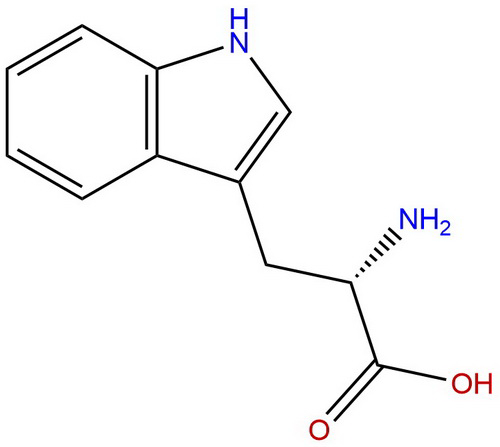


Product name: L-Tryptophan
Synonym name:
Catalogue No.: BP3447
Cas No.: 73-22-3
Formula: C11H12N2O2
Mol Weight: 204.229
Botanical Source:
Physical Description:
Type of Compound: Amino Acids
Purity: 95%~99%
Analysis Method: HPLC-DAD or/and HPLC-ELSD
Identification Method: Mass, NMR
Packing: Brown vial or HDPE plastic bottle
Storage: Store in a well closed container, protected from air and light. Put into refrigerate or freeze for long term storage.
Whenever possible, you should prepare and use solutions on the same day. However, if you need to make up stock solutions in advance, we recommend that you store the solution as aliquots in tightly sealed vials at -20℃. Generally, these will be useable for up to two weeks.
The product could be supplied from milligrams to grams
Inquire for bulk scale.
For Reference Standard and R&D, Not for Human Use Directly.
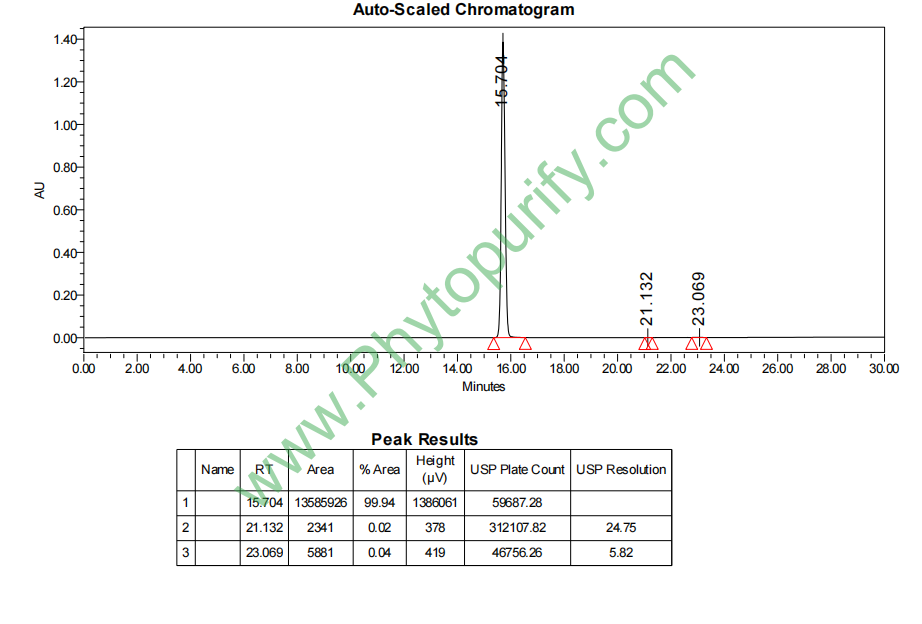
HPLC of L-Tryptophan
Storage conditions:Short-term storage at 2~8℃, long-term storage at -20 ~ -80℃
79.1100
-.6668
-.6760
.9902
.4944
2.8925
Low
33.8570
2.3006
Yes
Yes
No
No
No
No
0.0
No
No
No
No
L-tryptophan (CAS number: 73-22-3), as one of the essential amino acids for the human body, has attracted much attention due to its key role in protein synthesis and the generation of various bioactive molecules. It is not only the basic unit for protein construction, but also a precursor for the biosynthesis of neurotransmitters serotonin (5-hydroxytryptamine), melatonin, and vitamin B3 (nicotinamide). In recent years, with the in-depth study of its multiple physiological functions, L-tryptophan has shown extensive pharmacological value in fields such as neurological and psychiatric disorders, bone metabolism regulation, and immune regulation. In addition, the promoting effect of L-tryptophan on the stemness maintenance and osteogenic ability of bone marrow mesenchymal stem cells (BMSCs) provides a new approach for the treatment of bone metabolism diseases such as osteoporosis. However, high concentrations of L-tryptophan also exhibit potential toxic effects of cell proliferation inhibition and cell cycle arrest, suggesting that its dosage and application should be carefully considered.
This article aims to systematically review the chemical structure and physicochemical properties of L-tryptophan, plant sources and extraction methods, pharmacological activity and mechanism of action, pharmacological evaluation, pharmacokinetic characteristics, as well as its clinical application prospects and future development directions. It is expected to provide comprehensive and in-depth reference materials for researchers in the field of natural product pharmacology.
L-tryptophan is an essential aromatic amino acid with a molecular formula of C11H12N2O2 and a molecular weight of 204.2290. Its structural features include an alpha amino acid skeleton and a side chain with an indole ring, which endows it with unique chemical properties and biological activity. The chemical structural formula of L-tryptophan is as follows:
In terms of physical and chemical properties, L-tryptophan exhibits high water solubility (approximately 0.9902 g/100 mL), with a LogP value of -0.6668, demonstrating strong hydrophilicity and facilitating in vivo absorption and distribution. The polar surface area (TPSA) is 79.11 Å ², indicating that its molecules have moderate polarity, which is conducive to binding with biomolecules. The blood-brain barrier (BBB) has low permeability, indicating limited direct penetration ability in the central nervous system, but can indirectly affect brain function through metabolites. The negative result of hERG channel inhibition experiment indicates a low risk of cardiac toxicity. The Ames mutagenicity test result is 0.0, indicating that its genotoxicity risk is relatively low and has a good safety basis.
L-tryptophan is widely present in various plant proteins, especially abundant in leguminous plants, grains, and nuts. Common plant sources include soybeans, corn, wheat, peanuts, and sesame. Due to its binding form in proteins, extraction and purification usually rely on protein hydrolysis and subsequent separation and purification techniques.
Traditional extraction methods include:
In recent years, genetic engineering microbial fermentation has become the mainstream technology for the industrial production of L-tryptophan. Through metabolic engineering modifications of microorganisms such as Escherichia coli and Corynebacterium glutamicum, efficient synthesis has been achieved, with significantly improved yield and purity, reduced costs, and met large-scale demand.
L-tryptophan is the rate limiting precursor for serotonin synthesis. It is catalyzed by tryptophan hydroxylase (TPH1, TPH2) to generate 5-hydroxytryptophan, which is then converted to serotonin by aromatic L-amino acid decarboxylase (DDC). Serotonin, as an important neurotransmitter in the central nervous system and peripheral system, is involved in regulating emotions, sleep, appetite, and cognitive function. The changes in L-tryptophan levels directly affect the synthesis of serotonin, which in turn has a regulatory effect on neurological and psychiatric disorders such as depression, anxiety, and sleep disorders.
In addition, L-tryptophan metabolite melatonin plays a crucial role in regulating circadian rhythms and immune function. Vitamin B3 (nicotinamide) is involved in cellular energy metabolism and DNA repair, demonstrating the importance of L-tryptophan in multiple metabolic pathways.
The latest research shows that L-tryptophan can promote the dry maintenance and osteogenic ability enhancement of bone marrow mesenchymal stem cells (BMSCs) in vitro and in vivo. The mechanism may involve regulating the Wnt/β - catenin signaling pathway and bone morphogenetic protein (BMP) expression, promoting bone matrix synthesis and mineralization processes. This discovery provides potential natural drug candidates for the treatment of bone metabolism diseases such as osteoporosis and fracture healing.
It is worth noting that high concentrations of L-tryptophan have inhibitory effects on cells, inducing cell cycle arrest and reducing cell proliferation. This effect may be achieved by regulating cell cycle related proteins and inducing oxidative stress, indicating its potential application value in regulating tumor cell proliferation and immune cell function.
The biological effects of L-tryptophan are mainly mediated by its metabolites and related enzyme systems. The key molecular targets include:
In addition, the kynurenine pathway in L-tryptophan metabolism is closely related to immune regulation and neuroprotection, and related enzymes such as IDO (indoleamine 2,3-dioxygenase) play important roles in inflammation and tumor microenvironment.
L-tryptophan, as an endogenous essential amino acid, has good safety and tolerability. The pharmacological parameters are as follows:
In terms of pharmacokinetics, L-tryptophan is well absorbed orally and mainly enters the bloodstream through the active transport system of the small intestine. It is widely distributed in the body, with some entering brain tissue. Metabolism mainly occurs through the liver tryptophan hydroxylase and canine urea pathway, generating various active metabolites. Excretion is mainly through urine, with a moderate half-life. As it is an essential amino acid, its concentration in the body is significantly influenced by dietary intake and metabolic regulation.
The potential application of L-tryptophan in clinical practice is mainly reflected in the following aspects:
Assistive treatment for neurological and psychiatric disorders
Due to its crucial role as a precursor of serotonin, L-tryptophan is used as an adjuvant therapy for depression, anxiety, and sleep disorders. Multiple clinical studies have shown that moderate supplementation of L-tryptophan can improve emotional state and sleep quality, especially in patients with mild to moderate depression. However, dosage control and individual differences still need further optimization.
Intervention for Bone Metabolic Diseases
The discovery of L-tryptophan promoting the osteogenic ability of BMSCs provides a new therapeutic target for osteoporosis and fracture healing. In the future, composite formulations or functional nutritional supplements can be developed in combination with bone metabolism regulators to enhance bone health management.
Immune regulation and anti-inflammatory effects
L-tryptophan and its metabolites play a significant role in regulating immune responses and inhibiting inflammatory responses, especially in autoimmune diseases and chronic inflammatory states, with potential application value.
Tumor treatment adjuvant
The characteristic of high concentration L-tryptophan induced cell cycle arrest provides a theoretical basis for the inhibition of tumor cell proliferation. Combined with new treatment methods such as immune checkpoint inhibitors, the L-tryptophan related metabolic pathway may become a new target for future cancer treatment.
Future research should focus on dose optimization, metabolic regulation mechanisms, synergistic effects with other drugs, and efficacy validation of L-tryptophan in different disease models. At the same time, the advancement of genetic engineering microbial production technology will promote its industrial application, meeting the needs of clinical and nutritional supplement markets.
As an endogenous essential amino acid, L-tryptophan is not only the foundation of protein synthesis, but also the precursor of various important bioactive molecules. Its multiple pharmacological effects in neurotransmitter synthesis, bone metabolism regulation, and immune regulation endow it with broad clinical application prospects. Despite the potential risk of cell proliferation inhibition at high concentrations, the application of reasonable doses still demonstrates good safety and efficacy. In the future, combining modern molecular biology and medicinal chemistry techniques, in-depth analysis of the mechanism of action and metabolic network of L-tryptophan will lay a solid foundation for its development into a new natural medicine or functional nutrient. In summary, L-tryptophan, as a natural product, has significant scientific value and broad clinical translational potential in the field of pharmacology.
