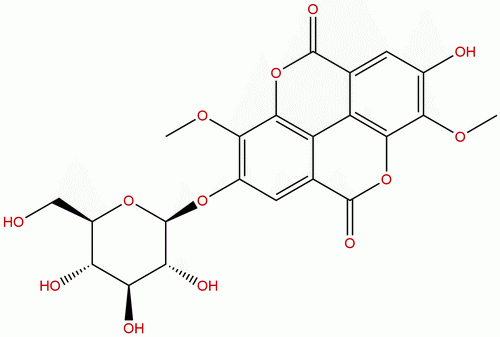


Product name: 3,3'-Di-O-methylellagic acid 4'-glucoside
Synonym name: 3,8-Di-O-methylellagic acid 2-O-glucoside
Catalogue No.: SBP03490
Cas No.: 51803-68-0
Formula: C22H20O13
Mol Weight: 492.389
Botanical Source:
Physical Description:
Type of Compound: Phenols
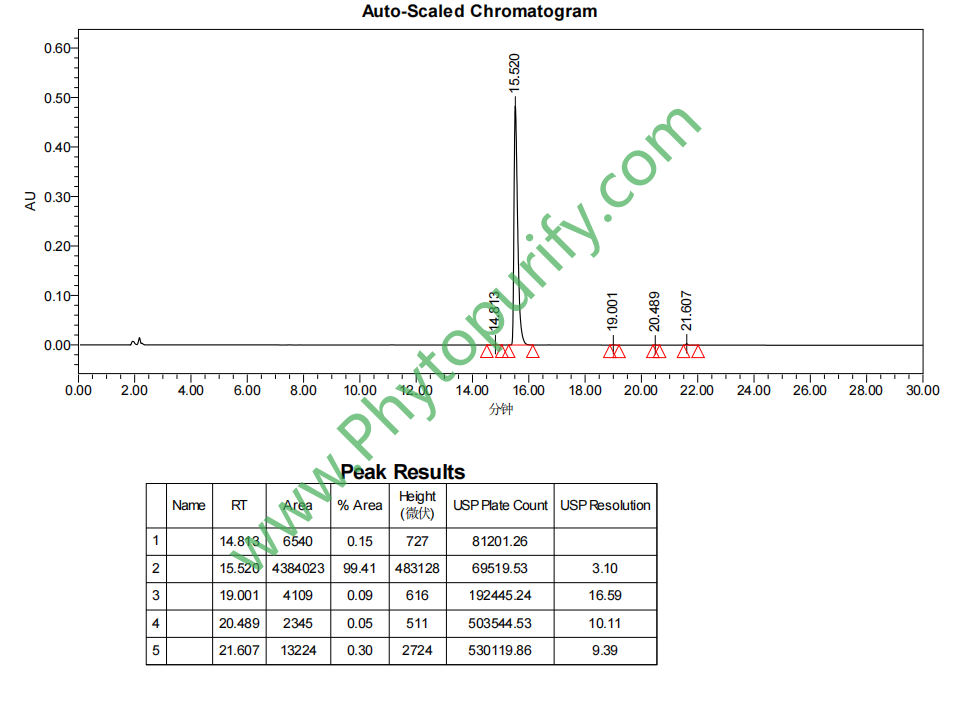
Purity: 95%~99%
Analysis Method: HPLC-DAD or/and HPLC-ELSD
Identification Method: Mass, NMR
Packing: Brown vial or HDPE plastic bottle
The product could be supplied from milligrams to grams
Inquire for bulk scale.
For Reference Standard and R&D, Not for Human Use Directly.
HPLC of 3,3'-Di-O-methylellagic acid 4'-glucoside
Storage conditions:Short-term storage at 2~8℃, long-term storage at -20 ~ -80℃
198.4900
.1269
.1054
.5477
.5656
.2228
Low
70.0832
4.2781
Yes
No
No
No
Yes
No
0.9
Yes
No
Yes
Yes
Natural products, as an important source of drug discovery, play an irreplaceable role in the long history of human fight against diseases. Tannic acid and its derivatives are a class of polyphenolic compounds widely present in the plant kingdom, which have attracted much attention due to their significant biological activities such as antioxidant, anti-inflammatory, and anti-tumor. 3,3 '- dimethylellagic acid-4' - O-glucoside (DMEAG) is a methylated and glycosylated derivative of ellagic acid. Its chemical structure combines the antioxidant properties of ellagic acid parent nucleus with the water solubility improvement brought by glycosidic bonds. The compound has a CAS number of 51803-68-0 and a molecular weight of 492.3890. It belongs to an important member of the natural tannic acid glycoside compound family.
In recent years, with the deepening of research on natural polyphenolic compounds, the pharmacological activities of DMEAG in antioxidant, skin protective, anti-inflammatory and other aspects have gradually been revealed. Especially through its multi-target mechanism of regulating the nuclear factor E2 related factor 2 (NRF2)/antioxidant response element (ARE) signaling pathway, inhibiting tyrosinase (TYR) activity, and regulating matrix metalloproteinases (MMPs) expression, it has demonstrated potential application value in oxidative stress-related diseases, skin photoaging, and pigmentation disorders. This article will provide a systematic review of the research progress of DMEAG from the aspects of chemical structure, plant origin, pharmacological activity, mechanism of action, and medicinal properties, in order to provide reference for the in-depth development and clinical application of this compound.
The chemical structure of DMEAG is based on ellagic acid as the parent nucleus, which undergoes methylation modification on the hydroxyl groups at positions 3 and 3 ', while a glucose group is attached to the hydroxyl group at position 4'. Tannic acid itself is a dimer formed by the internal esterification reaction of two gallic acid molecules, with four phenolic hydroxyl groups and two lactone ring structures. Methylation modification increases the lipid solubility of DMEAG compared to tannic acid, while the introduction of glucose groups significantly improves its water solubility. This structural modification strategy is very common in natural product chemistry, aimed at optimizing the pharmacokinetic properties of compounds.
From the perspective of structure-activity relationship, the phenolic hydroxyl group of DMEAG is a key functional group that exerts antioxidant activity and can clear free radicals through hydrogen atom transfer or single electron transfer mechanisms. Although methylation modification reduces the number of hydroxyl groups that can participate in free radical scavenging, it may enhance the metabolic stability of compounds and prolong their in vivo action time. Glycosylation not only affects solubility, but may also alter the biological activity profile of compounds by affecting their binding to target proteins.
According to the calculated chemical prediction data, the oil-water partition coefficient (LogP) of DMEAG is 0.1269, indicating that the compound has moderate lipophilicity and is conducive to transmembrane transport. The topological polar surface area (TPSA) is 198.4900 Å ², and a higher TPSA value suggests that the compound may not easily penetrate the blood-brain barrier (BBB). Actual predictions also show that its BBB permeability is at a low level. The water solubility parameter is 0.5477 mg/mL, which belongs to a moderately soluble compound, consistent with the presence of multiple hydroxyl and sugar groups in its molecule.
In terms of safety prediction, the hERG inhibition risk assessment was negative, indicating a lower risk of DMEAG induced cardiac QT interval prolongation. The Ames test predicted a value of 0.9, indicating that the compound may not have significant genetic toxicity. These preliminary pharmacological parameters provide favorable safety basis for the further development of DMEAG.
DMEAG, as a naturally occurring derivative of tannic acid, has been found in various plants. Its main sources include plant families such as Rosaceae, Myrtaceae, Euphorbiaceae, etc. Specifically, this compound has been reported in the following plants:
It is worth noting that the content of DMEAG varies greatly among different plants and is influenced by factors such as growth environment, harvest season, and variety. Generally speaking, the fruits and leaves of berry plants are important sources of this compound, but the content is usually low and requires efficient extraction and purification techniques to obtain sufficient amounts of pure product.
The extraction of DMEAG usually adopts solvent extraction method, and commonly used solvents include methanol, ethanol, acetone or their aqueous solutions. Due to the presence of multiple phenolic hydroxyl groups in the compound, degradation may occur under alkaline conditions. Therefore, the pH is usually controlled within the neutral or weakly acidic range during the extraction process. Modern technologies such as ultrasound assisted extraction and microwave-assisted extraction can significantly improve extraction efficiency and shorten extraction time.
Separation and purification steps usually include: solvent extraction of crude extract (such as ethyl acetate extraction), silica gel column chromatography, Sephadex LH-20 gel column chromatography, preparative high-performance liquid chromatography (prep HPLC), etc. Among them, Sephadex LH-20 column chromatography has a particularly outstanding separation effect on polyphenolic compounds, which can achieve effective separation based on molecular size and polarity differences. In recent years, new separation techniques such as high-speed countercurrent chromatography (HSCCC) and supercritical fluid chromatography (SFC) have gradually been applied to the purification of tannic acid glycosides.
For the structural identification of DMEAG, techniques such as ultraviolet spectroscopy (UV), infrared spectroscopy (IR), mass spectrometry (MS), and nuclear magnetic resonance spectroscopy (NMR) are commonly used. Among them, high-resolution mass spectrometry (HR-MS) can provide accurate molecular weight information, while one-dimensional and two-dimensional NMR spectra (such as 1H-NMR, 13C-NMR, HMBC, HSQC) can determine the connection position and configuration of sugar groups.
Antioxidant activity is one of the core pharmacological effects of DMEAG. Multiple in vitro studies have shown that DMEAG can effectively scavenge various free radicals, including 1,1-diphenyl-2-trinitrophenylhydrazine (DPPH) free radical, 2,2 '- diazobis (3-ethylbenzothiazole-6-sulfonic acid) (ABTS) cationic free radical, superoxide anion free radical, and hydroxyl free radical. Its antioxidant capacity is comparable to or slightly lower than tannic acid, but superior to many common natural antioxidants such as vitamin C and vitamin E.
At the cellular level, DMEAG can protect various cells from oxidative stress damage. For example, in human keratinocytes (HaCaT cells), DMEAG pretreatment can significantly reduce the increase in reactive oxygen species (ROS) levels induced by hydrogen peroxide (H ₂ O ₂) or ultraviolet light (UVB), reduce the production of lipid peroxidation product malondialdehyde (MDA), and increase the activity of intracellular antioxidant enzymes such as superoxide dismutase (SOD), catalase (CAT), and glutathione peroxidase (GPX). In addition, DMEAG can upregulate the expression of heme oxygenase-1 (HMOX1), further enhancing the antioxidant defense ability of cells.
Given the regulatory role of DMEAG on TYR and MMPs, it demonstrates significant potential in the field of skin protection. TYR is a key rate limiting enzyme in the process of melanin synthesis, and its abnormally elevated activity can lead to hyperpigmentation disorders such as melasma and freckles. Research has shown that DMEAG can inhibit TYR activity in a dose-dependent manner, with a half maximal inhibitory concentration (IC ₅₀) at the micromolar level. Compared with the classic whitening agent arbutin, DMEAG has comparable or stronger inhibitory activity and lower cytotoxicity.
MMP1 and MMP3 are the main enzymes involved in extracellular matrix degradation, and their overactivation is closely related to skin photoaging. DMEAG can inhibit the upregulation of MMP1 and MMP3 expression induced by UVB, while promoting collagen synthesis, thereby exerting anti photoaging effects. In addition, DMEAG can protect the skin from UV damage at multiple levels by activating the NRF2 signaling pathway and upregulating the expression of antioxidant enzyme genes.
The anti-inflammatory activity of DMEAG has been confirmed in various inflammatory models. In a macrophage model stimulated by lipopolysaccharide (LPS), DMEAG can significantly inhibit the release of pro-inflammatory factors such as tumor necrosis factor - α (TNF - α), interleukin-6 (IL-6), and interleukin-1 β (IL-1 β). The mechanism may be related to the inhibition of activation of the nuclear factor kappa B (NF - κ B) signaling pathway. In addition, DMEAG can downregulate the expression of cyclooxygenase-2 (COX-2) and inducible nitric oxide synthase (iNOS), and reduce the production of prostaglandin E ₂ (PGE ₂) and nitric oxide (NO).
Preliminary studies also suggest that DMEAG may have anti-tumor, neuroprotective, and cardiovascular protective activities. In tumor cell lines, DMEAG can induce cell cycle arrest and apoptosis, but its concentration is high and its selectivity needs to be improved. In neural cell models, DMEAG can alleviate oxidative stress-induced neuronal damage, indicating its potential application value in neurodegenerative diseases. However, these studies are still in the preliminary stage and require more experimental evidence to support them.
NRF2 is a core transcription factor for cells to cope with oxidative stress, and its interaction with Kelch like ECH related protein 1 (KEAP1) regulates the expression of downstream antioxidant genes. DMEAG can promote the dissociation of NRF2 and KEAP1, causing NRF2 to translocate into the nucleus and bind to antioxidant response elements (ARE), thereby initiating the transcription of a series of antioxidant enzyme genes, including SOD1, SOD2, CAT, GPX1, HMOX1, etc. This mechanism is the core molecular basis for DMEAG to exert antioxidant activity.
It is worth noting that DMEAG has a moderate activation effect on NRF2, which is different from the overactivation effect that some potent NRF2 activators may cause. This mild regulatory mode may be more conducive to maintaining intracellular redox homeostasis and avoiding potential side effects caused by excessive activation.
TYR is a copper containing oxidase that catalyzes the hydroxylation of tyrosine to dopaquinone, which is the rate limiting step in melanin synthesis. The inhibitory effect of DMEAG on TYR may be achieved through the following mechanisms: firstly, the phenolic hydroxyl group of DMEAG can chelate with copper ions in the active center of TYR, competitively inhibiting substrate binding; Secondly, DMEAG may reduce enzyme activity by lowering the expression level of TYR protein; In addition, the antioxidant activity of DMEAG can reduce the oxidative environment required for melanin synthesis, indirectly inhibiting melanin production.
Molecular docking studies have shown that DMEAG can form stable hydrogen bonds and hydrophobic interactions with the active sites of TYR, and its binding energy is superior to many known TYR inhibitors. This multi-level inhibitory mechanism gives DMEAG a unique advantage in whitening efficacy.
MMP1 (collagenase-1) and MMP3 (matrix metalloproteinase-1) are key enzymes involved in skin photoaging. The regulation of MMPs by DMEAG involves multiple signaling pathways: on the one hand, DMEAG inhibits the phosphorylation of mitogen activated protein kinase (MAPK) pathways (such as p38 and JNK), reduces the activation of transcription factor activator protein-1 (AP-1), and downregulates the transcription of MMP1 and MMP3; On the other hand, DMEAG upregulates the expression of tissue metalloproteinase inhibitors (TIMPs) by activating the NRF2 pathway, thereby inhibiting the function of MMPs at the enzyme activity level.
The pharmacological activity of DMEAG cannot be explained by a single target, but is achieved through the synergistic action of multiple targets and pathways. For example, in terms of skin protection, DMEAG simultaneously acts on TYR (inhibiting melanin synthesis), MMPs (inhibiting collagen degradation), and NRF2 (enhancing antioxidant defense), giving it a comprehensive advantage in anti-aging and whitening. In addition, DMEAG comprehensively upregulates antioxidant enzymes such as SOD1, SOD2, CAT, and GPX1, forming a complete antioxidant network with stronger biological effects than single target drugs.
Based on the Lipinski Rule of Five, the drug properties of DMEAG were evaluated: its molecular weight was 492.3890 Da (slightly above the threshold of 500 Da), LogP was 0.1269 (meeting the requirement of<5), the number of hydrogen bond donors (phenolic and sugar hydroxyl groups) was 7 (exceeding the threshold of 5), and the number of hydrogen bond acceptors was 13 (exceeding the threshold of 10). Therefore, DMEAG deviates from the Lipinski rule in terms of molecular weight and the number of hydrogen bond donors and acceptors, suggesting that its oral bioavailability may be low. However, for natural products, many active compounds do not fully comply with Lipinski's rules, but can still exert pharmacological effects through other routes of administration, such as topical application.
The water solubility of DMEAG (0.5477 mg/mL) is at a moderate level, which provides some convenience for its formulation development. However, the higher TPSA value (198.4900 Å ²) and the greater number of hydrogen bond acceptors limit its ability to penetrate cell membranes through passive diffusion. The prediction results of low BBB permeability also confirm this, although it limits its application in central nervous system diseases, for peripheral targets such as skin, liver, and kidneys, low BBB permeability may actually reduce central side effects.
The metabolism of tannic acid glycosides in vivo usually involves hydrolysis and methylation modification of glycosidic bonds. The 4 '- O-glucoside bond of DMEAG may be hydrolyzed by gut microbiota or β - glucosidase in the liver, releasing the glycoside 3,3' - dimethyl tannic acid. In addition, phase II metabolic enzymes in the liver, such as UDP glucuronosyltransferase and sulfotransferase, may modify phenolic hydroxyl groups with glucuronidation or sulfation, promoting their excretion.
In terms of safety evaluation, negative hERG inhibition results and lower Ames test predicted values (0.9) indicate that DMEAG has good safety prospects. However, it should be pointed out that these data are mainly based on computational predictions and still need to be validated through systematic in vitro and in vivo toxicology studies.
Given that the oral bioavailability of DMEAG may be low, topical application (such as skin application) may be the most direct route of administration. Its antioxidant and whitening activities make it an ideal candidate ingredient for cosmetics and dermatological drugs. In addition, nanoformulation technologies such as liposomes, nanoemulsions, and solid lipid nanoparticles can be used to improve the transdermal absorption and stability of DMEAG. For oral administration, prodrug design, absorption enhancers, or special formulation techniques (such as phospholipid complexes) can be considered to improve its bioavailability.
The multiple pharmacological activities of DMEAG make it have broad application prospects in the field of skin care. As an antioxidant, it can be added to sunscreen products to enhance protection against UV induced skin damage; As a TYR inhibitor, it can be developed as a whitening and spot removing product for the treatment of pigmentation disorders; As an inhibitor of MMPs, it can be used in anti-aging products to delay the process of skin aging. At present, some cosmetics companies have begun to pay attention to the application of tannic acid glycosides in skincare products, but the industrial application of DMEAG is still in its infancy.
Oxidative stress is the common pathological mechanism of many chronic diseases (such as cardiovascular diseases, diabetes, neurodegenerative diseases, inflammatory diseases, etc.). DMEAG is expected to play a role in the prevention and treatment of these diseases by activating the NRF2 pathway and upregulating the antioxidant enzyme system. For example, in a non-alcoholic fatty liver disease (NAFLD) model, DMEAG may improve liver function by reducing liver oxidative stress and inflammatory response; In the complications of diabetes, DMEAG may protect vascular endothelial cells and renal tubular cells by inhibiting oxidative stress induced by high glucose.
The combined use of DMEAG with other natural products or drugs may result in synergistic effects. For example, combined use with vitamin C or vitamin E can enhance antioxidant effects; Combined use with arbutin or quercetin can improve whitening efficacy; Combined use with retinoic acid or peptides can enhance anti-aging effects. In addition, DMEAG, as an NRF2 activator, may be used in combination with certain chemotherapy drugs to improve patient tolerance by reducing oxidative stress damage caused by chemotherapy.
Although DMEAG exhibits various pharmacological activities and good safety prospects, its development still faces several challenges: firstly, the content of DMEAG in natural sources is low, and the extraction and purification costs are high, requiring the development of efficient chemical or biological synthesis methods; Secondly, the pharmacokinetic properties of DMEAG, especially its oral bioavailability, need to be improved and appropriate formulation strategies need to be explored; Thirdly, the in vivo pharmacological research on DMEAG is currently insufficient, and more animal models and preclinical studies are needed to verify its efficacy and safety; Finally, although the multi-target mechanism of action of DMEAG brings comprehensive advantages, it also increases the complexity of mechanism research, requiring in-depth analysis through methods such as systems pharmacology and network pharmacology.
Future research directions should include: establishing a chemical synthesis route for DMEAG and achieving large-scale production; Conduct systematic pharmacokinetic studies to clarify its in vivo metabolic pathways and bioavailability; Evaluate its in vivo efficacy in skin protection, anti-inflammatory, anti-tumor and other aspects using animal models; Explore the synergistic effects of DMEAG with other active ingredients and develop compound formulations; Conduct preliminary clinical studies to verify its safety and efficacy in the human body.
3,3 '- dimethyltannic acid-4' - O-glucoside, as a natural polyphenolic compound, has shown important research value and application potential in the fields of antioxidant, skin protection, anti-inflammatory, etc. due to its unique chemical structure and multi-target pharmacological activity. It achieves comprehensive intervention on oxidative stress and skin aging by regulating the NRF2/ARE signaling pathway, inhibiting TYR activity, and modulating MMPs expression. The pharmacological evaluation shows that the compound has good safety characteristics, although its oral bioavailability may be limited, the local topical route provides a feasible solution for its application.
With the continuous deepening of natural product chemistry and pharmacology research, as well as the rapid development of modern formulation technology, DMEAG is expected to move from laboratory research to clinical application, becoming an important candidate ingredient for skin care products and oxidative stress-related disease treatment drugs. However, from basic research to practical applications, there are still many challenges that require the collaborative efforts of researchers from multiple disciplines such as chemistry, pharmacy, pharmacology, and toxicology. I believe that in the near future, DMEAG and its derivatives will play a more important role in human health.
