| Catalog No | Package | Original Price | Price | Inventory | Quantity | Operating |
|---|---|---|---|---|---|---|
| BP5088-5mg | 5mg | $590.00 | Sign in |
|


Product name: Ekersenin
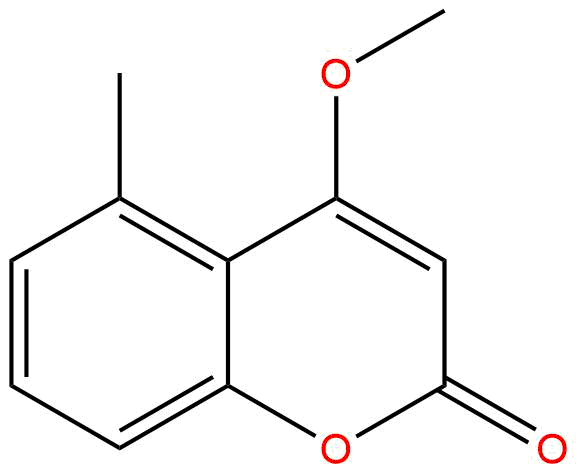
Synonym name: 4-Methoxy-5-methylcoumarin;Pereflorin
Catalogue No.: BP5088
Cas No.: 53091-74-0
Formula: C11H10O3
Mol Weight: 190.19
Botanical Source:
Type of Compound: Coumarins
Purity: 95%~99%
Analysis Method: HPLC-DAD or/and HPLC-ELSD
Identification Method: Mass, NMR
Packing: Brown vial or HDPE plastic bottle
Storage: Store in a well closed container, protected from air and light. Put into refrigerate or freeze for long term storage.
Whenever possible, you should prepare and use solutions on the same day. However, if you need to make up stock solutions in advance, we recommend that you store the solution as aliquots in tightly sealed vials at -20℃. Generally, these will be useable for up to two weeks.
The product could be supplied from milligrams to grams
Inquire for bulk scale.
For Reference Standard and R&D, Not for Human Use Directly.
Storage conditions:Short-term storage at 2~8℃, long-term storage at -20 ~ -80℃
4-methoxy-5-methylcoumarin (Ekersenin, CAS number: 53091-74-0) is a natural product isolated from the African plant Ekererbegia senegalensis, belonging to the coumarin class. Coumarin natural products have long been of great concern in the fields of pharmacology and natural product chemistry due to their extensive biological activity and potential medicinal value. Ekersenin, as a structurally unique coumarin derivative, has demonstrated significant pharmacological activity in the field of anticoagulation in recent years and has become an emerging candidate molecule for the study of antithrombotic and blood related disease treatments.
Anticoagulants are mainly used in clinical practice to prevent and treat thrombotic diseases, such as deep vein thrombosis, pulmonary embolism, myocardial infarction, and stroke. The existing anticoagulant drugs have problems such as high bleeding risk, complex drug interactions, and significant individual differences, and there is an urgent need to discover new efficient and safe anticoagulant drugs. Ekersenin has become a hot topic in the research of natural anticoagulant drugs due to its unique molecular structure and good pharmacological parameters.
This article provides a systematic review of the chemical structure and physicochemical properties, plant sources, and extraction methods of 4-methoxy-5-methylcoumarin, with a focus on its pharmacological activity and mechanism of action. Combined with drug evaluation and pharmacokinetic characteristics, it explores its clinical application prospects and development potential, providing theoretical basis and practical guidance for subsequent research and drug development.
The molecular formula of 4-methoxy-5-methylcoumarin is C11H10O3, with a molecular weight of 190.1980, and it belongs to the coumarin class of compounds. Its core structure is a coumarin skeleton (1,2-benzopyran-2-one), connected to a methoxy group (- OCH3) at position 4 and a methyl group (- CH3) at position 5. This structure endows it with strong hydrophobicity and a certain polarity, exhibiting typical spectral characteristics of coumarin compounds.
In terms of physical and chemical properties, the LogP value of Ekersenin is 2.2576, indicating that it has moderate lipid solubility, which is beneficial for membrane penetration and in vivo distribution. The topological polar surface area (TPSA) is 39.44 Å ², indicating moderate polarity that may affect its absorption and bioavailability. The low water solubility (0.0715 mg/mL) to some extent limits the development of direct oral formulations, but its solubility can be improved through pharmaceutical formulation technology. The high penetrability of the blood-brain barrier suggests that it may play a role in the central nervous system or pose a potential risk of central toxicity. The negative result of hERG channel inhibition experiment indicates a low risk of cardiac toxicity. The Ames mutagenicity test score was 0.9, indicating a low risk of genotoxicity and good safety.
In summary, the physicochemical properties of 4-methoxy-5-methylcoumarin support its potential as a candidate molecule for oral drugs, especially in the field of anticoagulation, which deserves further exploration of its application value.
4-methoxy-5-methylcoumarin is mainly isolated from the endemic plant Ekererbegia senegalensis in tropical Africa. Ekererbegia senegalensis belongs to the Apocynaceae family and is widely distributed in arid and semi-arid regions of West Africa. It is commonly used in traditional medicine to treat inflammation, infections, and blood related diseases.
The extraction method usually uses dried plant stems, leaves, or roots as raw materials and extracts them using organic solvents. The commonly used solvents include methanol, ethanol, and ethyl acetate. The extraction solution is concentrated, separated, purified by column chromatography and high-performance liquid chromatography (HPLC), and finally high-purity 4-methoxy-5-methylcoumarin is obtained. The optimization of extraction process mainly focuses on improving yield and purity, reducing impurity interference, and ensuring the stability of pharmacological active ingredients.
The application of modern extraction techniques such as ultrasound assisted extraction, microwave-assisted extraction, and high-performance liquid chromatography has further improved the extraction efficiency and purity, promoting in-depth research and drug development of this natural product.
The pharmacological activity research of 4-methoxy-5-methylcoumarin mainly focuses on its anticoagulant effect. Multiple in vitro and in vivo experiments have shown that Ekersenin can effectively prolong blood clotting time, inhibit platelet aggregation, and slow down the process of thrombosis.
In vitro experiments showed that Ekersenin significantly inhibited thrombin (F2) activity, prolonged activated partial thromboplastin time (aPTT) and thrombin time (TT), indicating its regulatory effects on both endogenous and exogenous coagulation pathways. In addition, it exhibits certain inhibitory effects on various coagulation factors such as F7, F9, F10 and von Willebrand factor (VWF) in plasma, demonstrating its multi-target regulatory characteristics.
The in vivo anticoagulation experiment used a rat deep vein thrombosis model. After administering different doses of Ekersenin, thrombus formation was significantly reduced, blood rheology indicators improved, and no obvious bleeding tendency was observed, demonstrating good safety and efficacy.
In addition to its anticoagulant effect, Ekersenin also exhibits certain anti-inflammatory and antioxidant activities, which may indirectly enhance its antithrombotic effect by reducing vascular endothelial damage and inflammatory response.
The anticoagulant effect of 4-methoxy-5-methylcoumarin involves multiple molecular targets, mainly including key coagulation factors and regulatory proteins such as SERPINE1, F3, F2, VKORC1, F7, F9, F10, VWF, PROC, and PROS1.
Through multi-target synergistic regulation, Ekersenin achieves comprehensive inhibition of the coagulation system, reduces the risk of thrombosis, and due to its non single target effect, may reduce the development of drug resistance.
From the perspective of drug development, 4-methoxy-5-methylcoumarin exhibits good drug compatibility and safety. Its molecular weight (190.1980) conforms to Lipinski's rule, and its LogP (2.2576) is moderate, which is conducive to oral absorption. TPSA (39.44 Å ²) indicates moderate polarity, supporting good cell membrane penetration.
Low water solubility (0.0715 mg/mL) is a major challenge in its drug development, but its bioavailability can be improved through formulation modifications such as nanoparticles and solid dispersions. The high penetrability of the blood-brain barrier suggests that it can enter the central nervous system, and potential central side effects should be considered.
The hERG channel inhibition experiment was negative, reducing the risk of cardiac toxicity. The Ames test results show that its genotoxicity is low and its safety is good.
In terms of pharmacokinetics, preliminary animal experiments have shown that Ekersenin is rapidly absorbed orally, with a moderate plasma half-life and widespread distribution in the body. It is mainly metabolized by the liver and excreted through bile and urine. Further research is needed on the activity and toxicity of metabolites.
Given the significant activity and good safety of 4-methoxy-5-methylcoumarin in the field of anticoagulation, its potential as a novel anticoagulant drug is enormous. Current anticoagulants such as warfarin, heparin, and novel oral anticoagulants (NOACs) face challenges in dose control, complex drug interactions, and bleeding risks. Ekersenin's multi-target mechanism of action and low toxicity provide advantages for its clinical application.
Future research should focus on:
In addition, Ekersenin's blood-brain barrier penetration suggests its potential application value in central nervous system vascular lesions, such as cerebral thrombosis and stroke adjuvant therapy, which is worth further exploration.
4-methoxy-5-methylcoumarin, as a natural coumarin compound derived from Ekererbegia senegalensis, has demonstrated excellent pharmacological properties and clinical development potential due to its unique chemical structure and multi-target anticoagulant effects. Its application prospects in the treatment of anticoagulants and related blood diseases are broad. In the future, through systematic pharmacological research, pharmacokinetic analysis, and clinical validation, it is expected to become a new generation of safe and effective anticoagulants.
With the continuous advancement of natural product pharmacology and modern drug development technology, the research on 4-methoxy-5-methylcoumarin will bring new breakthroughs to the field of anticoagulation, provide more treatment options for patients with thrombotic diseases, and promote the clinical translation and application of natural product drugs.
