


Synonym name: Techtochrysin; Techtochrysine; Tectochrysin
Catalogue No.: BP0103
Cas No.: 520-28-5
Formula: C16H12O4
Mol Weight: 268.268
Botanical Source: Alpinia oxyphylla Miq.
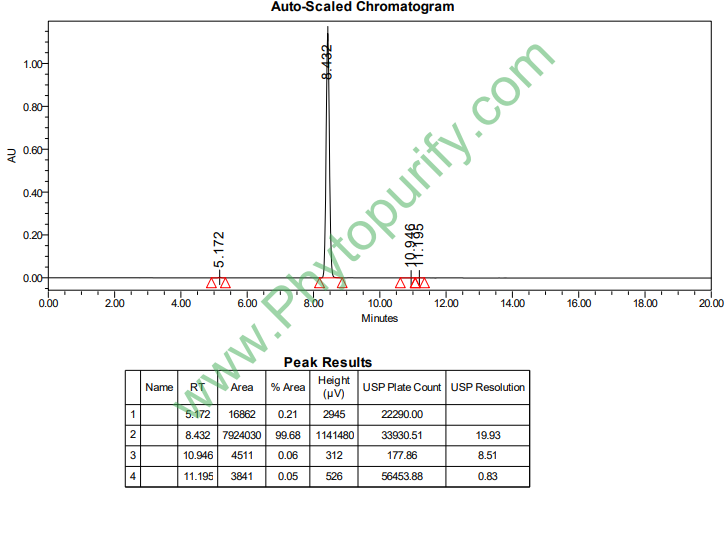
Purity: 95%~99%
Analysis Method: HPLC-DAD or/and HPLC-ELSD
Identification Method: Mass, NMR
Packing: Brown vial or HDPE plastic bottle
Can be supplied from milligrams to grams.
For Reference Standard and R&D, Not for Human Use Directly.
Inquire for bulk scale.
Description:
Tectochrysin is a promising inhibitor for the reversal of ABCG2-mediated drug transport, it leads to apoptotic cell death in NSCLC cells through activation of DR3 and Fas expression via inhibition of STAT3 phosphorylation.Tectochrysin has antioxidant effect, it also exhibits a significant hepatoprotective activity in hepatic damage induced by CCl4-intoxication in rats.
References:
Arch Pharm Res. 2003 Jan;26(1):43-6.
In vivo anti-oxidant activities of tectochrysin.
The anti-oxidant activities of Tectochrysin, a major compound of propolis, were investigated.
METHODS AND RESULTS:
Tectochrysin exhibited a significant decrease in serum transaminase activities elevated by hepatic damage induced by CCl4-intoxication in rats. Tectochrysin tested exhibited a lipid peroxidation causing a significant decrease in MDA production in TBA-reactant assay. Tectochrysin was strong in the increase in the anti-oxidant enzymes such as hepatic cytosolic superoxide dismutase, catalase and glutathione peroxidase activities in CCl4-intoxicated rats.
CONCLUSIONS:
These results suggest that Tectochrysin possess not only the anti-oxidant, but also the activities in CCl4-intoxicated rats. Especially, Tectochrysin was found to cause significant increases in the rat liver cytosolic SOD, catalase, GSH-px activities as well as a significant decrease in the MDA production.
HPLC of Techtochrysin
Storage conditions:Short-term storage at 2~8℃, long-term storage at -20 ~ -80℃
63.6000
3.0400
2.8000
Low
No
No
No
No
No
No
No
Flavonoids, as secondary metabolites of plants, have long been of great concern in the fields of pharmacology and natural product chemistry due to their extensive biological activity and potential medicinal value. Techtochrysin (CAS number: 520-28-5) is a monohydroxy monomethoxy flavonoid with a hydroxyl group at position 4 and a methoxy group at position 7 of the flavonoid skeleton. Due to its unique chemical properties and diverse biological activities, it has become a research hotspot in recent years. Yang Ya Huang not only exhibits significant anti-tumor activity, but also has functions of stopping diarrhea and regulating plant metabolism, demonstrating its potential application value in the treatment of various diseases.
Especially in the field of cardiovascular disease, Yangyahuang has shown regulatory effects on multiple targets related to myocardial infarction (MI), such as APP, PTPN1, MAOA, ABCB1, ABCG2 and other molecular targets, suggesting that it may exert a protective effect on the myocardium through the synergistic action of multiple targets. In addition, the pharmacological parameters of Yangyahuang are good, with low liver toxicity, no cardiac toxicity, and hERG channel inhibition, indicating a good safety basis. This article aims to provide a systematic review of the chemical structure, plant origin, pharmacological activity, mechanism of action, pharmacological evaluation, and clinical application prospects of Yangyaopin, with the hope of providing theoretical basis and reference for its future drug development and clinical research.
Yang Ya Huang belongs to the class of flavonoids, which is a monohydroxy monomethoxy flavonoid with a chemical formula of C16H12O5 and a molecular weight of 284.26. Its structural feature is the substitution of 4-hydroxy (- OH) and 7-methoxy (- OCH3) groups in the flavonoid skeleton, endowing it with unique physicochemical properties and biological activity. The LogP value of Yang Ya Huang is 3.04, indicating moderate hydrophobicity, which is beneficial for cell membrane penetration and bioavailability. Its polar surface area (TPSA) is 63.6 Å ² and the number of hydrogen bond acceptors is 4, indicating its hydrophilicity and binding potential in intermolecular interactions.
From the perspective of molecular conformation, the 4-hydroxy group provides hydrogen bond donor function, while the presence of the 7-methoxy group enhances the hydrophobicity and stability of the molecule. This structural combination enables yangyaopin to form stable hydrogen bonds when bound to protein targets, while also enhancing affinity through hydrophobic interactions. In addition, Yang Ya Huang showed low blood-brain barrier penetration ability, indicating limited activity in the central nervous system, but this also reduces the potential risk of central neurotoxicity.
Yangya flavin is mainly found in various traditional Chinese medicinal materials and plants, especially in some flavonoid rich plants such as Yangya genus plants. Its natural form is mostly free or bound flavonoids, and its content is greatly affected by plant species, growth environment, and harvesting time. Common plant sources include plant species named Techtochrysin and their related genera, as well as other flavonoid rich medicinal plants reported.
The extraction method often uses organic solvent extraction combined with chromatographic separation technology. The commonly used extraction solvents include ethanol, methanol, and their aqueous solutions. The extraction process is usually carried out under medium to low temperature conditions to avoid degradation of thermosensitive components. After extraction, Yang Ya Huang was purified by methods such as silica gel column chromatography and reverse phase high performance liquid chromatography (RP-HPLC). In recent years, ultrasound assisted extraction and microwave-assisted extraction techniques have been introduced to improve extraction efficiency and purity, while reducing solvent usage and extraction time.
The purified Yangya flavin was structurally identified by mass spectrometry (MS), nuclear magnetic resonance (NMR), and infrared spectroscopy (IR) to ensure its purity and structural accuracy, providing a reliable material basis for subsequent pharmacological activity research.
The pharmacological activities of Yangya Huang include anti-tumor, antidiarrheal, anti-inflammatory, and cardiovascular protection, demonstrating its potential as a multifunctional natural product.
A large number of in vitro cell experiments and some in vivo model studies have shown that yangyaopin has inhibitory effects on proliferation, induces apoptosis, and blocks cell cycle in various tumor cells. The mechanism involves regulating tumor related signaling pathways such as PI3K/Akt, MAPK, and NF - κ B pathways, which in turn affect cell proliferation, migration, and invasion ability. In addition, Yang Ya Huang can regulate the tumor microenvironment, inhibit tumor angiogenesis, enhance the sensitivity of chemotherapy drugs, and demonstrate potential adjuvant therapeutic value.
As a traditional antidiarrheal ingredient, Yangyahuang exerts its antidiarrheal effect by regulating the contractility of intestinal smooth muscle and intestinal secretion function. Its mechanism of action may be related to inhibiting the release of intestinal inflammatory factors, regulating the balance of intestinal microbiota, and enhancing intestinal barrier function. Related animal experiments have shown that Yangya Huangsu can effectively alleviate diarrhea symptoms and shorten the course of the disease.
In models of myocardial infarction and related cardiovascular diseases, yangya flavin exhibits antioxidant, anti-inflammatory, and anti apoptotic effects. It can regulate the oxidative stress level within myocardial cells, inhibit the release of inflammatory mediators, and protect myocardial cells from ischemia-reperfusion injury. In addition, Yang Ya Huang has a protective effect on endothelial function, promotes vasodilation and blood flow recovery, and contributes to the recovery of myocardial function.
Yang Ya Huang also exhibits certain neuroprotective, antibacterial, and immune regulatory activities, indicating its broad potential for application in the treatment of various diseases.
Yang Ya Huang exerts its pharmacological effects through multi-target and multi pathway regulation, especially in diseases such as myocardial infarction. Its targets include APP, PTPN1, MAOA, ABCB1, ABCG2, SYNJ2, ALOX5, TRPV1, CNR1, and SHBG.
In summary, Yangya flavin exhibits a complex and effective mechanism of action by synergistically regulating the metabolism, inflammation, apoptosis, and repair processes of myocardial cells through multiple targets.
The pharmacological parameters of Yangya Huang indicate that it has good potential for drug development. Its molecular weight is 284.26, which meets the drug affinity requirements of Lipinski rule. The LogP value is 3.04, indicating that it has moderate lipid solubility, which is beneficial for cell membrane penetration and oral absorption. The TPSA is 63.6 Å ², supporting good bioavailability and cell permeability.
In terms of safety, Yang Ya Huang has no hepatotoxicity, no cardiotoxicity, and does not inhibit hERG channels, reducing the risk of arrhythmia. The Ames test is negative, indicating that it does not have genetic toxicity and has high safety. The low penetration ability of the blood-brain barrier suggests that its potential side effects on the central nervous system are relatively small.
Pharmacokinetic studies have shown that Yang Ya Huang is well absorbed after oral administration, but its bioavailability is limited due to the action of metabolic enzymes. Its main metabolic pathways include phase I and phase II metabolism in the liver, producing water-soluble metabolites that are excreted through the kidneys. Moderate half-life, suitable for daily administration. In the future, optimizing its pharmacokinetic properties through structural modification or drug carrier technology will further enhance its clinical application value.
Based on the multi-target, multi mechanism action characteristics and good safety of Yangya flavin, it has broad application prospects in the prevention and treatment of cardiovascular diseases, especially myocardial infarction, in the future. Its antioxidant, anti-inflammatory, and cell protective effects provide new ideas for the intervention of myocardial ischemia-reperfusion injury. In addition, the anti-tumor and antidiarrheal activities of Yangya Huang also lay the foundation for its application in tumor adjuvant therapy and digestive system diseases.
Although clinical research on Yangyahuangyin is still in its infancy, its potential as a natural medicine or drug lead compound is becoming increasingly prominent with the in-depth analysis of pharmacological mechanisms and optimization of drug properties. In the future, it is necessary to strengthen the research on its in vivo pharmacodynamics, toxicology, and pharmacokinetic system, conduct preclinical and clinical trials, and clarify its effective dosage, safety range, and indications.
In addition, based on its multi-target properties, Yangyahuangsu can be used in combination with other drugs to exert synergistic effects. The application of new drug delivery systems such as nanocarriers and liposomes will also help improve their bioavailability and targeting, and promote their clinical translation.
Yang Ya Huang, as a structurally unique monohydroxy methoxy flavonoid, has shown significant potential as a new natural medicine due to its diverse pharmacological activities and good medicinal properties. Its research progress in the fields of anti-tumor, antidiarrheal, and cardiovascular protection, especially its mechanism of action in multi-target regulation related to myocardial infarction, provides rich examples for natural product pharmacology research.
In the future, by deepening the pharmacological mechanism research, optimizing its pharmacokinetic properties, and conducting systematic clinical evaluations, it is expected to promote its transition from laboratory to clinical application and become an effective natural medicine for treating various diseases. The study of Yangyahuang not only enriches the pharmacological knowledge system of flavonoids, but also provides valuable resources and insights for the development of natural product drugs.
