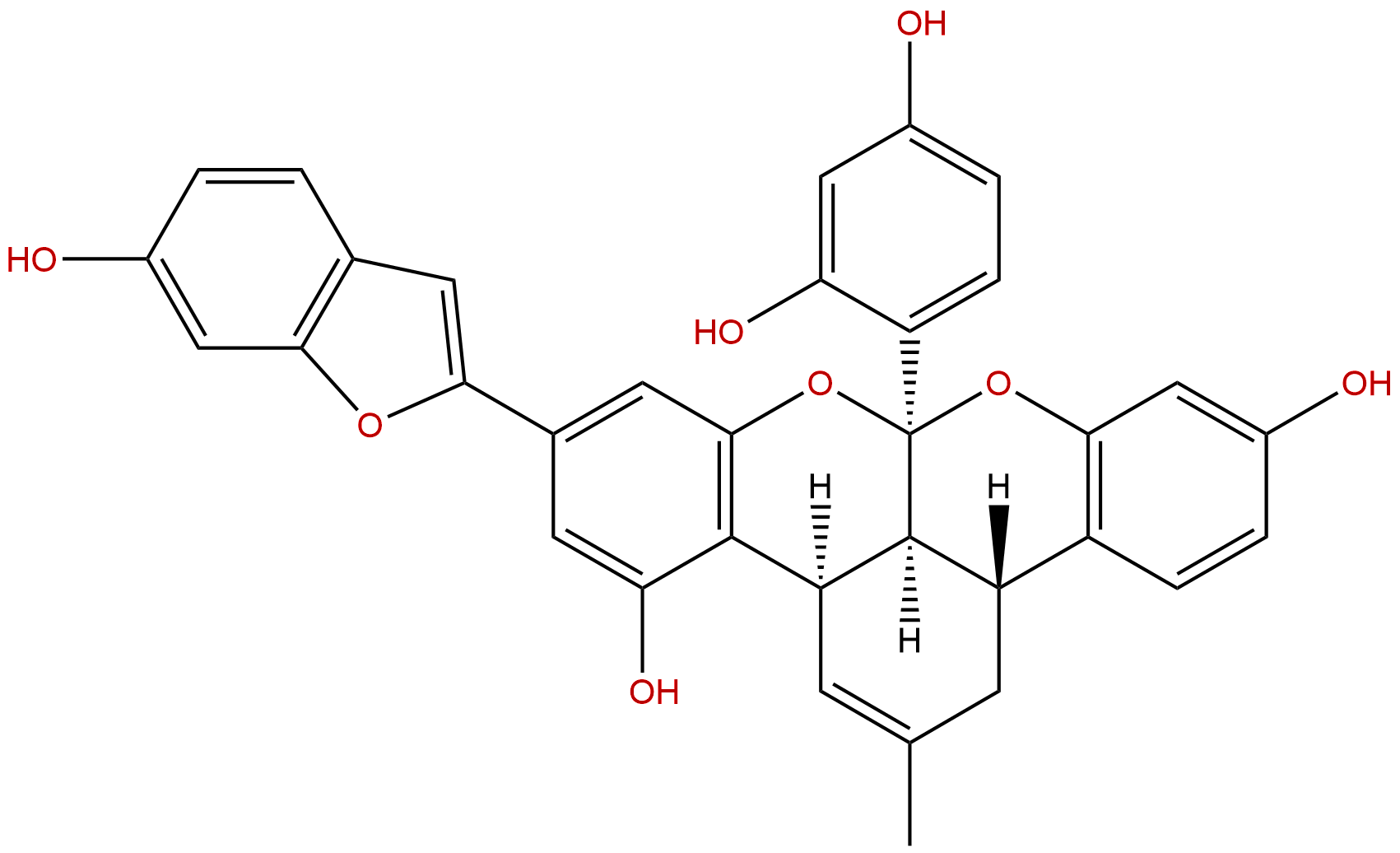


Product name: Mulberrofuran G
Synonym name:
Catalogue No.: SBP02868
Cas No.: 87085-00-5
Formula: C34H26O8
Mol Weight: 562.574
Botanical Source:
Physical Description: Powder
Type of Compound: Phenols
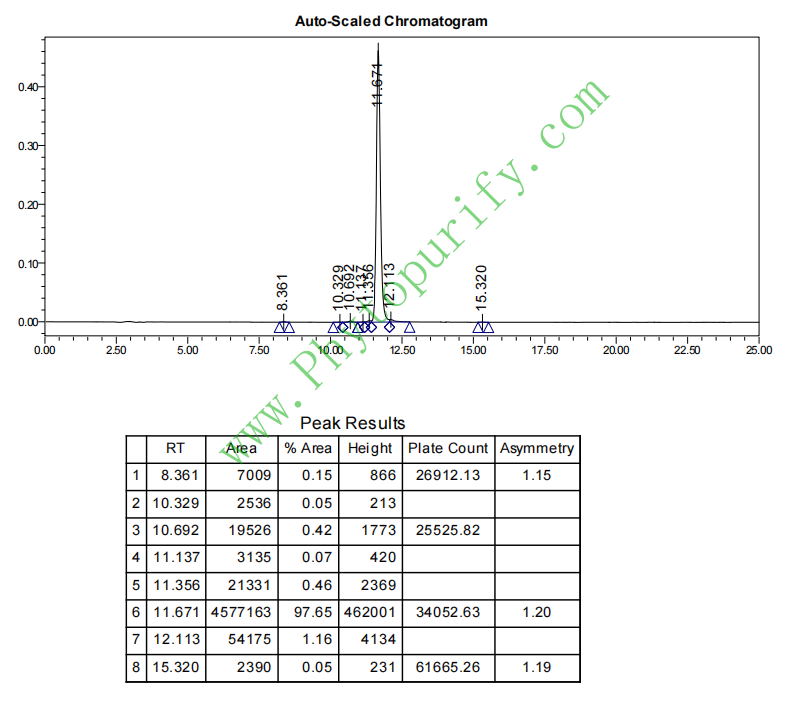
Purity: 95%~99%
Analysis Method: HPLC-DAD or/and HPLC-ELSD
Identification Method: Mass, NMR
Packing: Brown vial or HDPE plastic bottle
The product could be supplied from milligrams to grams. Inquire for bulk scale.
We provide solution to improve the water-solubility of compounds, thereby facilitating the variety of activity tests and clinic uses.
For Reference Standard and R&D, Not for Human Use Directly.
HPLC of Mulberrofuran G
Storage conditions:Short-term storage at 2~8℃, long-term storage at -20 ~ -80℃
147.9600
4.0000
3.5000
Low
Unknown
Unknown
Unknown
Unknown
Unknown
Unknown
Mulberrofuran G (CAS number: 87085-00-5) is a natural product derived from the Morus genus, which has attracted much attention due to its unique chemical structure and multi-target pharmacological activity. In recent years, with the deepening development of natural product pharmacology, mulberry furan G has become one of the hotspots in natural medicine research due to its significant performance in multiple biological effects such as anti-inflammatory, antioxidant, antiviral, anti-tumor, and neuroprotective effects. As an effective inhibitor of NADPH oxidase (NOX) and tyrosinase, it has shown potential therapeutic value in various disease models, especially in the fields of tumors, neurodegenerative diseases, and inflammatory diseases.
This article aims to systematically review the chemical structure and physicochemical properties, plant sources, and extraction methods of mulberry furan G, with a focus on analyzing its pharmacological activity and mechanism of action, exploring its pharmacological properties and pharmacokinetic characteristics, and looking forward to its clinical application prospects, providing theoretical support and reference for subsequent basic and clinical research.
Mulberry furan G is a complex polyphenolic compound with a molecular formula of C34H26O9 and a molecular weight of 554.56. Its structural characteristics include the presence of multiple phenolic hydroxyl groups and furan rings, which endow it with strong biological activity. The LogP value of mulberry furan G is about 4.0, indicating its moderate lipid solubility, which facilitates membrane penetration, but may also affect its water solubility and bioavailability. Its topological polar surface area (TPSA) is 147.96 Å ², and the number of hydrogen bond acceptors is 8, indicating that its molecule has strong polarity and hydrogen bond formation ability, which is of great significance for its binding to biomolecule targets.
From a medicinal chemistry perspective, the molecular weight of mulberry furan G is relatively large and contains multiple polar groups, which may limit its oral absorption and blood-brain barrier penetration ability. Existing data indicates that its blood-brain barrier permeability is low, suggesting that its efficacy in the central nervous system may depend on specific administration strategies or structural modifications.
Mulberry furan G is mainly found in Morus spp., especially in the root bark and leaves of mulberry trees (Morus alba L.), where its content is relatively abundant. Mulberry plants are widely used in traditional Chinese medicine, with functions such as clearing heat and detoxifying, promoting blood circulation and removing blood stasis. Mulberry furan G, as one of its main active ingredients, bears some pharmacological activities.
The common methods for extracting mulberry furan G include organic solvent extraction and column chromatography separation. Generally, ethanol or methanol is used for reflux extraction of mulberry leaves or root bark, followed by liquid-liquid distribution, silica gel column chromatography, and high-performance liquid chromatography (HPLC) purification to obtain high-purity mulberry furan G. In recent years, ultrasound assisted extraction and supercritical CO2 extraction techniques have also been applied to improve extraction efficiency and purity. In addition, the identification of mulberry furan G mainly relies on mass spectrometry (MS) and nuclear magnetic resonance (NMR) techniques to ensure the accuracy of its structure.
The pharmacological activity research of mulberry furan G covers multiple aspects such as anti-tumor, neuroprotective, anti-inflammatory, antioxidant, and antiviral effects, demonstrating its comprehensive therapeutic potential with multiple targets and mechanisms.
Multiple in vitro and in vivo studies have shown that mulberry furan G has significant inhibitory effects on various tumor cells. Its targets involve anti apoptotic proteins such as MCL1 and BCL2, STAT3 signaling pathway, MMP2 matrix metalloproteinases, TOP1 and TOP2A topoisomerases, as well as tumor microenvironment regulatory factors such as HIF1A. By regulating these targets, mulberry furan G can induce tumor cell apoptosis, inhibit cell proliferation and migration, block tumor angiogenesis, and thus exert anti-tumor effects.
In a neurodegenerative disease model, mulberry furan G protects nerve cells from damage by inhibiting NADPH oxidase (NOX2) and tyrosinase activity, reducing oxidative stress and the production of neurotoxic substances. In addition, mulberry furan G also affects the abnormal accumulation of beta amyloid precursor protein (APP) and Tau protein (MAPT), regulates the inflammatory response mediated by nuclear factor kappa B (NFKB1), and slows down the progression of neurodegenerative diseases such as Alzheimer's disease.
Mulberry furan G can significantly inhibit the activity of NOX2 and cyclooxygenase-2 (PTGS2), reduce the expression of pro-inflammatory factors such as tumor necrosis factor alpha (TNF), interleukin-6 (IL6), and nuclear factor kappa B, and alleviate the inflammatory response. Its antioxidant effect is achieved by activating nuclear factor erythroid associated factor 2 (NFE2L2) and regulating antioxidant enzyme systems such as glutathione peroxidase 1 (GPX1) and superoxide dismutase 1 (SOD1), clearing free radicals and protecting cells from oxidative damage.
Mulberry furan G exhibits the ability to inhibit virus replication and regulate immune responses in viral infection models. Its targets include NOX2, interferon regulatory factor 3 (IRF3), nuclear factor kappa B (NFKB1), and cytokine signal transduction inhibitory factor 1 (SOCS1). By regulating these factors, mulberry furan G can enhance host antiviral immunity, inhibit viral protease activity, and alleviate virus mediated inflammation and cell damage.
The multi-target mechanism of action of mulberry furan G is the basis for its diverse pharmacological activities. Its main targets and mechanisms of action can be summarized as follows:
NADPH oxidase (NOX) inhibition Mulberry furan G, as an effective inhibitor of NOX (IC50 of approximately 6.9 μ M), reduces the generation of reactive oxygen species (ROS), alleviates oxidative stress, protects cells from oxidative damage, and plays a key role in neuroprotection and anti-inflammatory effects.
Tyrosinase inhibition By inhibiting tyrosinase, mulberry furan G affects melanin synthesis and related signaling pathways, indirectly regulating neuronal function and inflammatory response.
Regulation of anti-tumor signaling pathways Mulberry furan G interferes with tumor cell proliferation and survival by regulating the MCL1 and BCL2 mediated apoptotic pathways, inhibiting signaling pathways such as STAT3 and MAPK1. Meanwhile, inhibiting MMP2 and HIF1A can help block tumor invasion and angiogenesis.
Regulation of inflammatory factors Inhibiting the expression of PTGS2, TNF, IL6, and NFKB1, reducing inflammatory response, and protecting tissues from chronic inflammatory damage.
Antiviral immune regulation By activating IRF3 and regulating SOCS1, the interferon signaling pathway is enhanced to enhance antiviral immune response.
Activation of oxidative stress defense system Regulating the NFE2L2 signaling pathway, promoting the expression of antioxidant enzymes, and enhancing cellular antioxidant capacity.
The synergistic effect of these multi-target mechanisms of action enables mulberry furan G to exhibit broad therapeutic potential in various disease models.
The pharmacological parameters of mulberry furan G show that it has certain development potential, but there are also challenges. The high molecular weight (554.56) and polarity (TPSA 147.96) may limit its oral absorption and bioavailability. LogP of 4.0 indicates moderate lipid solubility, which is beneficial for cell membrane penetration, but may also lead to insufficient water solubility.
At present, there is a lack of data on the hepatotoxicity, cardiotoxicity (including hERG channel inhibition), and genotoxicity (Ames test) of mulberry furan G, and further systematic evaluation is needed to ensure safety. Its blood-brain barrier permeability is low, indicating that its application in central nervous system diseases may require structural optimization or special drug delivery methods (such as nanocarriers, brain targeted delivery systems).
In terms of pharmacokinetics, related research is relatively limited. Preliminary in vivo metabolic studies have shown that mulberry furan G may be metabolized by liver enzymes, producing multiple metabolites that affect its half-life and biological activity. In the future, it is necessary to conduct in-depth research on its absorption, distribution, metabolism, and excretion (ADME) characteristics to provide a basis for clinical development.
Mulberry furan G, as a multifunctional natural product, has broad clinical application potential. It has shown promising prospects in the field of anti-tumor treatment, especially as an adjuvant therapy for refractory tumors. By regulating multiple tumor related signaling pathways, mulberry furan G is expected to become an important candidate for novel anti-cancer drugs or combination therapies.
In terms of neurodegenerative diseases, mulberry furan G is expected to alleviate the pathological progression of diseases such as Alzheimer's disease and Parkinson's disease by antioxidant, anti-inflammatory, and regulating abnormal accumulation of nerve proteins. Although its blood-brain barrier permeability is limited, it still has clinical development value through optimization of drug delivery systems.
In addition, the anti-inflammatory and antiviral properties of mulberry furan G make it potentially applicable in chronic inflammatory diseases and viral infections (such as respiratory viral infections), especially in the current global prevention and treatment of viral diseases.
Future research should focus on:
Mulberry furan G, as a polyphenolic natural product derived from mulberry plants, has shown broad research and application prospects in various fields such as anti-tumor, neuroprotective, anti-inflammatory, antioxidant, and antiviral due to its unique chemical structure and multi-target pharmacological activity. It achieves comprehensive regulation of various diseases by inhibiting NADPH oxidase and tyrosinase, regulating multiple signaling pathways.
Although the pharmacological properties and pharmacokinetic characteristics of mulberry furan G still need further improvement and validation, with the advancement of natural product research technology and the development of drug delivery systems, mulberry furan G is expected to become an important candidate molecule for future multifunctional drug development. Future research should focus on in-depth analysis of its mechanism of action, safety assessment, and clinical translation, providing a solid scientific foundation for the development of natural product drugs.
