

Storage conditions:Short-term storage at 2~8℃, long-term storage at -20 ~ -80℃
75.8500
1.0600
.7700
Low
No
No
No
Unknown
No
Unknown
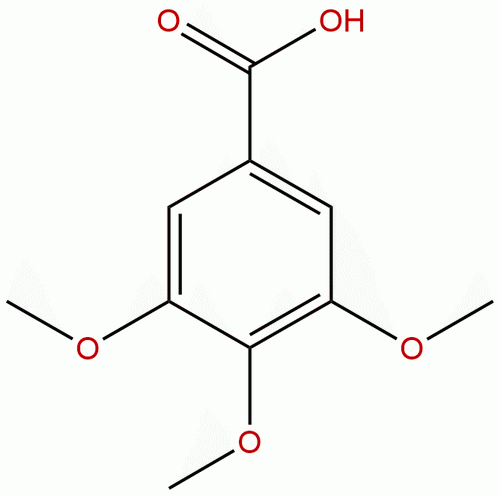
3,4,5-trimethoxybenzoic acid (CAS number 118-41), also known as Eudesic acid or Trimethylgallic acid, is an important derivative of benzoic acid. As a typical representative of natural products and their derivatives, trimethyl gallate has received widespread attention in the fields of medicinal chemistry and natural product pharmacology in recent years due to its unique chemical structure and diverse biological activities. This compound not only exhibits significant antibacterial activity, but also shows a minimum inhibitory concentration (MIC) as low as 0.97 μ g/mL, especially against Staphylococcus aureus. It also demonstrates potential therapeutic value in various pathological states such as antioxidant and anti-inflammatory effects. This article aims to systematically review the chemical structure and physicochemical properties, plant sources and extraction methods, pharmacological activity and mechanism of action, pharmacological evaluation and pharmacokinetic characteristics of trimethyl gallate, and explore its clinical application prospects and development directions, providing theoretical basis and practical guidance for related research.
The chemical formula of trimethyl gallate is C11H14O5, with a molecular weight of 212.20. Its structure is based on a benzoic acid skeleton, with hydroxyl groups at positions 3, 4, and 5 replaced by methoxy groups to form a trimethyl ether structure, known as 3,4,5-trimethoxybenzoic acid. This structure endows it with strong stability and moderate polarity, with a LogP value of 1.06, indicating moderate lipophilicity that facilitates cell membrane permeability without being overly hydrophobic. The molecular surface area (TPSA) is 75.85 Å ² and the number of hydrogen bond acceptors is 5, indicating that it has a certain hydrophilicity and is conducive to forming hydrogen bonds with biomolecules.
The physicochemical properties of trimethyl gallate endow it with excellent pharmacokinetic potential in drug design. Its low blood-brain barrier permeability (Low BBB penetration) suggests that the compound has a lower risk of side effects in the central nervous system. Both hepatotoxicity and cardiotoxicity are low-risk, and there is no hERG channel inhibitory activity, indicating good cardiac safety. Although the mutagenicity test results of Ames are not yet clear, existing data support its potential as a safer drug candidate molecule.
Gallic acid trimethyl ether is widely present in various plants, especially in plant groups rich in benzoic acid derivatives. Its natural sources mainly include gallate plants (such as Rhus spp.), some woody plants, and medicinal herbaceous plants. Trimethyl gallate in plants usually exists in its free state or in combination with other phenolic compounds.
In terms of extraction methods, commonly used techniques include solvent extraction, ultrasound assisted extraction, and liquid-liquid extraction. Reflux extraction using methanol, ethanol, or ethyl acetate as solvents is the most common method, and the combination of ultrasound assistance can significantly improve extraction efficiency. After concentration, separation and purification (such as silica gel column chromatography and reverse phase high-performance liquid chromatography) of the extract, high-purity gallic acid trimethyl ether can be obtained. In recent years, green extraction technologies such as supercritical CO2 extraction and microwave-assisted extraction have also been used to improve extraction efficiency and environmental friendliness.
Gallic acid trimethyl ether exhibits inhibitory effects on various bacteria, especially on Gram positive bacterium Staphylococcus aureus (S. aureus) with significant activity. Its minimum inhibitory concentration (MIC) is 0.97 μ g/mL, demonstrating strong antibacterial ability. This activity makes it potentially valuable for the development of anti infective drugs, especially in the context of the increasing number of drug-resistant strains. The development prospects of gallic acid trimethyl ether as a natural antibacterial agent have attracted much attention.
Gallic acid trimethyl ether has significant antioxidant activity, which can scavenge free radicals and alleviate cell damage caused by oxidative stress. Its antioxidant mechanism mainly activates the nuclear factor erythroid 2-related factor 2 (NRF2) signaling pathway, inducing the expression of downstream antioxidant enzymes such as heme oxygenase 1 (HMOX1), and enhancing the cell's antioxidant defense ability.
In addition, trimethyl gallate exhibits excellent anti-inflammatory activity. It can inhibit the expression of pro-inflammatory factors such as tumor necrosis factor alpha (TNF - α), interleukin-6 (IL-6), and cyclooxygenase-2 (PTGS2, COX-2), and alleviate the inflammatory response. Both in vitro and in vivo experiments have confirmed its efficacy in various inflammatory models, suggesting its potential therapeutic value in inflammatory diseases such as arthritis and inflammatory bowel disease.
Although there are relatively few reports on the other pharmacological effects of trimethyl gallate, its structure is similar to various bioactive benzoic acid derivatives. Future research is expected to reveal its potential in anti-tumor, neuroprotective, and metabolic regulation fields.
The pharmacological effects of gallic acid trimethyl ether are mainly achieved by regulating key molecular targets. Its antioxidant and anti-inflammatory effects involve the following main targets:
TNF (tumor necrosis factor alpha)As an important pro-inflammatory cytokine, TNF plays a central role in various inflammatory and immune responses. Gallic acid trimethyl ether can inhibit the expression and signaling of TNF, and alleviate inflammatory response.
PTGS2 (cyclooxygenase-2, COX-2)PTGS2 is a key enzyme that catalyzes prostaglandin synthesis during inflammation. Gallic acid trimethyl ether exerts anti-inflammatory effects by inhibiting the expression of PTGS2 and reducing the production of inflammatory mediators.
IL6 (interleukin-6)IL-6 is a multifunctional pro-inflammatory cytokine involved in immune regulation and inflammatory response. Gallic acid trimethyl ether can inhibit the secretion of IL-6 and regulate the inflammatory microenvironment.
NRF2 (Nuclear Factor Red Blood Cell 2-Associated Factor 2)NRF2 is a transcription factor that regulates cellular antioxidant response. Gallic acid trimethyl ether activates the NRF2 signaling pathway, promotes the expression of antioxidant enzymes such as HMOX1, and enhances cellular antioxidant capacity.
HMOX1 (Heme Oxygenase 1)As a key antioxidant enzyme downstream of NRF2, HMOX1 is involved in the alleviation of oxidative stress. Gallic acid trimethyl ether protects cells from oxidative damage by upregulating HMOX1 expression.
The synergistic regulation of these targets constitutes the molecular basis for the multiple pharmacological effects of trimethyl gallate, providing theoretical support for its application in antibacterial, anti-inflammatory, and antioxidant therapy.
The pharmacological parameters of gallic acid trimethyl ether show that it has good potential for drug development. The molecular weight is moderate (212.20), which conforms to the ideal range of Lipinski rule. The LogP value of 1.06 indicates that it has good lipid solubility, which is beneficial for oral absorption. The TPSA is 75.85 Å ², which is suitable for cell membrane permeability but not easy to cross the blood-brain barrier, reducing the risk of central nervous system side effects.
In terms of safety, the risk of hepatotoxicity and cardiotoxicity of gallic acid trimethyl ether is relatively low, and there is no hERG channel inhibition, indicating good cardiac safety. Although the results of Ames mutagenicity tests are not yet clear, existing data do not show significant genetic toxicity risks.
Pharmacokinetic studies have shown that trimethyl gallate has good oral absorption and high bioavailability. Its distribution in the body is mainly limited to peripheral tissues, and its blood-brain barrier permeability is low. The metabolic pathway mainly involves demethylation and carboxylation modification of methoxy groups through the liver enzyme system, and the metabolites have low toxicity. Excretion is mainly accomplished through the renal and biliary pathways.
In the future, in-depth pharmacokinetic and toxicological evaluations, especially long-term toxicity and mutagenicity studies, will provide more comprehensive safety data support for the clinical development of trimethyl gallate.
Gallic acid trimethyl ether has broad clinical application potential due to its significant antibacterial, antioxidant, and anti-inflammatory activities. Its potent inhibitory effect on Staphylococcus aureus makes it an important candidate for the development of new antibacterial drugs, especially in the context of increasingly severe drug-resistant strains. Natural product based antibacterial agents have irreplaceable advantages.
The antioxidant and anti-inflammatory properties make trimethyl gallate potentially valuable in the treatment of chronic inflammatory diseases, cardiovascular diseases, neurodegenerative diseases, and other fields. By regulating the NRF2-HMOX1 signaling pathway, trimethyl gallate can alleviate oxidative stress and inflammatory response, and improve the pathological status of related diseases.
In addition, trimethyl gallate, as an important building block in organic synthesis, also provides an ideal chemical basis for structural modification and new drug design. By combining structural optimization and drug carrier technology, it is expected to enhance its bioavailability and targeting, and expand its clinical application scope.
However, current clinical research on trimethyl gallate is still in its infancy, and in the future, systematic pharmacological, pharmacokinetic, and safety evaluations are needed to validate its efficacy and safety through clinical trials. Meanwhile, in-depth analysis of its molecular mechanism and multi-target mode of action will provide theoretical support for its precise treatment.
Gallic acid trimethyl ether, as a structurally unique derivative of benzoic acid, has shown broad research and application prospects in the field of natural product pharmacology due to its significant antibacterial, antioxidant, and anti-inflammatory activities. Its excellent pharmacokinetic parameters and safety features have laid a solid foundation for the development of new drugs. In the future, through in-depth interdisciplinary research, it is expected to promote the clinical transformation of trimethyl gallate and become a new drug for treating infectious diseases and inflammation related diseases. Continued attention to its mechanism of action, pharmacokinetics, and clinical applications will inject new vitality into the development of natural product pharmacology.
