| Catalog No | Package | Original Price | Price | Inventory | Quantity | Operating |
|---|---|---|---|---|---|---|
| BP5114-5mg | 5mg | $350.00 | Sign in |
|


Storage conditions:Short-term storage at 2~8℃, long-term storage at -20 ~ -80℃
Natural products, as important resources for drug discovery, occupy an irreplaceable position in modern pharmacological research. Lignin derivatives have received increasing attention in recent years due to their unique structures and diverse biological activities. Threo-guaiacylglycerol - β - O-4 '- sinapyl ether (CAS number: 288864-26-6) is a typical lignin model compound, belonging to the β - O-4' - linked bisphenol class compounds, with potential pharmacological activity and good pharmaceutical properties. This article will systematically review the chemical structure and physicochemical properties, plant sources and extraction methods, pharmacological activity and mechanism of action, pharmacological evaluation and pharmacokinetic characteristics of the compound, and explore its clinical application prospects and development trends. The aim is to provide reference and inspiration for the pharmacological research of natural products.
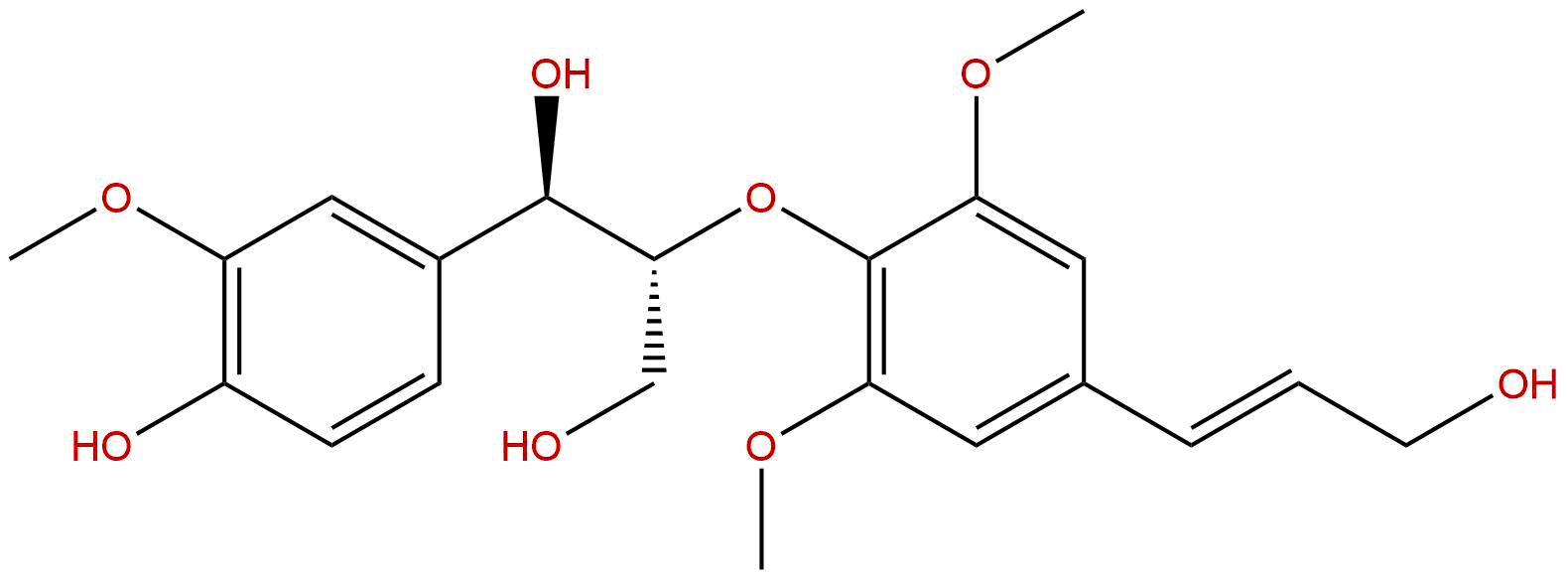
The molecular formula of Su style guaiacol based glycerol - β - O-4 '- mustard alcohol ether is C22H26O8, with a molecular weight of 406.4310. Its structural feature is that guaiacylglycerol and sinapyl alcohol are connected by a β - O-4 'ether bond, belonging to the typical lignin β - O-4' linking unit. The stereoconfiguration of this compound is the threo type, indicating that the spatial arrangement of its two chiral centers is trans. The structure contains multiple hydroxyl and methoxy groups, endowing it with high polarity and hydrogen bond donor ability.
In terms of physical and chemical properties, the LogP value of the compound is 1.4730, indicating that it has moderate lipid solubility, which is beneficial for cell membrane permeation. The topological polar surface area (TPSA) is 117.8400 Å ², indicating its high polarity and favorable solubility in aqueous phase. The water solubility is 1.1806, indicating that it has a certain solubility in physiological environments. The low permeability of the blood-brain barrier suggests its limited distribution in the central nervous system. The hERG channel inhibition test was negative, indicating a low risk of cardiac toxicity. The Ames test result is 0.0, indicating no mutagenicity and good safety.
Su style guaiacol glycerol - β - O-4 '- sinapine is mainly found in various lignin rich plants, especially in the xylem tissues of grasses and dicotyledonous plants. This compound, as one of the degradation products of lignin, is commonly found in wood, plant fibers, and their processing by-products. Typical plant sources include Populus spp., Salix spp., and the stems of certain grasses such as corn and wheat.
The extraction method mainly relies on chemical or enzymatic degradation techniques of lignin. Common extraction processes include:
In recent years, research on the enzymatic degradation of lignin and enrichment of this compound has gradually increased, demonstrating the advantages of green environmental protection and high selectivity.
The pharmacological activities of Su style guaiacol based glycerol - β - O-4 '- sinapine mainly focus on its antioxidant, anti-inflammatory, anti-tumor, and neuroprotective properties.
antioxidant activity
This compound contains multiple phenolic hydroxyl groups and has strong free radical scavenging ability. In vitro DPPH and ABTS free radical scavenging experiments showed significant antioxidant activity, which can effectively inhibit lipid peroxidation and protect cells from oxidative stress damage.
anti-inflammatory effect
In the inflammatory model, this compound reduces the inflammatory response by inhibiting the production of inflammatory mediators such as TNF - α, IL-6, and NO. The mechanism involves inhibition of the NF - κ B signaling pathway, which reduces the transcriptional activity of inflammatory genes.
Anti-tumor effect
Studies at the cellular level have shown that Su style guaiacol glycerol - β - O-4 '- sinapine can induce tumor cell apoptosis and inhibit cell proliferation. Its function may be achieved by regulating cell cycle proteins and activating mitochondrial apoptosis pathways.
Neuroprotective effect
Although the permeability of the blood-brain barrier is low, this compound has shown a protective effect against oxidative stress-induced neuronal damage in an in vitro neuronal model, suggesting its potential application value in peripheral nervous system diseases.
The pharmacological activity of Su style guaiacol based glycerol - β - O-4 '- sinapine is closely related to its molecular structure. Its polyphenol structure enables it to directly scavenge free radicals and reduce oxidative stress. In addition, the compound exerts biological effects by regulating multiple signaling pathways:
NF - κ B signaling pathway
This compound inhibits the phosphorylation and degradation of I κ B α, preventing NF - κ B transcription factors from entering the nucleus, thereby suppressing the expression of inflammatory factors and reducing the inflammatory response.
MAPK signaling pathway
Research has shown that it can regulate the activity of ERK, JNK, and p38 MAPK, affecting cell proliferation and apoptosis processes.
Mitochondrial apoptosis pathway
By regulating the expression of Bcl-2 family proteins, promoting the release of cytochrome c, activating the caspase cascade reaction, and inducing tumor cell apoptosis.
Antioxidant defense mechanism
This compound can activate the Nrf2/ARE signaling pathway, promote the expression of antioxidant enzymes such as superoxide dismutase (SOD) and glutathione peroxidase (GPx), and enhance intracellular antioxidant capacity.
The pharmacological evaluation shows that Su style guaiacol based glycerol - β - O-4 '- sinapine has good drug compatibility and safety. Its LogP value is moderate, indicating good cell membrane permeability; Higher TPSA and water solubility contribute to in vivo distribution and metabolism. The hERG channel has no inhibitory effect and reduces the risk of cardiac toxicity. Ames test negative, indicating no mutagenic risk.
Pharmacokinetic studies have shown that the compound has good oral absorption, but its distribution in the central nervous system is limited due to low blood-brain barrier permeability. Metabolism in the body is mainly carried out through the liver's phase I and phase II enzyme systems, including hydroxylation, methylation, and glucuronic acid binding reactions. The main excretion pathways are renal and biliary excretion.
In addition, the half-life in the body is moderate and the bioavailability is high, making it suitable for oral administration. There is no significant risk of drug interactions, indicating its potential as a candidate drug.
Su style guaiacol based glycerol - β - O-4 '- sinapine has broad clinical application prospects due to its multiple pharmacological activities and good safety. Its anti-inflammatory and antioxidant properties make it potential for adjuvant therapy in chronic inflammatory diseases, metabolic syndrome, and cardiovascular diseases. The anti-tumor activity suggests that it can be used as a novel natural drug candidate molecule for adjuvant therapy of tumors.
Future research should focus on:
In depth analysis of pharmacological mechanisms
Combining modern technologies such as genomics and proteomics, systematically elucidate its targets and signaling pathway network.
Pharmacokinetic and Toxicological System Evaluation
Conduct long-term toxicology research to clarify the safe dose range and potential toxicity.
Formulation development and optimization of administration routes
To address the issue of insufficient blood-brain barrier permeability, new delivery systems such as nanocarriers have been developed to improve targeting and bioavailability.
Preclinical and clinical research
Conduct animal models and early clinical trials to verify its efficacy and safety, and promote its clinical translation.
Su style guaiacol based glycerol - β - O-4 '- sinapine, as a typical lignin derived natural product, exhibits rich pharmacological activity and good medicinal properties. Its multiple biological effects such as antioxidant, anti-inflammatory, and anti-tumor provide a solid foundation for the development of new natural medicines. In the future, through in-depth mechanism research, pharmacokinetic optimization, and clinical validation, it is expected to develop into an effective drug for treating various diseases. The field of natural product pharmacology should continue to focus on the research of lignin derivatives, promote the rational utilization of natural product resources, and develop innovative drugs.
