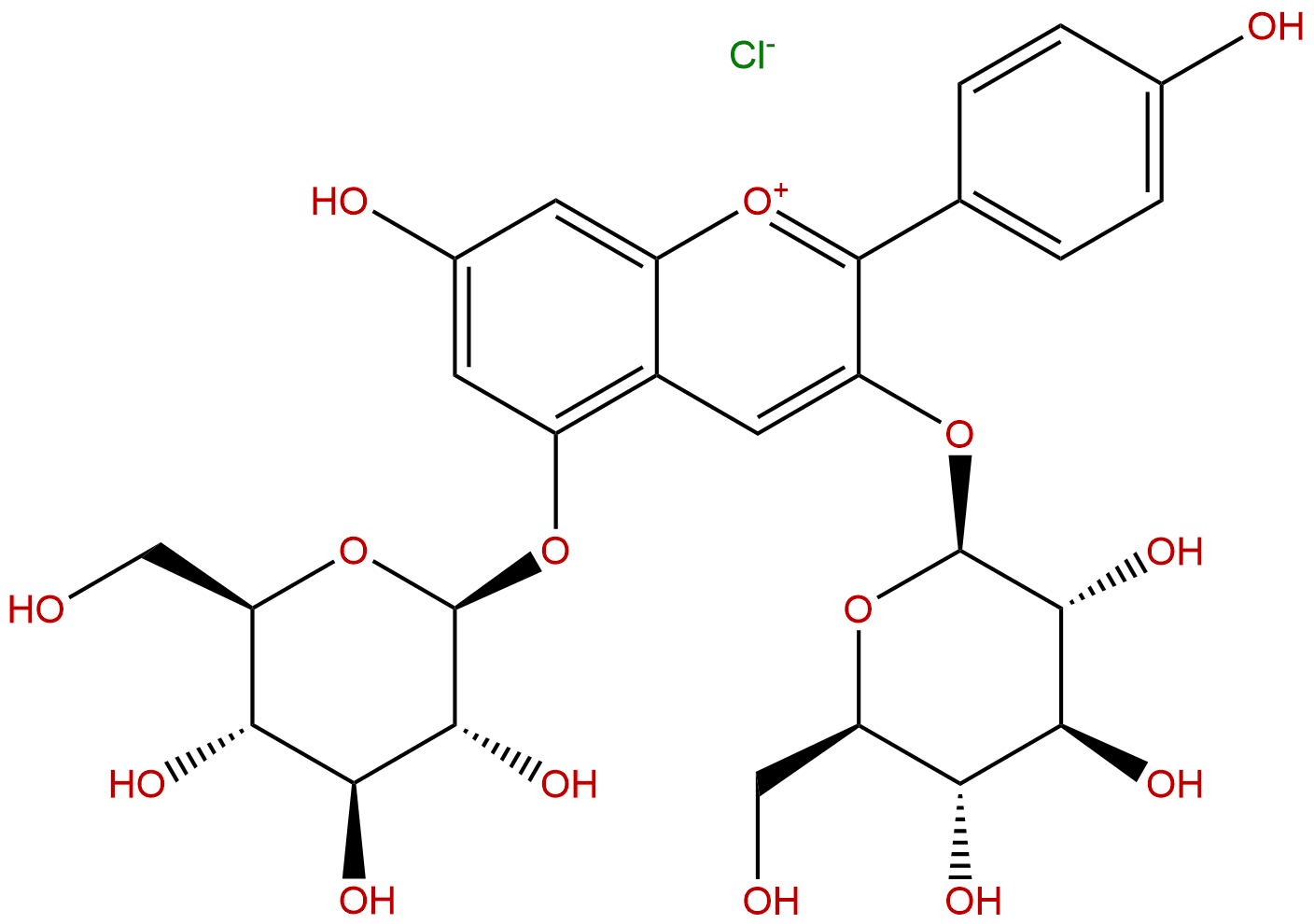


Product name: Pelargonidin-3,5-O-diglucoside chloride
Synonym name:
Catalogue No.: BPF2170
Cas No.: 17334-58-6
Formula: C27H31ClO15
Mol Weight: 630.98
Botanical Source:
Purity: 95%~99%
Analysis Method: HPLC-DAD or/and HPLC-ELSD
Identification Method: Mass, NMR
Packing: Brown vial or HDPE plastic bottle
Can be supplied from milligrams to grams.
For Reference Standard and R&D, Not for Human Use Directly.
Inquire for bulk scale.
Storage conditions:Short-term storage at 2~8℃, long-term storage at -20 ~ -80℃
256.8000
-1.2000
-2.5000
No
.8500
No
Negative
Natural products, as an important source of drug discovery, play an irreplaceable role in the long history of human fight against diseases. Among them, anthocyanins, as a water-soluble pigment widely present in the plant kingdom, not only endow fruits, vegetables, and flowers with rich colors, but also attract attention due to their diverse biological activities. Among numerous anthocyanin monomers, Pelargonidin-3,5-diglucoside chloride, as a major glycosylation form of Pelargonidin, is gradually becoming a hot topic in the field of natural product pharmacology research due to its unique chemical structure and wide pharmacological potential.
Geranium extract is one of the six major types of anthocyanins, with a basic structure of 3,5,7-trihydroxy-2- (4-hydroxyphenyl) benzopyran cation, which has only one hydroxyl group on its B ring, giving it a relatively unique chemical property in the anthocyanin family. Chlorinated geranium-3,5-diglucoside, as the name suggests, is a disaccharide formed by attaching a glucose group to the C3 and C5 hydroxyl groups of the geranium-containing nucleus, and exists in the form of a chloride salt. This glycosylation modification not only enhances the water solubility and stability of the molecule, but also profoundly affects its absorption, metabolism, and targeting in vivo.
From the perspective of disease spectrum, this compound demonstrates intervention potential across multiple fields such as metabolism, cardiovascular disease, inflammation, tumors, and neurodegeneration. Its target network is complex, covering key regulatory factors of energy metabolism such as AMPK (PRKAA1), glucose transporter SGLT2, oxidized low-density lipoprotein receptor LOX-1 (OLR1), apoptosis regulatory protein BCL2, inflammatory core pathway TLR4/STAT3, and key transcription factor NFE2L2 (Nrf2) of antioxidant defense system. This multi-target and multi pathway mode of action demonstrates unique therapeutic advantages in dealing with complex diseases, especially pathological processes involving oxidative stress, chronic inflammation, and metabolic disorders.
This article aims to provide a systematic professional review of chlorinated geranium-3,5-diglycosides. We will start with its chemical structure and physical and chemical properties, sort out its main plant sources and extraction technologies, deeply explore its pharmacological activities in diabetes, cardiovascular disease, inflammation, cancer, neurodegenerative diseases and other fields, and focus on clarifying its mechanism of action and molecular targets. On this basis, combined with the current status of drug efficacy evaluation and pharmacokinetic research, the future clinical application prospects and challenges faced are discussed, in order to provide comprehensive scientific references for the in-depth research and development of this natural product.
The chemical structure of chlorinated geranium-3,5-diglucoside is the material basis for its biological activity. Its core skeleton is Pelargonidin, a type of anthocyanin. The basic structure of geraniums is 2-phenylbenzopyran cation (Huangyan salt), which has one hydroxyl group at the C5 and C7 positions of the A ring, one hydroxyl group at the C4 'position of the B ring, and no substituents at the C3' and C5 'positions. This B-ring monohydroxy structure is a key feature that distinguishes it from cyanidin (B-ring adjacent dihydroxy) and Delphinidin (B-ring trihydroxy), and also determines its characteristic orange red color.
In the chlorinated geranium-3,5-diglucoside, two D-glucose molecules are respectively connected to the C3 and C5 hydroxyl groups of the geranium-containing nucleus through β - glycosidic bonds. This 3,5-diglycosylation pattern is common in nature and significantly alters the physicochemical properties of the parent nucleus molecule. Firstly, the introduction of sugar groups greatly increases the polarity and water solubility of molecules, making them easier to accumulate in vacuoles of plant cells and facilitate transport in biological fluids. Secondly, glycosylation is crucial for the stability of anthocyanins. Free anthocyanins (such as geraniums) are highly unstable under physiological pH conditions and easily hydrate to form colorless pseudobases or chalcones. The glycosylation at positions C3 and C5 effectively inhibits hydration reactions through steric hindrance and electronic effects, significantly improving the stability of the molecule in neutral or weakly alkaline environments. In addition, glycosylation enhances the molecule's resistance to light, heat, and oxidative degradation.
The molecular formula of this compound is C27H31ClO15, with a molecular weight of approximately 630.98 g/mol. Its CAS registration number is 17334-58-6. As a chloride salt, it dissociates into positively charged anthocyanin cations and chloride ions in aqueous solution. Its UV visible absorption spectrum characteristics are usually characterized by a maximum absorption peak at around 500-520 nm in the visible region (attributed to the π→π * transition of the Huangyan salt structure), and another absorption peak at around 270-280 nm in the UV region (attributed to the benzoyl structure of the A ring). This characteristic absorption allows it to be used as a natural pigment in the food industry (E number E163), but in pharmacological research, its color change is often used as an indicator to monitor its structural transformation under different pH conditions (such as from red yellow salt cations to colorless pseudobases).
Chlorinated geranium-3,5-diglucoside does not exist in isolation, but is widely distributed in various plants, especially in fruits, flowers, and vegetables that appear orange red to red in content. Its main plant sources include:
The method for extracting chlorinated geranium-3,5-diglycosides usually follows the general extraction strategy for anthocyanin compounds, with the core goal of maximizing extraction efficiency and minimizing degradation. The main methods include:
Solvent extraction method This is the most classic method. Due to the stable cationic form of anthocyanins under acidic conditions (pH 2-4), acidic organic solvents are commonly used for extraction. Methanol, ethanol, or acetone aqueous solutions (usually containing 0.1% -1% hydrochloric acid or formic acid) are commonly used solvents. Among them, acidified ethanol is highly favored due to its low toxicity and suitability for the food industry. The extraction process is usually carried out at low temperatures (4-25 ° C) to avoid degradation of anthocyanins caused by high temperatures. To improve the extraction rate, techniques such as ultrasound assisted extraction (UAE), microwave-assisted extraction (MAE), or high-pressure assisted extraction can be combined. UAE destroys cell walls through cavitation effect, while MAE accelerates solvent permeation through internal heating, both of which can significantly shorten extraction time and improve yield.
Purification Method The crude extract contains a large amount of impurities such as sugars, organic acids, proteins, etc., which require further purification. Solid phase extraction (SPE) is the preferred method, with C18 reverse phase silica gel column being the most commonly used. Load the acidified crude extract onto the sample, wash it with water or low concentration acid water to remove water-soluble impurities, and then elute the target anthocyanin with an acidic methanol or acetonitrile solution. In addition, preparative high-performance liquid chromatography (Prep-HPLC) is the gold standard for obtaining high-purity monomers (such as geranium-3,5-diglucoside chloride). By optimizing the mobile phase (such as formic acid/acetonitrile/water system) and chromatographic column (C18 column), effective separation of the target compound from other analogues (such as geranium-3-glucoside) can be achieved.
Emerging Green Extraction Technologies In recent years, various green extraction technologies have been developed to reduce the use of organic solvents. For example, deep eutectic solvents (DES) and natural deep eutectic solvents (NADES) have shown great potential in anthocyanin extraction due to their designability, low toxicity, and high solubility. In addition, supercritical fluid extraction (SFE, typically using CO ₂ and adding ethanol as an entrainer) and pressurized liquid extraction (PLE) have also received attention due to their high efficiency and environmental friendliness.
The pharmacological activity research of chlorinated geranium-3,5-diglucoside is mainly based on its commonality as an anthocyanin (such as antioxidant and anti-inflammatory) and the specific effects brought by its unique molecular structure. Existing research has revealed its potential therapeutic value in various disease models.
This is the most fundamental pharmacological activity of geranium-3,5-diglucoside chloride. The phenolic hydroxyl group in its molecular structure (especially the meta diphenol structure of the A ring) is an effective hydrogen atom donor, which can directly scavenge free radicals (such as DPPH ·, ABTS ·+, · OH, O ₂ · -), chelate transition metal ions (such as Fe ² ⁺, Cu ² ⁺), thereby blocking the chain reaction of free radicals and reducing oxidative stress damage to cells (such as vascular endothelial cells and neurons). In cell models, it can significantly reduce the levels of reactive oxygen species (ROS) induced by H ₂ O ₂ or lipopolysaccharides (LPS).
In terms of anti-inflammatory properties, this compound can inhibit the production of various pro-inflammatory mediators. Research has shown that in LPS stimulated macrophages such as RAW264.7 cells, it can downregulate the expression of inducible nitric oxide synthase (iNOS) and cyclooxygenase-2 (COX-2), thereby reducing the release of nitric oxide (NO) and prostaglandin E ₂ (PGE ₂). Meanwhile, it can also inhibit the secretion of key pro-inflammatory cytokines such as tumor necrosis factor - α (TNF - α), interleukin-1 β (IL-1 β), and interleukin-6 (IL-6). These effects are closely related to their regulation of downstream signaling pathways.
Pelargonin-3,5-diglycoside chloride has shown many potential in the prevention and treatment of diabetes and its complications.
Cardiovascular disease is the leading cause of death worldwide, with oxidative stress, inflammation, and lipid metabolism disorders being its core pathological processes. Chlorogeranium-3,5-diglucoside exerts cardiovascular protection through a multi-target mechanism.
The anticancer activity of anthocyanins is one of the research hotspots. Chlorogeranium-3,5-diglucoside exhibits growth inhibition and pro apoptotic effects in various cancer cell lines.
Oxidative stress and neuroinflammation are common features of neurodegenerative diseases such as Alzheimer's disease (AD) and Parkinson's disease (PD). Chlorinated geranium-3,5-diglucoside shows neuroprotective potential.
The pharmacological activity of chlorinated geranium-3,5-diglucoside is not derived from a single target, but is achieved through a network regulation mode of "multi-target, multi pathway". Its core mechanism of action can be summarized as follows:
Regulating energy metabolism and insulin signaling pathway:AMPK(PRKAA1) It is one of its core targets. By directly or indirectly activating AMPK, this compound can simulate the state of energy restriction, promote glucose uptake and fatty acid oxidation, inhibit liver gluconeogenesis, and thus improve metabolic syndrome and type 2 diabetes. In addition, regarding PTPN1 Inhibition can enhance the phosphorylation level of insulin receptors and improve insulin signaling. Correct SGLT2 Inhibition provides an insulin independent pathway for lowering blood sugar levels.
Regulating inflammation and immune response:TLR4 It is a key receptor that initiates innate immune responses. This compound can inhibit the binding of TLR4 to its ligands (such as LPS, ox LDL) or interfere with its downstream signal transduction, thereby inhibiting the activation of NF - κ B and MAPK pathways. This leads to a decrease in the production of pro-inflammatory cytokines (TNF - α, IL-6) and inflammatory mediators (NO, PGE2).STAT3 It is a key transcription factor that connects inflammation and cancer. This compound exerts anti-inflammatory, anti proliferative, and pro apoptotic effects by inhibiting the phosphorylation and nuclear translocation of STAT3, downregulating its target genes (such as BCL2, MCL1, Cyclin D1, VEGF). Correct IDO1 Inhibition can help reverse immune suppression in the tumor microenvironment.
Intervention in cell proliferation and apoptosis This compound regulates BCL2 family proteins by(BCL2, MCL1)The balance is used to induce cell apoptosis. Meanwhile, it may inhibit NOTCH1 Signal pathways are used to block the dry maintenance and differentiation of cancer cells. Correct ABCB1 The regulation of chemotherapy drugs may overcome multidrug resistance by inhibiting their drug efflux function, increasing the accumulation of chemotherapy drugs in cancer cells.
Antioxidant defense and detoxification:NFE2L2(Nrf2) It is the main regulator of cellular antioxidant response. This compound may enhance the cell's defense against oxidative stress by activating the Nrf2/ARE signaling pathway, inducing the expression of a series of antioxidant enzymes such as HO-1, NQO1, SOD, CAT. In addition, it has an impact on XDH (xanthine dehydrogenase) The inhibitory effect can reduce the production of uric acid and superoxide, further alleviating oxidative damage.
Affects lipid metabolism and vascular function: Through upward adjustment ABCA1 It can promote the reverse transport of cholesterol and play an anti atherosclerotic role. Correct LOX-1(OLR1) Inhibition of ox LDL inhibited endothelial cell activation and dysfunction induced by ox LDL. Correct ESR2 (estrogen receptor beta) The regulation may mediate some of its cardiovascular and neuroprotective effects.
Although chlorinated geranium-3,5-diglycosides have shown extensive pharmacological activity in vitro and in vivo models, their pharmacological properties face significant challenges, which is also a common problem faced by all anthocyanin compounds.
Pharmacokinetic (ADME) bottleneck:
- absorb After oral administration, the compound is mainly absorbed in the stomach and small intestine. However, its complete glycoside form has an extremely low absorption rate (usually less than 2%). Most of them will enter the colon and be hydrolyzed into aglycones (geraniums) and glycosides under the action of β - glucosidase produced by the gut microbiota. Glycosides themselves are also unstable and rapidly degrade into metabolites such as phenolic acids (such as 4-hydroxybenzoic acid, 4-hydroxyphenylacetic acid). Therefore, it is mainly these metabolites that truly enter the systemic circulation and reach the target organs, rather than the prototype compounds.
- distribution The concentration of prototype compounds and their metabolites in blood is usually very low (nanomolar to low micromolar levels), far below the effective concentration commonly used in in vitro experiments (micromolar to millimolar levels). They have a high binding rate with plasma proteins (mainly albumin).
- Metabolism Experienced extensive phase II metabolism, including methylation, glucuronidation, and sulfation. These binding reactions occur in the intestinal wall and liver, further reducing the bioavailability of the prototype compound.
- excretion Metabolites are mainly excreted through bile and urine.
Drug Challenge:
- Low bioavailability This is the biggest obstacle. After oral administration, the actual dose that reaches the target in active form is negligible.
- Chemical instability Sensitive to pH, light, heat, and oxidants, easily degraded during formulation and storage.
- Fast metabolism It is rapidly metabolized and cleared in the body, with a short half-life.
Improvement strategy:
- Structural modification Introducing more stable functional groups (such as methylation, acylation) through chemical synthesis or biotransformation, or designing prodrugs to improve stability and absorption.
- New drug delivery system Encapsulating the compound using nanotechnology such as liposomes, nanoparticles, and polymer micelles can improve its water solubility, stability, intestinal permeability, and bioavailability. For example, phospholipid complexes and cyclodextrin inclusion complexes have been shown to effectively enhance the oral absorption of anthocyanins.
- combination therapy Combined with other bioactive substances such as piperine, which can inhibit glucuronidation and P-glycoprotein, it may increase its bioavailability.
- Non oral administration route Explore delivery routes such as transdermal, nasal, or injection to bypass first pass effects and intestinal metabolism.
Despite the challenges of drug formation, the clinical application prospects of chlorinated geranium-3,5-diglucoside are still broad, especially in the fields of functional foods, dietary supplements, and adjuvant therapy.
Functional foods and dietary supplements Given its abundant plant sources and recognized safety (as a natural pigment for long-term use), developing it as a functional food ingredient or dietary supplement is currently the most realistic path. The standardized extract (rich in this compound) is used to help improve blood sugar, blood lipid and antioxidant status, and prevent cardiovascular disease and diabetes. Future research requires more rigorous human clinical trials to validate its long-term effects and optimal dosage.
Adjuvant therapy drugs After clarifying its mechanism of action and key targets, it can be used as an adjuvant therapy drug in combination with existing clinical drugs such as metformin, statins, and chemotherapy drugs. For example, use its anti-inflammatory, antioxidant and insulin resistance improving properties to assist in the treatment of diabetes and its complications; Utilize its potential to reverse multidrug resistance and enhance immunity to assist in cancer treatment. The key is to solve its bioavailability problem through a new drug delivery system, so that it can achieve effective therapeutic concentrations.
lead optimization The multi-target skeleton of this compound provides valuable lead structures for medicinal chemists. By systematically studying the structure-activity relationship (SAR) of its core skeleton (geraniums), derivatives with higher metabolic stability, stronger target selectivity, and better pharmacokinetic properties can be designed and synthesized. For example, one can try replacing easily hydrolyzed glycosidic bonds with more stable functional groups or introducing functional groups that can enhance target binding affinity.
Precision Medicine and Personalized Nutrition With a deeper understanding of the gut microbiome, in the future, personalized nutritional interventions can be achieved by predicting an individual's ability to metabolize anthocyanins based on their gut microbiota composition. The health benefits of this compound may be more significant for individuals who are able to efficiently convert chlorinated geranium-3,5-diglycosides into active metabolites.
Chlorinated geranium-3,5-diglucoside, as a common orange red anthocyanin in nature, has shown great potential as a multifunctional natural active molecule due to its unique chemical structure and extensive pharmacological activity across metabolism, cardiovascular, inflammatory, tumor, and neurodegenerative diseases. Its mechanism of action involves precise regulation of multiple key signaling nodes and targets such as AMPK, TLR4, STAT3, NFE2L2, BCL2, etc., reflecting the intervention advantages of natural products with "multiple targets and pathways".
However, from laboratory discovery to clinical application, the compound still faces severe challenges, with the core being its extremely low bioavailability and chemical instability. Future research should focus on: (1) further elucidating its true active form (prototype or metabolite) and its target of action in vivo; (2) Develop efficient nano delivery systems or conduct rational prodrug design to overcome ADME bottlenecks; (3) Conduct rigorously designed and adequately sampled randomized controlled clinical trials to validate their effectiveness and safety in different populations.
In summary, geranium-3,5-diglucoside chloride is a highly valuable natural product for research. Overcoming the barriers to its medicinal properties has the potential to transform it from a "pigment on the dining table" into a "multifunctional nutritional drug" that can effectively benefit human health, playing an important role in the prevention and treatment of chronic diseases. In depth research on it will also provide valuable experience and inspiration for the development of other similar natural products.
Batch can search by a CAS number,one per line
