| Catalog No | Package | Original Price | Price | Inventory | Quantity | Operating |
|---|---|---|---|---|---|---|
| BP1564-20mg | 20mg | $30.00 | Sign in |
|


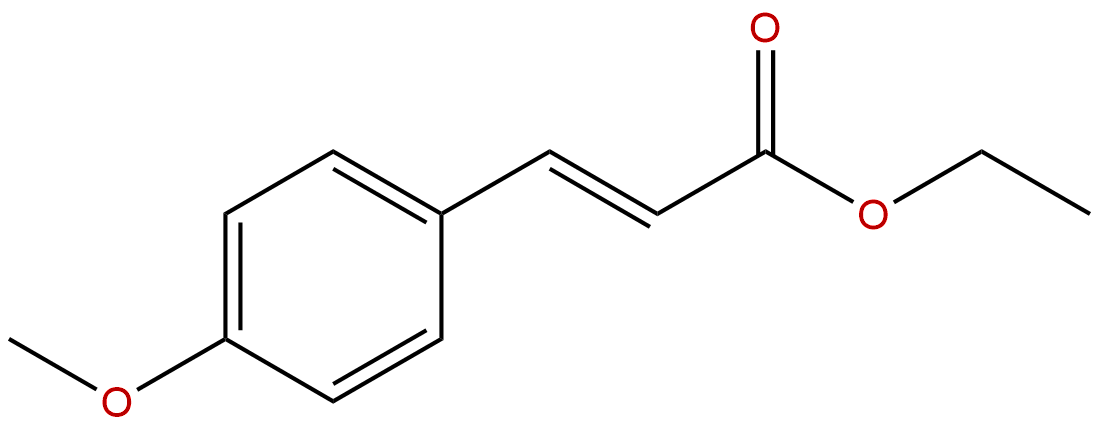
Product name: Ethyl 4-methoxycinnamate
Synonym name:
Catalogue No.: BP1564
Cas No.: 24393-56-4
Formula: C12H14O3
Mol Weight: 206.241
Botanical Source: "Major constit. of oil of Kaempferia galanga (galangal), from Curcuma zedoaria and from Securidaca longipedunculata fres"
Physical Description: Powder
Type of Compound: Phenylpropanoids
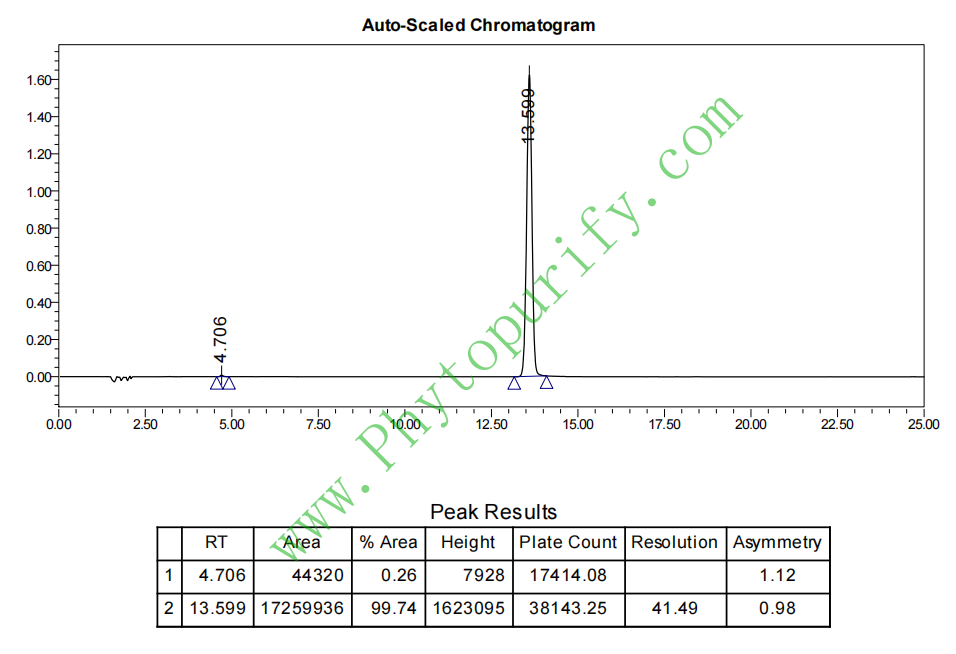
Purity: 95%~99%
Analysis Method: HPLC-DAD or/and HPLC-ELSD
Identification Method: Mass, NMR
Packing: Brown vial or HDPE plastic bottle
The product could be supplied from milligrams to grams. Inquire for bulk scale.
We provide solution to improve the water-solubility of compounds, thereby facilitating the variety of activity tests and clinic uses.
For Reference Standard and R&D, Not for Human Use Directly.
HPLC of Ethyl 4-methoxycinnamate
Storage conditions:Short-term storage at 2~8℃, long-term storage at -20 ~ -80℃
35.5300
3.0796
3.0796
.1127
5.7722
61.4766
High
84.0468
1.6357
Yes
No
No
No
No
Yes
0.3
No
Yes
Yes
Yes
Natural products have long been an important treasure trove for innovative drug discovery, among which cinnamic acid and its derivatives have attracted much attention due to their wide range of biological activities. Ethyl 4-methoxycinnamate (EMC), also known as 4-methoxycinnamate ethyl ester, has gradually emerged as a new focus of pharmacological research in recent years, as a member of the cinnamate ester class of compounds, standing out from the background of traditional medicinal plants. The compound was initially identified as a secondary metabolite in various plants, and its significant anti-inflammatory activity subsequently caught the attention of researchers. Inflammation is the basic pathophysiological process for the body to deal with injury or infection, but uncontrolled chronic inflammation is the core driver of many major diseases, including rheumatoid arthritis, atherosclerosis, neurodegenerative diseases and cancer. Therefore, the search for efficient and low toxicity new anti-inflammatory drugs has always been a key area of pharmaceutical research and development. EMC, with its potential to regulate multiple key inflammatory targets such as interleukin-6 (IL-6), signal transducer and activator of transcription 3 (STAT3), nuclear factor kappa B (NF - κ B) key subunit RELA, tumor necrosis factor - α (TNF - α), and transient receptor potential vanillic acid subtype 1 (TRPV1), demonstrates unique advantages in intervening in the inflammatory network through multiple pathways and targets. This article aims to systematically review the chemical properties, plant sources, pharmacological activities, molecular mechanisms of action, pharmacological characteristics, and clinical application prospects of EMC, in order to provide comprehensive academic references for the in-depth development and transformation research of this natural product.
The molecular formula of ethyl methoxycinnamate is C12H14O3, with a CAS number of 24393-56-4 and a molecular weight of 206.2410. Its chemical structure is based on cinnamic acid as the basic skeleton, characterized by a methoxy group (- OCH3) attached to the para position (4-position) of the benzene ring, and the formation of ethyl ester (- COOCH2CH3) on the carboxylic acid group. This structural modification significantly affects its physicochemical properties.
From the perspective of physical and chemical parameters, the logarithm of the lipid water partition coefficient (LogP) of EMC is 3.0796, indicating its good lipid solubility, which facilitates its penetration of the cell membrane and interaction with intracellular targets. The topological polar surface area (TPSA) is 35.53 Å ², which is relatively small and further confirms its good membrane permeability. Its water solubility is relatively low, about 0.1127 mg/mL, which suggests that in the development of formulations, it may be necessary to improve its solubility through techniques such as salt formation, cyclodextrin inclusion, or nanoformulation. It is worth noting that the predictive model shows that EMC has a high blood-brain barrier permeability, which provides a potential pharmacokinetic basis for its application in central nervous system related inflammatory diseases such as neuroinflammation. In addition, its hERG inhibition risk is negative, and the preliminary Ames test result is 0.3 (usually considered a value less than 1.5 indicating a low risk of mutagenicity), providing early clues for its relatively good safety.
EMC is relatively widely distributed in nature, mainly found in various medicinal plants such as Zingiberaceae and Orchidaceae. Among them, the most famous source is Concave lip ginger(Boesenbergia rotunda (L.) Mansf., The rhizome commonly known as "Thai ginseng" or "finger ginger". In traditional Southeast Asian medicine, concave lip ginger is used to treat gastrointestinal diseases, inflammation, and oral ulcers, and its active ingredient research has confirmed that EMC is one of its main active ingredients. In addition, in some orchid plants and Galangal The presence of EMC was also detected in Alpinia officinarum Hance.
Organic solvent extraction is commonly used to extract EMC from plant materials. The most commonly used method is Ethanol or methanol reflux extraction The specific process generally includes: crushing dried plant materials (such as ginger roots and stems), extracting them with appropriate concentrations of ethanol (such as 70% -95%) under reflux conditions several times, combining the extracts, and concentrating them under reduced pressure to obtain crude extracts. Subsequently, utilizing Chromatographic separation technology High purity EMC can be obtained by separating and purifying the crude extract using techniques such as silica gel column chromatography and high-performance liquid chromatography, and identifying its structure through spectroscopic methods such as nuclear magnetic resonance (NMR) and mass spectrometry (MS). With the development of green extraction technology,Ultrasound assisted extraction and Microwave assisted extraction These methods have also been applied in the extraction of EMC, which can effectively shorten the extraction time, improve the extraction efficiency, and reduce the amount of organic solvents used.
Numerous in vitro and in vivo pharmacological studies have confirmed that the core pharmacological activity of EMC is concentrated in anti-inflammatory And extend to closely related fields such as pain relief and antioxidant.
anti-inflammatory activity This is the most comprehensive and significant activity in EMC research. EMC has shown strong anti-inflammatory effects in various animal models of acute and chronic inflammation. For example, in mouse ear xylene induced inflammation models and carrageenan induced rat paw swelling models, EMC can dose dependently inhibit tissue edema and inflammatory cell infiltration. Its anti-inflammatory efficacy is often comparable or slightly superior to positive drugs such as indomethacin or dexamethasone. In chronic inflammation models such as Freund's complete adjuvant induced arthritis rat models, EMC not only reduces joint swelling but also improves pathological damage to joint tissue.
Analgesic activity Inflammation and pain often coexist. The analgesic effect of EMC has been confirmed in acetic acid-induced writhing test (chemical irritant pain) and hot plate test (thermal irritant pain) in mice. Its analgesic mechanism not only stems from its powerful anti-inflammatory effect, reducing the sensitization of pain receptors by inflammatory mediators, but may also be related to its direct action on ion channels related to pain perception (such as TRPV1, TRPA1).
antioxidant activity Oxidative stress and inflammatory processes mutually promote each other. Research has shown that EMC has the ability to scavenge free radicals such as DPPH and ABTS, and can enhance the activity of intracellular antioxidant enzymes such as superoxide dismutase (SOD) and glutathione peroxidase (GSH Px), reduce the level of lipid peroxidation product malondialdehyde (MDA), and alleviate oxidative damage.
Other potential activities Some studies also suggest that EMC may have antimicrobial and anti ulcer activities, but research in these areas is still in its early stages and requires more evidence to support it.
The anti-inflammatory effect of EMC is not achieved through a single pathway, but presents the characteristics of multi-target and networked regulation, mainly involving the following key molecular targets and signaling pathways:
Inhibition of NF - κ B signaling pathway NF - κ B is the core transcription factor of inflammatory response. EMC can inhibit the activation of I κ B kinase (IKBKB) induced by inflammatory stimuli such as lipopolysaccharide (LPS), prevent the degradation of inhibitory protein I κ B, and thus inhibit the translocation of NF - κ B (especially its key subunit RELA/p65) to the nucleus. This leads to the blockade of gene transcription for a series of downstream pro-inflammatory factors (such as TNF - α, IL-6) and enzymes (such as inducible nitric oxide synthase NOS2, cyclooxygenase-2 PTGS2/COX-2).
Regulating the JAK/STAT3 signaling pathway IL-6 is an important pro-inflammatory cytokine, and its signaling is mainly conducted through the JAK/STAT3 pathway. Research has found that EMC can effectively inhibit the production of IL-6 and block the phosphorylation activation of STAT3, thereby suppressing the inflammatory response and cell proliferation driven by this pathway. This is particularly important in chronic inflammation and certain inflammation related cancer models.
Regulating inflammasome activity The activation of inflammasomes (such as NLRP3) leads to the activation of caspase-1 (CASP1), which in turn promotes the maturation and release of potent pro-inflammatory cytokines such as IL-1 β and IL-18. Research has shown that EMC can inhibit the assembly and activation of NLRP3 inflammasomes, reduce the activation of caspase-1, and thus suppress pyroptosis and IL-1 β secretion.
Intervention in pain perception related ion channels EMC has been proven to be TRPV1 receptor Antagonists. TRPV1 is a key molecule mediating thermal pain and inflammatory pain. EMC can directly inhibit the transmission of nociceptive signals by antagonizing TRPV1, which is closely related to its analgesic effects in hot plate experiments and neuropathological pain models. In addition, it has an impact on TRPA1 Another ion channel associated with inflammatory pain and cold pain may also have a regulatory effect.
Affects the arachidonic acid metabolism pathway EMC has a certain inhibitory effect on cyclooxygenase (COX), especially on PTGS1/COX-1 The inhibition may contribute to its anti-inflammatory and antiplatelet aggregation effects. Meanwhile, inhibiting NOS2 and reducing excessive production of nitric oxide (NO) is also one of its anti-inflammatory mechanisms.
In summary, EMC forms a synergistic anti-inflammatory network by simultaneously acting on multiple key nodes such as NF - κ B, STAT3, inflammasomes, and TRP channels, which may be the molecular basis for its highly efficient anti-inflammatory activity.
Based on its physicochemical parameters and preliminary biological data, EMC shows certain potential for drug development, but its comprehensive pharmacokinetic characteristics still need to be further explored.
Absorption, distribution, metabolism, excretion (ADME):
Preliminary evaluation of safety:
Pharmaceutical considerations Low water solubility is the main challenge in the development of EMC formulations. Explorable dosage forms include:Solid dispersion、Cyclodextrin inclusion、liposome、nanoemulsion or nanoparticle Wait. These technologies can significantly improve their solubility and dissolution rate, which may in turn improve oral bioavailability.
The multi-target anti-inflammatory properties of EMC have depicted broad prospects for its application in various disease fields, but its transformation still faces challenges.
Potential therapeutic areas:
Challenges faced and future research directions:
Ethyl methoxycinnamate (EMC), as a natural cinnamate ester derived from traditional medicinal plants, has become a promising new star in the field of natural product pharmacology due to its excellent multi-target anti-inflammatory activity. It constructs an efficient anti-inflammatory network by synergistically inhibiting NF - κ B, STAT3, inflammasome, and antagonizing key targets such as TRPV1, demonstrating significant therapeutic effects in various inflammation and pain models. The preliminary pharmacological parameters, such as good membrane permeability, blood-brain barrier permeability, and low hERG inhibition and genotoxicity risk, have laid the foundation for its further development. However, there are still many scientific issues that need to be addressed from laboratory research to clinical applications, including its systematic pharmacokinetic behavior, long-term toxicological characteristics, and precise in vivo metabolic fate. Future research should focus on these conversion bottlenecks and actively explore their structural optimization and novel drug delivery systems. With the continuous deepening of research, EMC is expected to provide a natural and novel candidate drug for the treatment of inflammatory diseases, demonstrating the sustained vitality of natural products in modern drug development.
