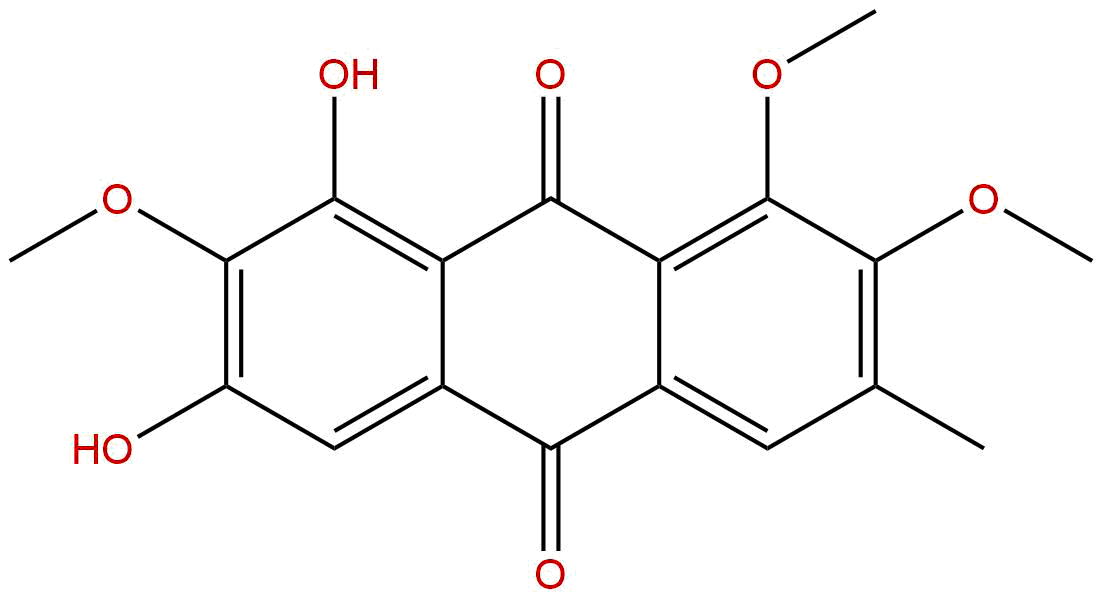


Product name: 6,8-Dihydroxy-1,2,7-trimethoxy-3-methylanthraquinone
Synonym name: 1,3-Dihydroxy-2,7,8-trimethoxy-6-methyl-9,10-anthracenedione
Catalogue No.: BP5285
Cas No.: 1622982-59-5
Formula: C18H16O7
Mol Weight: 344.319
Botanical Source:
Type of Compound: Anthraquinones
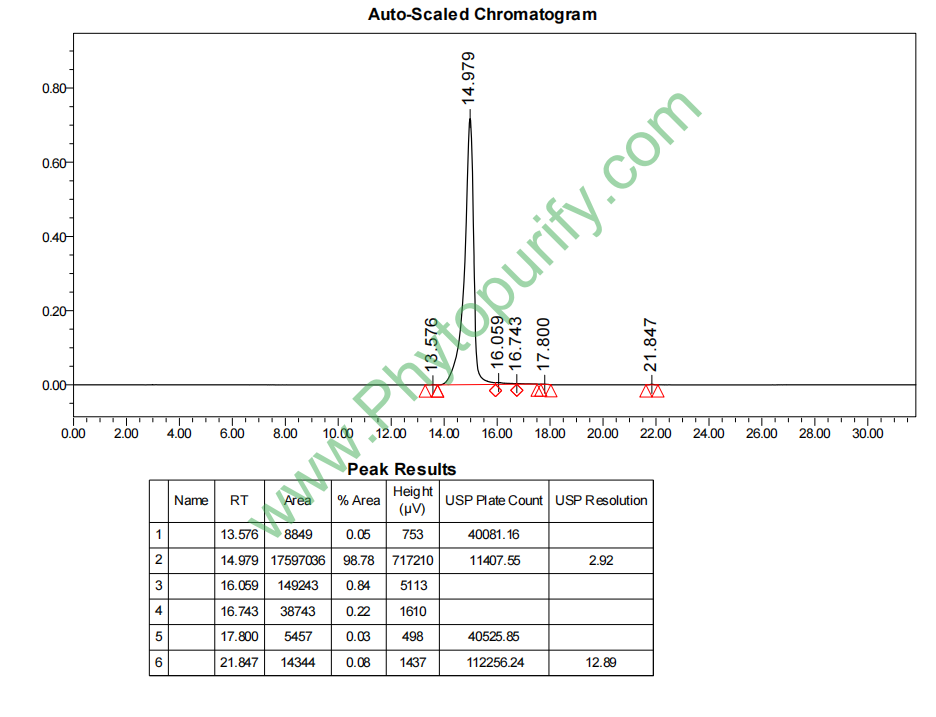
Purity: 95%~99%
Analysis Method: HPLC-DAD or/and HPLC-ELSD
Identification Method: Mass, NMR
Packing: Brown vial or HDPE plastic bottle
Storage: Store in a well closed container, protected from air and light. Put into refrigerate or freeze for long term storage.
Whenever possible, you should prepare and use solutions on the same day. However, if you need to make up stock solutions in advance, we recommend that you store the solution as aliquots in tightly sealed vials at -20℃. Generally, these will be useable for up to two weeks.
The product could be supplied from milligrams to grams
Inquire for bulk scale.
For Reference Standard and R&D, Not for Human Use Directly.
HPLC of 6,8-Dihydroxy-1,2,7-trimethoxy-3-methylanthraquinone
Storage conditions:Short-term storage at 2~8℃, long-term storage at -20 ~ -80℃
102.2900
2.8569
2.0886
.0174
4.3578
9.4717
Low
88.3054
2.6105
Yes
No
Yes
No
Yes
Yes
1.2
Yes
No
Yes
No
Natural products, as an important source of drug discovery, have played an indispensable role in the long history of human fight against diseases. Anthraquinones are a class of quinone derivatives widely found in nature, with the core structure being the tricyclic aromatic quinone system. These compounds have long been a hot topic in medicinal chemistry and pharmacology research due to their diverse biological activities, such as anti-inflammatory, antibacterial, anti-tumor, diarrhea, and immune regulation. From classic emodin and rhein to more complex multi substituted derivatives, anthraquinone compounds exhibit enormous structural diversity and therapeutic potential.
6,8-Dihydroxy-1,2,7-trimethoxy-3-methylanthraquinone (DTM-AQ) is a structurally novel multi substituted anthraquinone derivative. Its chemical structure is characterized by the presence of multiple hydroxyl and methoxy substituents on the anthraquinone core, which may endow it with a unique biological activity spectrum different from traditional anthraquinone compounds. In recent years, with the advancement of separation and purification techniques and structural identification methods, DTM-AQ has been discovered and identified from certain specific plants. Its potential pharmacological activity, especially in the field of anti-inflammatory applications, has attracted widespread attention from researchers.
Inflammation is a complex defensive response of the body to infections, tissue damage, or harmful stimuli. However, uncontrolled chronic inflammation is the common pathological basis of many major diseases, such as rheumatoid arthritis, inflammatory bowel disease, atherosclerosis, neurodegenerative diseases and even cancer. At present, commonly used anti-inflammatory drugs in clinical practice, such as nonsteroidal anti-inflammatory drugs (NSAIDs) and glucocorticoids, have definite therapeutic effects, but long-term use often accompanies significant gastrointestinal, cardiovascular, and metabolic side effects. Therefore, searching for efficient and low toxicity novel anti-inflammatory lead compounds from natural products is an important direction for current drug development. The emergence of DTM-AQ provides new candidate molecules for this field. This article aims to provide a systematic review of the chemical structure, plant origin, pharmacological activity, mechanism of action, and medicinal properties of DTM-AQ, in order to provide scientific basis for the in-depth research and development of this compound.
The chemical name of DTM-AQ is 6,8-dihydroxy-1,2,7-trimethoxy-3-methylanthraquinone, and its core skeleton is 9,10-anthraquinone. According to the naming convention, the positions and types of substituents are as follows: three methoxy groups (- OCH ∝) are attached to the 1st, 2nd, and 7th positions of the anthraquinone nucleus, respectively; There are two hydroxyl groups (- OH) connected at positions 6 and 8; There is a methyl group (- CH3) connected at position 3. This substitution mode gives it a high degree of symmetry and polarity characteristics. Its molecular formula is C ₁₉ H ₁₆ O ₇, and its molecular weight is 344.3190 g/mol. The CAS number is 1622982-59-5.
From the perspective of structure-activity relationship (SAR) analysis, the multiple phenolic hydroxyl and methoxy groups of DTM-AQ are the key functional groups for its biological activity. Phenolic hydroxyl groups are generally considered to be the main contributors to antioxidant and free radical scavenging activities, and can also form hydrogen bonds with target proteins in organisms, affecting their binding ability to targets. Methoxy groups may regulate their interactions with cell membranes or specific enzyme active sites by affecting the lipophilicity, electron cloud distribution, and spatial hindrance of molecules. The methyl group at position 3 is a hydrophobic group that may facilitate the binding of molecules to certain hydrophobic pockets.
The physicochemical properties of DTM-AQ are an important basis for its medicinal properties. The key parameters are as follows:
- molecular weight:344.3190 Da, Meets the general range of small molecule drugs (<500 Da).
- Lipid water partition coefficient (LogP): 2.8569. This value indicates that DTM-AQ has moderate lipophilicity, which can penetrate cell membranes well without being difficult to dissolve and transport in water due to excessive lipophilicity. This LogP value is within the ideal range for oral drug molecules (usually 1-3).
- Topological Polarity Surface Area (TPSA): 102.2900 Å ². TPSA is an important indicator for predicting drug oral absorption and blood-brain barrier penetration ability. Generally, molecules with TPSA<140 Å ² have good oral absorption potential. The high TPSA value of DTM-AQ is mainly due to the oxygen atoms in its two hydroxyl groups and three methoxy groups. This suggests that it may be mainly absorbed through passive diffusion and active transport mechanisms, but its ability to penetrate the blood-brain barrier is relatively low.
- Water solubility:0.0174 mg/mL。 This value is relatively low and belongs to insoluble compounds. Low water solubility is one of the main challenges faced by many natural products in drug development, which may lead to low oral bioavailability. It is necessary to improve its solubility and dissolution rate through formulation techniques such as nanocrystals, solid dispersions, liposomes, etc.
- Blood-brain barrier (BBB) penetrability: Low. This is consistent with higher TPSA values, indicating that DTM-AQ is difficult to pass through the blood-brain barrier, so its pharmacological effects may mainly focus on peripheral tissues and are less likely to produce central nervous system related side effects.
- HERG inhibition: No. HERG (human Ether - à - go Related Gene) potassium channel inhibition is the main cause of drug-induced cardiac toxicity (QT interval prolongation). DTM-AQ has no hERG inhibitory activity, which is an important safety advantage.
- Ames test 1.2. The Ames test is used to evaluate the mutagenicity of compounds. This value indicates that DTM-AQ is weakly or suspiciously positive in the Ames test, suggesting a possible genetic toxicity risk. This needs to be given special attention and validation in subsequent toxicology studies.
DTM-AQ is a relatively rare natural product, currently known to primarily originate from certain specific plant species. According to existing literature reports, this compound is mainly derived from Salvia genus Separated from plants. For example, research has shown that Salvia miltiorrhiza DTM-AQ was found in the rhizome of Danshen. Danshen is a widely used traditional Chinese medicine for promoting blood circulation and removing blood stasis. Its chemical components mainly include fat soluble tanshinones and water-soluble salvianolic acids. DTM-AQ, as a trace component with low content in Danshen, has enriched the chemical composition library of Danshen. In addition, there are also reports from other Salvia plants, such as Salvia prionitis The compound was isolated from the red root grass. This indicates that DTM-AQ may have a certain distribution pattern in Salvia plants, but its content is usually low.
Given the low content of DTM-AQ in plants, its extraction and separation typically require a combination of various modern chromatographic techniques to achieve efficient enrichment and purification.
Extract Conventional extraction methods include solvent extraction. Due to the moderate lipophilicity of DTM-AQ, organic solvents with moderate polarity, such as methanol, ethanol, or ethyl acetate, are usually used for cold soaking or hot reflux extraction of dried plant powders. To improve extraction efficiency, ultrasound assisted extraction or microwave-assisted extraction techniques can be used. The extract was concentrated under reduced pressure to obtain the total extract.
Preliminary separation The total extract is usually suspended in water and then subjected to liquid-liquid extraction using solvents of different polarities such as petroleum ether, ethyl acetate, n-butanol, etc. DTM-AQ is usually enriched in the ethyl acetate extraction site due to its polarity.
chromatographic separation This is the core step of purifying DTM-AQ. Common chromatographic methods include:
Structural Identification The purified compounds were structurally confirmed using modern spectroscopic techniques, including nuclear magnetic resonance spectroscopy (¹ H-NMR, ¹ ³ C-NMR, 2D-NMR), mass spectrometry (HR-ESI-MS), infrared spectroscopy (IR), and ultraviolet visible spectroscopy (UV Vis). Through comparison with literature data or comprehensive analysis, its structure was ultimately determined to be 6,8-dihydroxy-1,2,7-trimethoxy-3-methylanthraquinone.
At present, the pharmacological activity research on DTM-AQ is still in its infancy, but existing research results have preliminarily revealed its significant potential in the field of anti-inflammatory.
Inflammatory response involves a series of complex cellular and molecular events. Multiple in vitro cell model studies have evaluated the anti-inflammatory effects of DTM-AQ.
Given the broad-spectrum biological activity of anthraquinone compounds, DTM-AQ may also have other pharmacological effects, but there are few related research reports. Based on its structural characteristics and preliminary computer simulation screening, it is speculated that it may have:
- antioxidant activity The two phenolic hydroxyl groups in the molecule are potential hydrogen atom donors, capable of scavenging free radicals and exerting antioxidant effects. Oxidative stress is closely related to inflammation, and antioxidant activity may be one of the mechanisms of its anti-inflammatory effect.
- Antibacterial activity Many anthraquinone compounds have antibacterial properties, and the inhibitory activity of DTM-AQ against certain Gram positive bacteria or fungi is worth exploring.
- Cytotoxicity/Antitumor Activity Some anthraquinone compounds, such as doxorubicin, are classic anti-tumor drugs. The inhibitory effect of DTM-AQ on the proliferation of specific tumor cell lines needs to be studied.
The anti-inflammatory mechanism of DTM-AQ is multi-level and multi-target, mainly involving the regulation of key signaling pathways. Based on existing research, its core mechanism can be summarized as follows:
Nuclear factor kappa B (NF - κ B) is one of the most important transcription factors in inflammatory response. In the resting state, NF - κ B binds to its inhibitory protein I κ B α and exists in an inactive form in the cytoplasm. When cells are stimulated by LPS, TNF - α, etc., I κ B kinase (IKK) is activated, leading to phosphorylation and ubiquitination degradation of I κ B α, releasing NF - κ B. The free NF - κ B immediately translocates into the nucleus and binds to the κ B site in the promoter region of the target gene, initiating the transcription of a series of pro-inflammatory genes including TNF - α, IL-6, IL-1 β, iNOS, and COX-2.
Research has shown that DTM-AQ can effectively inhibit LPS induced phosphorylation and degradation of I κ B α, thereby preventing nuclear translocation and transcriptional activity of NF - κ B. By blocking the NF - κ B pathway, DTM-AQ inhibits the expression of various pro-inflammatory factors at the transcriptional level, achieving a broad-spectrum anti-inflammatory effect.
The mitogen activated protein kinase (MAPK) family, including ERK, JNK, and p38 MAPK, is another pathway that plays a key role in inflammatory signal transduction. After being activated by upstream signals, these kinases regulate the activity of downstream transcription factors (such as AP-1) through phosphorylation cascade reactions, thereby affecting the expression of inflammatory genes.
DTM-AQ has been shown to inhibit LPS induced phosphorylation of p38 MAPK and JNK, with little effect on ERK phosphorylation. This suggests that DTM-AQ may synergistically exert anti-inflammatory effects by selectively inhibiting the p38 and JNK pathways, in conjunction with the NF - κ B pathway.
The above study revealed that the main targets of DTM-AQ include TNF, NOS2, IL6, IL1B, and COX2. These targets do not exist in isolation, but form a complex inflammatory signaling network. DTM-AQ regulates multiple downstream effector molecules by acting on key kinases upstream, such as IKK, p38, JNK. Molecular docking simulation studies have also preliminarily confirmed that DTM-AQ can form stable interactions with the active sites or key binding regions of these target proteins, mainly driven by hydrogen bonding and hydrophobic interactions with amino acid residues. For example, its hydroxyl and methoxy groups can form hydrogen bonds with polar amino acids in COX-2 or iNOS active centers, while the anthraquinone core is embedded in hydrophobic pockets.
Based on the Lipinski Five Rules and modern medicinal chemistry evaluation standards, the pharmacological properties of DTM-AQ can be preliminarily evaluated as follows:
Therefore, DTM-AQ fully complies with Lipinski's five rules, indicating that it has the basic chemical backbone to become an orally active drug. However, it Low water solubility(0.0174 mg/mL) is a critical weakness that may lead to incomplete oral absorption and low bioavailability. In addition,Weak positive result of Ames test It is suggested that there may be a risk of genetic toxicity, which is a major obstacle in the evaluation of drug properties and requires strict toxicological assessment and structural optimization.
At present, research data on the in vivo pharmacokinetics (ADME) of DTM-AQ is extremely scarce. Based on its physicochemical properties and research on similar compounds, the following inferences can be made:
DTM-AQ, as a novel multi-target anti-inflammatory natural product, has the following clinical application prospects:
Despite the encouraging potential demonstrated by DTM-AQ, there are still many challenges from discovery to clinical application, and future research should focus on the following areas:
6,8-dihydroxy-1,2,7-trimethoxy-3-methylanthraquinone (DTM-AQ) is a structurally unique natural anthraquinone compound found in plants of the Salvia genus. Its physical and chemical properties meet the basic requirements of oral medication, but low water solubility and potential genetic toxicity are the main challenges facing its drug development. Existing research has clearly confirmed that DTM-AQ significantly downregulates the expression of key inflammatory targets such as TNF - α, IL-6, IL-1 β, iNOS, and COX-2 by inhibiting the NF - κ B and MAPK signaling pathways, demonstrating multi-target and multi pathway anti-inflammatory activity. As a novel anti-inflammatory lead molecule, DTM-AQ has potential application value in the treatment of chronic inflammatory diseases. However, obstacles in pharmacokinetics and toxicology still need to be overcome from laboratory discovery to clinical translation. In the future, interdisciplinary in-depth research combining medicinal chemistry, pharmacology, toxicology, and pharmacy will help fully reveal the therapeutic potential of DTM-AQ and promote it as a new candidate drug for treating human inflammatory diseases.
