


Product name: Shanzhiside methylester
Synonym name:
Catalogue No.: BP1300
Cas No.: 64421-28-9
Formula: C17H26O11
Mol Weight: 406.384
Botanical Source: Mussaenda parviflora and Salvia digitaloides
Physical Description: Powder
Type of Compound: Iridoids
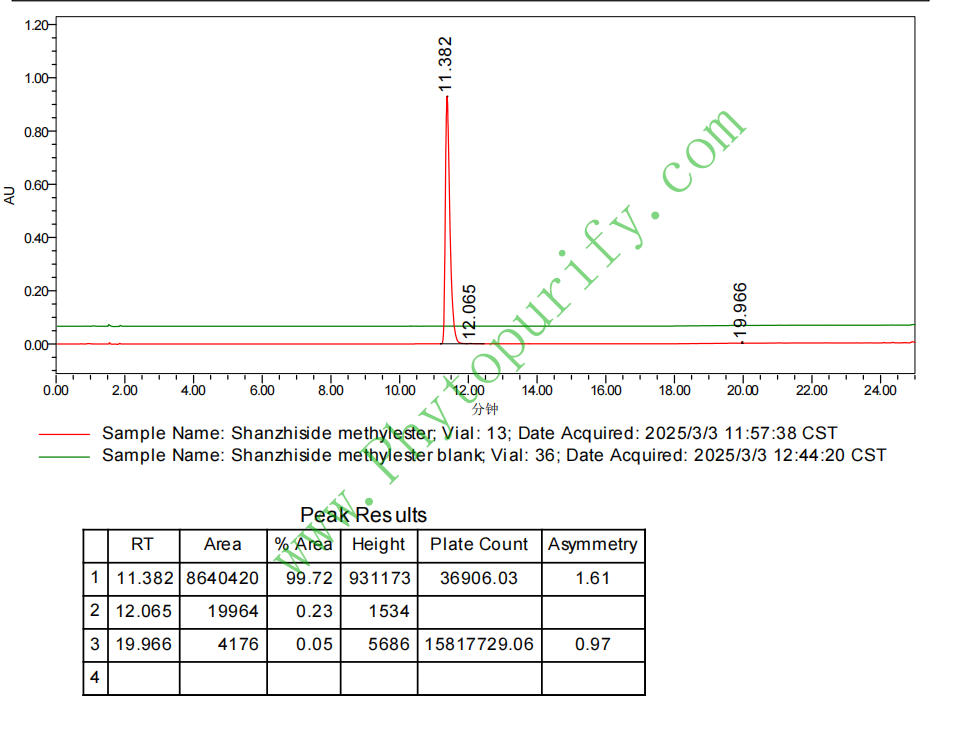
Purity: 95%~99%
Analysis Method: HPLC-DAD or/and HPLC-ELSD
Identification Method: Mass, NMR
Packing: Brown vial or HDPE plastic bottle
Storage: Store in a well closed container, protected from air and light. Put into refrigerate or freeze for long term storage.
Whenever possible, you should prepare and use solutions on the same day. However, if you need to make up stock solutions in advance, we recommend that you store the solution as aliquots in tightly sealed vials at -20℃. Generally, these will be useable for up to two weeks.
The product could be supplied from milligrams to grams, up to kilograms
Inquire for bulk scale.
Descriptions:
Shanzhiside methylester, the principle effective iridoid glycoside from the analgesic herb Lamiophlomis rotata , reduces neuropathic pain by activating spinal GLP-1 receptors and subsequently stimulating microglial β-endorphin expression via the p38 MAPK signaling; stimulation of the endogenous β-endorphin expression may be a novel and effective strategy for the discovery and development of analgesics for the long-term treatment of chronic pain. [1]
References:
[1] Fan H, Li T F, Gong N, et al. Neuropharmacol, 2015, 101:98-109.
[2] Xi H E, Mao X, Fan P C, et al. Chinese J Exp Trad Med Formulae. 2010, 16(07):50-2
HPLC of Shanzhiside methylester
Storage conditions:Short-term storage at 2~8℃, long-term storage at -20 ~ -80℃
Shanzhiside methyl ester (CAS number: 64421-28-9) is a natural iridoid glycoside with significant biological activity, which has attracted much attention due to its unique chemical structure and diverse pharmacological effects. As one of the common active ingredients in traditional Chinese medicine, Shanzhi glycoside methyl ester has shown great potential for application in anti-inflammatory, analgesic, neuroprotective and other fields. In recent years, with the deepening development of natural product pharmacology, the molecular mechanism and target of Shanzhizhi glycoside methyl ester have gradually been revealed, especially its regulatory role in inflammation related diseases has aroused widespread research interest. This article will provide a systematic review of the chemical structure, plant origin, pharmacological activity, mechanism of action, pharmacological evaluation, and clinical application prospects of Shanzhi glycoside methyl ester, aiming to provide scientific basis and theoretical support for the further development and application of this natural product.
Shanzhi glycoside methyl ester belongs to the iridoid monoterpene glycoside class, with a molecular formula of C19H30O10 and a molecular weight of 406.3840. Its chemical structure contains a core skeleton of cyclohexene ether terpenes and a glycosidic group, with a complex structure and multiple hydroxyl and methyl substituents, endowing it with good water solubility and biological activity. According to calculations, the LogP value of Shan Zhi Zhi Gan methyl ester is -1.5453, indicating its strong hydrophilicity; The polar surface area (TPSA) is 175.3700, indicating that its molecular polarity is high and may affect its cell membrane permeability and bioavailability. In addition, the water solubility of Shanzhi glycoside methyl ester reaches 43.2892, which is beneficial for its dissolution and distribution in the body. It is worth noting that the compound has a low blood-brain barrier penetration ability, suggesting that its direct action in the central nervous system may be limited, but this also reduces the risk of central side effects. The hERG channel inhibition experiment showed a negative result, indicating that the risk of cardiac toxicity of Shanzhizhi glycoside methyl ester is relatively low; The Ames test result is 0.0, indicating no significant mutagenicity and high safety.
Methyl ester of Gardenia jasminoides is mainly found in various traditional Chinese medicinal herbs, with Gardenia jasminoides Ellis being the main source. As a traditional Chinese medicine, Gardenia jasminoides has always been used for the treatment of clearing heat and detoxifying, promoting diuresis and reducing yellowing. Methyl ester of Gardenia jasminoides is one of its important active ingredients. In addition to Gardenia jasminoides, this compound can also be detected in some other plants with abundant content of cyclohexene ether terpenes, but the content is relatively low.
The commonly used methods for extracting methyl ester of Shanzhi glycoside include solvent extraction, ultrasound assisted extraction, and high-performance liquid chromatography (HPLC) separation and purification. Generally, ethanol or methanol is used as the solvent for crude extraction, followed by enrichment and purification through liquid-liquid distribution and column chromatography techniques. In recent years, green extraction techniques such as supercritical CO2 extraction and microwave-assisted extraction have also been attempted to improve extraction efficiency and purity. The purified Shan Zhi glycoside methyl ester is often subjected to structural identification and content determination using modern analytical methods such as mass spectrometry (MS) and nuclear magnetic resonance (NMR).
The pharmacological activity research of Shanzhi glycoside methyl ester mainly focuses on its anti-inflammatory, analgesic, and neuroprotective effects. A large number of in vitro cell models and in vivo animal experiments have shown that shanzhizhi methyl ester can significantly inhibit the expression of inflammatory factors, alleviate inflammatory reactions, and improve the pathological status of related diseases.
anti-inflammatory effect
Shanzhi glycoside methyl ester regulates the inflammatory signaling pathway through multiple targets, significantly reducing the expression of pro-inflammatory cytokines such as IL-6 and TNF - α, and inhibiting the release of inflammatory mediators. Its inhibitory effect on cyclooxygenase (PTGS1, PTGS2) and inducible nitric oxide synthase (NOS2) reduces the production of prostaglandins and NO, and alleviates inflammatory reactions. In animal models, Shanzhizhi glycoside methyl ester exhibits protective effects against various inflammatory diseases such as arthritis and enteritis.
Analgesic effect
Shanzhi glycoside methyl ester has a regulatory effect on pain related ion channels such as TRPV1 and TRPA1, reducing neuropathic pain and inflammatory pain. By inhibiting the excessive activation of these ion channels, reducing neuronal excitability, and alleviating pain symptoms.
Neuroprotective effect
In the model of neurological diseases, shanzhizhi methyl ester can alleviate neuronal damage and promote neurological function recovery by inhibiting inflammatory response and regulating apoptosis related protein CASP1. Its regulation of the STAT3 and NFKB1 signaling pathways helps to suppress neuroinflammation and protect neuronal survival.
In addition, Shanzhi glycoside methyl ester exhibits multiple pharmacological effects such as antioxidant and immune regulation, demonstrating broad therapeutic potential.
The pharmacological effects of Shanzhi glycoside methyl ester depend on its regulation of multiple key molecular targets, involving a complex signal transduction network.
IL-6 and STAT3 pathway
IL-6 is a typical pro-inflammatory cytokine that mediates inflammation and cell proliferation by activating the STAT3 signaling pathway. Shanzhi glycoside methyl ester can inhibit the expression of IL-6 and the phosphorylation of STAT3, block the activation of this pathway, and alleviate inflammation and related pathological changes.
CASP1 (caspase 1)
CASP1 is a key enzyme in inflammasome activation, involved in the maturation and release of pro-inflammatory cytokine IL-1 β. Shanzhi glycoside methyl ester inhibits CASP1 activity, blocks the activation of inflammasomes, and reduces the release of inflammatory mediators.
TRPV1 and TRPA1 ion channels
TRPV1 and TRPA1 play important roles in pain and inflammation perception. Shanzhi glycoside methyl ester reduces neuronal overexcitement, alleviates pain and inflammation by regulating the activity of these two channels.
PTGS1 and PTGS2 (cyclooxygenase 1 and 2)
PTGS enzyme catalyzes the synthesis of prostaglandins and is an important mediator of inflammatory response. The inhibitory effect of Shanzhi glycoside methyl ester on PTGS1 and PTGS2 reduces the production of prostaglandins and alleviates inflammatory symptoms.
TNF and NOS2
TNF - α is another important pro-inflammatory factor, and excessive nitric oxide produced by NOS2 exacerbates inflammation. Shanzhi glycoside methyl ester further exerts anti-inflammatory effects by inhibiting the expression of both.
NFKB1 (nuclear factor kappa B)
NFKB1 is a key transcription factor that regulates the expression of inflammatory genes. Shanzhi glycoside methyl ester can block the activation of NFKB1, inhibit the transcription of inflammatory genes, and alleviate inflammatory reactions.
In summary, Shanzhi glycoside methyl ester regulates inflammation and pain related signaling networks through multi-target and multi pathway synergistic effects, exerting its pharmacological effects.
From the perspective of medicinal properties, Shanzhi glycoside methyl ester exhibits certain advantages and challenges. Its molecular weight is 406.3840, belonging to the category of medium molecular weight compounds, with a LogP value of -1.5453, indicating strong hydrophilicity, which is beneficial for dissolution and distribution in body fluids, but may limit its cell membrane penetration. A high TPSA (175.3700) indicates a high polarity, which may affect oral absorption and bioavailability.
The low penetration ability of the blood-brain barrier means that the direct effect of Shan Zhi Zhi Zhi Gan methyl ester on the central nervous system is limited, but this also reduces the potential risk of central neurotoxicity. HERG channel inhibition was negative and Ames test showed no mutagenicity, indicating good safety and low risk of cardiac and genetic toxicity.
In terms of pharmacokinetics, existing research is relatively limited, but based on its physicochemical properties, it is speculated that its oral bioavailability may be limited. In vivo metabolism is mainly carried out through the liver enzyme system, and the activity and toxicity of metabolites need further study. In the future, it is necessary to improve its pharmacokinetic properties, in vivo stability, and targeting through structural modification or drug carrier technology.
Based on the significant activities of Shanzhizhi glycoside methyl ester in anti-inflammatory, analgesic, and neuroprotective aspects, its potential for application in various inflammation related diseases is enormous. Especially in the adjuvant treatment of rheumatoid arthritis, inflammatory bowel disease, neuropathic pain, and certain neurodegenerative diseases, Shanzhizhi glycoside methyl ester is expected to become a new natural drug candidate molecule.
Future research should focus on the following aspects:
In depth analysis of pharmacological mechanisms
Further elucidate the mechanism of action of Shanzhi glycoside methyl ester at the cellular and molecular levels, particularly its regulatory network on inflammatory signaling pathways.
Pharmacokinetic and pharmacodynamic studies
Systematically evaluate its absorption, distribution, metabolism, and excretion characteristics in the body, optimize the dosing regimen, and improve bioavailability.
Structural optimization and formulation development
Improve its drug properties, enhance targeting and efficacy through chemical modification or nanocarrier technology.
Preclinical and clinical research
Conduct animal models and human clinical trials to verify their safety and effectiveness, and promote their clinical translation.
Combination therapy strategy
Explore the synergistic effects of Shanzhizhi glycoside methyl ester with other drugs and expand its clinical indications.
In summary, as a natural product with multi-target anti-inflammatory effects, Shanzhi glycoside methyl ester has good development prospects and deserves further in-depth research and clinical development.
Shanzhi glycoside methyl ester, as a cyclic terpenoid glycoside, has become a hot topic in natural product pharmacology research due to its unique chemical structure and significant anti-inflammatory and analgesic activities. It exerts multi-target synergistic anti-inflammatory effects by regulating multiple inflammation related signaling pathways such as IL-6/STAT3, CASP1, TRPV1/TRPA1, PTGS1/PTGS2, TNF, NOS2, and NFKB1, demonstrating broad medicinal value. Although there are certain limitations to its pharmacological properties, its good safety and diverse pharmacological effects provide a solid foundation for its clinical application. In the future, with the advancement of structural optimization, pharmacokinetic improvement, and clinical research, Shanzhi glycoside methyl ester is expected to become an important natural medicine for treating inflammation and related diseases, contributing new natural drug resources to human health.
