Introduction/Overview
Natural products, as an important treasure trove for drug discovery, play an irreplaceable role in the history of human disease prevention and treatment. Among them, iridoid glycosides have become a hot topic in pharmacological research due to their structural diversity and wide range of biological activities. Shanzhiside (CAS number: 29836-27-9) is a typical iridoid glycoside, mainly derived from traditional medicinal plants such as Gardenia jasminoides Ellis. Modern pharmacological research has shown that Shan Zhi glycoside exhibits significant multiple pharmacological activities such as anti-inflammatory, antioxidant, hepatoprotective, and neuroprotective effects, especially in the field of liver diseases, demonstrating enormous potential for application. Hepatitis, especially viral hepatitis, alcoholic and drug-induced liver injury, has a complex pathological process involving multiple mechanisms such as oxidative stress, inflammatory cascade reactions, and cell apoptosis. Currently, clinical treatment methods still have limitations. Shanzhi glycoside provides new candidate molecules for the development of novel hepatoprotective drugs by regulating multiple key targets closely related to hepatitis, such as BCL2, STAT3, TNF, NFKB1, CASP3, IL6, etc. The purpose of this article is to systematically review the chemical structure, plant origin, pharmacological activity, mechanism of action, and medicinal properties of Shanzhizhi glycoside, and to prospect its clinical application prospects, in order to provide comprehensive scientific references for the in-depth research and development of this compound.
Chemical structure and physicochemical properties
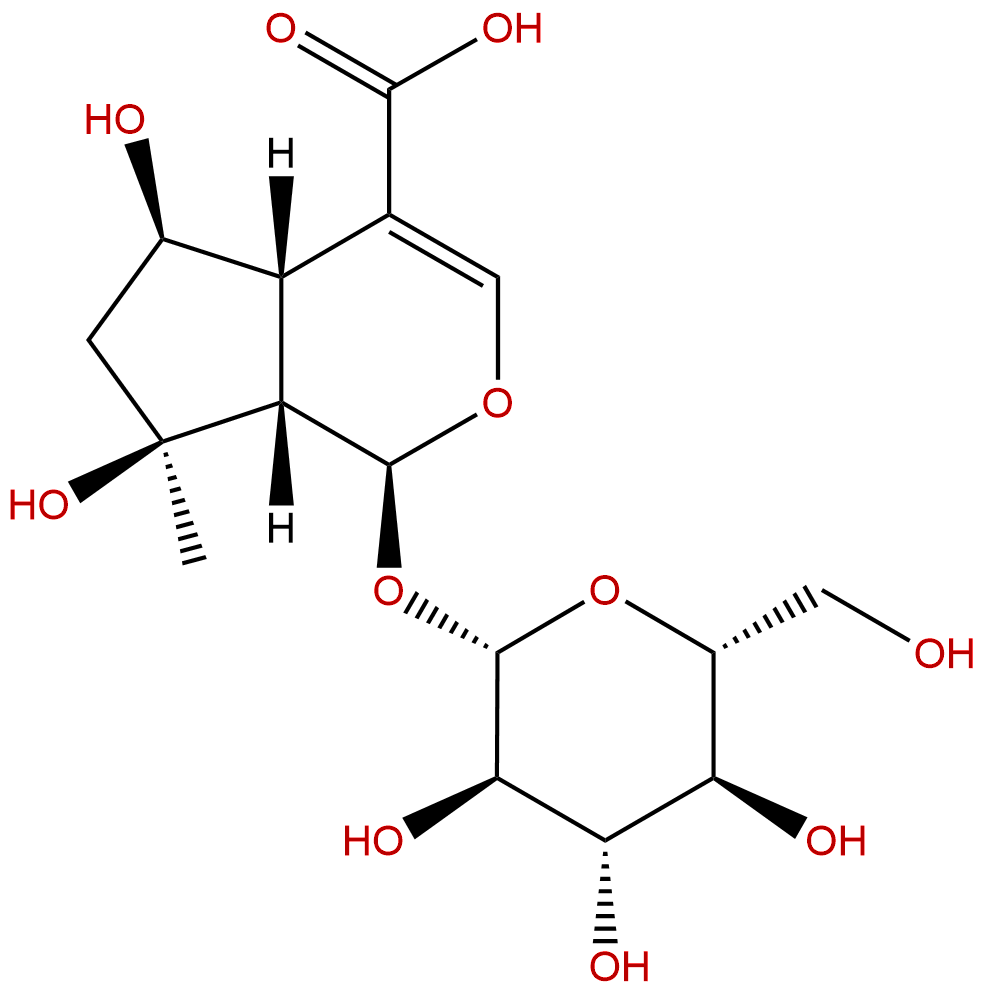
Shanzhi glycoside is a monoterpene iridoid glycoside compound. Its molecular formula is C16H24O11 and its molecular weight is 392.3570. Its core structure is cyclopentane pyran ring (characteristic skeleton of cyclohexene ether terpenes), which is connected to a glucose group through a glycosidic bond at C-1 position. This structure gives it typical physicochemical properties of cyclohexene ether terpenes.
From the analysis of the parameters related to drug properties, Shanzhizhi glycoside exhibits good water solubility (about 40.0521 mg/L), which is mainly attributed to the presence of multiple polar hydroxyl and sugar groups in its molecule, resulting in a negative theoretical partition coefficient (LogP) (-1.6786), indicating that it is a hydrophilic compound. Its topological polar surface area (TPSA) is as high as 186.37 Å ², further confirming its strong polarity characteristics. These properties determine the distribution characteristics of Shanzhi glycoside in the body: its ability to penetrate the blood-brain barrier is predicted to be "low", suggesting that its direct effect on the central nervous system may be limited, but it also reduces the potential risk of central nervous system side effects. In early safety evaluations, Shan Zhi glycoside showed good potential: it has no inhibitory activity on hERG potassium channels (hERG inhibition: no), indicating a low risk of causing QT interval prolongation in the heart; The Ames test result is 0.0, indicating preliminarily that it has no mutagenicity. These physical and chemical properties, as well as preliminary safety parameters, have laid a favorable foundation for the subsequent development of Shanzhi glycoside.
Plant sources and extraction methods
Shanzhiglycoside mainly exists in the dried and ripe fruits of Gardenia jasminoides Ellis, a plant in the Rubiaceae family. As a traditional Chinese medicine, Gardenia jasminoides has the effects of relieving fire and irritability, clearing heat and dampness, cooling blood and detoxifying. Its active ingredients mainly include cyclohexene ether terpenoid glycosides (such as geniposide and mountain gardenoside), saffron glycosides, and organic acids. In addition, a small amount has also been detected in certain honeysuckle plants such as Lonicera japonica.
The extraction and separation of Shan Zhi glycoside usually follow the conventional process of natural product chemistry. Firstly, crush the gardenia fruit and use solvent extraction method. Common extraction solvents include methanol, ethanol, or ethanol water solutions of different concentrations. Heating reflux, ultrasound assisted, or microwave-assisted extraction techniques are used to improve extraction efficiency. After obtaining the crude extract, it is preliminarily enriched and purified by macroporous adsorption resin (such as D101, AB-8) column chromatography, and gradient elution is performed using water and different concentrations of ethanol. Shanzhi glycoside is usually enriched in the water or low concentration ethanol elution site. Further purification requires the use of modern chromatographic techniques such as silica gel column chromatography, reverse phase silica gel (such as ODS) column chromatography, and high performance liquid chromatography (HPLC). At present, analytical and preparative HPLC have become the core technologies for identifying and obtaining high-purity mountain glycoside standards, with commonly used mobile phases being methanol water or acetonitrile water systems. The optimization goal of the extraction process is to improve the yield and purity of Shan Zhi glycoside while maintaining its biological activity.
Pharmacological activity research
A large number of pharmacological studies both in vitro and in vivo have confirmed that Shanzhi glycoside has various biological activities, among which its liver protective effect is the most prominent and profound.
1. Liver protective activity:
Shanzhi glycoside has shown significant protective effects on various experimental liver injury models. In a chemical liver injury mouse model induced by carbon tetrachloride (CCl4), D-galactosamine (D-GalN), and acetaminophen (APAP), pre-treatment with kaempferol can dose dependently reduce serum levels of alanine aminotransferase (ALT) and aspartate aminotransferase (AST), alleviate liver tissue pathological damage such as hepatocyte necrosis and inflammatory cell infiltration. In the ConA induced immune liver injury model, Shan Zhi glycoside also showed anti-inflammatory and anti hepatocyte apoptosis effects.
2. Anti inflammatory and immune regulatory activity:
Shanzhi glycoside has shown anti-inflammatory effects in various acute and chronic inflammation models. For example, in a lipopolysaccharide (LPS) - stimulated macrophage model (such as RAW264.7 cells), kaempferol can significantly inhibit the production of nitric oxide (NO), prostaglandin E2 (PGE2), and various inflammatory mediators. In the in vivo inflammatory model induced by carrageenan in rats, such as paw swelling, Shan Zhi Gan also showed anti-inflammatory effects. Its immune regulatory effect is reflected in regulating the balance of T lymphocyte subsets and inhibiting excessive immune reactions.
3. Antioxidant activity:
Shanzhi glycoside has strong free radical scavenging ability and antioxidant stress resistance. In pathological conditions such as liver injury, it can enhance the activity of endogenous antioxidant enzymes such as superoxide dismutase (SOD) and glutathione peroxidase (GPX) in liver tissue, reduce the content of malondialdehyde (MDA), and alleviate the damage of oxidative stress to cells.
4. Neuroprotective activity:
Although the blood-brain barrier permeability is low, some studies suggest that Shan Zhi glycoside or its metabolites may have a certain protective effect on the nervous system. In studies such as cerebral ischemia-reperfusion injury and Alzheimer's disease models, Shan Zhi glycoside has shown the potential to alleviate neuronal apoptosis and improve cognitive function, and its mechanism may be related to anti-inflammatory and antioxidant effects.
5. Other activities:
In addition, there are research reports that Shan Zhi Gan has certain activities such as anti depression, anti anxiety, and cardiovascular protection, but there is relatively little research in these areas and further exploration is needed.
Mechanism of action and molecular targets
The pharmacological effects of Shanzhi glycoside, especially its hepatoprotective effect, are achieved through the synergistic regulation of multiple targets and pathways. The core of its functional network revolves around inhibiting inflammatory response, antioxidant stress, and regulating cell apoptosis, involving the following key molecular targets and signaling pathways:
1. Inhibit the NF - κ B inflammatory pathway:
Nuclear factor kappa B (NF - κ B, encoded by NFKB1) is the core transcription factor of inflammatory response. Under the stimulation of LPS, TNF - α, and other factors, Shan Zhi glycoside can inhibit the degradation of I κ B α and the nuclear translocation of NF - κ B p65 subunit, thereby downregulating the gene expression of a series of pro-inflammatory mediators downstream, including tumor necrosis factor - α (TNF - α), interleukin-6 (IL-6), interleukin-1 β (IL-1 β), as well as inducible nitric oxide synthase (iNOS) and cyclooxygenase-2 (COX-2, encoded by PTGS2). This is the main mechanism by which Shan Zhi glycoside exerts anti-inflammatory effects.
2. Regulating the STAT3 signaling pathway:
Signal transducer and activator of transcription factor 3 (STAT3) plays a critical role in cell proliferation, survival, and inflammation. Shanzhi glycoside can inhibit the phosphorylation (activation) of STAT3, thereby affecting the expression of downstream genes related to cell survival and inflammation. Inhibition of the STAT3 pathway helps to break the vicious cycle of inflammation and promote tissue repair.
3. Regulating the balance of cell apoptosis:
Apoptosis is crucial in liver injury. Shanzhi glycoside can upregulate the expression of anti apoptotic protein B cell lymphoma 2 (BCL-2), while downregulating the expression of pro apoptotic proteins such as Bax, and inhibiting the activation of caspase-3 (CASP3). This series of effects helps maintain the survival of liver cells and reduce apoptotic cell death.
4. Enhance antioxidant defense system:
Shanzhi glycoside can activate the nuclear factor E2 related factor 2 (Nrf2) pathway, promote the expression of downstream antioxidant enzymes such as glutathione peroxidase 1 (GPX1) and heme oxygenase-1 (HO-1), thereby enhancing the cell's resistance to oxidative stress.
5. Affects estrogen receptor signaling:
There are studies suggesting that Shan Zhi glycoside may interact with estrogen receptor beta (ESR2), which may partially mediate its tissue protective effects, especially in metabolism and inflammation regulation related to estrogen signaling, but its specific role still needs to be clarified.
6. Direct inhibition of pro-inflammatory mediators:
In addition to regulating transcription factors, Shanzhi glycoside may also directly or indirectly inhibit the production and activity of cytokines such as TNF - α, IL-6, IL-1 β, forming a three-dimensional intervention on the inflammatory network.
In summary, Shanzhi glycoside exerts its anti hepatitis and organ protective effects by acting on multiple targets such as NFKB1, STAT3, TNF, IL6, IL1B, PTGS2, BCL2, CASP3, GPX1, interweaving into a complex pharmacological network.
Evaluation of drug properties and pharmacokinetics
Although Shanzhi glycoside exhibits excellent pharmacological activity, whether it can become a successful drug candidate molecule still requires systematic pharmacological evaluation and pharmacokinetic studies.
Pharmacokinetic characteristics:
Existing research indicates that Shan Zhi glycoside belongs to hydrophilic compounds, and its absorption degree and rate after oral administration may be limited by its permeability. Animal pharmacokinetic studies have shown that the oral bioavailability of Shanzhi glycoside may not be high. It is distributed quickly in the body, but mainly in organs with abundant blood supply, such as the liver and kidneys, with less amount entering brain tissue, which is consistent with its prediction of low blood-brain barrier permeability. Shanzhi glycoside mainly undergoes phase II metabolic reactions in the body, such as glucuronic acid binding, forming more polar metabolites, which are then excreted through the kidneys and urine. The prototype drug may also be partially excreted through bile. Its half-life in the body is relatively short, and it may require multiple administrations or dosage form modifications to maintain effective blood drug concentration.
Advantages and challenges of pharmaceutical properties:
Advantage: ① Good safety potential: Preliminary genetic toxicity (Ames test negative) and cardiac safety (no hERG inhibition) data are good. ② Good water solubility is beneficial for the development of formulations. ③ The mechanism of action is clear, and multi-target synergy may have comprehensive therapeutic effects on complex diseases such as hepatitis.
Challenge: ① The oral bioavailability may be low, which is the main obstacle to its development into oral formulations. ② Metabolism is fast and the half-life is short. ③ Although there are many targets, it is also necessary to be alert to potential off target effects and long-term toxic side effects, which require a more comprehensive preclinical toxicology evaluation.
Formulation strategy:
To improve the medicinal properties of Shan Zhi Gan, the following strategies can be considered: ① Structural modification Through prodrug design, such as esterification modification to enhance its lipid solubility and membrane permeability, the original drug is released after hydrolysis in vivo. ② New drug delivery system Develop phospholipid complexes, cyclodextrin inclusion complexes, nanoparticles (such as liposomes, polymer nanoparticles), microemulsion or self microemulsion systems, etc., to improve their solubility, stability, and oral absorption. ③ Exploration of administration routes Besides oral administration, injection administration (such as intravenous injection for acute liver injury) or local administration routes can be considered.
Clinical application prospects and prospects
Shanzhi glycoside, as a natural compound with clear multi-target hepatoprotective activity, has broad clinical application prospects, but solid research is still needed to promote its transformation.
Potential application directions:
1. Liver disease adjuvant therapy drugs This is the most direct application direction of Shanzhi glycoside. It can be developed as an adjuvant therapy for viral hepatitis, alcoholic liver disease, non-alcoholic fatty liver disease (NAFLD), and drug-induced liver injury, especially for controlling liver inflammation and oxidative stress stages. It can be used as a supplement or combination therapy to existing antiviral drugs and hepatoprotective drugs, in order to improve efficacy and reduce side effects.
2. antiinflammatory drug Based on its extensive anti-inflammatory mechanism, research can be expanded to treat other inflammatory diseases such as arthritis, colitis, dermatitis, etc.
3. Adjuvant therapy for neurodegenerative diseases Despite the limitations of the blood-brain barrier, new therapeutic approaches may still be provided for conditions such as cerebral ischemia and Alzheimer's disease through formulation techniques or exploration of the activity of its metabolites.
Future research focus and prospects:
1. In depth mechanism research By utilizing proteomics, metabolomics, and gene editing techniques, further precise elucidation of the direct target of Shanzhizhi glycoside (such as whether it directly interacts with ESR2) and its downstream signaling network, and discovery of new mechanisms of action.
2. Optimization of drug properties in the system Systematic and standardized pharmacokinetic studies must be conducted to clarify its ADME (absorption, distribution, metabolism, excretion) characteristics. Concentrate efforts to solve the bottleneck problem of low bioavailability through formulation or prodrug strategies.
3. Comprehensive preclinical development Complete GLP toxicology evaluations that comply with international standards, including long-term toxicity, reproductive toxicity, carcinogenicity tests, etc., to provide sufficient safety data for its clinical research application (IND).
4. Clinical study design Future clinical research should first focus on the field of liver disease, design rigorous randomized controlled trials, and evaluate the effectiveness and safety of their use alone or in combination.
5. Source quality control Establish a comprehensive quality control system from GAP cultivation of Gardenia jasminoides to the production of Shanzhizhi glycoside raw materials, ensuring stable and uniform quality of medicinal materials and compounds.
Conclusion
Shanzhi glycoside is a cyclic iridoid glycoside isolated from the traditional Chinese medicine Gardenia jasminoides. With its significant anti-inflammatory, antioxidant, and anti apoptotic pharmacological activities, it has shown great application value in the treatment of diseases such as hepatitis. Its mechanism of action involves the regulation of multiple key targets such as NF - κ B, STAT3, apoptosis related proteins, and antioxidant pathways, reflecting the advantages of natural product multi-target synergistic therapy. Despite facing challenges such as oral bioavailability in drug development, these obstacles are expected to be overcome through the optimization of modern medicinal chemistry and formulation methods. In the future, with a deeper analysis of its molecular mechanism, the advancement of systematic pharmacological research, and the development of standardized clinical evaluation, Shanzhizhi glycoside is expected to evolve from a promising lead compound into an innovative drug for the treatment of liver inflammatory diseases and other inflammation related diseases, contributing to the inheritance and development of traditional Chinese medicine treasure trove and meeting the unfinished clinical needs.