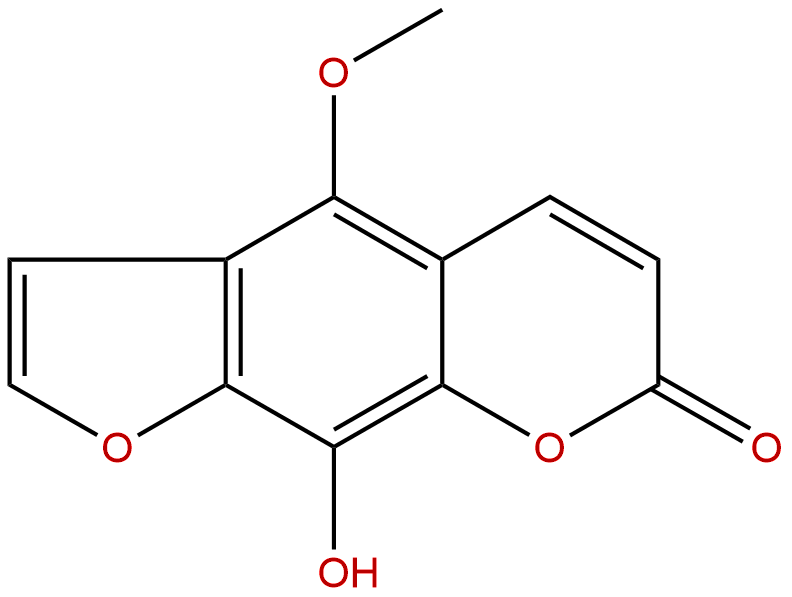


Synonym name:
Catalogue No.: BP0109
Cas No.: 1603-47-0
Formula: C12H8O5
Mol Weight: 232.191
Botanical Source:
Purity: 95%~99%
Analysis Method: HPLC-DAD or/and HPLC-ELSD
Identification Method: Mass, NMR
Packing: Brown vial or HDPE plastic bottle
Can be supplied from milligrams to grams.
For Reference Standard and R&D, Not for Human Use Directly.
Inquire for bulk scale.
Storage conditions:Short-term storage at 2~8℃, long-term storage at -20 ~ -80℃
77.5800
1.7800
1.7800
Low
null
Unknown
Unknown
No
Unknown
Yes
Unknown
null
8-Hydroxybergapten (CAS number 1603-47-0) is a naturally occurring furan coumarin compound widely distributed in plants of the Rutaceae family, particularly in the Citrus and Ruta genera. As an important member of the furan coumarin family, 8-hydroxybergamot lactone has attracted widespread attention in the field of natural product pharmacology in recent years due to its unique chemical structure and diverse biological activities. This compound is not only converted into Isopenicillin through O-methyltransferase mediated reactions in plants, but also exhibits significant biological activity, especially in the potential treatment of anti wrinkle beauty and obstructive sleep apnea (OSA) related diseases, showing promising application prospects.
This article aims to systematically review the chemical structure and physicochemical properties, plant sources and extraction methods, pharmacological activity and mechanism of action, pharmacological evaluation and pharmacokinetic characteristics of 8-hydroxybergamot lactone, and explore its potential and future development directions in clinical applications, providing theoretical basis and reference for the in-depth research and drug development of this natural product.
8-Hydroxybergamot lactone belongs to the class of furan coumarins, with a molecular formula of C12H8O5 and a molecular weight of 232.19. Its structural features include a coumarin core structure, combined with a furan ring and a hydroxyl substituent located at position 8. This hydroxyl group endows it with strong polarity and biological activity, while providing a site for subsequent enzymatic modifications.
In terms of physicochemical properties, the LogP value of 8-hydroxybergamot lactone is 1.78, indicating its moderate lipid solubility, which is beneficial for membrane penetration and in vivo distribution. The polar surface area (TPSA) is 77.58 Å ², indicating its hydrophilicity and hydrogen bonding ability. The molecule contains 5 hydrogen bond receptors, which may participate in various hydrogen bond interactions with biological targets. The low permeability of the blood-brain barrier suggests its limited ability to penetrate the central nervous system. Toxicological evaluation shows that it has no hepatotoxicity, cardiotoxicity, or hERG channel inhibition effect, and has high safety. However, the results of Ames mutagenicity test are not yet clear.
8-Hydroxybergamot lactone is mainly found in plants of the Rutaceae family, especially in plants of the Ruta genus such as Ruta graveolens and Citrus medica var. sarcodactyls. Ruta plants have been widely studied for their abundant furan coumarin compounds, among which 8-hydroxybergamot lactone, as a representative component, has important chemical and pharmacological value.
The extraction method usually uses organic solvent extraction combined with chromatographic separation technology. Common extraction solvents include ethanol, methanol, and ethyl acetate, which can effectively dissolve furan coumarin compounds. The extraction process generally includes the following steps:
In addition, studies on biosynthetic pathways have shown that 8-hydroxybergamot lactone can be catalyzed by O-methyltransferase to convert to penicillin in cell-free extracts of Ruta cells, indicating its metabolic dynamics and biosynthetic regulatory mechanisms in plants.
The pharmacological activity research of 8-hydroxybergamot lactone covers multiple aspects such as anti wrinkle beauty, antioxidant, anti-inflammatory, and neuroprotection, especially showing significant effects in the field of skin anti-aging.
Multiple in vitro and in vivo studies have shown that 8-hydroxybergamot lactone can effectively inhibit the activity of collagenase (MMPs), reduce collagen degradation, promote the synthesis of skin elastin, thereby achieving anti wrinkle and improving skin texture effects. In addition, the compound exhibits good photoprotective effects by regulating oxidative stress-related signaling pathways and reducing UV induced skin damage.
8-Hydroxybergamot lactone can inhibit the activity of inflammatory mediators such as prostaglandin 1 (PTGS1) and monoamine oxidase A (MAOA), and alleviate inflammatory reactions. Its antioxidant capacity is mainly achieved by clearing free radicals and regulating the intracellular antioxidant enzyme system, which helps alleviate the pathological process of oxidative stress-related diseases.
Research has shown that 8-hydroxybergamot lactone may participate in the pathological mechanism of obstructive sleep apnea by regulating various molecular targets such as APP, ESR1/2, HMGCR, etc. Its potential effects on neuronal protection, inflammation inhibition, and metabolic regulation provide new ideas for the treatment of OSA and related neurological diseases.
The biological activity of 8-hydroxybergamot lactone is attributed to its interactions with multiple key molecular targets, involving signal transduction, enzyme activity regulation, and gene expression regulation.
8-Hydroxybergamot lactone regulates cellular signaling pathways and exerts multiple pharmacological effects by binding to the aforementioned targets. For example, its inhibitory effect on MAOA and PTGS1 reduces neuroinflammation and oxidative stress, promoting neuroprotection; Activation of ESR1/2 enhances the synthesis of skin collagen and improves skin structure; The regulation of HMGCR contributes to lipid metabolism balance and indirectly affects the metabolic basis of sleep apnea.
In addition, 8-hydroxybergamot lactone is converted to penicillin in Ruta cells by O-methyltransferase catalysis, suggesting that it may exert a wider range of biological activities in vivo through metabolites.
Medicinal properties are an important consideration in the development of natural products into drugs. 8-Hydroxybergamot lactone exhibits excellent performance in multiple pharmacokinetic and safety indicators.
Overall, 8-hydroxybergamot lactone has good pharmacokinetic characteristics and safety basis, making it suitable as a candidate drug for further preclinical studies.
8-Hydroxybergamot lactone, as a multifunctional natural product, has broad clinical application potential.
Its anti collagenase activity and ability to promote collagen synthesis make it an ideal ingredient for anti-aging skincare products. In the future, nanocarriers or composite formulations can be used to enhance skin permeability and stability, expanding their market applications.
OSA, as a common sleep disorder, is associated with multiple metabolic and inflammatory pathways. 8-Hydroxybergamot lactone has potential therapeutic value by regulating multiple targets such as APP, MAOA, ESR, etc. Future research should focus on its efficacy validation in OSA animal models and clinical trials.
Its anti-inflammatory, antioxidant, and neuroprotective effects suggest potential for development in neurodegenerative diseases, metabolic syndrome, and inflammation related diseases. By combining modern drug design and targeted delivery technology, its clinical value can be further explored.
At present, the in vivo pharmacokinetics, metabolic pathways, and long-term safety of 8-hydroxybergamot lactone still require systematic research. The in-depth analysis of its biosynthetic mechanism and enzymatic conversion process will help achieve efficient production through biosynthetic engineering. In addition, network pharmacology research based on multi-target mechanisms will promote its application in precision medicine.
8-Hydroxybergamot lactone, as a natural furan coumarin compound with unique structure and multiple biological activities, has shown broad application prospects in fields such as anti wrinkle beauty and obstructive sleep apnea. Its good drug efficacy and safety lay a solid foundation for subsequent drug development. In the future, by combining modern molecular biology, pharmacology, and medicinal chemistry technologies, in-depth exploration of its mechanism of action and clinical efficacy will promote the clinical translation of this natural product, benefiting human health.
