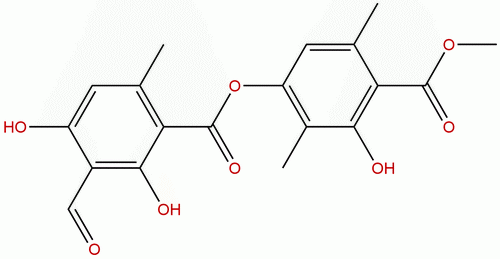


Product name: Atranorin
Synonym name: Atranorine;Parmelin; Parmelin Acid; Usnarin; Usnarin Acid
Catalogue No.: SBP60027
Cas No.: 479-20-9
Formula: C19H18O8
Mol Weight: 374.345
Botanical Source:
Physical Description:
Type of Compound: Phenols
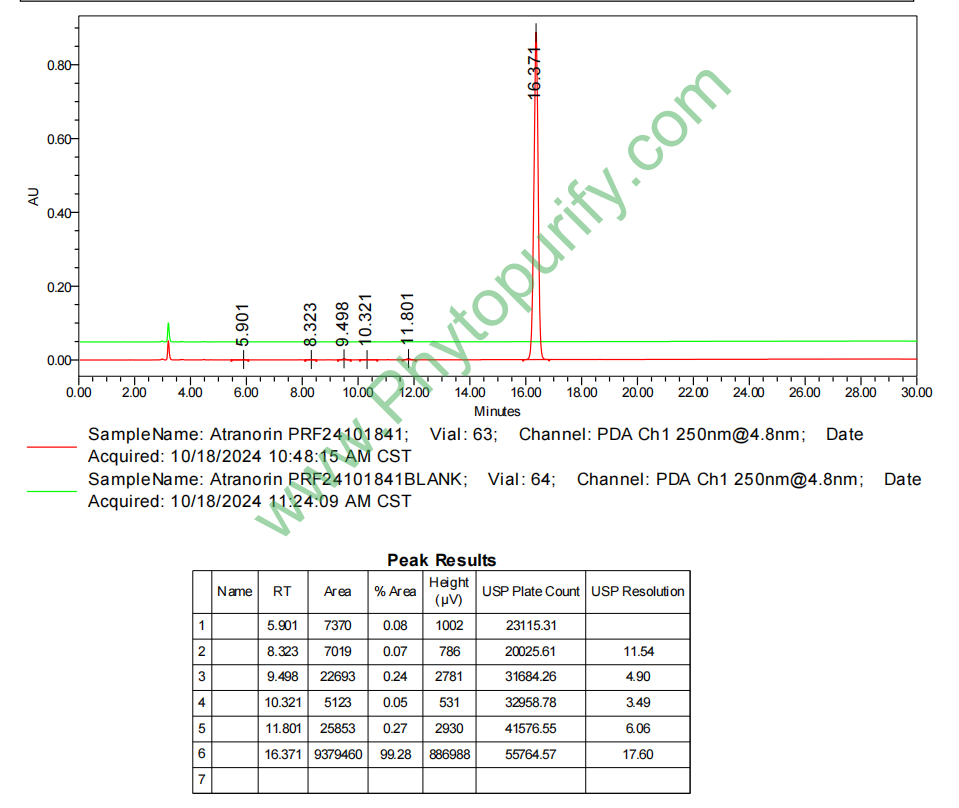
Purity: 95%~99%
Analysis Method: HPLC-DAD or/and HPLC-ELSD
Identification Method: Mass, NMR
Packing: Brown vial or HDPE plastic bottle
The product could be supplied from milligrams to grams
Inquire for bulk scale.
For Reference Standard and R&D, Not for Human Use Directly.
HPLC of Atranorin
Storage conditions:Short-term storage at 2~8℃, long-term storage at -20 ~ -80℃
Atranorin (CAS number: 479-20-9) is a typical secondary metabolite of lichens, belonging to the class of phenolic compounds with abundant biological activity. In recent years, lychee extract has become a research hotspot in the field of natural product pharmacology due to its multi-target and multifunctional pharmacological properties. Its significant antibacterial, anti-inflammatory, antioxidant, anti glycation, analgesic, and anti-tumor activities endow it with potential application value in various disease models, especially in the treatment research of myelodysplastic syndrome, tumors, and inflammation related diseases, showing good prospects.
Litchi extract, as an inhibitor of the Akt signaling pathway, can regulate cell proliferation, apoptosis, and metabolic processes, revealing its potential mechanism in tumor therapy. In addition, its ability to scavenge free radicals (DPPH, ABTS free radical scavenging IC50 of 117 μ M and<10 μ M, respectively) and promote wound healing have further expanded its pharmacological application scope. This article provides a systematic review of the chemical structure and physicochemical properties, plant sources and extraction methods, pharmacological activity, mechanism of action, pharmacological evaluation, and clinical application prospects of lychee extract. The aim is to provide theoretical support and research directions for its subsequent drug development and clinical translation.
The chemical name of lychee extract is 3- formyl-7-hydroxy-8-methyl-6-methoxycarbonyl-1,4-dihydroxy-2-naphthoic acid methyl ester, Molecular formula C19H18O8, molecular weight 374.3450. Its structural core is a benzoquinone skeleton derived from benzoic acid, containing multiple hydroxyl and carboxyl functional groups, endowing it with strong polarity and biological activity. The LogP value of lychee extract is 3.2557, indicating that it has moderate lipid solubility, which is beneficial for cell membrane penetration and bioavailability. Its topological polar surface area (TPSA) is 130.36 Å ², reflecting its high polarity and hydrogen bond donor/acceptor ability, which has a significant impact on its binding with biomolecules.
In terms of water solubility, the water solubility of lychee extract is 0.2145 mg/mL, which belongs to low solubility compounds, which may limit its oral absorption and bioavailability. The low permeability of the blood-brain barrier suggests that its role in the central nervous system is limited, but it also reduces the risk of central toxicity. The hERG channel inhibition test result was negative, indicating a low risk of cardiac toxicity for lychee extract. The Ames mutagenicity test result was 0.6, suggesting a low genetic toxicity risk and good safety basis.
Litchi extract mainly comes from lichens, especially from various genera of lichens such as Cladonia, Stereocalon, and other lichens in the family Lichenidae. Lichens, as symbiotic organisms, produce a large amount of secondary metabolites to adapt to extreme environments, among which lychee extract is an important secondary metabolite of benzoic acid.
Traditional extraction methods often use organic solvents such as ethanol, methanol, or ethyl acetate for extraction, combined with ultrasound assisted extraction or Soxhlet extraction to improve extraction efficiency. The extraction solution undergoes purification steps such as concentration, separation, and column chromatography (silica gel column, reverse phase C18 column) to obtain high-purity lychee extract. In recent years, green and efficient methods such as supercritical CO2 extraction and microwave-assisted extraction have gradually been applied to the extraction of lychee extract, significantly improving the extraction efficiency and purity, reducing the use of organic solvents, and in line with the environmental trend of modern natural product extraction.
Lychee extract exhibits inhibitory effects on various Gram positive and Gram negative bacteria, especially on clinically common pathogenic bacteria such as Staphylococcus aureus and Streptococcus pneumoniae. Its antibacterial mechanism may involve multiple pathways such as cell membrane disruption, protein synthesis inhibition, and DNA damage, and it also exhibits certain activity against drug-resistant strains, indicating its potential as a novel antibacterial agent.
Litchi extract exhibits significant anti-inflammatory activity by inhibiting the release of inflammatory mediators and activating inflammatory signaling pathways. In vitro and in vivo experiments have shown that lychee extract can downregulate the NF - κ B and MAPK signaling pathways, reduce the expression of pro-inflammatory cytokines such as TNF - α, IL-6, and IL-1 β, and alleviate inflammatory responses. In addition, it has a protective effect on inflammatory cell infiltration and tissue damage, and is suitable for adjuvant therapy of inflammatory diseases.
Litchi extract exhibits significant scavenging ability against DPPH and ABTS free radicals, with IC50 values of 117 μ M and less than 10 μ M, respectively, demonstrating strong antioxidant activity. Its antioxidant mechanism mainly activates the Nrf2 signaling pathway, induces the expression of downstream antioxidant enzymes (such as SOD1, CAT, GPX1, HMOX1, etc.), and enhances the antioxidant defense ability of cells. In addition, lychee element can also inhibit protein glycosylation reaction, slow down the formation of AGEs (advanced glycation end products), and has potential anti diabetes complications.
Lychee extract has shown good analgesic effects in various animal models, which may be related to its inhibition of inflammatory mediator release and regulation of neurotransmitters. The analgesic mechanism still needs further research, but there is evidence to suggest that it works by regulating the central and peripheral pain transmission pathways.
Litchi extract, as an Akt inhibitor, can block the PI3K/Akt/mTOR signaling pathway, induce tumor cell apoptosis, inhibit cell proliferation and migration. A number of in vitro cell experiments and in vivo tumor model studies have shown that lychee has inhibitory effects on a variety of tumor types (such as breast cancer, lung cancer, colorectal cancer, etc.). Its anti-tumor mechanism involves multiple aspects such as cell cycle arrest, induction of mitochondrial dependent apoptosis, and inhibition of tumor angiogenesis, demonstrating good potential for drug development.
The effect of lychee extract on promoting wound healing is mainly achieved by regulating inflammatory response, promoting fibroblast proliferation, and collagen synthesis. The experimental results indicate that lychee extract can promote wound closure speed, improve wound tissue structure, and has potential application value in wound repair.
The multiple pharmacological effects of lychee extract are attributed to its regulation of multiple molecular targets, particularly in the fields of antioxidant and anti-tumor effects.
Lychee extract enhances cellular antioxidant capacity by activating nuclear factor E2 related factor 2 (Nrf2) and its downstream target genes (such as SOD1, SOD2, CAT, GPX1, HMOX1). As the main regulator of intracellular antioxidant response, Nrf2 activation can promote the expression of antioxidant enzymes, eliminate excess free radicals, and alleviate oxidative stress damage. In addition, lychee extract also regulates the activity of matrix metalloproteinases (MMP1, MMP3) and tyrosinase (TYR), participates in extracellular matrix remodeling and melanin metabolism, and indirectly affects redox balance.
Lychee extract inhibits Akt kinase activity, blocks the PI3K/Akt signaling pathway, and regulates cell proliferation, apoptosis, and metabolism. The Akt pathway is abnormally activated in various tumor cells, promoting tumor cell survival and drug resistance. The inhibitory effect of lychee extract effectively induces tumor cell apoptosis and inhibits metastasis. In addition, lychee extract may also alleviate the promoting effect of inflammatory microenvironment on tumors by regulating signaling pathways such as NF - κ B and MAPK.
Lychee extract inhibits the expression of pro-inflammatory factors TNF - α, IL-6, and IL-1 β, reducing inflammatory response. Its mechanism of action involves inhibiting the activation of the NF - κ B signaling pathway, blocking inflammatory signal transduction, and reducing inflammatory cell infiltration. Lychee extract may also regulate immune cell function and promote the maintenance of immune homeostasis.
The molecular weight (374.3450) and LogP (3.2557) of lychee extract meet the basic requirements of Lipinski's rule, indicating its good drug similarity. A higher TPSA (130.36 Å ²) suggests strong polarity, which may affect oral absorption and cell membrane penetration. The low water solubility (0.2145 mg/mL) is a major limitation for its medicinal properties, and its bioavailability needs to be improved through drug formulation technology.
The blood-brain barrier has low permeability, making it suitable for treating peripheral diseases and reducing the risk of central nervous system side effects. The negative inhibition of hERG channel and good Ames test results indicate its high safety and low risk of genetic toxicity.
At present, there is limited research on the pharmacokinetics of lychee extract. Preliminary in vivo experiments have shown that its oral bioavailability is limited, mainly through liver metabolism, with a moderate half-life. In the future, further systematic research is needed to study its absorption, distribution, metabolism, and excretion (ADME) characteristics, optimize dosing regimens, and design dosage forms.
Litchi extract has good clinical translation prospects due to its extensive pharmacological activities, especially in the fields of anti-tumor, anti-inflammatory, and antioxidant potential. As an Akt inhibitor, it is suitable for adjuvant therapy of malignant hematological diseases such as myelodysplastic syndrome and solid tumors. In addition, the anti-inflammatory and wound healing promoting effects of lychee extract provide a new treatment approach for chronic inflammatory diseases and wound repair.
However, the clinical application of lychee extract still faces many challenges, including insufficient bioavailability due to low water solubility, unclear pharmacokinetic characteristics, and lack of systematic clinical safety evaluation. Future research should focus on optimizing the drug formulation of lychee extract, analyzing its metabolic mechanism in vivo, and conducting preclinical toxicology studies to promote its progress towards clinical trials.
In addition, the design and synthesis of derivatives based on the structure of lychee extract, combined with modern medicinal chemistry and computer-aided drug design techniques, are expected to develop candidate drugs with stronger activity and lower side effects. The in-depth analysis of the multi-target mechanism of action will also promote the application and expansion of lychee extract in the treatment of various complex diseases.
Litchi extract, as a natural secondary metabolite of benzoic acid derived from lichens, has become an important subject of natural product pharmacology research due to its diverse biological activities and good safety. Its significant effects in antibacterial, anti-inflammatory, antioxidant, anti glycation, analgesic, and anti-tumor aspects reveal its potential as a candidate molecule for multifunctional drugs. Although there are still certain limitations in pharmacokinetics and clinical applications, with the continuous advancement of extraction and purification technology, drug formulations, and mechanism research, lychee extract is expected to become an important component of future new natural medicines.
Future research should focus on refining the mechanism of action, pharmacokinetic optimization, and preclinical safety evaluation of lychee extract, combined with modern drug development strategies, to promote its clinical application and benefit more patients. The research on lychee extract not only enriches the theoretical system of natural product pharmacology, but also provides new drug resources and treatment ideas for the treatment of various diseases.
