


Product name: Germacrone
Synonym name: Germacrol (obsol;)
Catalogue No.: BP0641
Cas No.: 6902-91-6
Formula: C15H22O
Mol Weight: 218.34
Botanical Source: Geranium macrorrhizum, Curcuma wenyujin and Rhododendron adamsii
Physical Description: Cryst.
Type of Compound: Sesquiterpenoids
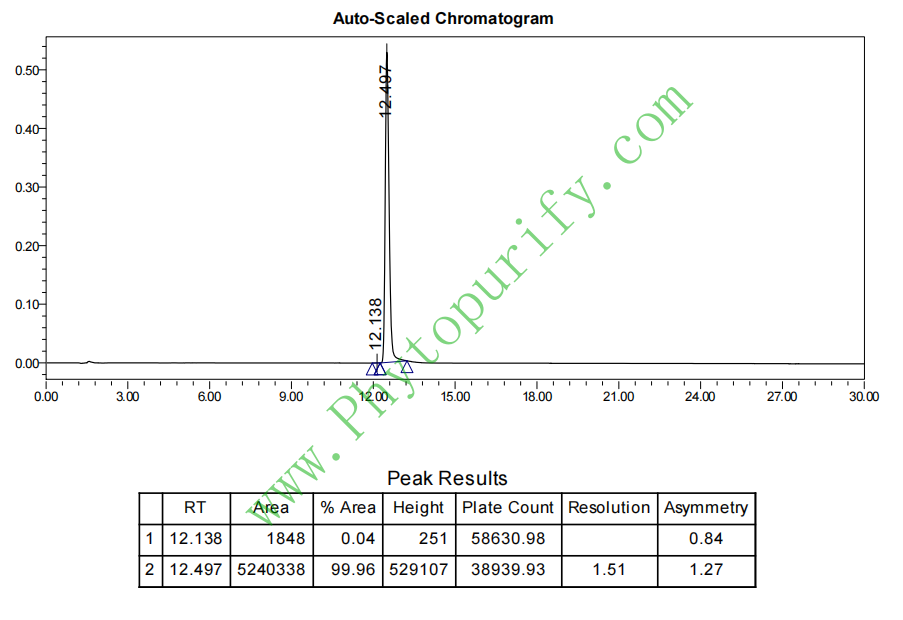
Purity: 95%~99%
Analysis Method: HPLC-DAD or/and HPLC-ELSD
Identification Method: Mass, NMR
Packing: Brown vial or HDPE plastic bottle
Storage: Store in a well closed container, protected from air and light. Put into refrigerate or freeze for long term storage.
Whenever possible, you should prepare and use solutions on the same day. However, if you need to make up stock solutions in advance, we recommend that you store the solution as aliquots in tightly sealed vials at -20℃. Generally, these will be useable for up to two weeks.
The product could be supplied from milligrams to grams, up to kilograms
Inquire for bulk scale.
Descriptions:
Germacrone, a natural product isolated from Rhizoma curcuma, can inhibit the proliferation of breast cancer cell lines by inducing cell cycle arrest and apoptosis through mitochondria-mediated caspase pathway. [1]
Germacrone moderately inhibits CYP2B6 and CYP3A4 activities in vitro, with IC50 values below 10 uM,and produces two oxidized metabolites and four glutathione conjugates. [2]
Germacrone has anti-tumor activity against liver cancer via regulating the expression of proteins related to G2/M cell cycle and apoptosis, and p53 and oxidative damage may play important roles in the inhibition of human hepatoma cells growth by germacrone. [3]
Germacrone shows antiviral activity against the H1N1 and H3N2 influenza A viruses and the influenza B virus in a dose-dependent manner, exerts an effective protection of mice from lethal infection and reduces the virus titres in the lung, it could as a therapeutic agent alone or in combination with other agents for the treatment of influenza virus infection. [4]
References:
[1] Zhong Z, Chen X, Tan W, et al. Eur J Pharmacol, 2011, 667(1-3):50-5.
[2] Pimkaew P, Küblbeck J, Petsalo A, et al. Toxicol In Vitro, 2013, 27(6):2005-12.
[3] Liu Y, Wang W, Fang B, et al. Eur J Pharmacol, 2012, 698(1-3):95-102.
[4] Liao Q, Qian Z, Liu R, et al. Antivir Res, 2013, 100(3):578-588.
[5] Tai C, Zhong Z, Zhang Q. Drug Standards of China, 2012,13(2):93-95.
HPLC of Germacrone
Storage conditions:Short-term storage at 2~8℃, long-term storage at -20 ~ -80℃
17.0700
3.9115
3.9115
.0586
8.5300
22.6563
High
85.1464
3.8005
No
Yes
No
No
No
No
0.0
No
Yes
Yes
Yes
Natural products have always been an important treasure trove for innovative drug discovery, among which sesquiterpenes have attracted much attention due to their structural diversity and wide range of biological activities. Germacrone, also known as (E) -6,10-dimethyl-3-propylene-1,6-cyclodecen-8-one, is a typical bicyclic sesquiterpene ketone with a CAS number of 6902-91-6. It was initially isolated and identified as a volatile component of various medicinal plants. Traditionally, its source plants such as Wenjujin and Curcuma are commonly used for promoting blood circulation, removing blood stasis, promoting qi circulation, and relieving pain. Modern pharmacological research has revealed that gemarone is far more than just an aromatic component. It exhibits multiple biological activities including antiviral, anti-inflammatory, anti-tumor, neuroprotective, and antioxidant effects, transforming it from a simple phytochemical component into a lead compound with significant research value. Especially in the current trend of drug development for multi-target and multi pathway treatment of complex diseases, the natural molecule of gemcitabine, which has multiple effects, has become particularly eye-catching. This article aims to provide a systematic review of the chemical properties, plant sources, pharmacological activities, molecular mechanisms of action, and potential medicinal properties of gemcitabine, in order to provide comprehensive scientific references for the in-depth research and development of this compound.
The molecular formula of Jimatone is C15H22O, with a molecular weight of 218.3400. The basic skeleton of this compound is a ten membered ring of gemane type sesquiterpene, which contains an alpha, beta unsaturated ketone group (cyclododecene-8-one) and an isopropylidene side chain. This unique structure is an important material basis for its biological activity, especially the alpha, beta unsaturated ketone groups, which often act as Michael reaction receptors and covalently bind with nucleophilic groups (such as thiol groups) in biomolecules, thereby affecting various protein functions.
From the analysis of physical and chemical properties, the lipid water partition coefficient (LogP) of Jimatone is 3.9115, indicating its good lipophilicity. Its topological polar surface area (TPSA) is relatively low, only 17.0700 Å ². These parameters collectively determine that gemperidone has high cell membrane permeability. The water solubility data (approximately 0.0586 mg/mL) confirms its insolubility in water, which poses a challenge for its formulation development. It is worth noting that based on its physical and chemical properties, gemcitabine has a high blood-brain barrier permeability, which is consistent with its pharmacological activity reports in neuroprotection, providing the possibility for the treatment of central nervous system diseases. The preliminary safety prediction shows that the hERG inhibition risk is negative, and the Ames test result is 0.0, indicating a low potential risk of cardiac and genetic toxicity, providing a favorable safety starting point for subsequent development.
Jimatone is mainly found in Zingiberaceae plants and is a key active ingredient and aroma source in various traditional Chinese medicinal materials.
1. Main source plants:
* Curcuma wenyujin Its rhizome (Curcuma zedoaria) is one of the most abundant and common sources of gibberellin.
* Curcuma phaeocaulis and Curcuma kwangsiensis from Guangxi These medicinal herbs of Curcuma zedoaria contain a high content of gibberellin.
* Turmeric and other plants in the genus Turmeric It has also been detected in some varieties of turmeric (Curcuma longa).
* Other plants There is also a small distribution in some plants of the Ericaceae and Asteraceae families.
A large number of in vitro and in vivo studies have confirmed that gemcitabine has broad and significant pharmacological activities.
Antiviral activity Jimatone exhibits a clear inhibitory effect on influenza virus. Research has shown that it can effectively inhibit the proliferation of influenza A viruses (H1N1, H3N2) and influenza B viruses. Its function may be related to interfering with the virus envelope function and inhibiting a certain link in the virus replication cycle, providing candidate molecules for the development of new anti influenza drugs.
Anti inflammatory and immune regulatory activity In inflammatory disease models such as rheumatoid arthritis, gemcitabine has shown good therapeutic effects. The mechanism involves regulating the balance of Th1/Th2 helper T cells and inhibiting excessive immune responses. At the same time, it can significantly inhibit the activation of the nuclear factor kappa B signaling pathway, thereby downregulating the expression of various pro-inflammatory cytokines (such as TNF - α, IL-1 β, IL-6) and exerting anti-inflammatory effects.
Antitumor activity Jimatone has growth inhibitory and pro apoptotic effects on various cancer cell lines.
Neuroprotective activity In neurodegenerative disease models such as traumatic brain injury, cerebral ischemia-reperfusion injury, and Alzheimer's disease, gemcitabine has shown protective effects. Its high blood-brain barrier permeability allows it to directly act on the central nervous system, protecting neurons through multiple pathways such as antioxidant, anti apoptotic, and neuroinflammatory inhibition.
antioxidant activity Jimatone itself can directly scavenge free radicals and upregulate the intracellular antioxidant defense system, such as activating the Nrf2/ARE pathway, enhancing the expression of antioxidant enzymes, and thereby reducing oxidative stress damage.
The multiple pharmacological activities of Jimatone stem from its interactions with multiple molecular targets, forming a complex network. Based on the provided prostate cancer-related targets, explain their possible network of action:
Regulating cell apoptosis and survival:
Intervention in hormone related pathways:
Inhibit tumor invasion and metastasis:
Overcoming multidrug resistance:
Regulating oxidative stress and inflammation:
Other potential targets:
In summary, gemcitabine exerts its synergistic effect against prostate cancer and other diseases by simultaneously acting on multiple key targets and pathways such as apoptosis, hormones, invasion, drug resistance, and oxidative stress.
Despite its broad pharmacological activity, the pharmacological properties of Jimatone still require systematic evaluation.
Pharmacokinetic characteristics Existing studies have shown that oral absorption of gemcitabine is relatively fast, but its bioavailability may be low due to significant first pass effects. In the body, gemcitabine is mainly metabolized through the liver, involving redox reactions of cytochrome P450 enzymes (such as CYP3A4), as well as binding reactions with glucuronic acid or sulfuric acid. Its main metabolites may have decreased activity or become inactive. Jimatone and its metabolites are mainly excreted through the kidneys and bile. Its high lipid solubility and blood-brain barrier permeability are prominent advantages in its pharmacokinetics.
Challenges and optimization of drug development:
safety Preliminary toxicological studies have shown that the toxicity of gemcitabine is relatively low, but long-term toxicity, reproductive toxicity, and interactions with other drugs still require further evaluation. Its lack of hERG inhibition and Ames negative results are a good starting point.
The clinical application prospects of gemcitabine are broad, but the road ahead is long.
Potential therapeutic areas:
Future research directions:
Jimatone, as a natural sesquiterpene compound derived from traditional medicinal plants, has shown great potential in modern pharmacological research due to its unique chemical structure and multi-target, multi pathway pharmacological mechanism of action. Its wide range of biological activities, from antiviral and anti-inflammatory to anti-tumor and neuroprotective, reveal its potential as a multifunctional therapeutic drug. Despite facing challenges such as water solubility and metabolic stability in drug development, these obstacles are expected to be overcome through the optimization of modern medicinal chemistry and pharmacology methods. In the future, through deeper mechanism research, rational structural modification, and standardized clinical development, Jimatone is expected to move from the laboratory to clinical practice, providing new candidate drugs or treatment strategies for the treatment of various major human diseases such as tumors, neurodegenerative diseases, and viral infections, fully reflecting the sustained value of natural products in innovative drug development.
