Introduction/Overview
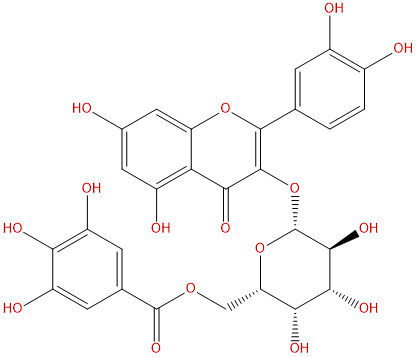
Quercetin 3-O - (6 '' - galloyl) - β - D-galactopyranoside (Quercetin 3-O - (6 '' - galloyl) - beta-D-galactopyranoside, hereinafter referred to as Quercetin galloyl galactoside) is a natural flavonoid glycoside compound belonging to quercetin derivatives. As a versatile natural product, this compound has attracted widespread attention in recent years for its potential pharmacological activities in various pathological states such as cardiovascular disease, tumors, antioxidants, osteoporosis, and lung diseases due to its unique structural modifications and multi-target effects. This article aims to systematically review the chemical properties, plant sources, pharmacological activities, mechanisms of action, pharmacological evaluation, and clinical application prospects of Quercetin 3-O - (6 '' - galloyl) - β - D-galactoside, providing theoretical basis and reference for subsequent related research.
Chemical structure and physicochemical properties
The molecular formula of Quercetin 3-O - (6 '' - galloyl) - β - D-galactoside is C29H24O17, with a molecular weight of 616.4840. Its structure is based on the quercetin skeleton, which is connected to β - D-galactose through glycosidic bonds at the 3-hydroxyl position. The 6 '' hydroxyl group of galactose is further esterified to form a gallic acid group. The typical feature of this compound is the polyphenolic structure complex of flavonoid nuclei, glycosides, and gallic acid, which endows it with good biological activity and strong antioxidant properties.
In terms of physical and chemical properties, the LogP value of the compound is about 1.0241, indicating that it has moderate lipophilicity and is conducive to cell membrane permeation; The topological polar surface area (TPSA) is relatively high (277.27 Å ²), indicating strong polarity that may affect oral absorption and bioavailability. The water solubility is 0.2748, indicating limited solubility in water, but its water solubility has been improved through glycosylation modification. Low blood-brain barrier permeability reduces the risk of central nervous system side effects. The hERG channel inhibition test was negative, indicating a low risk of cardiac toxicity. The Ames mutagenicity test score is 0.6, indicating that the compound has a low risk of genotoxicity and a good safety basis.
Plant sources and extraction methods
Quercetin 3-O - (6 '' - galloyl) - β - D-galactoside is mainly found in various traditional Chinese medicinal materials and plants, especially in some Quercetin rich plant species such as Ginkgo biloba leaves, tea leaves, and some traditional medicinal plants (such as gardenia, hawthorn, etc.). Quercetin and its esterified glycosides are commonly found in these plants and have high medicinal value.
The extraction method usually uses organic solvent extraction combined with liquid chromatography separation technology. The specific steps include:
- Raw material pretreatment Select plant dried powder with high content of quercetin glycosides for crushing and sieving.
- Solvent extraction Ethanol water mixed solutions (such as 70% ethanol) are often used for reflux or ultrasound assisted extraction to improve extraction efficiency.
- Crude extract concentration Obtain a concentrated extract by reducing pressure and concentrating to remove the solvent.
- Separation and purification Using silica gel column chromatography, reverse phase high-performance liquid chromatography (RPHPLC), or preparative liquid chromatography techniques, combined with mass spectrometry and nuclear magnetic resonance (NMR) for structural identification, quercetin galloyl galactoside was purified.
- Crystallization and drying Purified compounds are obtained into high-purity products through crystallization or freeze-drying.
In recent years, the application of supercritical CO2 extraction and membrane separation technology has also provided new ideas for the green and efficient extraction of this compound.
Pharmacological activity research
Quercetin 3-O - (6 '' - galloyl) - β - D-galactoside exhibits significant pharmacological activity in various disease models, mainly including the following aspects:
1. Cardiovascular diseases
This compound exerts cardiovascular protection by regulating multiple signaling pathways. Research has shown that it can activate AMPK (PRKAA1), promote energy metabolism and cellular homeostasis; Inhibit TLR4 mediated inflammatory response and reduce myocarditis damage; Regulating BCL2 family proteins and inhibiting cardiomyocyte apoptosis; Reduce platelet selective protein (SELP) expression to prevent thrombosis. In addition, regulation of PTPN1 (protein tyrosine phosphatase 1B) and PRKCA (protein kinase C alpha) can help improve insulin resistance and vascular function.
2. Prostate cancer
Quercetin galloyl galactoside exhibits anti proliferative and pro apoptotic effects in prostate cancer cells. It inhibits the proliferation and migration of tumor cells by regulating the STAT3 signaling pathway; Activate the apoptotic pathway mediated by CASP9; Regulating the expression of AR (androgen receptor) and CYP19A1 (aromatase) to intervene in hormone dependent tumor growth; In addition, by upregulating the NFE2L2 (NRF2) antioxidant pathway, the oxidative stress state of tumor cells can be alleviated.
3. Antioxidant effect
As a polyphenolic compound, quercetin galloyl galactoside exhibits strong antioxidant capacity. It activates the NFE2L2/NRF2 signaling pathway, induces the expression of downstream antioxidant enzymes such as SOD1, SOD2, CAT, GPX1, and HMOX1, clears free radicals, and reduces oxidative damage. Meanwhile, inhibiting the activity of MMP1 and MMP3 helps maintain extracellular matrix stability and delay tissue aging.
4. Osteoporosis
This compound exerts anti osteoporosis effects by regulating bone metabolism related targets. It activates the AMPK and SIRT1 signaling pathways, promotes osteoblast activity, and inhibits osteoclast differentiation; Regulating the expression of estrogen receptors (ESR1, ESR2) to improve bone density; Inhibit the expression of inflammatory factor TNF and alleviate bone resorption; In addition, it affects the PPARG and MAPK signaling pathways and regulates bone metabolism balance.
5. Pulmonary diseases (chronic obstructive pulmonary disease, COPD)
Quercetin galloyl galactoside enhances lung tissue antioxidant defense by activating the NFE2L2/NRF2 pathway; Inhibit NFKB1 mediated inflammatory response and reduce inflammatory cell infiltration; Regulating the signaling of vascular endothelial growth factor receptor KDR and PI3K to improve pulmonary vascular function; In addition, intervening in cytokine signaling mediated by IL1R1 and IL6R can alleviate chronic inflammatory states.
Mechanism of action and molecular targets
The multi-target mechanism of action of Quercetin 3-O - (6 '' - galloyl) - β - D-galactoside is the basis of its pharmacological activity, involving multiple signaling pathways and key proteins:
- AMPK(PRKAA1)As a cellular energy sensor, activating AMPK promotes metabolic homeostasis, inhibits inflammation and cell apoptosis.
- BCL2 Regulating the apoptotic pathway to protect cells from excessive apoptosis.
- STAT3 Participating in cell proliferation and immune regulation, inhibiting their abnormal activation can help with anti-tumor treatment.
- NFE2L2/NRF2 Dominate antioxidant response and induce expression of multiple antioxidant enzymes.
- PTPN1 Regulating insulin signaling and inflammatory response, affecting metabolic diseases and tumors.
- ESR1/ESR2 Estrogen receptors regulate bone metabolism and hormone related diseases.
- MAPK1/MAPK8 Participate in cell proliferation, differentiation, and stress response.
- CASP9 Key enzymes involved in mitochondrial pathway apoptosis.
- TLR4 Inflammatory response initiates receptors, mediating immune activation.
- SIRT1 Regulating cell lifespan and metabolism.
- MMP1/MMP3 Matrix metalloproteinases are involved in tissue remodeling.
- AKR1B1 Aldose reductase is involved in complications of diabetes.
- SELP Platelet selective factor, involved in thrombus formation.
- AR Androgen receptor, a key target for prostate cancer.
- CYP19A1 Aromatase regulates estrogen synthesis.
- PIK3CA PI3K catalytic subunit regulates cell survival and proliferation.
- TNF Pro-inflammatory cytokines mediate inflammation and bone resorption.
- NFKB1 Inflammatory transcription factors.
- KDR Vascular endothelial growth factor receptor regulates angiogenesis.
- IL1R1/IL6R Inflammatory cytokine receptors.
Overall, quercetin galloyl galactoside achieves multidimensional pharmacological effects by synergistically regulating multiple targets and signaling pathways mentioned above.
Evaluation of drug properties and pharmacokinetics
Quercetin 3-O - (6 '' - galloyl) - β - D-galactoside exhibits certain advantages and challenges in drug development:
- Molecular weight and polarity The molecular weight of 616.4840 is relatively high, with a TPSA of 277.27 Å ², indicating its strong polarity, which may limit oral absorption and cell membrane permeability.
- fat-soluble LogP is about 1.02, moderate, which is beneficial for the distribution of drugs in the body.
- Water solubility The water solubility is 0.2748, which is relatively low and may affect the development and bioavailability of the formulation.
- Blood-brain barrier permeability Low, reducing the risk of adverse reactions in the central nervous system.
- safety HERG channel inhibition is negative, reducing the risk of cardiac toxicity; The Ames test score is 0.6, indicating low genotoxicity.
- Metabolic stability At present, there is limited data on in vitro and in vivo metabolism, and it is speculated that glycosylation and esterification structures may affect enzymatic metabolism rate and metabolic pathways.
- pharmacokinetics Preliminary animal experiments have shown that the compound is slowly absorbed after oral administration, and its bioavailability is limited. Therefore, it is necessary to improve the formulation or modify the structure to enhance in vivo exposure.
In the future, the focus should be on conducting systematic pharmacokinetic studies, including absorption, distribution, metabolism, and excretion (ADME) characteristics, combined with in vivo targeted delivery technology, to optimize its clinical development potential.
Clinical application prospects and prospects
Quercetin 3-O - (6 '' - galloyl) - β - D-galactoside has shown extensive clinical potential due to its multi-target and multi pathway pharmacological activities
- Prevention and treatment of cardiovascular diseases Through regulating energy metabolism, anti-inflammatory and anti apoptosis mechanisms, it is expected to become a candidate drug for preventing and treating atherosclerosis, myocardial ischemia-reperfusion injury and heart failure.
- Tumor treatment adjuvant Especially in the field of prostate cancer, combining with existing hormone therapy may improve efficacy and reduce side effects.
- Antioxidant and anti-aging properties As a natural antioxidant, it can be used as an adjuvant therapy for chronic diseases and age-related degenerative diseases.
- Management of osteoporosis By regulating the bone metabolism signaling pathway, it promotes bone formation, inhibits bone resorption, and has a bone protective effect.
- Relief of pulmonary diseases In chronic inflammatory lung diseases such as COPD, lung function is improved through antioxidant and anti-inflammatory effects.
However, current preclinical research on this compound is still in its early stages and lacks systematic clinical trial data. Future research should focus on:
- Optimize extraction and preparation processes to improve purity and stability;
- Conduct in-depth pharmacokinetic and toxicological evaluations to ensure safety;
- Design a reasonable clinical trial plan to verify its efficacy and safety;
- Explore combination therapy strategies to enhance synergistic effects;
- Using novel delivery systems such as nanocarriers to overcome bioavailability limitations.
Conclusion
Quercetin 3-O - (6 '' - galloyl) - β - D-galactoside, as a structurally unique natural flavonoid glycoside compound, has shown broad application prospects in cardiovascular diseases, tumors, antioxidants, osteoporosis, and lung diseases due to its multi-target and multifunctional pharmacological properties. Although there are certain challenges in its pharmacological development, through the optimization of modern medicinal chemistry and formulation technology, it is expected to overcome absorption and metabolic limitations and promote its clinical translation. Future systematic research will provide a solid foundation for the drug development of this compound, promoting the application and development of natural products in modern medicine.