| Catalog No | Package | Original Price | Price | Inventory | Quantity | Operating |
|---|---|---|---|---|---|---|
| BP0296-100mg | 100mg | $20.00 | Sign in |
|


Storage conditions:Short-term storage at 2~8℃, long-term storage at -20 ~ -80℃
Butyl 4-hydroxybenzoate (CAS number: 94-26-8), as an important organic molecular entity, is widely present in nature, especially in the secondary metabolites of various plants. As a member of the paraben preservatives, it is widely used in the fields of food, cosmetics, and medicine due to its excellent antibacterial properties and low toxicity. In recent years, with the development of natural product pharmacology, the pharmacological activity and molecular mechanism of butyl hydroxybenzoate have gradually deepened, especially in the prevention and treatment of bacterial infection related diseases, showing potential application value. This article will provide a systematic review of the chemical structure and physicochemical properties, plant sources and extraction methods, pharmacological activity, mechanism of action and molecular targets, pharmacological evaluation and pharmacokinetic characteristics of butyl hydroxybenzoate. Finally, it will explore its clinical application prospects and future research directions.
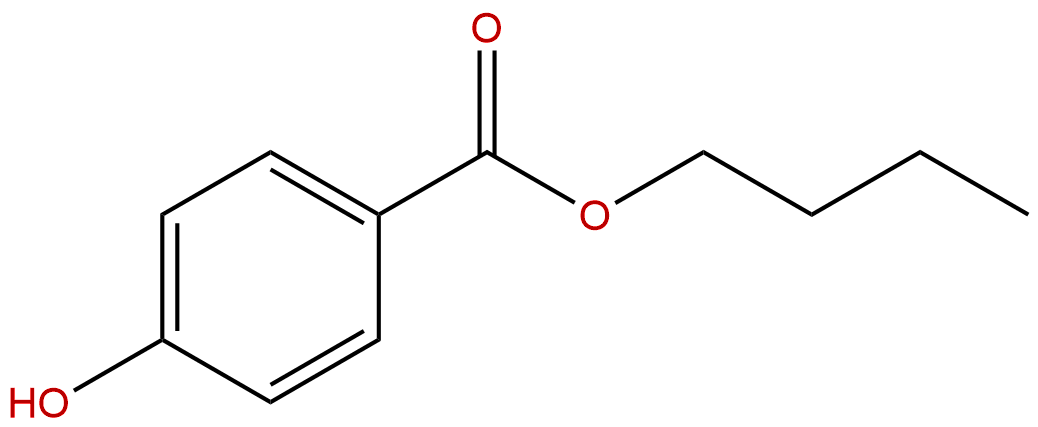
The chemical formula for butyl hydroxybenzoate is C11H14O3, with a molecular weight of 194.23. Its structure is composed of a para hydroxy substituted benzene ring and a butyl ester group connected by an ester bond. The presence of hydroxyl groups in the molecule gives it a certain polarity, while the butyl group increases hydrophobicity, resulting in moderate lipid solubility (LogP of about 3.2) overall, which has a positive impact on its biofilm penetration.
In terms of physical and chemical properties, the topological polar surface area (TPSA) of butyl hydroxybenzoate is 46.53 Å ², with 3 hydrogen bond acceptors, indicating its hydrophilicity and potential for binding with biomolecules. Its molecular structure is stable, easily soluble in organic solvents, and appears as a colorless or light yellow crystalline solid at room temperature. According to the prediction of blood-brain barrier permeability, it has a high penetration ability, indicating its potential application in central nervous system related diseases.
Butyl paraben is widely present in various plants, especially in the roots, stems, leaves, and fruits of certain medicinal plants. Typical plant sources include Rosaceae, Solanaceae, and Umbelliferae plants, which synthesize parabens through the phenylalanine metabolic pathway in their bodies. Its content is greatly affected by plant species, growth environment, harvesting period, and processing methods.
The common methods for extracting butyl paraben mainly include solvent extraction, supercritical fluid extraction, and microwave-assisted extraction. Traditional solvent extraction often uses ethanol, methanol, or ethyl acetate as solvents, and is purified through impregnation or reflux extraction, combined with liquid-liquid distribution and column chromatography techniques. Modern extraction techniques such as supercritical CO2 extraction are gradually being applied due to their high efficiency and environmental friendliness, which can extract high-purity butyl paraben at lower temperatures and reduce the degradation of heat sensitive components. In addition, microwave-assisted extraction promotes cell wall rupture through microwave energy, improves extraction efficiency, and shortens extraction time.
The pharmacological activity research of butyl hydroxybenzoate mainly focuses on its antibacterial, anti-inflammatory, and antioxidant properties. A large number of in vitro experiments have shown that this compound has significant inhibitory effects on various Gram positive and negative bacteria, especially exhibiting low minimum inhibitory concentrations (MIC) against Staphylococcus aureus, Escherichia coli, and Pseudomonas aeruginosa. Its antibacterial mechanism involves multiple pathways such as cell membrane disruption, protein synthesis inhibition, and DNA replication interference.
In addition, butyl hydroxybenzoate also exhibits certain anti-inflammatory activity. By inhibiting the release of inflammatory mediators and regulating immune cell function, inflammation can be alleviated. Related in vivo model studies have shown that it has a protective effect in reducing local inflammation and systemic inflammatory responses caused by bacterial infections.
In terms of antioxidant activity, butyl paraben can scavenge free radicals, reduce oxidative stress damage to cells, and further support its potential in preventing and treating infections and related complications.
The mechanism of action of butyl paraben against bacterial infections involves multiple molecular targets, mainly including MCL1, TLR4, PTPN1, APEX1, SERPINE1, PRKCA, GYRA, GYPB, FTSZ, and FABI.
In summary, butyl hydroxybenzoate achieves effective inhibition and immune regulation against bacterial infections through multi-target and multi pathway synergistic effects.
From the perspective of pharmacological parameters, butyl paraben has good potential for drug development. Its molecular weight is 194.23, which conforms to the ideal range of Lipinski's rule. The LogP value is 3.2, indicating moderate lipid solubility, which is beneficial for cell membrane penetration and in vivo distribution. The TPSA is 46.53 Å ² and the number of hydrogen bond acceptors is 3, both of which contribute to improving bioavailability.
Toxicological evaluation shows that the acute toxicity of butyl hydroxybenzoate is relatively low, with an LD50 of about 2000 mg/kg, indicating its high safety. Hepatotoxicity, cardiotoxicity (including hERG channel inhibition), and genotoxicity (Ames test) were all negative, further supporting its safety.
In terms of pharmacokinetics, the compound exhibits excellent blood-brain barrier penetration ability, indicating its potential in the treatment of central nervous system diseases. Its metabolism in the body is mainly carried out through the liver enzyme system, and the metabolites are stable and have no significant toxicity. Moderate half-life in the body, conducive to maintaining effective drug concentration.
However, further detailed research is needed on its oral bioavailability and metabolic pathways to optimize the dosing regimen and formulation design.
Butyl hydroxybenzoate, as a naturally derived compound, has broad clinical application prospects due to its multi-target antibacterial properties and good safety. It may become a novel adjuvant or alternative therapeutic drug in the prevention and treatment of bacterial infections, especially drug-resistant strains. In addition, its anti-inflammatory and antioxidant effects provide potential therapeutic strategies for infection related inflammatory diseases.
Future research should focus on the following aspects:
Butyl hydroxybenzoate, as a natural compound with multiple biological activities, exhibits excellent antibacterial, anti-inflammatory, and safety characteristics. Its multi-target mechanism of action provides new ideas and strategies for the treatment of bacterial infections. Although there is a preliminary understanding of its pharmacological effects and drug properties, further mechanism research and systematic preclinical evaluation are still needed to promote its clinical application. In the future, with the continuous advancement of natural product pharmacology and modern drug development technology, butyl paraben is expected to become an important drug candidate in the field of anti infection, contributing new strength to human health.
