Pharmacological research progress and clinical application prospects of Albanin A
Introduction/Overview
Natural products, as an important source of drug discovery, have long played an irreplaceable role in maintaining human health and treating diseases. Flavonoids, as an important component of plant secondary metabolites, have attracted much attention due to their structural diversity and wide range of biological activities. Albanin A, as a flavonoid compound with unique pharmacological characteristics, has shown significant research value in neuroprotection, anti-inflammatory, and anti-tumor fields in recent years.
The discovery of Albanin A can be traced back to the late 1970s, when it was initially isolated from the mulberry family. With the deepening of research, scientists have gradually revealed its multi-target and multi pathway action characteristics. In particular, its unique mechanism of inhibiting glutamate release by regulating the calcium ion/calmodulin/adenylate cyclase 1 (AC1) signaling pathway in the synapse provides a new approach for the treatment of neurodegenerative diseases. Meanwhile, Albanin A has shown remarkable potential in the field of anti-tumor activity, as it can exert anti-tumor activity by regulating multiple key targets such as MCL1, BCL2, STAT3, etc.
This article will provide a systematic review of the research progress of Albanin A from multiple dimensions, including chemical structure, plant origin, pharmacological activity, mechanism of action, pharmacological evaluation, and clinical application prospects, in order to provide reference for the in-depth research and development of this compound.
Chemical structure and physicochemical properties
Chemical structural characteristics
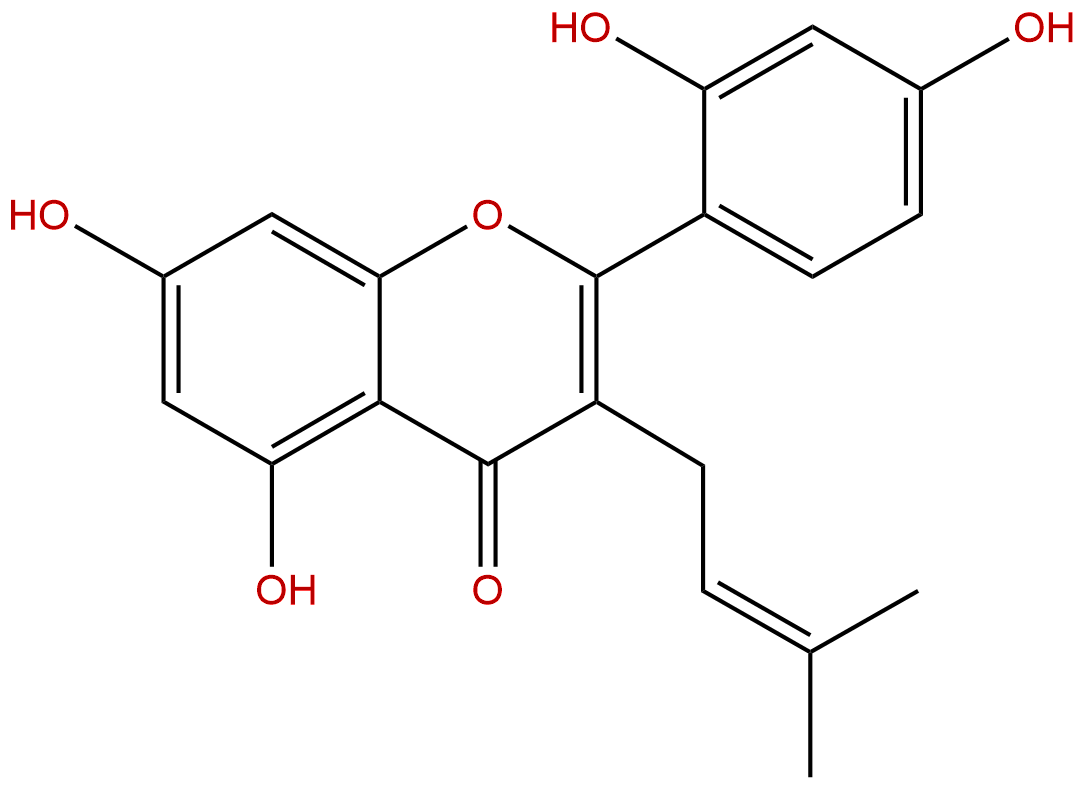
Albanin A belongs to the flavonoid compound family, and its chemical structure has typical flavonoid skeleton characteristics. From the structural analysis, the parent nucleus of Albanin A is a 2-phenylchromenone structure, with multiple hydroxyl substituents on the A and B rings. These hydroxyl groups not only endow the molecule with excellent hydrogen bond donor/acceptor capabilities, but also serve as an important structural basis for its biological activity. The molecular formula is C20H18O6 and the molecular weight is 354.3580 g/mol.
It is worth noting that the chemical structure of Albanin A contains an isopentenyl side chain, which is a unique structural feature in flavonoid compounds. The introduction of isopentenyl not only increases the lipophilicity of the molecule, but also significantly affects its interaction mode with biological targets. Research has shown that the presence of isopentenyl groups can enhance the binding ability of flavonoid compounds to cell membranes, promote their transmembrane transport, and thus improve their bioavailability.
Physical and chemical property parameters
From the perspective of medicinal properties, the physicochemical parameters of Albanin A exhibit the following characteristics:
Lipid water partition coefficient (LogP): 3.5278. This value indicates that Albanin A has moderate lipid solubility, being able to dissolve in lipid environments while maintaining a certain degree of water solubility. LogP values in the range of 2-4 are generally considered the ideal lipid water balance range for drug molecules, which is beneficial for oral absorption and transmembrane transport.
Topological Polarity Surface Area (TPSA): 111.1300 Å ². TPSA is an important parameter for predicting drug oral absorption and blood-brain barrier penetration ability. The TPSA value of Albanin A is slightly higher than the ideal range for oral medication (usually<140 Å ²), indicating that it may be absorbed through active transport or paracellular pathways.
Water solubility:0.0583 mg/mL。 The low water solubility of this compound may limit the development of its oral formulations. However, its solubility can be improved through appropriate formulation techniques such as nanoemulsions, liposomes, cyclodextrin inclusion complexes, etc.
Blood-brain barrier penetration ability: Low. This characteristic presents both challenges and opportunities for the neuroprotective effect. On the one hand, low blood-brain barrier penetration may limit its direct effects in the central nervous system; On the other hand, by regulating peripheral glutamate levels or indirectly affecting central nervous system function, Albanin A may still exert neuroprotective effects.
HERG inhibition: Negative. HERG potassium channel inhibition is an important indicator of drug cardiac toxicity, and Albanin A has no hERG inhibitory effect, indicating its good cardiac safety.
Ames test: 0.6. This value indicates that Albanin A presents weak positive or negative results in the Ames test, suggesting a low risk of genetic toxicity.
Plant sources and extraction methods
Main plant sources
Albanin A mainly exists in Moraceae plants, especially in the root bark, stem bark, and leaves of Morus plants. The plants currently reported to contain Albanin A include:
-
Mulberry tree (Morus alba L.)Mulberry trees are one of the main sources of Albanin A, with high content in their root bark and stem bark. Mulberry tree, as a traditional Chinese medicinal herb, has a long history of medicinal use. Its root bark (mulberry bark) is commonly used to treat diseases such as cough and edema.
-
Morus Australis Poir The root bark of chicken mulberry also contains abundant Albanin A, which is another important natural source.
-
Broussonetia Papyrifera As another representative of the mulberry family, Albanin A has also been detected in the fruit and bark of the mulberry tree.
-
Other mulberry plants Compounds such as Morus mongolica and Morus cathayana may also contain this compound.
Extraction and purification methods
The extraction of Albanin A is usually carried out using organic solvent extraction combined with modern chromatographic separation techniques. The classic extraction process is as follows:
Step 1: Raw material pretreatment Crush the dried plant material (usually root bark or stem bark) to an appropriate particle size and sieve through a 40-60 mesh sieve.
Step 2: Solvent Extraction Ethanol or methanol is used as the extraction solvent, and the solid-liquid ratio is usually 1:10-1:20 (w/v). The extraction is carried out at room temperature or under heating conditions. To improve extraction efficiency, ultrasound assisted extraction or microwave-assisted extraction techniques can be used. Research has shown that extracting 70% ethanol solution at 60 ℃ for 2 hours can achieve a higher yield of Albanin A.
Step 3: Extraction and Enrichment After vacuum concentration, the extract was subjected to liquid-liquid extraction using solvents such as petroleum ether, ethyl acetate, and n-butanol in sequence. Albanin A is mainly enriched in the ethyl acetate extraction layer.
Step 4: Chromatographic Separation Silica gel column chromatography, ODS reverse phase column chromatography, Sephadex LH-20 gel chromatography and other separation technologies were used for purification. Common elution systems include gradient elution systems such as chloroform methanol and ethyl acetate methanol.
Step 5: Structural Identification Confirm the structure of the isolated compounds using techniques such as nuclear magnetic resonance spectroscopy (NMR), mass spectrometry (MS), and infrared spectroscopy (IR).
In recent years, the application of advanced separation technologies such as high-speed countercurrent chromatography (HSCCC) and preparative high-performance liquid chromatography (pre HPLC) has significantly improved the separation efficiency and purity of Albanin A.
Pharmacological activity research
Neuroprotective effect
One of the most notable pharmacological activities of Albanin A is its neuroprotective effect. Glutamate is the most important excitatory neurotransmitter in the central nervous system, but excessive release can lead to excitotoxicity and participate in the pathological processes of various neurodegenerative diseases. Albanin A exerts neuroprotective effects by inhibiting the release of glutamate in the synaptosomes.
Research has shown that Albanin A can significantly reduce glutamate release induced by high potassium stimulation or 4-aminopyridine. In the model of cerebral ischemia-reperfusion injury, Albanin A pretreatment can reduce infarct size and improve neurological function scores. In addition, in Alzheimer's disease models, Albanin A can alleviate beta amyloid induced neuronal damage and protect synaptic plasticity.
anti-inflammatory activity
Inflammatory response is a common pathological basis for various diseases. Albanin A exhibits significant anti-inflammatory activity both in vitro and in vivo. In a macrophage model stimulated by lipopolysaccharide (LPS), Albanin A can inhibit the production of pro-inflammatory cytokines such as tumor necrosis factor - α (TNF - α), interleukin-6 (IL-6), and interleukin-1 β (IL-1 β). Meanwhile, it can also reduce the synthesis of nitric oxide (NO) and prostaglandin E2 (PGE2), which is related to the inhibition of inducible nitric oxide synthase (iNOS) and cyclooxygenase-2 (COX-2) expression.
Albanin A exhibits dose-dependent anti-inflammatory effects in both acute inflammation models (such as carrageenan induced foot swelling) and chronic inflammation models (such as adjuvant arthritis). Its anti-inflammatory mechanism involves the regulation of nuclear factor kappa B (NF - κ B) and mitogen activated protein kinase (MAPK) signaling pathways.
Antitumor activity
Albanin A exhibits anti proliferative and pro apoptotic activity in various tumor cell lines. The study involves the following types of tumors:
breast cancer Albanine A can inhibit the proliferation of MCF-7 and MDA-MB-231 breast cancer cells, and induce cell cycle arrest in G0/G1 phase. Its mechanism of action is related to down regulating the expression of estrogen receptor α (ESR1) and aromatase (CYP19A1), suggesting its therapeutic potential in hormone dependent breast cancer.
liver cancer In HepG2 and Huh7 liver cancer cells, Albanin A induces apoptosis by activating the caspase cascade reaction, while inhibiting the expression of matrix metalloproteinase 2 (MMP2), reducing cell migration and invasion ability.
Lung cancer Albanin A has cytotoxic effects on A549 lung cancer cells, which involve inhibition of topoisomerase I (TOP1) and topoisomerase II alpha (TOP2A), interfering with DNA replication and transcription processes.
leukemia In HL-60 and K562 leukemia cells, Albanin A induces mitochondrial apoptosis by downregulating the expression of MCL1 and BCL2, upregulating the expression of BAX. At the same time, it can also inhibit the phosphorylation of signal transduction and transcription activator 3 (STAT3), blocking the downstream transmission of anti apoptotic signals.
Other tumors Albanin A also exhibits certain inhibitory effects on tumor cells such as colon cancer, gastric cancer, and melanoma. It is worth noting that Albanin A has low toxicity to normal cells and exhibits a certain degree of selectivity.
Other pharmacological activities
In addition to the main activities mentioned above, Albanin A also has biological activities such as antioxidant, antibacterial, and antiviral. Its antioxidant activity is related to its ability to scavenge free radicals and chelate metal ions; Antibacterial activity mainly targets Gram positive bacteria such as Staphylococcus aureus and Bacillus subtilis.
Mechanism of action and molecular targets
Neuroprotective mechanism
The core mechanism of the neuroprotective effect of Albanin A involves the regulation of the Ca ² ⁺/calmodulin/adenylate cyclase 1 (AC1) signaling pathway. Specifically:
-
Inhibit the influx of calcium ions Albanin A can block voltage dependent calcium channels (VDCC) and N-methyl-D-aspartate (NMDA) receptor-mediated calcium influx, reducing intracellular calcium ion concentration at presynaptic terminals.
-
Interference with calmodulin activation Calmodulin (CaM), as a calcium ion sensor, undergoes conformational changes upon binding to calcium ions, activating downstream effectors. Albanin A may directly bind to calmodulin, interfering with its interaction with AC1.
-
Inhibit AC1 activity Adenylate cyclase 1 (AC1) is a calmodulin dependent adenylate cyclase subtype that regulates cAMP synthesis in presynaptic terminals. Albanin A inhibits AC1 activity, reduces cAMP production, and subsequently lowers protein kinase A (PKA) activity, ultimately inhibiting the release of glutamate vesicles.
-
Reduced release of glutamate The inhibition of the above signaling pathways leads to a decrease in presynaptic glutamate release, reducing excitotoxicity and protecting neurons from damage.
Anti inflammatory mechanism
The anti-inflammatory effect of Albanin A involves the regulation of multiple signaling pathways:
-
Inhibition of NF - κ B pathway Albanin A can inhibit the phosphorylation and degradation of I κ B α, prevent the nuclear translocation of NF - κ B p65 subunit, and thus reduce the transcription of pro-inflammatory genes.
-
MAPK pathway regulation Albanin A can inhibit the phosphorylation of p38 MAPK and JNK, but has little effect on the phosphorylation of ERK, exhibiting selective regulatory characteristics.
-
NLRP3 inflammasome inhibition The latest research shows that Albanin A can inhibit the assembly and activation of NLRP3 inflammasomes, reduce the activation of caspase-1 and mature secretion of IL-1 β.
Antitumor mechanism
The anti-tumor effect of Albanin A is multi-target and multi pathway:
-
Apoptosis induction By downregulating the anti apoptotic proteins MCL1 and BCL2, upregulating the pro apoptotic protein BAX, activating caspase-9 and caspase-3, and initiating mitochondrial pathway apoptosis.
-
STAT3 signal suppression Albanin A can inhibit the phosphorylation of the Tyr705 site of STAT3, block its dimerization and nuclear translocation, and reduce the expression of downstream target genes such as Cyclin D1, Survivor, and VEGF.
-
HIF-1 α regulation Under hypoxic conditions, Albanin A can inhibit the protein accumulation of hypoxia inducible factor 1 alpha (HIF-1 alpha), reduce its transcriptional activity, and thus inhibit tumor angiogenesis.
-
Topoisomerase inhibition Albanin A, as an inhibitor of topoisomerase I and II α, can stabilize DNA topoisomerase complexes, leading to DNA damage and cell death.
-
Regulation of estrogen signaling In breast cancer cells, albanin A can down regulate the expression of ESR1 and inhibit estrogen mediated cell proliferation signal.
Evaluation of drug properties and pharmacokinetics
Analysis of drug properties parameters
Based on Lipinski's Five Rules and Veber's Rules, the pharmacological parameters of Albanin A are as follows:
- Molecular weight (354.36 Da)<500 Da, in compliance with regulations
- LogP(3.53)< 5, comply with the rules
- Number of hydrogen bond donors (4)<5, in compliance with the rules
- The number of hydrogen bond acceptors (6) is less than 10, which complies with the rules
- TPSA (111.13 Å ²)<140 Å ², compliant with Veber rules
- The number of rotatable keys (3) is less than 10, which complies with the Veber rule
The above parameters indicate that Albanin A has a good pharmacological basis. However, its low water solubility (0.0583 mg/mL) may become a limiting factor in the development of oral formulations.
Pharmacokinetic characteristics
At present, there is insufficient systematic research on the pharmacokinetics of Albanin A, but some data are available for reference:
absorb Based on LogP and TPSA parameters prediction, the oral absorption of Albanin A may be moderate. Its low water solubility may lead to limited dissolution rate and affect oral bioavailability. Formulation strategies such as solid dispersions, nanocrystals, etc. may improve their absorption.
distribution The distribution volume of Albanin A may be moderate, and its binding rate with plasma proteins needs to be experimentally determined. Its blood-brain barrier penetration is low, indicating limited distribution of the central nervous system.
Metabolism As a flavonoid compound, Albanin A may undergo extensive phase II metabolism, including glucuronidation and sulfation. CYP450 enzyme mediated phase I metabolism may also occur, especially the oxidation of isopentenyl side chains.
excretion Metabolites are mainly excreted through bile and urine. The renal excretion of the prototype drug may be limited.
safety evaluation
The preliminary safety evaluation results of Albaning A are encouraging:
- No hERG inhibitory effect, low risk of cardiac toxicity
- Ames test negative, low risk of genetic toxicity
- Low toxicity to normal cells, exhibiting a certain degree of selectivity
However, systematic toxicology research (including acute toxicity, chronic toxicity, reproductive toxicity, etc.) still needs to be conducted to comprehensively evaluate its safety.
Clinical application prospects and prospects
Neurodegenerative diseases
The unique mechanism by which Albanin A exerts neuroprotective effects by inhibiting glutamate release makes it potentially valuable in the treatment of neurodegenerative diseases such as cerebral ischemia, Alzheimer's disease, and Parkinson's disease. Especially its low blood-brain barrier penetration suggests that it may indirectly affect central nervous system function by regulating peripheral glutamate levels, or achieve central delivery through non-traditional pathways such as intranasal administration.
Inflammatory diseases
The anti-inflammatory activity of Albanin A makes it promising for the treatment of chronic inflammatory diseases such as rheumatoid arthritis, inflammatory bowel disease, and asthma. Its multi-target action characteristics may provide better therapeutic effects than single target drugs.
tumor therapy
The anti-tumor activity spectrum of Albanin A is extensive, involving multiple types of tumors. Its multi-target mechanism of action, including apoptosis induction, STAT3 inhibition, HIF-1 α regulation, etc., makes it a potential candidate drug for combination chemotherapy. Especially its dual regulation of MCL1 and BCL2 has special value in overcoming tumor drug resistance.
Challenges and Countermeasures
Despite the multifaceted pharmacological activities and good pharmacological basis of Albanin A, its development still faces the following challenges:
-
Low water solubility It can be improved through formulation techniques such as liposomes, nanoemulsions, and cyclodextrin inclusion complexes.
-
The bioavailability is uncertain Systematic pharmacokinetic studies are needed to explore prodrug design strategies.
-
Target selectivity The multi-target effect is both an advantage and a challenge, and it is necessary to clarify the main target and potential off target effects.
-
Insufficient preclinical research More in vivo pharmacological, toxicological, and pharmacokinetic studies are needed.
Future research directions
-
structural optimization Improve pharmacokinetic properties through chemical modifications, such as introducing water-soluble groups or altering the structure of isopentenyl groups.
-
Combination drug research Explore the synergistic effect of Albanin A with existing drugs and develop a combination therapy plan.
-
New drug delivery system Develop targeted delivery systems to improve tissue selectivity and therapeutic efficacy of drugs.
-
Biomarker research Search for biomarkers that predict therapeutic efficacy and monitor toxicity to guide personalized treatment.
-
Clinical translational research After completing sufficient preclinical research, proceed with clinical trials.
Conclusion
Albanin A, as a flavonoid compound with unique structural characteristics, exhibits various pharmacological activities in the fields of neuroprotection, anti-inflammatory, and anti-tumor. Its neuroprotective mechanism of inhibiting glutamate release by regulating the Ca ² ⁺/calmodulin/AC1 signaling pathway, as well as its characteristic of exerting anti-tumor activity through multi-target action, make it an important candidate compound for natural product drug development.
Although the overall pharmacological parameters of Albanin A are good, low water solubility and limited pharmacokinetic data remain the main challenges for its clinical translation. Future research should focus on structural optimization, formulation improvement, and systematic preclinical evaluation to fully tap into the therapeutic potential of this natural product.
With a deeper understanding of the mechanism of action of Albanin A and continuous advancements in drug development technology, we have reason to believe that this ancient natural product will bring new vitality to modern drug development and contribute to human health.