

Synonym name:
Catalogue No.: BP1397
Cas No.: 483-90-9
Formula: C16H20O6
Mol Weight: 308.33
Botanical Source: Toddalia asiatica (Toddalia aculeata)
Purity: 95%~99%
Analysis Method: HPLC-DAD or/and HPLC-ELSD
Identification Method: Mass, NMR
Packing: Brown vial or HDPE plastic bottle
Can be supplied from milligrams to grams.
For Reference Standard and R&D, Not for Human Use Directly.
Inquire for bulk scale.
Description:
Toddalolactone, a natural coumarin, inhibits the activity of recombinant human Plasminogen activator inhibitor-1 (PAI-1) in a dose-dependent manner, yielding an IC50 value of 37.31 ± 3.23 μM.
References:
Phytother Res. 2002 May;16(3):281-2.
Spasmolytic activity of Toddalia asiatica Var. floribunda.
The spasmolytic activity of the aerial parts of Toddalia asiatica var. floribunda (family Rutaceae) was evaluated.
METHODS AND RESULTS:
The ethanol extract exhibited significant spasmolytic activity and was then partitioned into five fractions. The activity was found to be concentrated only in the hexane and chloroform fractions.
CONCLUSIONS:
This activity was shown not to be due to the coumarins, Toddalolactone and toddanone, as was previously thought.
Front Pharmacol. 2017 Jul 21;8:489.
Inhibition of PAI-1 Activity by Toddalolactone as a Mechanism for Promoting Blood Circulation and Removing Stasis by Chinese Herb Zanthoxylum nitidum var. tomentosum.
Traditional Chinese medicine has been used to treat a variety of human diseases for many centuries. Zanthoxylum nitidum var. tomentosum is used as an adjuvant to promote blood circulation and remove stasis. However, the mechanisms of improving circulation and other biological activities of Z. nitidum var. tomentosum are still unclear. Plasminogen activator inhibitor-1 (PAI-1) regulates the plasminogen activation system through inhibition of tissue-type and urokinase-type plasminogen activators (tPA and uPA). PAI-1 has been linked to fibrin deposition that evolves into organ fibrosis and atherosclerosis.
METHODS AND RESULTS:
In the present study, we showed that ethanol extract prepared from Z. nitidum var. tomentosum exhibited PAI-1 inhibitory activity, and identified Toddalolactone as the main active component that inhibited the activity of recombinant human PAI-1 with IC50 value of 37.31 ± 3.23 μM, as determined by chromogenic assay, and the effect was further confirmed by clot lysis assay. In vitro study showed that Toddalolactone inhibited the binding between PAI-1 and uPA, and therefore prevented the formation of the PAI-1/uPA complex. Intraperitoneal injection of Toddalolactone in mice significantly prolonged tail bleeding and reduced arterial thrombus weight in a FeCl3-induced thrombosis model. In addition, the hydroxyproline level in the plasma and the degree of liver fibrosis in mice were decreased after intraperitoneal injection of Toddalolactone in CCl4-induced mouse liver fibrosis model.
CONCLUSIONS:
Taken together, PAI-1 inhibition exerted by Toddalolactone may represent a novel molecular mechanism by which Z. nitidum var. tomentosum manifests its effect in the treatment of thrombosis and fibrosis.
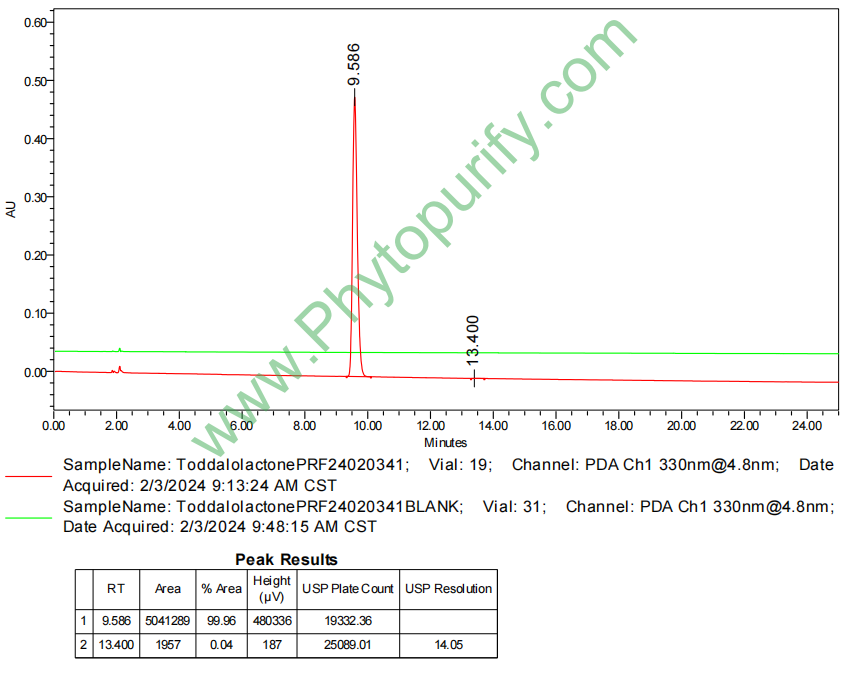
HPLC of Toddalolactone
Storage conditions:Short-term storage at 2~8℃, long-term storage at -20 ~ -80℃
89.1300
1.4533
1.4535
.4396
1.1645
8.8941
High
69.4284
3.1167
Yes
No
No
No
No
Yes
0.6
Yes
No
Yes
Yes
Natural products, as an important treasure trove for drug discovery and development, play an irreplaceable role in the long history of human fight against diseases. Among them, coumarin compounds have always been a hot topic in medicinal chemistry and pharmacology research due to their extensive and significant biological activities. Toddalolatone (CAS number: 483-90-9), as a natural product of furan coumarins isolated from traditional medicinal plants, has attracted much attention in recent years due to its pharmacological activities in anti-tumor, anti thrombotic and other aspects. This compound belongs to the family Rutaceae and the genus Dracaenopsis Toddalia asiatica(Often referred to as Flying Dragon Palm Blood or Double faced Needle, but it should be noted that it is similar to the Double faced Needle in the Rutaceae family of Sichuan pepper plants)Zanthoxylum nitidum One of the main active ingredients for differentiation. Early studies have revealed its ability to inhibit the activity of recombinant human plasminogen activator inhibitor-1 (PAI-1), with an IC50 of 37.31 μ M, suggesting its potential in regulating the fibrinolytic system and preventing thrombotic diseases. Further research has found that Zanthoxylum bungeanum exhibits strong anti-tumor activity, which involves inducing apoptosis, inhibiting proliferation, invasion and metastasis, and is closely related to multiple key tumor related targets such as MCL1, BCL2, STAT3, MMP2, TOP1, HIF1A, TOP2A, MAPK1, ESR1, CYP19A1, etc. This article aims to systematically review the chemical structure, plant origin, pharmacological activity, mechanism of action, and medicinal properties of Zanthoxylum bungeanum, in order to provide comprehensive scientific references for the in-depth research and potential drug development of this natural product.
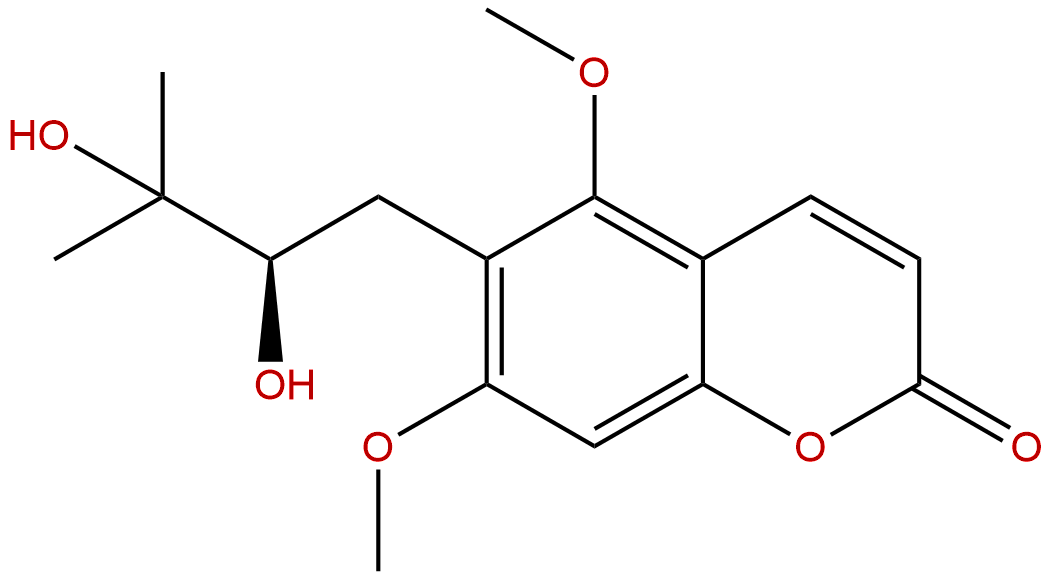
Zanthoxycoumarin is a typical linear furan coumarin, with the chemical name 8- (2 ', 3' - epoxy-3-methylbutyl) -7-methoxycoumarin. Its molecular formula is C18H20O5 and its molecular weight is 308.3300. Structurally, its parent nucleus is 7-hydroxycoumarin (umbelliferone), in which the hydroxyl group at position 7 is replaced by a methoxy group, and a side chain of 2 ', 3' - epoxy-3-methylbutyl is connected at position 8. This unique epoxy structure is considered one of the key pharmacophores for its various biological activities.
Based on its chemical structure calculation, the drug properties related parameters show that the lipid water partition coefficient (LogP) of Zanthoxylum bungeanum is 1.4533, indicating that it has moderate lipophilicity and is conducive to transmembrane absorption. The topologically polar surface area (TPSA) is 89.1300 Å ², which is relatively low and usually favorable for the membrane permeability of the compound. The predicted water solubility value is 0.4396 mg/mL, which belongs to the category of slight solubility, which may pose certain challenges in formulation development. It is worth noting that the predictive model shows a high blood-brain barrier permeability, which provides a structural basis for its application in the treatment of central nervous system related diseases such as glioma. In early safety warning indicators, Zanthoxylum bungeanum was predicted to have no risk of hERG potassium channel inhibition (hERG inhibition: no), which reduces its potential toxicity in inducing QT interval prolongation in the heart. The Ames test predicted a value of 0.6, indicating a low risk of mutagenicity, but this value still needs to be further confirmed through experiments. Overall, Zanthoxylum bungeanum exhibits ideal drug like molecular characteristics, laying the foundation for its subsequent development.
Mao two-sided needle extract mainly comes from plants of the Rutaceae family, including the genus Dracaenopsis Toddalia asiatica (L.) Lam.。 This plant is widely distributed in tropical and subtropical regions of Asia and Africa, as well as in southwestern and southern China. Its roots, stems, leaves, etc. are often used in folk medicine to treat rheumatic pain, traumatic injuries, stomach pain, malaria, and other diseases, with a long history of medicinal use.
Organic solvent extraction is commonly used to extract trichomoniasis from plant materials. The common process is as follows: dry the Toddalia asiatica Grind the root or stem bark and first degrease it with petroleum ether or n-hexane to remove strong lipophilic impurities such as chlorophyll and wax. Subsequently, medium polarity solvents such as ethyl acetate, chloroform, or methanol were used for hot reflux extraction or ultrasound assisted extraction. Ethyl acetate is often chosen due to its good selectivity towards coumarin components. After decompression and concentration, the crude extract is separated and purified through a series of chromatographic techniques, including silica gel column chromatography (usually with petroleum ether ethyl acetate or chloroform methanol gradient elution), Sephadex LH-20 column chromatography and high performance liquid chromatography (HPLC) preparation. The identification of berberine mainly relies on the determination of physicochemical constants, thin-layer chromatography (TLC) behavior, and the combination of modern spectroscopic techniques such as nuclear magnetic resonance (NMR, especially 1H NMR and 13C NMR), mass spectrometry (MS), and ultraviolet (UV) spectroscopy, which are compared and confirmed with known standard spectral data. In recent years, modern separation technologies such as supercritical fluid extraction and high-speed countercurrent chromatography have also been attempted to improve extraction efficiency and purity.
Mao two-sided needle extract has diverse pharmacological activities, among which anti-tumor effect is the core focus of its research. At the same time, it has also shown potential in cardiovascular system, antibacterial and anti-inflammatory aspects.
Antitumor activity A large number of in vitro studies have shown that LMZ can significantly inhibit the proliferation and induce apoptosis of many human tumor cell lines, including breast cancer (such as MCF-7, MDA-MB-231), lung cancer (A549), liver cancer (HepG2, SMMC-7721), colon cancer (HCT-116, SW480), prostate cancer (PC-3) and leukemia (HL-60) cells. Its function is not limited to inhibiting cell growth, but also effectively inhibits the migration and invasion ability of tumor cells, indicating its potential for anti metastasis. In in vivo animal models, it has also been confirmed that Zanthoxylum bungeanum can inhibit the growth of transplanted tumors in nude mice, and its toxicity is relatively low.
Antithrombotic and fibrinolytic regulatory activity As an inhibitor of PAI-1 (IC50=37.31 μ M), microneedle can weaken the inhibitory effect of PAI-1 on tissue type plasminogen activator (t-PA), thereby promoting the conversion of plasminogen to plasmin and enhancing the degradation of fibrin. Elevated levels of PAI-1 are closely associated with thrombotic diseases, fibrosis, and tumor progression. Therefore, microneedle has clear application prospects in preventing and treating thrombosis (such as deep vein thrombosis and myocardial infarction) by targeting PAI-1.
Other activities The study also reported that Zanthoxylum bungeanum has certain anti-inflammatory, analgesic, antibacterial, and anti malaria activities. These activities are consistent with their traditional medicinal efficacy, but their strength and mechanism of action are not yet in-depth compared to anti-tumor research.
The anti-tumor effect of Zanthoxylum bungeanum involves multi-target and multi pathway synergistic mechanisms, and its molecular network is complex and extensive. The main targets and functions are as follows:
Regulating the apoptotic pathway (BCL2 family STAT3):
Inhibition of DNA Topoisomerase (TOP1/TOP2A)Mao Liangzhenxin has been proven to be an inhibitor of DNA topoisomerases I (TOP1) and II α (TOP2A). It can stably bind to TOP1-DNA or TOP2A-DNA complexes, preventing reconnection after DNA breakage, leading to the accumulation of single or double stranded DNA breaks, triggering DNA damage reactions, and ultimately blocking cells in the cell cycle and leading to apoptosis.
Inhibition of tumor invasion and metastasis (MMP2, HIF1A):
Intervention signal transduction pathway (MAPK1)Mitogen activated protein kinase 1 (MAPK1, also known as ERK2) is a key kinase in the MAPK/ERK pathway that regulates cell growth and survival. Zanthoxylum bungeanum can affect the activation status of the MAPK/ERK pathway, but its specific action of inhibition or activation may be cell type and concentration dependent, and further clarification is needed.
Regulating hormone related pathways (ESR1, CYP19A1):
In summary, Zanthoxylum bungeanum has formed a synergistic anti-tumor network by simultaneously acting on multiple key nodes such as apoptosis regulation, DNA damage repair, invasion and metastasis, signal transduction, and hormone metabolism. This is also the potential advantage of its high efficiency and potential to overcome drug resistance.
Despite showing good activity in vitro and preliminary in vivo models, the comprehensive pharmacological evaluation and pharmacokinetic studies of Zanthoxylum bungeanum are still relatively limited, and it is a key link that must be supplemented for clinical translation.
Absorption, distribution, metabolism, excretion (ADME):
Preliminary Safety Assessment The calculated toxicology prediction shows that there is no risk of hERG inhibition and a low risk of Ames mutagenicity, which is a positive signal. However, a comprehensive preclinical safety evaluation must include: acute toxicity, long-term repeated administration toxicity (28 or 90 days), genotoxicity complete set of experiments (Ames, micronucleus, chromosomal aberration), reproductive toxicity, and organ specific toxicity (such as hepatotoxicity and nephrotoxicity) studies. Coumarin compounds typically require attention to their potential phototoxicity and hepatic enzyme induction/inhibition effects.
Pharmaceutical considerations Its poor water solubility (0.44 mg/mL) may affect the development of its formulation. To improve its bioavailability, advanced drug delivery technologies such as nanocrystals, liposomes, cyclodextrin inclusion complexes, solid dispersions, or phospholipid complexes may be required. These techniques can increase its solubility and dissolution rate, improving in vivo behavior.
As a multi-target anti-tumor natural lead compound, the clinical application prospects of Zanthoxylum bungeanum are broad, but the road ahead is long and requires interdisciplinary collaboration.
As a lead compound for anti-tumor drugs Its multi-target mechanism of action may make it effective against various malignant tumors, especially those that are prone to developing resistance to single target drugs. Future research directions include:
Application in Antithrombotic Therapy Based on its clear PAI-1 inhibitory activity, microneedle can be developed as a novel fibrinolytic enhancer for the treatment or prevention of thrombotic diseases associated with excessive PAI-1, such as acute coronary syndrome and ischemic stroke. This requires finding a balance between its anticoagulant/antithrombotic activity and bleeding risk.
Challenges and Prospects:
Mao two-sided needle extract is derived from traditional medicinal plants Toddalia asiatica A furan coumarin compound with significant biological activity isolated from the middle. It not only exhibits antithrombotic potential by inhibiting PAI-1, but also becomes an attractive multi-target anti-tumor lead molecule due to its regulatory effects on multiple key tumor targets such as MCL1, BCL2, STAT3, TOP1/2A, MMP2, HIF1A, etc. Its moderate drug like parameters and predicted good blood-brain barrier permeability have added highlights to its drug development. However, from lead compounds to candidate drugs and even marketed drugs, multiple barriers such as pharmacokinetics, safety, formulation process, and clinical efficacy still need to be overcome. Future research should focus on in-depth molecular mechanism elucidation, systematic preclinical efficacy and safety evaluation, and drug chemical modification based on structural optimization. We believe that through continuous interdisciplinary efforts, Mao Liangzhensu has the potential to achieve breakthroughs in the research and development of anti-tumor and cardiovascular disease drugs, and contribute the power of natural products to human health.
