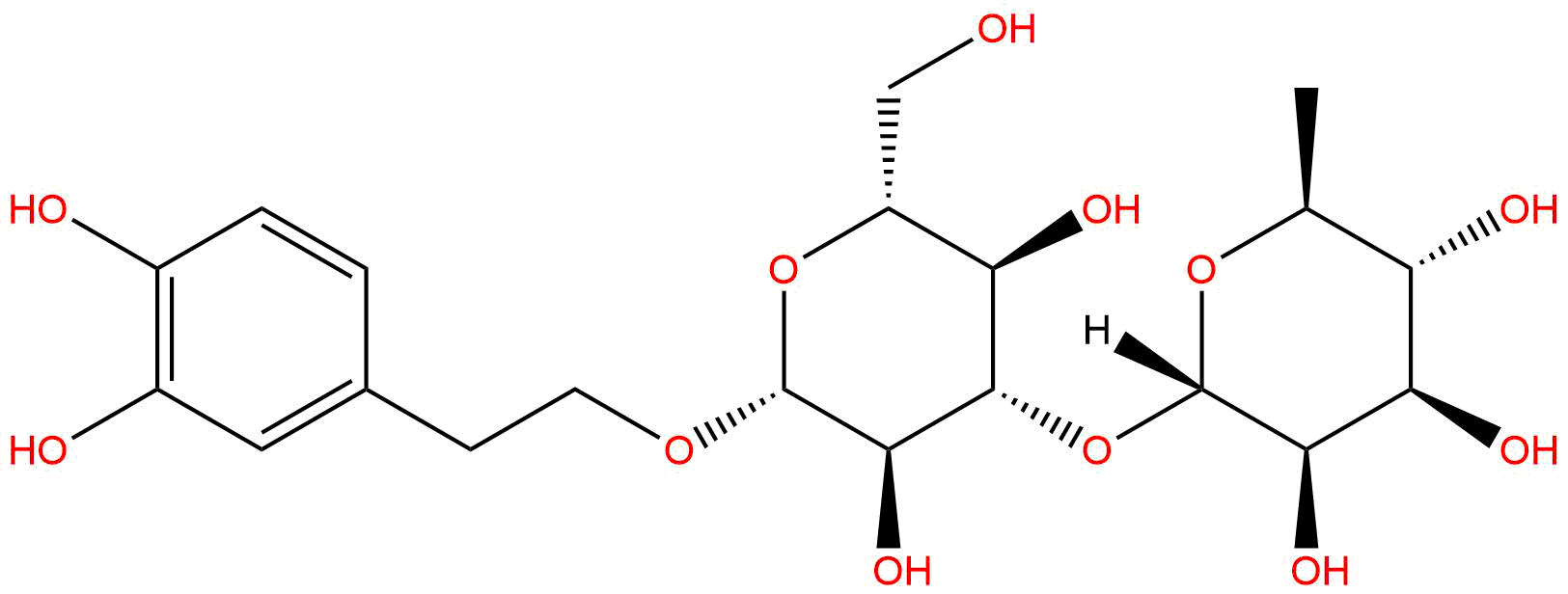


Product name: Decaffeoylacteoside
Synonym name: Verbasoside; Descaffeoylverbascoside
Catalogue No.: BP4720
Cas No.: 61548-34-3
Formula: C20H30O12
Mol Weight: 462.448
Botanical Source:
Type of Compound: Phenols
Purity: 95%~99%
Analysis Method: HPLC-DAD or/and HPLC-ELSD
Identification Method: Mass, NMR
Packing: Brown vial or HDPE plastic bottle
Storage: Store in a well closed container, protected from air and light. Put into refrigerate or freeze for long term storage.
Whenever possible, you should prepare and use solutions on the same day. However, if you need to make up stock solutions in advance, we recommend that you store the solution as aliquots in tightly sealed vials at -20℃. Generally, these will be useable for up to two weeks.
The product could be supplied from milligrams to grams
Inquire for bulk scale.
For Reference Standard and R&D, Not for Human Use Directly.
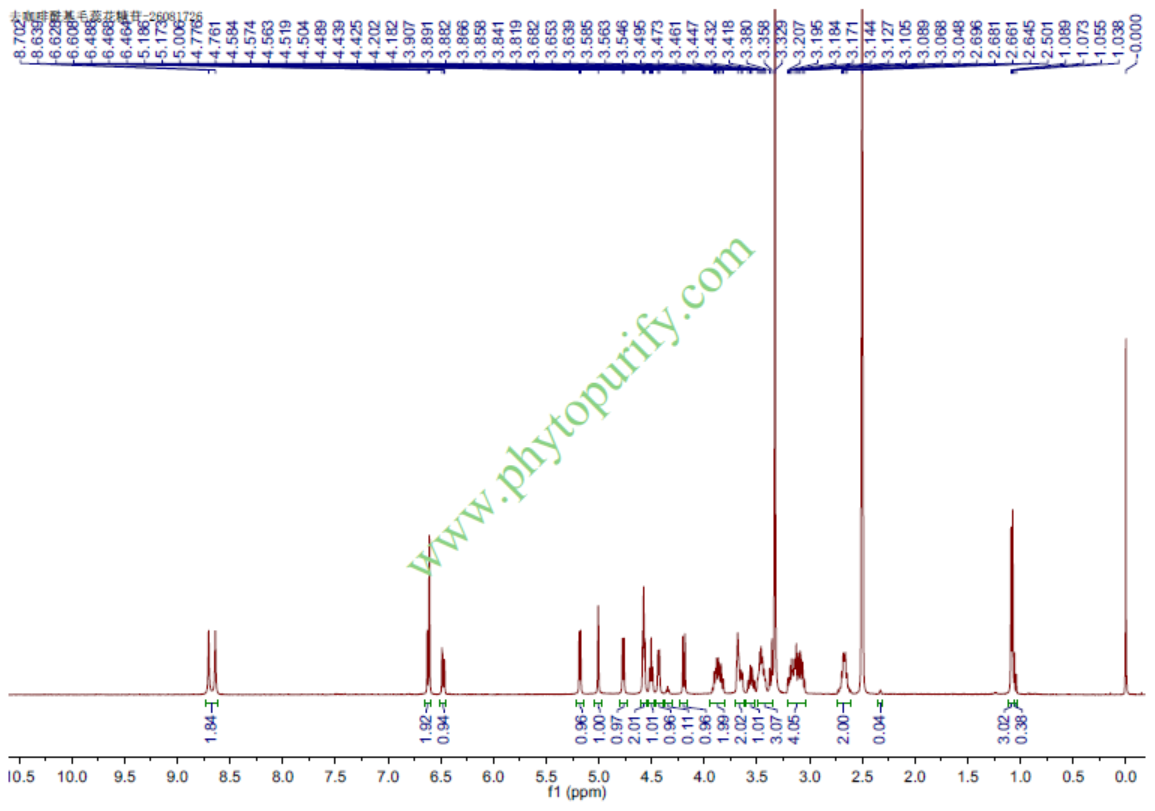
HNMR of Decaffeoylacteoside
Storage conditions:Short-term storage at 2~8℃, long-term storage at -20 ~ -80℃
Decafoylactoside (CAS number: 61548-34-3) is a natural product belonging to the glycoside class of compounds, which has received widespread attention in the pharmacology community due to its unique structure and multi-target biological activity. In recent years, as the incidence rate of neurodegenerative diseases continues to rise, searching for natural compounds with neuroprotective effects has become an important direction of drug research and development. As a moderate inhibitor of acetylcholinesterase (AChE), butyrylcholinesterase (BChE), and lipoxygenase (LOX), decaffeinated glycosides have shown potential neuroprotective activity, particularly in the treatment research of neurodegenerative diseases such as Alzheimer's disease (AD).
This article aims to provide a systematic review of the chemical structure and physicochemical properties, plant sources and extraction methods, pharmacological activity and mechanism of action, pharmacological evaluation and pharmacokinetic characteristics of decaffeinated glycosides, and explore their clinical application prospects and development trends in the field of neuroprotection, providing theoretical basis and practical guidance for related research.
Decaffeoyl based leaf sesame glycoside is a glycoside compound with a molecular formula of C21H26O12 and a molecular weight of 462.4480. Structurally, this compound removes the caffeoyl group from the glycosides of Epinephelus, while retaining the glycosidic bonds and phenolic hydroxyl groups of the aglycone moiety, endowing it with high polarity and water solubility. Its LogP value is -0.9774, indicating good hydrophilicity. The TPSA (topological polar surface area) is 198.76 Å ², indicating that the molecule has a large number of polar groups, which facilitate hydrogen bonding with biological targets.
The water solubility of decaffeinated glycosides in the leaves is 25.6435 mg/mL, which is a highly water-soluble compound. This property contributes to their absorption and distribution in the body. However, its blood-brain barrier (BBB) permeability is low, indicating limited ability to directly enter the central nervous system. The negative result of hERG channel inhibition experiment indicates that the compound has a low risk of cardiac toxicity. The Ames mutagenicity test result is 0.0, indicating a low risk of genotoxicity and meeting the basic requirements for safety evaluation.
Decaffeinated glycosides are mainly found in multiple traditional Chinese medicinal herbs and wild plants, especially in the Actaea spp., which are abundant in content. This type of plant is widely distributed in Asia and North America, and has always been used as an adjuvant therapy for anti-inflammatory, analgesic, and neurological diseases.
The commonly used methods for extracting caffeic acid glycosides from leaves of Aconitum include solvent extraction, ultrasound assisted extraction, and high-performance liquid chromatography (HPLC) separation and purification. Generally, ethanol water mixed solvents are used for extraction, utilizing their strong polar solubility to efficiently extract glycoside compounds. Ultrasound assisted extraction technology can significantly improve extraction efficiency and purity, and shorten extraction time. Subsequently, the separation and purification of caffeoyl glycosides were achieved through methods such as silica gel column chromatography and reverse phase HPLC, ensuring their structural integrity and biological activity.
In recent years, with the promotion of green chemistry concepts, supercritical CO2 extraction and microwave-assisted extraction technologies have also been attempted for the extraction of this compound, aiming to improve extraction efficiency, reduce solvent usage, and environmental pollution.
The pharmacological research on decaffeinated glycosides mainly focuses on their protective effects on the nervous system and related enzyme inhibitory activities. Experimental data shows that the compound has a moderate inhibitory effect on acetylcholinesterase (AChE) and butyrylcholinesterase (BChE), can delay the breakdown of acetylcholine, increase the effective concentration of neurotransmitters, and thus improve cognitive dysfunction. This mechanism is similar to the current clinical medication for Alzheimer's disease, indicating its potential therapeutic value.
In addition, the inhibitory effect of decaffeinated glycosides on lipoxygenase (LOX) suggests their anti-inflammatory and antioxidant properties. LOX participates in the generation of inflammatory mediators, and inhibiting its activity helps alleviate neuroinflammatory responses and protect nerve cells from oxidative stress damage.
The neuroprotective effect of the compound was further validated through in vitro cell models and animal experiments. It exhibits a protective effect on neurodegenerative disease models such as Alzheimer's disease and Parkinson's disease by regulating multiple signaling pathways, reducing neuronal apoptosis, and improving neuronal function.
The mechanism of action of decaffeinated glycosides involves multi-target and multi pathway synergistic regulation. Its main targets include:
These multi-target effects have shown broad potential in the field of neuroprotection for decaffeinated glycosides, which can slow down the progression of neurodegenerative diseases by comprehensively regulating the survival, function, and environment of neurons.
From the perspective of medicinal properties, decaffeinated glycosides have the following characteristics:
At present, there is limited pharmacokinetic data on this compound in vivo. Preliminary studies have shown that its oral bioavailability is limited, mainly through liver metabolism and renal excretion. In the future, it is necessary to conduct in-depth research on its metabolic pathways, half-life, tissue distribution, and excretion characteristics to guide clinical dosage form design and optimize dosing regimens.
As a multi-target natural product, decaffeinated glycosides have shown great potential for development in the field of neuroprotection. Its inhibitory effect on AChE/BChE is similar to the mechanism of existing Alzheimer's disease drugs, and it has anti-inflammatory, antioxidant, and anti apoptotic functions, providing a new approach for the comprehensive treatment of neurodegenerative diseases.
However, poor permeability of the blood-brain barrier is the main obstacle to its clinical application. Future research can enhance its brain concentration and therapeutic efficacy through strategies such as chemical modification and nanocarrier delivery systems. In addition, combining modern drug design techniques to optimize its pharmacokinetic properties and reduce potential toxicity risks will help it be transformed into clinical candidate drugs.
In addition, the application of decaffeinated glycosides in inflammatory diseases, oxidative stress-related diseases, and other fields is also worth further exploration. The multi-target and multi mechanism characteristics make it have a wide range of pharmacological activity potential, and it is expected to become a new drug for the treatment of various complex diseases.
As a natural glycoside compound with moderate AChE/BChE/LOX inhibitory activity, decaffeinated glycosides have shown significant value in the treatment of neurodegenerative diseases due to their multi-target neuroprotective mechanism and good safety characteristics. Although its blood-brain barrier permeability is limited, it is expected to overcome this limitation and achieve clinical translation through modern drug delivery technology and structural optimization.
Future research should focus on in-depth analysis of its pharmacokinetic characteristics, mechanism of action, and preclinical safety evaluation, in order to promote its transition from laboratory to clinical application. The development of decaffeinated glycosides not only enriches the research content of natural product pharmacology, but also provides valuable natural molecular templates for the innovation of neuroprotective drugs.
