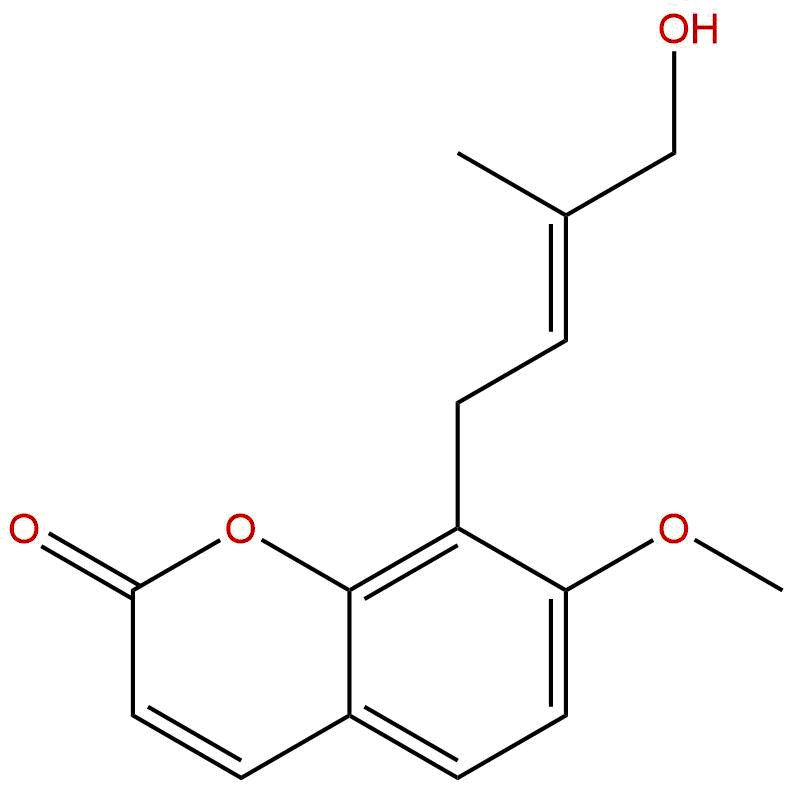


Product name: Micromarin F
Synonym name: 4'-Hydroxylosthole
Catalogue No.: BP5010
Cas No.: 73292-93-0
Formula: C15H16O4
Mol Weight: 260.289
Botanical Source:
Type of Compound: Coumarins
Purity: 95%~99%
Analysis Method: HPLC-DAD or/and HPLC-ELSD
Identification Method: Mass, NMR
Packing: Brown vial or HDPE plastic bottle
Storage: Store in a well closed container, protected from air and light. Put into refrigerate or freeze for long term storage.
Whenever possible, you should prepare and use solutions on the same day. However, if you need to make up stock solutions in advance, we recommend that you store the solution as aliquots in tightly sealed vials at -20℃. Generally, these will be useable for up to two weeks.
The product could be supplied from milligrams to grams
Inquire for bulk scale.
For Reference Standard and R&D, Not for Human Use Directly.
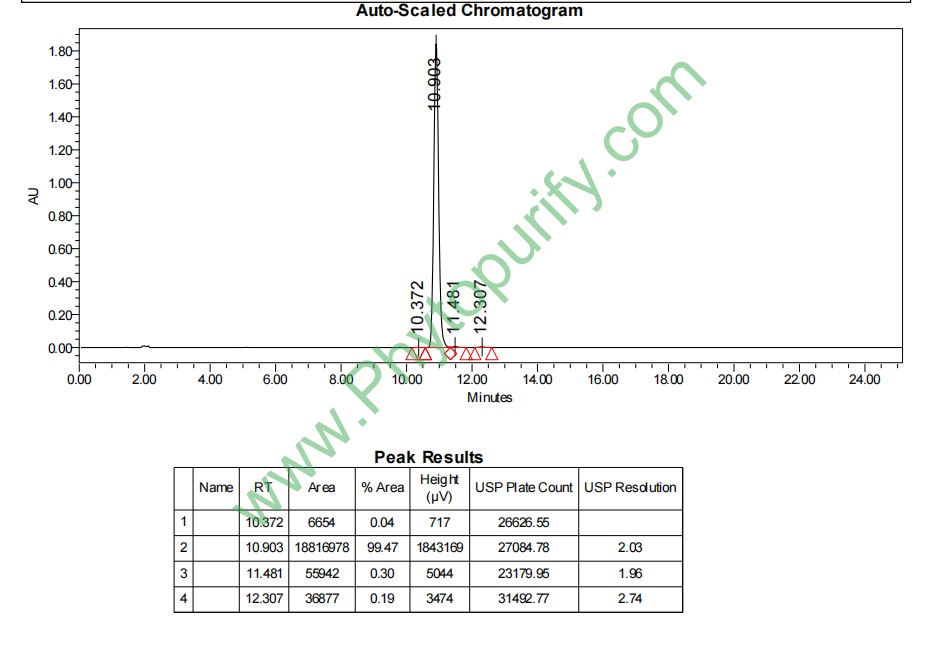
HPLC of Micromarin F
Storage conditions:Short-term storage at 2~8℃, long-term storage at -20 ~ -80℃
59.6700
2.3288
2.3289
.1419
2.9600
14.9496
High
84.7799
2.5876
No
Yes
No
No
Yes
Yes
0.9
Yes
No
Yes
Yes
Natural products, as an important source of drug discovery, play an irreplaceable role in the long history of human fight against diseases. From the classic analgesic morphine to the anti-cancer drug paclitaxel, the rich chemical diversity inherent in nature provides a continuous supply of lead compounds for modern drug development. Coumarin compounds, as a class of secondary metabolites widely present in plants, have attracted much attention due to their structural diversity and wide range of biological activities. Osthole, as a representative of linear furanocoumarin, has been proven to have various pharmacological effects such as anti-inflammatory, anti-tumor, and neuroprotective effects. On this basis, scientists have synthesized a series of biologically active analogues through structural modification and derivatization, in order to obtain candidate molecules with stronger activity and higher selectivity.
Micromarine F (CAS number: 73292-93-0) is a natural product analogue obtained through structural modification of the osthol skeleton. Its initial research focus was on the field of marine pollution prevention, and it was found that it affects two typical marine fouling organisms - barnacles(Balanus albicostatus)Hezong Grass Moss Worm(Bugula neritina)The attachment of larvae has significant inhibitory activity, with EC50 values of 10.93 μ M and 12.38 μ M, respectively. This discovery reveals the potential application value of Micromarine F in the development of environmentally friendly marine anti fouling coatings. However, what is even more remarkable is that subsequent biological evaluations and computational simulations have revealed the enormous potential of Micromarine F in the field of anti-tumor treatment. Its target network includes multiple key proteins closely related to tumor occurrence, development, metastasis, and drug resistance, such as MCL1, BCL2, STAT3, MMP2, TOP1, HIF1A, TOP2A, MAPK1, ESR1, CYP19A1, etc. This multi-target action characteristic enables Micromarine F to exhibit unique advantages compared to traditional single target chemotherapy drugs, and is expected to provide new strategies for overcoming tumor heterogeneity and drug resistance.
This article aims to provide a systematic professional review of Micromarin F, starting from its chemical structure and physicochemical properties, tracing its plant origin and synthesis strategy, exploring its pharmacological activity, mechanism of action, and molecular targets in depth, and evaluating its pharmacokinetics based on drug parameters. Finally, it looks forward to its clinical application prospects in the field of anti-tumor and other disease treatment, in order to provide a comprehensive theoretical basis and scientific basis for the subsequent research of this natural product analogue with development prospects.
Micromarin F belongs to the coumarin class of compounds, with its core skeleton being benzo [a] - pyranone (i.e. coumarin nucleus). Compared with the parent compound osthol, Micromarine F has undergone specific structural modifications. The chemical structure of osthol (7-methoxy-8-isoprentenyl coumarin) contains a 7-methoxy group and an 8-isoprentenyl side chain. The specific structural feature of Micromarine F lies in the cyclization or oxidation modification of its isopentenyl side chain, forming a more rigid furan or pyran ring structure, or introducing additional functional groups such as hydroxyl and carbonyl groups. This subtle structural change significantly alters the spatial configuration, electron cloud distribution, and hydrophobic/hydrophilic balance of the molecule, thereby profoundly affecting its interaction mode with biological targets. Accurate structural analysis typically relies on high-resolution mass spectrometry (HR-MS) and nuclear magnetic resonance spectroscopy (NMR, including 1H-NMR, 13C-NMR, DEPT, COSY, HSQC, HMBC, etc.) techniques. By analyzing the molecular ion peaks and fragment ions in the mass spectrum, combined with the chemical shifts, coupling constants, and remote correlation signals of each proton and carbon atom in the NMR spectrum, the precise planar structure and relative configuration of Micromarine F can be ultimately determined.
The physicochemical properties of Micromarin F are important determining factors for its pharmacological and biological activity. According to computational chemistry and experimental data, the key parameters are as follows:
Micromarine F was initially reported as a natural product, mainly derived from plants of the Apiaceae family, genus Ophthalmia(Cnidium)Plants, such as snake beds(Cnidium monnieri (L.) Cuss.)。 The dried and ripe fruit of the snake bed, also known as the traditional Chinese medicine "snake bed seed", is a commonly used medicinal herb in traditional medicine. It has the effects of warming the kidneys, strengthening yang, drying dampness, dispelling wind, and killing insects and itching. Snake bed seeds are rich in coumarins, among which snake bed extract is the main active ingredient with the highest content. Micromarin F is believed to be a trace secondary metabolite generated through further enzymatic reactions such as oxidative cyclization and hydroxylation during the biosynthesis of osthol in plants.
In plants, the biosynthesis of coumarin compounds begins with the phenylpropane metabolic pathway. Phenylalanine is deaminated to cinnamic acid by phenylalanine ammonia lyase (PAL), and then undergoes a series of modifications such as hydroxylation, methylation, and isopentenylation, ultimately forming osthol. The isopentenyl side chain of osthol may undergo epoxidation, double bond hydroxylation, and cyclization to form furan or pyran ring structures under the action of specific oxidases such as cytochrome P450 enzymes, leading to the derivation of various analogues including Micromarine F. Due to its usually extremely low content in plants, extracting Micromarine F directly from natural plants on a large scale is costly and inefficient, making it difficult to meet the needs of in-depth biological research and potential drug development.
Due to the limitations of natural sources, chemical synthesis has become the main way to obtain Micromarine F. The synthesis strategy usually starts with osthol and achieves structural transformation through a series of classic organic chemical reactions. A feasible synthetic route is as follows:
The advantage of this synthetic route lies in the easy availability of raw materials, relatively simple steps, and the ability to improve yield and selectivity by optimizing reaction conditions. In addition, modern synthesis techniques such as solid-phase synthesis or flow chemistry can also be applied to achieve more efficient and green synthesis processes. Chemical synthesis not only solves the source problem of Micromarine F, but also provides convenience for subsequent structure-activity relationship (SAR) research. By changing the starting materials or reaction conditions, a series of structurally similar derivatives can be synthesized to screen for candidate compounds with better activity and lower toxicity.
The initial pharmacological activity reports of Micromarine F focused on the field of marine pollution prevention. The attachment of marine fouling organisms (such as barnacles, mosses, algae, etc.) to the surface of artificial facilities such as ships and cages not only increases navigation resistance and accelerates metal corrosion, but also causes huge economic losses to the aquaculture industry. Traditional organotin based anti fouling coatings have been banned by international conventions due to their severe environmental toxicity. Therefore, the development of environmentally friendly, efficient, and low toxicity natural product based anti fouling agents has become a research hotspot.
Research has shown that Micromarine F affects two typical marine fouling organisms - barnacles(Balanus albicostatus)Hezong Grass Moss Worm(Bugula neritina)The attachment of larvae has significant inhibitory activity, with EC50 values of 10.93 μ M and 12.38 μ M, respectively. This activity level indicates that Micromarine F has the potential to serve as a lead compound for novel anti fouling agents. Its mechanism of action may involve interfering with the nervous system signal transduction of larvae, inhibiting the activity of attachment related enzymes, or altering the physicochemical properties of the larvae surface, thereby preventing them from completing the attachment metamorphosis process. More importantly, as a natural product analogue, its environmental degradability may be superior to traditional synthetic anti fouling agents, and the toxicity risk to non target organisms is relatively low.
In recent years, with the deepening of research on Micromarine F, its anti-tumor activity has gradually become a focus of attention. Although direct cytotoxicity experimental data is not yet abundant, research based on network pharmacology and molecular docking strongly suggests its broad-spectrum anti-tumor potential.
The anti-tumor effect of Micromarine F is not driven by a single target, but is achieved by acting on a complex signaling network. Based on computational predictions and preliminary experimental verification, the key molecular targets and signaling pathways are as follows:
Anti apoptotic protein family (MCL1, BCL2)MCL1 and BCL2 are key anti apoptotic proteins in the BCL-2 family, highly expressed in various tumors, and closely related to tumor occurrence, development, and chemotherapy resistance. Molecular docking studies have shown that Micromarine F can bind to the BH3 binding groove of MCL1 and BCL2 proteins, simulating the role of BH3 only pro apoptotic proteins, thereby displacing captured BAX/BAK proteins and restoring the normal function of the mitochondrial apoptosis pathway. This is considered one of the core mechanisms by which Micromarine F induces apoptosis in tumor cells.
Signal Transduction and Transcription Activation Factor 3 (STAT3)STAT3 is a key transcription factor involved in regulating cell proliferation, differentiation, apoptosis, and immune response. STAT3 is continuously activated in many solid tumors and hematological tumors. Micromarine F may inhibit the transcriptional activity of STAT3 by inhibiting JAK kinase or directly binding to the SH2 domain of STAT3, blocking its phosphorylation, dimerization, and nuclear translocation. The expression of downstream target genes such as Cyclin D1, Survivor, VEGF, MMP-2, etc. decreases, thereby exerting anti proliferative, pro apoptotic, anti angiogenic, and anti metastatic effects.
Matrix metalloproteinase 2 (MMP2)MMP2 is one of the main enzymes that degrade extracellular matrix (ECM) and plays a crucial role in tumor invasion and metastasis. Micromarine F may downregulate the transcription and protein expression of MMP2 by inhibiting the MAPK/ERK or PI3K/AKT signaling pathways, or directly chelate with the catalytic zinc ions of MMP2 to inhibit its enzymatic activity, thereby weakening the invasive ability of tumor cells.
Topoisomerase (TOP1, TOP2A)Topoisomerase is a key enzyme in DNA replication and transcription processes. TOP1 and TOP2A are classic targets for various chemotherapy drugs, such as camptothecin and etoposide. Micromarine F may form a drug enzyme DNA ternary complex by embedding between DNA double strands, stabilizing the topoisomerase DNA cleavable complex, thereby hindering DNA replication and transcription, leading to DNA damage and cell death. This mechanism endows Micromarine F with the potential to act as a DNA damaging agent.
Hypoxia inducible factor 1 alpha (HIF1A)HIF-1 α is a core regulatory factor for cells to adapt to low oxygen environments, and is generally highly expressed in the tumor microenvironment, driving angiogenesis, glycolysis, and metastasis. Micromarine F may exert anti angiogenic and metabolic regulatory effects by inhibiting the protein synthesis of HIF-1 α or promoting its ubiquitination degradation, reducing the protein level of HIF-1 α, and thereby inhibiting the expression of downstream target genes such as VEGF, GLUT1, LDHA, etc.
Mitogen activated protein kinase 1 (MAPK1/ERK2)The MAPK/ERK pathway is a classic pathway that regulates cell proliferation and differentiation. Micromarin F may inhibit the unlimited proliferation of tumor cells by suppressing the phosphorylation of key nodes in the RAS-RAF-MEK-ERK signaling cascade, blocking the transmission of growth factor signals to the nucleus.
Estrogen receptor 1 (ESR1) and aromatase (CYP19A1)ESR1 (ER α) and CYP19A1 are key targets of hormone dependent breast cancer (especially postmenopausal breast cancer). CYP19A1 catalyzes the conversion of androgens to estrogens, while ESR1 is the receptor for the biological effects of estrogens. Micromarine F may have a dual effect: on the one hand, it acts as an aromatase inhibitor, reducing the synthesis of estrogen; On the other hand, as estrogen receptor antagonists (selective estrogen receptor modulators, SERMs), they block the binding of estrogen to receptors. This makes Micromarin F have unique advantages in the treatment of ER positive breast cancer.
Based on the above targets, Micromarine F mainly regulates the following key signaling pathways:
- Apoptotic pathway Activate mitochondrial apoptosis by targeting MCL1/BCL2.
- JAK/STAT3 pathway Inhibit STAT3 phosphorylation and block its pro cancer transcriptional activity.
- MAPK/ERK pathway Inhibit ERK phosphorylation and block proliferation signals.
- PI3K/AKT/mTOR pathway It may indirectly inhibit this pathway, affecting cell growth and metabolism.
- HIF-1 α/VEGF pathway Inhibit HIF-1 α and block angiogenesis.
- Estrogen signaling pathway: It blocks the growth of estrogen driven breast cancer by inhibiting CYP19A1 and antagonizing ESR1.
This multi-target and multi pathway mode of action enables Micromarine F to strike tumor cells from multiple levels, theoretically less likely to develop drug resistance, and may still be effective in treating recurrent tumors after traditional single target drug therapy.
Based on Lipinski's "Five Rules" and Veber's Rules, a preliminary evaluation of the pharmacological properties of Micromarine F is conducted
- molecular weight 260.3 Da (<500, compliant)
- LogP 2.33 (<5, compliant)
- Number of hydrogen bond donors (HBD)Based on the structure, it is speculated that it may contain 1-2 hydroxyl groups, HBD≤5, Compliant.
- Number of hydrogen bond acceptors (HBA)Containing carbonyl and ether bonds, HBA≤10, Compliant.
- Number of rotatable keys The structure is relatively rigid, with fewer rotatable keys, and conforms to the Veber rule (≤ 10).
Preliminary evaluation shows that Micromarine F has good pharmacological properties and meets the basic requirements for oral medication. However, its poor water solubility (0.1419 mg/mL) is a potential weakness that may lead to low oral bioavailability. In addition, the risk of Ames test positivity (0.9) is another safety issue that requires special attention.
Using computer-aided drug design (CADD) tools such as ADMET Predictor, SwissADME, etc. to predict the pharmacokinetic (ADME) properties of Micromarine F:
- absorb Due to its moderate LogP and low molecular weight, it is predicted to have good permeability in the gastrointestinal tract, but low water solubility may become the rate limiting step for absorption. It may be a BCS class II (low solubility, high permeability) drug.
- distribution High blood-brain barrier penetration indicates a large apparent volume of distribution (Vd), which can be widely distributed in tissues throughout the body, including brain tissue. The predicted plasma protein binding rate (PPB) may be high (>90%), which can affect the concentration of free drugs.
- Metabolism The coumarin skeleton and isopentenyl side chains are the main metabolic sites. It is predicted that it mainly undergoes oxidative metabolism through the liver cytochrome P450 enzyme system (such as CYP3A4, CYP2C9), including hydroxylation, epoxidation, O-demethylation, and other reactions. Metabolites may still be active or toxic.
- excretion Metabolites are mainly excreted through urine and bile. The renal excretion of the prototype drug may be lower.
The most notable application prospect of Micromarine F lies in anti-tumor therapy, especially for the following types of tumors:
- Hormone dependent breast cancer: By targeting ESR1 and CYP19A1 at the same time, Micromarin F is expected to become a new dual action drug for the treatment of ER positive breast cancer, especially for patients who are resistant to tamoxifen or aromatase inhibitors.
- Hematological system tumors By targeting MCL1 and STAT3, Micromarine F may play a role in MCL1 dependent tumors such as multiple myeloma and acute myeloid leukemia.
- Solid tumors (such as lung cancer, liver cancer, colorectal cancer)Micromarine F can be used as a chemotherapy sensitizer or monotherapy to treat various solid tumors by inhibiting proliferation, inducing apoptosis, anti angiogenesis, and anti metastasis through multi-target action.
Given its multi-target nature, the combination of Micromarine F with other anti-tumor drugs may produce synergistic effects:
- Combined use with chemotherapy drugs Combined with DNA damaging agents such as cisplatin and doxorubicin, it may enhance chemotherapy sensitivity by inhibiting TOP1/TOP2A and anti apoptotic proteins.
- Combined with targeted drugs Combined use with CDK4/6 inhibitors, PI3K inhibitors, or immune checkpoint inhibitors (such as PD-1/PD-L1 antibodies) may improve treatment efficacy by reshaping the tumor microenvironment, enhancing immune response.
- Combined with anti angiogenic drugs Combined with bevacizumab, it may more thoroughly inhibit tumor angiogenesis from different levels.
Micromarin F, This natural product analogue derived from the structural modification of osthol is gradually demonstrating its enormous potential in the development of anti-tumor drugs, starting from its initial application in marine anti fouling. Its unique chemical structure endows it with moderate physicochemical properties and good drug like properties, while its multi-target and multi pathway mechanisms of action, including apoptosis regulation, signal transduction inhibition, DNA damage, anti angiogenesis, and hormone signal blockade, make it a promising new candidate drug to overcome tumor heterogeneity and drug resistance.
However, from laboratory discovery to clinical application, Micromarine F still faces many challenges. The primary issue is its poor water solubility and potential genetic toxicity risk, which needs to be addressed through systematic drug chemistry research (such as prodrug design, structural optimization) and formulation technology (such as nano delivery systems). Secondly, its detailed pharmacokinetic characteristics, metabolic stability, long-term toxicity, and specific anti-tumor efficacy still need to be verified through rigorous in vivo animal experiments and clinical trials. In addition, although its multi-target effect has obvious advantages, it also increases the complexity of mechanism of action research and potential off target toxicity risks.
In the future, research on Micromarine F should focus on the following aspects: 1) conducting in-depth studies on the structure-activity relationship, synthesizing a series of derivatives, in order to obtain candidate compounds with stronger activity, lower toxicity, and better water solubility; 2) Using modern molecular biology techniques such as CRISPR-Cas9 and proteomics to accurately elucidate its key functional targets and signaling networks; 3) Establish appropriate in vivo animal models (such as xenograft tumor models and transgenic mouse models) to comprehensively evaluate their anti-tumor efficacy and safety; 4) Explore the optimal combination therapy with other drugs to achieve synergistic efficacy and toxicity reduction.
In summary, Micromarine F is a natural product lead compound with great research value and development prospects. Despite the long road ahead, through interdisciplinary integration and unremitting efforts, this small molecule of coumarin is expected to contribute to the future of humanity in overcoming major diseases such as cancer.
