Introduction/Overview
Flavonoids, as a widely present class of polyphenolic compounds in nature, have attracted much attention in pharmacological research due to their diverse biological activities. Among numerous flavonoid derivatives, 5-methoxyflavone (CAS: 42079-78-7) has gradually become a potential lead compound in the field of drug development for neurodegenerative diseases due to its unique neuroprotective and central regulatory effects. This compound is not only a specific inhibitor of DNA polymerase β, but has also been shown to effectively antagonize the neurotoxicity induced by β - amyloid protein, demonstrating potential intervention value for complex diseases such as Parkinson's disease and Alzheimer's disease. Its sedative effect is achieved by regulating gamma aminobutyric acid type A (GABAA) receptors, further expanding its application prospects in neurological diseases. This article aims to systematically review the chemical properties, plant sources, multi-target pharmacological activities, mechanisms of action, pharmacological characteristics, and clinical translation potential of 5-methoxyflavone, in order to provide comprehensive scientific references for the deep development and utilization of this natural product.
Chemical structure and physicochemical properties
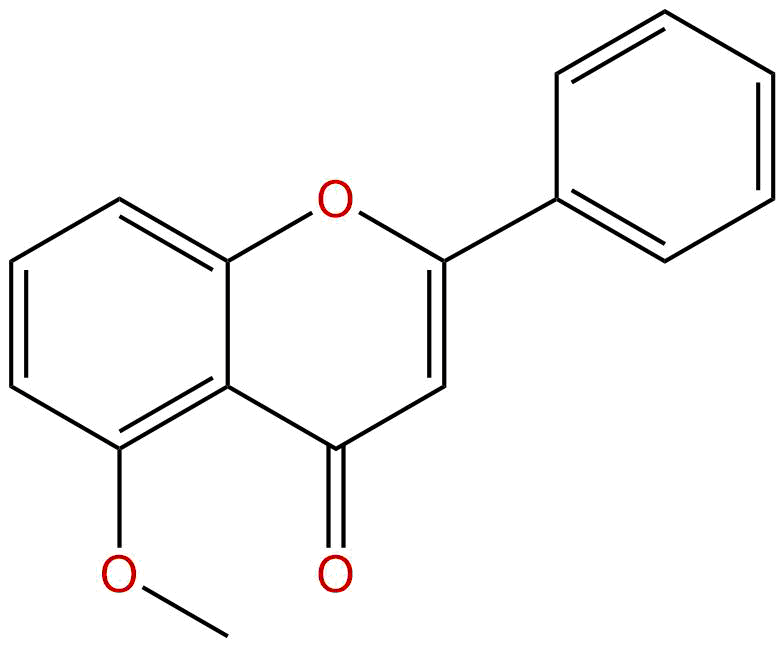
5-methoxyflavone belongs to the basic skeleton structure of flavonoids, and its parent nucleus is 2-phenylchromenone. Specifically, its chemical structure consists of a methoxy (- OCH3) substituent attached to the 5th carbon atom of the A ring in the basic skeleton of flavonoids. This modification has a significant impact on its physicochemical properties and biological activity.
Its molecular formula is C16H12O3 and its molecular weight is 252.2690. This structure endows it with typical flavonoid hydrophobic properties, and the calculated lipid water partition coefficient (LogP) is 3.1610, indicating its good lipid solubility, which is closely related to its ability to efficiently penetrate the blood-brain barrier. The topologically polar surface area (TPSA) is 39.44 Å ², which is relatively small and further supports its good membrane permeability. However, its water solubility is extremely low, about 0.0020 mg/mL, which poses certain challenges for its formulation development. In the preliminary safety screening, its Ames test value was 0.9, indicating a low risk of mutagenicity and no significant hERG potassium channel inhibitory activity, suggesting that its cardiac toxicity risk is controllable. These basic physicochemical and pharmacological parameters lay the foundation for subsequent pharmacological research and structural optimization.
Plant sources and extraction methods
5-methoxyflavone is not widely present in all plants, but rather a relatively specific distribution of secondary metabolites. The literature reports that it mainly comes from certain plant species in the Asteraceae, Rutaceae, and Lamiaceae families. For example, it has been detected in the skin of traditional medicinal plants such as Artemisia spp. and certain citrus plants. In addition, some rare medicinal plants may also be its source.
The extraction of 5-methoxyflavonoids from plant materials often uses classic natural product extraction and separation techniques. Firstly, organic solvents such as methanol, ethanol, or acetone are used to leach or reflux extract dried and crushed plant tissues, and their lipid solubility is utilized to dissolve them from plant cells. Subsequently, crude extract was obtained by vacuum concentration. Further purification relies on chromatographic techniques: silica gel column chromatography is commonly used, with different ratios of petroleum ether ethyl acetate or chloroform methanol gradient elution for preliminary separation; Combined with thin-layer chromatography (TLC) monitoring. To obtain high-purity monomers, it is usually necessary to use preparative high-performance liquid chromatography (HPLC) with a reverse phase C18 column and acetonitrile water as the mobile phase for fine separation. Modern technologies such as high-speed countercurrent chromatography (HSCCC) are also suitable for the efficient preparation of such moderately polar flavonoids due to their avoidance of solid adsorbents. The optimization of extraction process requires comprehensive consideration of solvent polarity, temperature, time, and selection of plant parts to maximize yield.
Pharmacological activity research
A large number of pharmacological studies in vitro and in vivo have revealed that 5-methoxyflavone has various biological activities, especially outstanding in the protection and regulation of the central nervous system.
- Neuroprotective effect This is its core activity. Research has shown that 5-methoxyflavone can significantly reduce the toxicity of β - amyloid protein (A β) to neuronal cells, increase cell survival rate, and reduce oxidative stress and apoptosis markers. In Parkinson's disease models, it can protect dopaminergic neurons from damage by neurotoxins such as MPP+and 6-OHDA.
- Central sedative effect Animal behavior experiments have confirmed that 5-methoxyflavone can prolong sleep time induced by pentobarbital sodium in mice, reduce spontaneous activity, and exhibit clear sedative effects. This effect is not dependent on the opioid system, but mainly related to the GABAergic nervous system.
- Enzyme inhibitory activity It has been identified as an effective inhibitor of DNA polymerase beta, an enzyme that plays a critical role in base excision repair. In addition, it has shown varying degrees of inhibitory potential against various enzymes related to neuroinflammation and diseases, such as BACE1, MAOA, ALOX15, AKR1B1, etc.
- Anti inflammatory and antioxidant effects By regulating inflammation related targets such as TLR4, 5-methoxyflavone can inhibit excessive activation of microglia and reduce the release of pro-inflammatory factors such as TNF - α, IL-1 β, and IL-6. The flavonoid structure itself also has the ability to scavenge free radicals and enhance intracellular antioxidant enzyme activity.
- Potential anti-tumor activity As an inhibitor of DNA repair enzymes, it may interfere with the DNA damage repair of tumor cells and have a synergistic effect with certain chemotherapy drugs. Its regulation of BCL2 family proteins also suggests that it may induce apoptosis in tumor cells.
Mechanism of action and molecular targets
The pharmacological effects of 5-methoxyflavone are not achieved through a single target, but exhibit characteristics of multi-target and network regulation, especially in its intervention potential for complex diseases such as Parkinson's disease.
- GABAA receptor regulation This is the main mechanism mediating the central sedative effect. 5-methoxyflavone can act as a positive allosteric regulator of GABAA receptors, enhancing the binding of GABA (the main inhibitory neurotransmitter) to the receptor, promoting chloride ion influx, thereby enhancing the inhibitory postsynaptic potential of neurons and producing sedative and anti anxiety effects.
- Neural protection related target network:
- AMPK (PRKAA1) activation AMPK is the core regulator of cellular energy metabolism. 5-methoxyflavone may activate the AMPK pathway, promote autophagy, inhibit mTOR signaling, help clear misfolded proteins (such as alpha synuclein), and improve mitochondrial function, which is crucial for neuronal survival.
- Regulation of apoptotic pathway Inhibiting mitochondrial pathway induced cell apoptosis by affecting the balance between pro apoptotic and anti apoptotic proteins (such as BCL2 family).
- Inhibition of β - secretase 1 (BACE1)Directly or indirectly inhibiting BACE1 activity and reducing A β production is one of the key steps in its fight against Alzheimer's disease like pathology.
- Anti inflammatory and oxidative stress Inhibiting the Toll like receptor 4 (TLR4) signaling pathway, blocking the nuclear translocation of NF - κ B, and thereby suppressing neuroinflammation. At the same time, inhibiting 15 lipoxygenase (ALOX15) and aldose reductase (AKR1B1) reduces the production of inflammatory mediators and oxidative stress products.
- Inhibition of monoamine oxidase A (MAOA)Inhibition of MAOA can reduce the degradation of monoamine neurotransmitters such as dopamine, help maintain dopamine levels in the striatum, and improve motor symptoms of Parkinson's disease.
- DNA repair and genomic stability By inhibiting DNA polymerase β and depurine/depyrimidine endonuclease 1 (APEX1), it may affect the process of DNA base excision repair. In specific contexts, such as tumor cells, this may increase genomic instability. And its potential effect on BLM helicase may also affect DNA replication and repair.
- Inhibition of protein tyrosine phosphatase 1B (PTPN1)PTPN1 is a negative regulator of the insulin signaling pathway, and its inhibition may indirectly improve neuronal insulin resistance and energy metabolism, which is increasingly being recognized in neurodegenerative diseases.
This multi-target mode of action enables 5-methoxyflavone to simultaneously intervene in multiple pathological processes in neurodegenerative diseases, including protein misfolding, mitochondrial dysfunction, oxidative stress, neuroinflammation, and synaptic dysfunction, demonstrating the therapeutic potential of "one stone, multiple birds".
Evaluation of drug properties and pharmacokinetics
Although 5-methoxyflavone exhibits promising pharmacological activity, its pharmacological properties still require comprehensive evaluation.
- Absorption, distribution, metabolism, excretion (ADME):
- absorb Good lipid solubility (LogP~3.16) is beneficial for its transmembrane passive diffusion, indicating that it may have good intestinal absorption after oral administration. However, its extremely low water solubility may limit its dissolution rate in gastrointestinal fluids, becoming the main limiting factor for oral bioavailability.
- distribution A smaller TPSA and moderate LogP value enable it to efficiently penetrate the blood-brain barrier (BBB permeability predicted as "high"), which is a key advantage for its central nervous system efficacy. It is expected to have a wide distribution in the body.
- Metabolism As a flavonoid compound, it is likely to undergo extensive phase I and phase II metabolism in the liver. Phase I metabolism mainly includes reactions such as demethylation and hydroxylation catalyzed by cytochrome P450 enzyme systems (such as CYP1A2, CYP2C9, CYP3A4); The combination reaction of II may involve glucuronidation and sulfation. The presence of 5-methoxy groups may affect their metabolic sites and rates.
- excretion Metabolites are mainly excreted through urine and bile.
- Optimization direction of drug properties:
- Solubility and bioavailability This is the main bottleneck in its development. The strategy includes: preparing new formulations such as nanocrystals, liposomes, cyclodextrin inclusion complexes, etc; Or carry out prodrug design, such as introducing hydrolyzable hydrophilic groups on phenolic hydroxyl groups to improve their water solubility.
- Selectivity and safety The multi-target characteristic is a double-edged sword, which may bring unexpected off target effects. It is necessary to improve the selectivity towards core therapeutic targets (such as neuroprotective targets) and reduce the effect on unrelated targets through structural modification. The negative inhibition of hERG is beneficial, but a more comprehensive preclinical safety evaluation (such as subacute toxicity, reproductive toxicity, etc.) needs to be completed.
- Pharmacokinetic optimization If it is found that its metabolism is too fast, it can be considered to modify easily metabolized sites (such as methoxy), introduce metabolic blocking groups such as fluorine atoms, and prolong the half-life.
Clinical application prospects and prospects
The clinical application prospects of 5-methoxyflavone mainly focus on the field of neurological diseases, but its transformation still faces challenges and opportunities.
Conclusion
In summary, 5-methoxyflavone, as a natural flavonoid compound with multi-target neuroprotective activity, has shown unique potential in addressing neurodegenerative diseases such as Parkinson's disease and Alzheimer's disease that have not yet met clinical needs. Its mechanism of action covers a wide range of aspects, from regulation of the GABAergic system to activation of AMPK energy metabolism, from anti-inflammatory and antioxidant effects to inhibition of key enzymes, reflecting the essence of multi-component and multi-target synergistic effects of natural products. Although it faces challenges in drug development, especially in terms of water solubility and complex mechanism of action analysis, through the cross fusion research of modern medicinal chemistry, pharmacy, and systems biology, reasonable structural optimization, formulation innovation, and mechanism deepening are expected to gradually push it from a promising natural lead compound to preclinical and clinical development stages. The continuous in-depth research on 5-methoxyflavonoids will not only contribute to the development of novel neurological therapeutic drugs, but also provide valuable examples for understanding the scientific implications of natural product interventions in complex diseases.