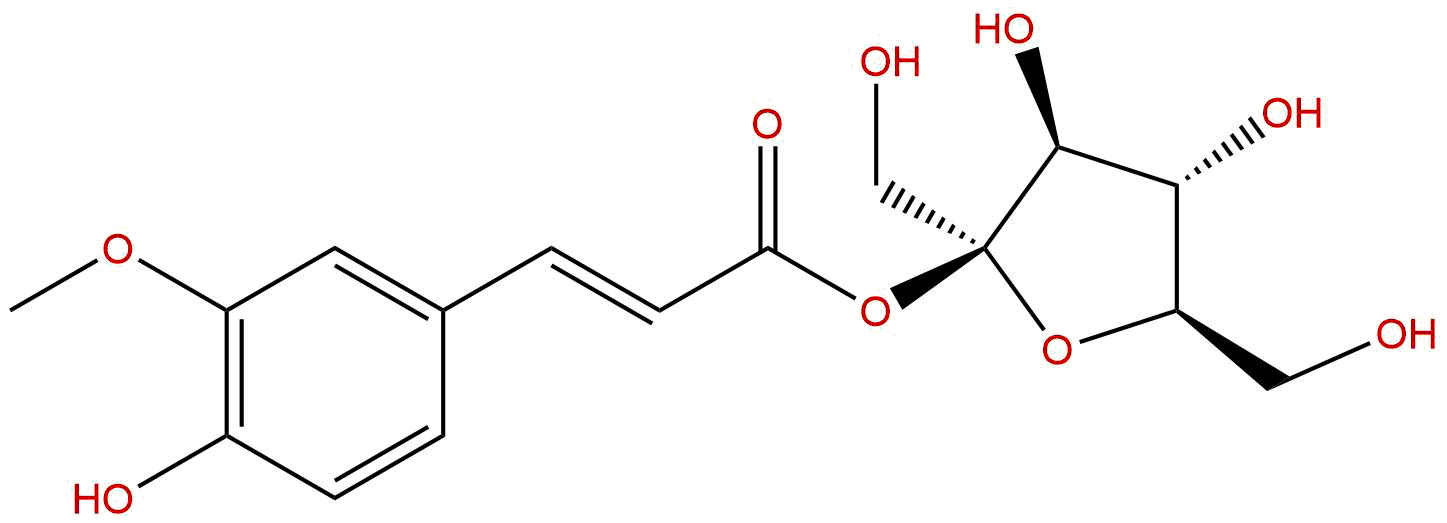


Product name: Feruloylfructoside
Synonym name: 2-Feruloylfructose;β-D-Fructofuranose,2-[3-(4-hydroxy-3-methoxyphenyl)-2-propenoate]
Catalogue No.: BP2442
Cas No.: 1258401-94-3
Formula: C16H20O9
Mol Weight: 356.327
Botanical Source:
Type of Compound: Phenylpropanoids
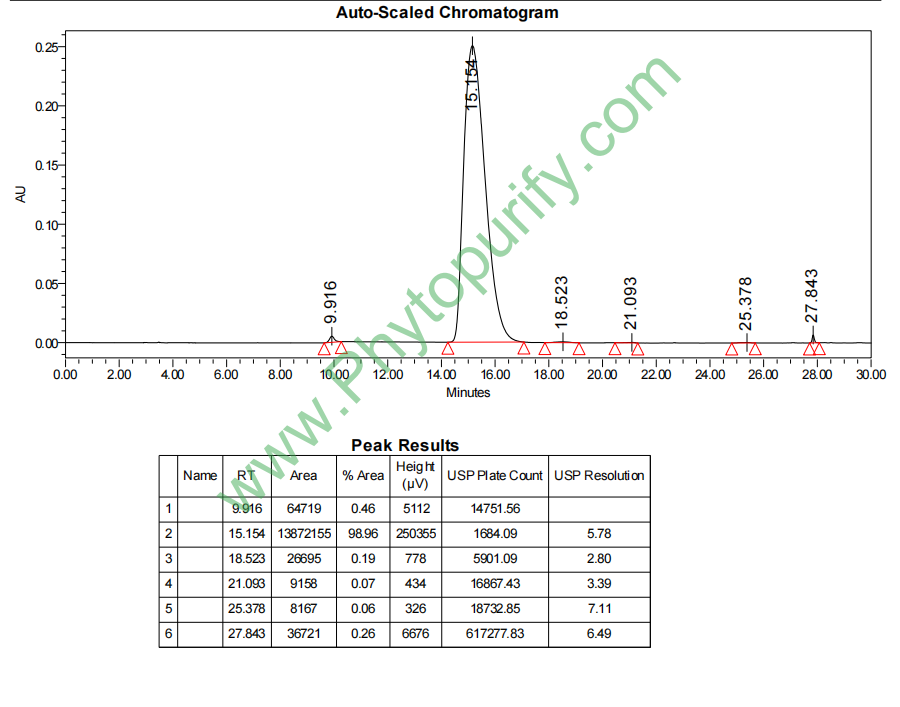
Purity: 95%~99%
Analysis Method: HPLC-DAD or/and HPLC-ELSD
Identification Method: Mass, NMR
Packing: Brown vial or HDPE plastic bottle
Storage: Store in a well closed container, protected from air and light. Put into refrigerate or freeze for long term storage.
Whenever possible, you should prepare and use solutions on the same day. However, if you need to make up stock solutions in advance, we recommend that you store the solution as aliquots in tightly sealed vials at -20℃. Generally, these will be useable for up to two weeks.
The product could be supplied from milligrams to grams
Inquire for bulk scale.
For Reference Standard and R&D, Not for Human Use Directly.
HPLC of Feruloylfructoside
Storage conditions:Short-term storage at 2~8℃, long-term storage at -20 ~ -80℃
167.3600
-2.5000
-2.0000
Low
No
No
No
Unknown
No
Unknown
Natural products, as an important source of drug discovery, play an irreplaceable role in the long history of human fight against diseases. Phenolic acid compounds are widely present in the plant kingdom and have attracted much attention due to their significant biological activities such as antioxidant, anti-inflammatory, and anti-tumor. Ferulic acid, as one of the most representative members, has been proven to have various pharmacological effects, but its poor water solubility and limited bioavailability have to some extent limited its clinical application. In recent years, researchers have found that ferulic acid often exists in the form of glycosides in plants, among which Feruloylfructoside, as a natural glycoside connected by ester bonds between ferulic acid and fructose, exhibits unique physicochemical properties and biological activities.
Feruloyl fructosyl glycosides (CAS number: 1258401-94-3) belong to the hydroxycinnamoyl glycoside class of compounds, in which the ferulic acid moiety provides the antioxidant active center of the phenolic hydroxyl group, while the fructose group endows the molecule with good water solubility. This structural feature may result in different absorption, distribution, metabolism, and excretion characteristics of ferulic acid in the body. In recent years, with the progress of separation and purification technology and activity screening methods, feruloyl fructose glycoside has made important progress in antioxidant, anti-inflammatory, neuroprotective, anti diabetes and other aspects. However, compared to ferulic acid, there is still a lack of systematic reviews on this compound. This article aims to comprehensively review the chemical structure, plant origin, pharmacological activity, mechanism of action, and medicinal characteristics of feruloyl fructoside, in order to provide reference for the in-depth research and development of this natural product.
The chemical structure of feruloyl fructoside is formed by the ester bond between ferulic acid and fructose. The carboxyl group of ferulic acid (4-hydroxy-3-methoxycinnamic acid) forms an ester bond with the hydroxyl group of fructose, and the specific connection position varies depending on the source. Common isomers include 1-O-feruloyl fructoside and 6-O-feruloyl fructoside. The ferulic acid moiety contains conjugated double bond systems (α, β - unsaturated carbonyl) and phenolic hydroxyl groups, which are the main contributors to its antioxidant activity. As a ketose, fructose's furan or pyran ring configuration may affect the spatial conformation and biological activity of the molecule.
From the perspective of physical and chemical properties, the molecular weight of feruloyl fructoside is 356.3100 Da, belonging to the small molecule glycoside class of compounds. Its lipid water partition coefficient (LogP) is -2.5000, indicating that the compound has strong hydrophilicity, which is closely related to the presence of multiple hydroxyl groups (fructose moiety) and carboxylic acid ester groups in the molecule. The extremely low LogP value means that the compound has difficulty penetrating the lipid bilayer of biological membranes, which significantly affects its oral absorption and blood-brain barrier permeability. The topological polar surface area (TPSA) is 167.3600 Å ², which is much higher than the recommended upper limit of 140 Å ² for oral medications, further confirming its high polarity and low membrane permeability characteristics. The number of hydrogen bond receptors is 9, mainly from hydroxyl and ester oxygen atoms, indicating that the molecule may interact with the target protein through hydrogen bonds.
It is worth noting that the blood-brain barrier permeability of feruloyl fructoside was evaluated as "Low", which is consistent with high polarity and low LogP values. The hepatotoxicity, cardiotoxicity, and hERG inhibition assessments were all negative, indicating that the compound did not exhibit significant organ toxicity risks in the preliminary safety evaluation. However, the Ames test results are unknown, and its genetic toxicity potential still needs further experimental verification. Overall, the physicochemical properties of feruloyl fructoside determine its unique advantages as a natural product (high water solubility, low toxicity) and potential challenges (low membrane permeability, bioavailability issues).
Ferulidylfructoside is widely distributed in nature, mainly found in plants such as Poaceae, Asteraceae, and Umbelliferae. Research has found that this compound has been detected in various medicinal and edible plants, with higher levels found in sources such as wheat (Triticum aestivum) and its bran, corn (Zea mays), barley (Hordeum vulgare), and other cereal plants; Traditional Chinese medicinal herbs such as Angelica sinensis and Ligusticum chuanxiong; And vegetables and fruits such as pineapple (Ananas comosus) and asparagus (Asparagus officinalis). It is worth noting that feruloyl fructoside is often combined with hemicellulose components such as arabinoxylan in plant cell walls, and is an important component of the cross-linking structure of plant cell walls.
From the perspective of plant chemical taxonomy, the accumulation of ferulic acid glycosides is closely related to the regulation of secondary metabolism in plants. In cereal bran, this compound often coexists with phenolic acids such as ferulic acid and ferulic acid, forming part of the plant defense system. Research has shown that the content of feruloyl fructioside in wheat bran can reach 0.1% -0.5% of dry weight, making it an important potential source for industrial extraction. In addition, the content of this compound in the roots and stems of Angelica sinensis is also relatively abundant, and it is often accompanied by active ingredients such as ferulic acid and ligustilide.
In terms of extraction methods, the extraction strategy of feruloyl fructoside needs to fully consider its polarity and thermal stability. Traditional solvent extraction methods often use methanol, ethanol, or acetone water mixed solvents (such as 60% -80% ethanol) for reflux extraction, and the extraction temperature is generally controlled at 40-60 ° C to avoid ester bond hydrolysis. In recent years, green extraction techniques such as ultrasound assisted extraction, microwave-assisted extraction, and enzyme assisted extraction have been widely used to optimize the extraction process of this compound. For example, pretreatment with cellulases and hemicellulases can effectively disrupt the structure of plant cell walls, release bound feruloyl fructosides, and increase extraction rates by 30% -50%. Supercritical fluid extraction (especially using CO ₂ and ethanol as co solvents) has advantages in maintaining the structural integrity of compounds, but the cost is relatively high.
Generally, macroporous adsorption resins (such as HPD-100 and D101) are used for preliminary enrichment, and refined by combining silica gel column chromatography, Sephadex LH-20 gel column chromatography and preparative high performance liquid chromatography (HPLC). The reverse phase C18 chromatography column combined with methanol water or acetonitrile water gradient elution system can achieve effective separation of ferulic acid glucoside and its structural analogues (such as ferulic acid and ferulic acid glucoside). The purity of the final product can be verified by HPLC-UV or HPLC-MS, usually requiring a purity of over 95% for subsequent pharmacological research.
The antioxidant activity of feruloyl fructoside is one of its most concerned pharmacological properties. Phenolic hydroxyl groups, as hydrogen atom donors, can effectively eliminate free radicals and interrupt the chain reaction of lipid peroxidation. In vitro studies have shown that feruloyl fructoside exhibits significant scavenging ability against 1,1-diphenyl-2-trinitrophenylhydrazine (DPPH) free radicals, 2,2 '- diazobis (3-ethylbenzothiazoline-6-sulfonic acid) (ABTS) cationic free radicals, and superoxide anion free radicals. Its half maximal inhibitory concentration (IC ₅₀) is usually in the range of 10-50 μ M, which is comparable to or slightly better than ferulic acid. It is worth noting that the introduction of fructose groups did not weaken the antioxidant capacity of ferulic acid, but instead improved its free radical scavenging efficiency in physiological environments by increasing the dispersibility of the molecule in the aqueous phase.
In cell models, feruloyl fructoside can significantly reduce oxidative stress damage induced by hydrogen peroxide (H ₂ O ₂). Pre treated PC12 nerve cells or HepG2 liver cells with this compound showed a significant decrease in intracellular reactive oxygen species (ROS) levels, while the activities of superoxide dismutase (SOD), glutathione peroxidase (GPx), and catalase (CAT) were restored, and the content of malondialdehyde (MDA) decreased. These results indicate that feruloyl fructoside not only directly scavenges free radicals, but also exerts indirect antioxidant effects by regulating the endogenous antioxidant enzyme system.
Inflammatory reaction is the common pathological basis of many chronic diseases (such as cardiovascular disease, diabetes, neurodegenerative disease). Feruloyl fructosides have shown great potential in anti-inflammatory properties. In the RAW264.7 macrophage model stimulated by lipopolysaccharide (LPS), this compound inhibits the production of nitric oxide (NO) and prostaglandin E ₂ (PGE ₂) in a concentration dependent manner, and its mechanism is related to the downregulation of inducible nitric oxide synthase (iNOS) and cyclooxygenase-2 (COX-2) expression. In addition, feruloyl fructoside can also reduce the secretion levels of pro-inflammatory cytokines such as tumor necrosis factor - α (TNF - α), interleukin-6 (IL-6), and interleukin-1 β (IL-1 β).
In animal models, feruloyl fructoside (orally administered at 50-200 mg/kg) can alleviate carrageenan induced foot swelling in rats and acetic acid-induced increased intra-abdominal capillary permeability in mice. Histopathological analysis showed that the compound can inhibit neutrophil infiltration and inflammatory exudation at the site of inflammation. These findings suggest that feruloyl fructoside may exert anti-inflammatory effects through a multi-target mechanism, rather than solely relying on antioxidant activity.
Given that ferulic acid has been proven to have neuroprotective effects, the application prospects of its glycoside derivative feruloyl fructoside in neurological diseases are also worthy of attention. In the Alzheimer's disease cell model induced by β - amyloid protein (A β), feruloyl fructoside can reduce A β aggregation, decrease tau protein hyperphosphorylation, and protect the expression of synaptic plasticity related proteins. In the glutamate induced excitotoxicity model, this compound can protect hippocampal neurons by inhibiting calcium influx and reducing apoptosis related proteins such as Bax/Bcl-2 ratio and caspase-3 activation.
It is worth noting that although the blood-brain barrier permeability of feruloyl fructoside has been evaluated as "Low", multiple studies have still observed its protective effects in central nervous system disease models. This may be attributed to the following mechanisms: (1) indirectly affecting the central nervous system by regulating peripheral inflammation and oxidative stress; (2) Under pathological conditions of blood-brain barrier damage, such as cerebral ischemia and neuroinflammation, this compound may enter brain tissue through passive diffusion or transporter mediated pathways; (3) Its metabolites, such as ferulic acid, may have better blood-brain barrier permeability. However, this contradictory phenomenon still needs to be further elucidated through pharmacokinetic and brain tissue distribution studies.
Feruloyl fructosides have also shown potential in regulating sugar metabolism. In vitro enzyme activity assays showed that the compound can inhibit the activity of α - glucosidase and α - amylase, with IC ₅₀ values of 0.5-2.0 mM and 0.8-3.0 mM, respectively, suggesting that it may lower postprandial blood glucose by delaying carbohydrate absorption. In the HepG2 cell model of insulin resistance, feruloyl fructoside can enhance the phosphorylation level of Akt in the insulin signaling pathway, promote membrane translocation of glucose transporter 4 (GLUT4), and improve insulin sensitivity.
In the streptozotocin (STZ) - induced diabetes rat model, the fasting blood glucose, glycosylated hemoglobin and serum insulin levels of rats were significantly improved after continuous oral administration of feruloyl fructose (100-300 mg/kg/d) for 4 weeks. At the same time, the compound can also reduce the oxidative stress and inflammatory reaction related to diabetes, and protect the function of pancreatic β cells. These results support the further development of feruloyl fructose as a candidate compound for anti diabetes.
In addition to the above main activities, feruloyl fructose glycoside has also been reported to have anti-tumor activity (inhibiting the proliferation of hepatoma cell HepG2 and breast cancer cell MCF-7, IC ≮ ₀ is about 50-100 μ M), antibacterial activity (MIC value for Staphylococcus aureus and Escherichia coli is 0.5-2.0 mg/mL), and hepatoprotective activity (reducing carbon tetrachloride induced acute liver injury). These diverse pharmacological activities further highlight the research value of the compound.
The pharmacological activity of feruloyl fructoside originates from its interactions with multiple molecular targets. From a molecular perspective, its mechanism of action can be summarized as follows:
Nrf2 is a key transcription factor that regulates the intracellular antioxidant defense system. Feruloyl fructoside can promote the dissociation of Nrf2 and Kelch like ECH related protein 1 (Keap1), causing Nrf2 to translocate into the nucleus and bind to ARE, thereby initiating the transcription of downstream antioxidant enzyme genes (such as HO-1, NQO1, SOD, GPx). This mechanism is particularly important under oxidative stress and inflammatory conditions, as it can enhance the self-protection ability of cells.
NF - κ B is the core regulatory factor of inflammatory response. Feruloyl fructoside can inhibit the activity of I κ B kinase (IKK), prevent the phosphorylation and degradation of I κ B α, and thus reduce the nuclear translocation of NF - κ B p65 subunit. This leads to transcriptional repression of downstream pro-inflammatory genes such as iNOS, COX-2, TNF - α, IL-6. Molecular docking studies suggest that this compound may exert inhibitory effects by interacting with the ATP binding site of IKK.
The MAPK pathway (including ERK, JNK, and p38) plays an important role in cellular stress response. Feruloyl fructoside can inhibit the phosphorylation of p38 and JNK induced by LPS or oxidative stress, but has little effect on the phosphorylation of ERK. This selective inhibition may be related to its specificity in regulating cell apoptosis and inflammatory response.
In improving insulin resistance, feruloyl fructoside promotes GLUT4 membrane translocation and glucose uptake by activating the insulin receptor substrate 1 (IRS-1)/phosphatidylinositol 3-kinase (PI3K)/Akt signaling pathway. In addition, the compound can also inhibit the activity of protein tyrosine phosphatase 1B (PTP1B), which is a negative regulator of insulin signaling. These effects collectively enhance insulin sensitivity.
Based on its chemical structural characteristics, feruloyl fructoside may bind to various protein targets through hydrogen bonding and hydrophobic interactions. Molecular docking studies have shown that the compound can form hydrogen bonds with the active site amino acid residues (such as Asp214, Glu276) of alpha glucosidase, thereby competitively inhibiting enzyme activity. Similarly, the interaction with residues such as Arg120 and Tyr355 of COX-2 may explain its selective inhibition of COX-2 rather than COX-1. However, these computational predictions still need to be validated through experimental methods such as surface plasmon resonance (SPR) or isothermal titration calorimetry (ITC).
Based on Lipinski's "Five Rules" and Veber's Rules, the pharmacological characteristics of feruloyl fructoside can be summarized as follows: the molecular weight (356.31 Da) meets the requirement of<500 Da; LogP (-2.50) is much lower than 5, indicating strong hydrophilicity; The number of hydrogen bond acceptors (9) exceeds the threshold of 10; The TPSA (167.36 Å ²) exceeds 140 Å ². These parameters suggest that the compound may have issues with poor oral absorption and low bioavailability. However, many active ingredients in natural products do not fully comply with traditional pharmacological rules, and their unique pharmacological activities still deserve further development.
It is worth noting that the liver toxicity, cardiac toxicity, and hERG inhibition evaluation of feruloyl fructoside are all negative, indicating that it has a good safety basis. This feature is relatively rare in natural products, providing advantages for their subsequent development.
At present, systematic research on the pharmacokinetics of feruloyl fructoside in vivo is still relatively limited. Based on its physicochemical properties and existing literature speculation, this compound may face the following challenges after oral administration: (1) low intestinal mucosal permeability: high polarity and low LogP value make it difficult for it to passively diffuse through intestinal epithelial cells; (2) Intestinal metabolism: Fructoside bonds may be hydrolyzed by esterases or glycosidases produced by gut microbiota, releasing ferulic acid and fructose; (3) First pass effect: The absorbed feruloyl fructoside may be further metabolized by liver esterases.
Intravenous administration studies (in rats) have shown that the plasma half-life (t ₁/₂) of feruloyl fructoside is approximately 30-60 minutes, and its distribution volume (Vd) is relatively small (about 0.2-0.5 L/kg), indicating that it is mainly distributed in the extracellular fluid. After oral administration, the absolute bioavailability may be less than 10%, but its pharmacokinetic characteristics may be improved through structural modifications (such as prodrug design, nano formulations) or route optimization (such as transdermal or nasal administration).
Preliminary metabolic studies suggest that feruloyl fructosyl glycosides undergo mainly ester bond hydrolysis and glycosidic bond cleavage in vivo, producing ferulic acid and fructose. Ferulic acid is further metabolized through methylation, sulfation, and glucuronidation, and ultimately excreted as a conjugate in urine and bile. Some unmetabolized prototype drugs may also be excreted through renal filtration. It is worth noting that gut microbiota may play an important role in the metabolism of ferulic acid glycosides, and their metabolites (such as ferulic acid and dihydroferulic acid) may contribute to some pharmacological activities.
Based on existing pharmacological activity data, feruloyl fructoside has potential application value in the following disease areas:
Metabolic diseases As an α - glucosidase inhibitor and insulin sensitizer, it can be used in the adjuvant treatment of type 2 diabetes. Its good water solubility makes it suitable for development as an oral liquid preparation or functional food additive.
Neurodegenerative diseases Although the blood-brain barrier permeability is limited, feruloyl fructoside may have indirect protective effects against Alzheimer's disease and Parkinson's disease through peripheral anti-inflammatory and antioxidant mechanisms. Combining nano delivery systems such as liposomes and polymer nanoparticles may enhance their brain targeting ability.
Inflammatory diseases In local inflammatory diseases such as arthritis and colitis, the high water solubility of feruloyl fructoside makes it suitable for development as a topical preparation or enema.
Liver protection In non-alcoholic fatty liver disease (NAFLD) and drug-induced liver injury, this compound exerts protective effects through antioxidant and anti-inflammatory mechanisms.
The main challenges facing the clinical translation of feruloyl fructoside include: (1) low oral bioavailability; (2) Unstable metabolism in the body; (3) Lack of systematic toxicological and pharmacokinetic data. Regarding these issues, future research can focus on the following directions:
Optimization of formulation technology Using nanocarriers such as solid lipid nanoparticles and polymer micelles to enhance oral absorption; Pre development drug strategies (such as acetylation, amino acid esterification) improve membrane permeability.
Structural modification Under the premise of maintaining pharmacological activity, adjust the LogP value through chemical modification (such as introducing hydrophobic groups such as methyl and ethyl) to balance water solubility and membrane permeability.
combination therapy: Used in combination with bioavailability enhancers such as piperine and quercetin, or in combination with existing drugs such as metformin and aspirin.
safety evaluation Complete Ames test, reproductive toxicity test, and long-term toxicity test, and establish a complete toxicology file.
With the deepening of research on natural product chemistry and pharmacology, feruloyl fructoside is expected to become a new type of "multi-target natural medicine". Future research should focus on: (1) using metabolomics and network pharmacology techniques to elucidate its in vivo action network; (2) Develop high-sensitivity LC-MS/MS method for quantitative analysis of the compound in biological samples; (3) Conduct preclinical pharmacological studies to clarify the effective dosage and treatment window; (4) Explore its interaction with gut microbiota and reveal the contributions of the gut brain axis and gut liver axis in pharmacological effects.
Feruloyl fructose glycoside, as a natural phenolic acid glycoside, based on its unique chemical structure, has shown multi-dimensional pharmacological activities such as antioxidant, anti-inflammatory, neuroprotective and anti diabetes. Its high water solubility and low toxicity provide a good safety foundation for drug development, but the extremely low LogP value and limited membrane permeability also pose major challenges in drug development. The current research is still in its early stages, and there are still many scientific issues that need to be addressed from activity discovery to clinical translation. Through innovative formulation technology, structural optimization, and in-depth mechanism research, feruloyl fructoside and its derivatives are expected to play a unique role in the treatment of metabolic and inflammatory diseases. In the future, with the advancement of green extraction technology and the elucidation of biosynthetic pathways, the large-scale production and application of this compound will become possible, providing a new paradigm for the development of natural product drugs.
