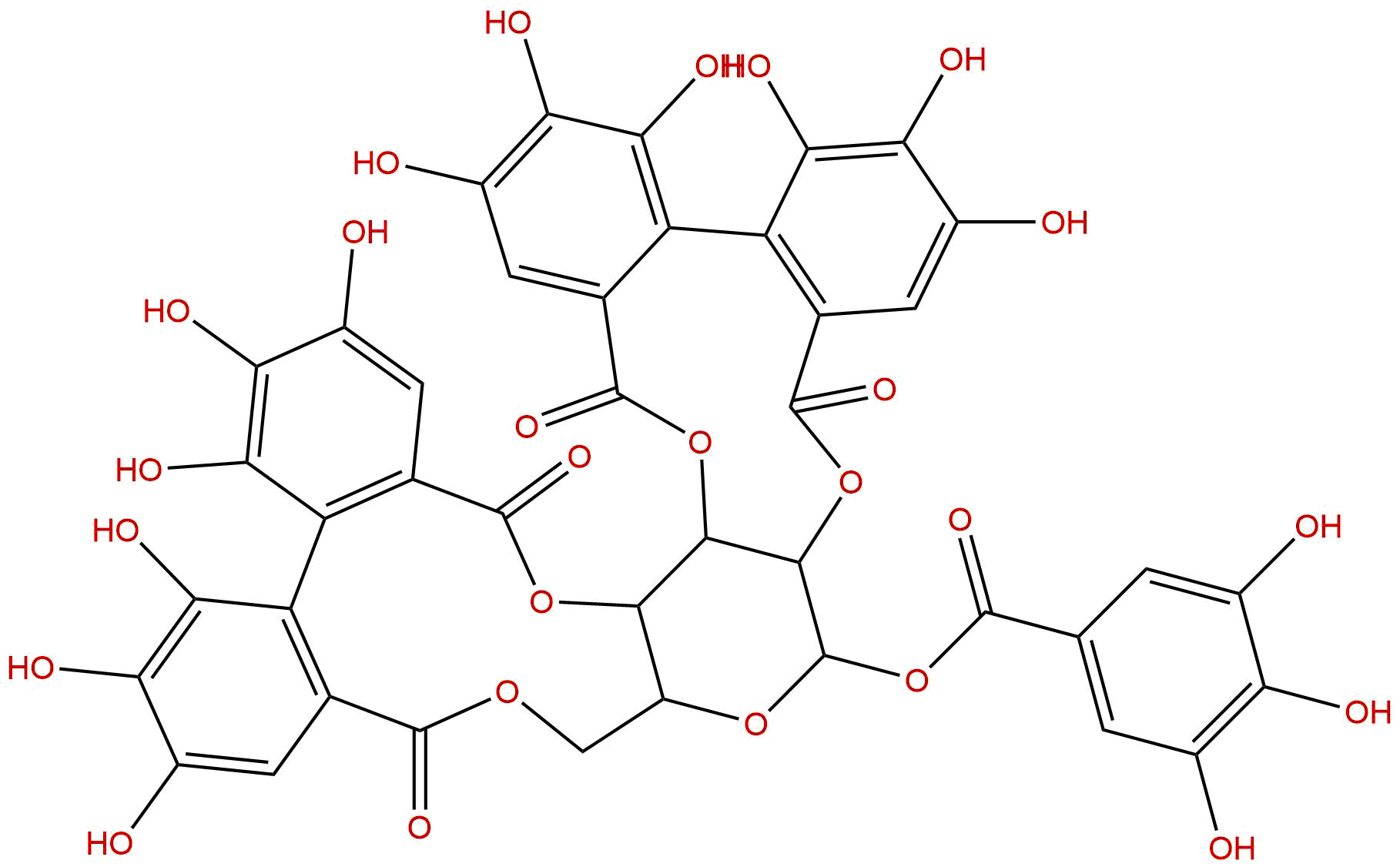
| Catalog No | Package | Original Price | Price | Inventory | Quantity | Operating |
|---|---|---|---|---|---|---|
| BP5066-5mg | 5mg | $750.00 | Sign in |
|


Storage conditions:Short-term storage at 2~8℃, long-term storage at -20 ~ -80℃
Casualitin is a natural polyphenolic compound with significant biological activity, belonging to the tannin family of tanning compounds. Its molecular structure is complex and contains multiple phenolic hydroxyl groups, endowing it with excellent antioxidant and enzyme inhibitory activity. In recent years, with the in-depth study of the pharmacological effects of natural products, Casuarina equisetifolia Tanting has gradually become a hot spot in pharmacology and drug development research due to its potential application value in the fields of diabetes, neurodegenerative diseases and antiviral. This article will provide a systematic review of the chemical structure, physicochemical properties, plant sources, and extraction methods of ephedra tanning agents. The focus will be on their pharmacological activity, mechanism of action, and molecular targets. Combined with pharmacological evaluation and pharmacokinetic data, the clinical application prospects and future research directions will be explored.
The molecular formula of ephedra tanning pavilion is C41H28O26, with a molecular weight of 936.6490, belonging to high molecular weight polyphenolic compounds. Its structural core is a typical polyphenolic cyclic skeleton of tanning agents, containing multiple phenolic hydroxyl and ester bonds, endowing it with high polarity and rich hydrogen bond donor/acceptor properties. The LogP value is 1.7369, indicating moderate lipophilicity and favorable interaction with biofilms. Its topological polar surface area (TPSA) is as high as 444.18 Å ², reflecting its strong polarity and extremely low water solubility (0.0009), which has a significant impact on its bioavailability and in vivo distribution. The difficulty of passing through the blood-brain barrier suggests that the direct effects of ephedra tanning agents on the central nervous system may be limited. In addition, the hERG channel inhibition experiment showed a negative result, indicating a low risk of cardiac toxicity; The Ames test result is 0.6, indicating a low risk of genotoxicity.
The ephedra tanning pavilion is mainly found in the bark, leaves, and fruits of various plants, especially in the ephedra family, where it is abundant. Common sources of plants include Casualina spp. and plants with high tannin content. The extraction method usually uses a mixed solvent system of polar solvents such as methanol, ethanol, or water, and obtains crude extracts through techniques such as ultrasound assisted extraction, reflux extraction, or Soxhlet extraction. Subsequently, purification was carried out using liquid-liquid partitioning, column chromatography (such as silica gel, C18 reverse phase column), and high-performance liquid chromatography (HPLC) to obtain high-purity ephedra tanning agents. The identification methods mainly rely on modern analytical techniques such as mass spectrometry (MS), nuclear magnetic resonance (NMR), and infrared spectroscopy (IR) to ensure the accuracy and purity of the structure.
The ephedra tanning agent exhibits potent and competitive alpha glucosidase inhibition, with an IC50 value of 0.21 μ g/mL, significantly superior to various traditional inhibitors. This activity makes it have potential application value in the treatment of diabetes, which can delay the digestion and absorption of carbohydrates, reduce the peak blood sugar after meals, and thus improve blood sugar control.
As an inhibitor of presenilin stabilizing factor like protein (PSFL), ephedra bark extract exhibits unique pharmacological potential in the field of neurodegenerative diseases. PSFL protein is closely related to the neuropathological processes associated with Alzheimer's disease (AD), and its inhibition helps to slow down neuronal degeneration and cognitive decline. Ma Huang Tan Ting may intervene in the pathological progression of AD by regulating PSFL protein, making it a candidate molecule for neuroprotective agents.
Ephedra bark extract exhibits inhibitory activity against various HIV related targets, including CCR5 and CXCR4, two major virus co receptors, HIV1 protease (HIV1-PR), integrase, reverse transcriptase (RT), and viral envelope protein gp120. Its multi-target inhibitory properties provide new ideas for the development of anti HIV drugs, especially in the treatment of drug-resistant viral strains, which have potential advantages.
The mechanism of action of ephedra tanning pavilion is diverse, mainly reflected in the following aspects:
Enzyme inhibition By competitively binding with the active site of alpha glucosidase, substrate binding is blocked, enzyme activity is inhibited, and carbohydrate metabolism is delayed.
Regulation of protein-protein interactions As a PSFL protein inhibitor, ephedra bark extract may stabilize neuronal function and slow down neurodegenerative changes by directly binding or regulating related signaling pathways.
Multi target antiviral mechanism By interfering with the virus's entry into receptors (CCR5, CXCR4), inhibiting key viral enzymes (HIV1-PR, Integrase, RT), and blocking the binding of virus envelope protein gp120 to host cells, the ephedra bark extract comprehensively inhibits multiple stages of the HIV replication cycle.
Antioxidant and anti-inflammatory effects Its rich phenolic hydroxyl structure endows it with strong free radical scavenging ability, reduces oxidative stress, inhibits the release of inflammatory mediators, and protects cells from damage.
The high molecular weight (936.65 Da) and high polarity (TPSA 444.18 Å ²) of ephedra tanning agents limit their oral bioavailability and cell membrane permeability. Very low water solubility (0.0009), which may lead to poor absorption in the body. Its LogP value is moderate (1.7369), indicating a certain degree of lipophilicity, which is beneficial for cell membrane penetration, but overall high polarity is still a limiting factor. The low penetration ability of the blood-brain barrier suggests that the efficacy of the central nervous system may depend on indirect mechanisms or require the assistance of special delivery systems.
In terms of safety, negative hERG channel inhibition reduces the risk of cardiac toxicity, and Ames test results show a low risk of genotoxicity, which meets the safety requirements for early drug development. Further research on in vivo pharmacokinetics (ADME) is needed in the future to clarify its metabolic pathways, half-life, and tissue distribution, providing a basis for dosage form design and clinical application.
As a multifunctional natural product, ephedra tanning pavilion has broad clinical application potential:
Treatment of diabetes Its potent alpha glucosidase inhibitory activity makes it an ideal candidate drug for controlling postprandial hyperglycemia. Through structural optimization and formulation improvement, it is expected to develop new oral hypoglycemic drugs.
Neurodegenerative diseases The inhibitory effect of PSFL protein on Alzheimer's disease provides a new target for neuroprotection. Combining modern drug delivery technologies, such as nanocarrier systems, can enhance their brain delivery efficiency and improve therapeutic efficacy.
Development of anti HIV drugs The multi-target inhibitory properties provide new ideas for the design of antiviral drugs, especially in the treatment of drug-resistant virus strains, which have potential advantages. Can be used in combination with existing antiviral drugs to achieve synergistic effects.
Antioxidant and anti-inflammatory applications Its natural antioxidant properties make it suitable for development as an adjuvant therapy to alleviate oxidative stress and inflammatory reactions associated with chronic diseases.
Future research should focus on pharmacokinetic optimization, structural modification, dosage form innovation, and preclinical safety evaluation of ephedra tanning agents, in order to promote their clinical translation. In addition, in-depth analysis of its molecular mechanism of action and interaction with targets provides a theoretical basis for precision therapy.
Casuarina equisetifolia Tanting, as a natural polyphenol compound with multiple pharmacological activities, shows broad application prospects in the fields of diabetes, neurodegenerative diseases and anti-virus. Its unique chemical structure endows it with significant enzyme inhibition and multi-target regulation capabilities, making it an important object of research in natural product pharmacology. Although there are certain challenges in its medicinal properties, through the optimization of modern medicinal chemistry and pharmacy methods, ephedra tanning agents have the potential to develop into a new generation of functional drugs. Future systematic research will further reveal its mechanism of action, promote its clinical application translation, and drive the innovative development of natural product drugs.
