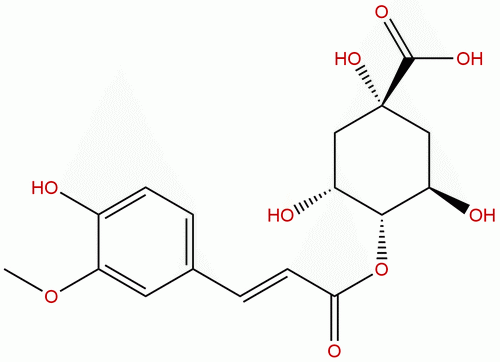


Product name: 4-feruloylquinic acid
Synonym name: 4-O-Feruloylquinic acid
Catalogue No.: BPF2392
Cas No.: 2613-86-7
Formula: C17H20O9
Mol Weight: 368.338
Botanical Source:
Physical Description:
Type of Compound: Phenylpropanoids
Purity: 95%~99%
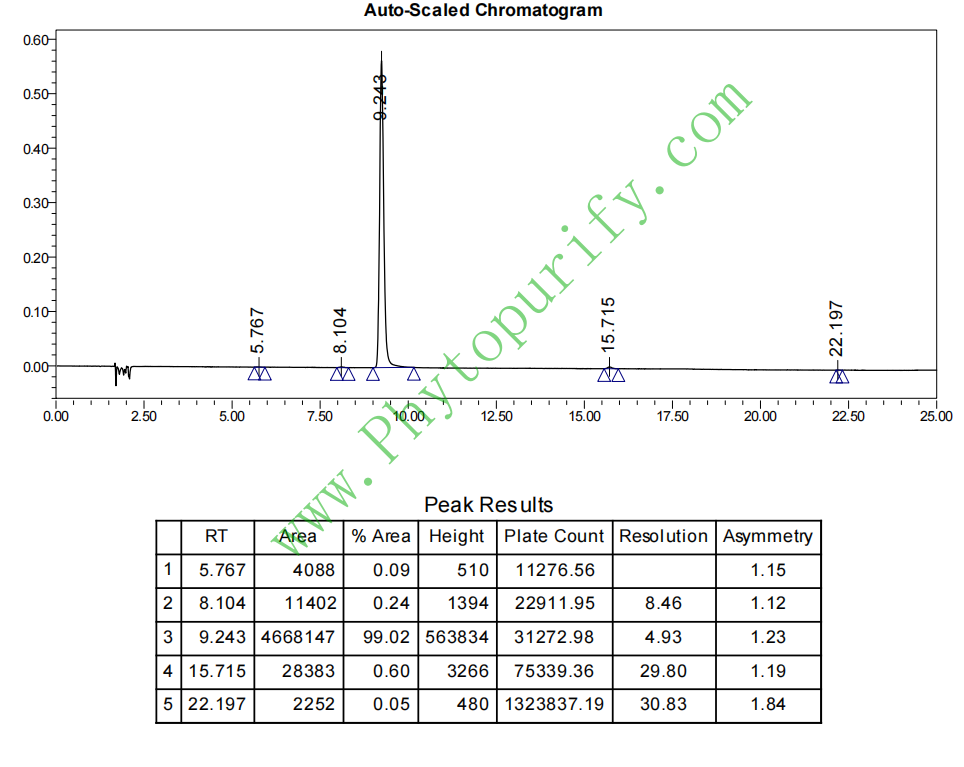
Analysis Method: HPLC-DAD or/and HPLC-ELSD
Identification Method: Mass, NMR
Packing: Brown vial or HDPE plastic bottle
The product could be supplied from milligrams to grams
Inquire for bulk scale.
For Reference Standard and R&D, Not for Human Use Directly.
HPLC of 4-Feruloylquinic acid
Storage conditions:Short-term storage at 2~8℃, long-term storage at -20 ~ -80℃
153.7500
.1434
-2.1077
5.0338
.7878
.5570
Low
71.3302
3.4862
Yes
No
No
No
Yes
No
0.0
Yes
Yes
Yes
Yes
Natural products, as important sources of drug lead compounds, play an irreplaceable role in human health maintenance and disease prevention and treatment. Among numerous natural polyphenolic compounds, quinic acid derivatives have attracted much attention due to their widespread presence in daily diet and various biological activities. 4-O-Feruloylquinic acid (4-FQA) is a phenolic acid compound formed by ester bonding between ferulic acid and quinic acid, and is an important member of the chlorogenic acid family. The molecular formula of this compound is C ₁₇ H ₂₀ O ₉, with a molecular weight of 368.3380 and a CAS registration number of 2613-86-7.
4-O-feruloylquinic acid is widely present in coffee, fruits, vegetables, and various medicinal plants, and is a common polyphenolic component in daily diet. In recent years, with the development of metabolomics and food science, 4-O-feruloylquinic acid has been proposed as a potential biomarker for food intake, opening up new directions for its application in nutritional epidemiology and dietary assessment. From the perspective of pharmacological activity, 4-O-feruloylquinic acid exhibits significant multiple biological activities such as antioxidant, anti-inflammatory, neuroprotective, and metabolic regulation. Its mechanism of action involves the regulation of multiple signaling pathways and molecular targets.
This article aims to systematically review the chemical properties, natural sources, extraction methods, pharmacological activities, molecular mechanisms, and pharmacological characteristics of 4-O-feruloylquinic acid, in order to provide comprehensive academic references for the in-depth research and development of this compound.
The chemical structure of 4-O-feruloylquinic acid consists of two parts: ferulic acid and quinic acid, which are connected to the 4-hydroxy group of quinic acid through ester bonds. The ferulic acid moiety contains a 3-methoxy-4-hydroxyphenylacrylic acid structure, and the methoxy and hydroxyl substituents on its benzene ring endow the molecule with unique antioxidant activity; The quinic acid moiety is a six membered ring polyhydroxy acid that provides multiple sites for molecular interactions with biomolecules.
From the perspective of stereochemistry, quinic acid has multiple chiral centers, and naturally occurring 4-O-feruloylquinic acid is typically in the (1R, 3R, 4S, 5R) - configuration. There are multiple ionizable phenolic hydroxyl and carboxyl groups in this molecule, which make it partially ionized under physiological pH conditions. This characteristic directly affects its solubility, membrane permeability, and binding mode with target proteins.
According to computational chemistry and experimental measurement data, the key physicochemical parameters of 4-O-feruloylquinic acid are as follows:
These physicochemical parameters collectively determine the absorption, distribution, metabolism, and excretion characteristics of 4-O-feruloylquinic acid in organisms. Its moderate LogP value and good water solubility enable it to effectively dissolve in the gastrointestinal tract after oral administration, but its high TPSA and low blood-brain barrier permeability limit its distribution in the central nervous system.
4-O-feruloylquinic acid is widely distributed in the plant kingdom, especially abundant in the following plants:
Coffee plants Coffee beans (Coffea arabica and Coffea canephora) are important sources of 4-O-feruloylquinic acid, with a content of 0.5-2.0% of dry weight in raw coffee beans. During the baking process, the compound undergoes partial degradation and isomerization.
Asteraceae plants Plants in the Asteraceae family, such as Echinacea purpurea, Matricaria chamomilla, and Taraxacum officinale, contain high levels of 4-O-feruloylquinic acid.
Solanaceae plants The compound can be detected in both the tubers of potatoes (Solanum tuberosum) and the fruits of eggplants (Solanum melongena).
Rosaceae plants The skin and flesh of fruits such as apples (Malus domestica) and pears (Pyrus communis) contain a certain amount of 4-O-feruloylquinic acid.
Umbelliferae plants This compound is also present in vegetables such as carrots (Daucus carota) and celery (Apium graveolens).
It is worth noting that the content of 4-O-feruloylquinic acid in plants is influenced by various factors such as variety, growth conditions, harvesting time, and processing methods. For example, the compound content in organically grown coffee beans is usually higher than that in conventionally grown coffee beans.
Based on the good water and alcohol solubility of 4-O-feruloylquinic acid, commonly used extraction solvents include:
- Water extraction method Using hot water (60-80 ° C) soaking or reflux extraction, suitable for large-scale production but with low selectivity
- Alcohol extraction method Using methanol or ethanol water mixed solvents (usually 50-80% ethanol), the extraction efficiency is higher than pure water
- Acetone water system For certain plant materials, acetone water (70:30) mixed solvents can achieve higher extraction rates
Ultrasound assisted extraction (UAE)By utilizing the cavitation effect of ultrasound to destroy cell walls and improve extraction efficiency, the extraction time can usually be shortened by 50-70%, while reducing the amount of solvent used.
Microwave assisted extraction (MAE)Microwave radiation rapidly heats up the interior of plant tissues, promoting the diffusion of target compounds into solvents and shortening extraction time to several minutes.
Supercritical fluid extraction (SFE)Using supercritical CO ₂ as the extraction solvent, a small amount of ethanol can be added as a co solvent. This method is environmentally friendly and has good selectivity, but the equipment cost is relatively high.
Pressure Liquid Extraction (PLE)Extracting under high temperature and high pressure conditions can significantly improve extraction efficiency and is suitable for compounds with good thermal stability.
The purification of 4-O-feruloylquinic acid in crude extract is usually carried out using the following chromatographic techniques:
- Macroporous adsorption resin Resins such as HPD-100 and AB-8 are initially purified by gradient ethanol elution
- Preparation type high performance liquid chromatography (Prep HPLC)Using a C18 reverse phase column with acetonitrile water or methanol water as the mobile phase, compounds with a purity of>98% can be obtained
- High Speed Counter Current Chromatography (HSCCC)Suitable for large-scale preparation, with the advantages of high sample recovery rate and low solvent consumption
The antioxidant activity of 4-O-feruloylquinic acid is one of its most noteworthy pharmacological properties. Multiple in vitro and in vivo studies have confirmed that this compound can exert antioxidant effects through various mechanisms:
Direct free radical scavenging The phenolic hydroxyl groups in 4-O-feruloylquinic acid molecules can effectively neutralize reactive oxygen species (ROS) and reactive nitrogen species (RNS), including hydroxyl radicals (• OH), superoxide anions (O ₂⁻•), peroxynitrite (ONOO ⁻), etc. Its antioxidant capacity is comparable to ferulic acid, and some experiments have shown that its IC ₅₀ value for scavenging DPPH free radicals is in the range of 10-30 μ M.
Metal ion chelation This compound can chelate transition metal ions such as Fe ² ⁺ and Cu ² ⁺, inhibit Fenton reaction and Haber Weiss reaction, thereby reducing the generation of hydroxyl radicals.
Restoration ability 4-O-feruloylquinic acid has significant reducing ability, which can reduce Fe ³ ⁺ to Fe ² ⁺, and its reducing ability is positively correlated with concentration.
In cell and animal models, 4-O-feruloylquinic acid exhibits significant anti-inflammatory effects:
-Inhibition of nitric oxide (NO) and prostaglandin E ₂ (PGE ₂) production in macrophages induced by lipopolysaccharide (LPS)
-Reduce the expression levels of pro-inflammatory cytokines such as tumor necrosis factor - α (TNF - α), interleukin-6 (IL-6), and interleukin-1 β (IL-1 β)
-Inhibition of cyclooxygenase-2 (COX-2) and inducible nitric oxide synthase (iNOS) activity
Despite the low blood-brain barrier permeability of 4-O-feruloylquinic acid, multiple studies have found its neuroprotective potential:
-Protecting neurons from oxidative stress-induced apoptosis
-Improving neurotoxicity induced by β - amyloid protein
-Reducing damage to dopaminergic neurons in Parkinson's disease models
4-O-feruloylquinic acid has a regulatory effect on glucose and lipid metabolism:
-Inhibit alpha glucosidase activity and delay carbohydrate digestion and absorption
-Improve insulin sensitivity and promote glucose uptake
-Reduce weight gain and fat accumulation induced by high-fat diet
The antioxidant effect of 4-O-feruloylquinic acid is not limited to directly scavenging free radicals, but more importantly, it exerts indirect antioxidant effects by regulating multiple antioxidant signaling pathways:
Nuclear factor E2 related factor 2 (NRF2, encoded by the NFE2L2 gene) is a core transcription factor in the cellular antioxidant defense system. 4-O-feruloylquinic acid can:
-Promote the dissociation of NRF2 and KEAP1, stabilize NRF2 and translocate it to the nucleus
-Enhance the binding between NRF2 and antioxidant response elements (ARE)
-Upregulate the expression of downstream antioxidant enzyme genes, including:
- Superoxide dismutase (SOD1 and SOD2)Catalytic dismutation of superoxide anions into hydrogen peroxide and oxygen
- Catalase (CAT)Decompose hydrogen peroxide into water and oxygen
- Glutathione peroxidase 1 (GPX1)Using glutathione to reduce hydrogen peroxide and organic peroxides
- Heme oxygenase 1 (HMOX1)Catalytic degradation of hemoglobin to produce biliverdin and carbon monoxide with antioxidant activity
Tyrosinase is a key enzyme in melanin synthesis, and its activity is regulated by the redox state. 4-O-feruloylquinic acid is obtained through:
-Directly inhibit the catalytic activity of TYR
-Regulating the transcription level of TYR gene
-Post translational modifications and degradation affecting TYR
Matrix metalloproteinases (MMPs) play a crucial role in extracellular matrix remodeling, and their abnormal activation is associated with skin aging, inflammation, and tumor invasion. 4-O-feruloylquinic acid can:
- Inhibition of MMP1 (collagenase)Reduce the degradation of type I collagen and protect the skin matrix
- Regulating MMP3 (matrix metalloproteinase): Affects the dynamic balance of extracellular matrix
-By inhibiting the MAPK and NF - κ B signaling pathways, the transcription levels of MMPs are reduced
The pharmacological activity of 4-O-feruloylquinic acid is not the result of a single target action, but is achieved through synergistic regulation of multiple targets and pathways:
Oxidation inflammation matrix remodeling network This compound simultaneously regulates the antioxidant enzyme system (SOD, CAT, GPX, HMOX), inflammatory mediators (COX-2, iNOS), and matrix degrading enzymes (MMP1, MMP3), forming a synergistic protective effect.
Epigenetic regulation The latest research suggests that 4-O-feruloylquinic acid may regulate the expression of antioxidant genes by affecting histone acetylation and DNA methylation status.
Gut microbiota interactions This compound can be metabolized by microorganisms in the intestine into more active metabolites, which may exert systemic effects through pathways such as the gut brain axis and gut liver axis.
Systematic evaluation of the pharmacological properties of 4-O-feruloylquinic acid based on Lipinski's five rules and Veber's rules:
| parameter | Numerical | Evaluation Criteria | compliance |
|---|---|---|---|
| molecular weight | 368.34 Da | <500 Da | Comply with |
| LogP | 0.14 | <5 | Comply with |
| Hbond donor | 5 | <5 | Critical |
| Number of hydrogen bond acceptors | 9 | <10 | Comply with |
| TPSA | 153.75 Ų | <140 Ų | slightly higher |
| Number of rotatable keys | 5 | <10 | Comply with |
From the above parameters, 4-O-feruloylquinic acid basically conforms to the synthetic drug rules, but its high TPSA and hydrogen bond donor number may affect its oral bioavailability.
4-O-feruloylquinic acid undergoes extensive metabolism in the body:
- Phase I metabolism Mainly occurring in the liver, involving ester hydrolysis (producing ferulic acid and quinic acid), hydroxylation, and methylation reactions
- Phase II metabolism Glucosylation and sulfation are the main binding reactions that generate various water-soluble metabolites
- Intestinal microbiota metabolism Microbial enzymes in the colon can hydrolyze ester bonds and further metabolize ferulic acid into phenylpropanoid derivatives
The discovery of 4-O-feruloylquinic acid as a potential food biomarker provides a new tool for nutritional epidemiological research:
- Dietary assessment By detecting the level of this compound in biological samples, the intake of coffee, fruits, and vegetables can be objectively evaluated
- Metabolomics Applications Establish a correlation network between diet, metabolites, and health using metabolomics techniques
- Personalized nutrition Develop precise dietary intervention plans based on individual metabolic characteristics
Given its excellent antioxidant activity and good safety, 4-O-feruloylquinic acid has potential for development in the field of health products
- Oral antioxidant Developed as a dietary supplement for the prevention of oxidative stress-related diseases
- Skin care products Develop anti-aging and whitening skincare products by utilizing its inhibition of TYR and MMP activity
- food additives As a natural antioxidant, it extends the shelf life of food
Although 4-O-feruloylquinic acid has various biological activities, its pharmacokinetic properties limit its direct application as a drug. Future directions for pharmaceutical chemistry optimization include:
4-O-feruloylquinic acid, as an important member of natural polyphenolic compounds, has shown broad application prospects in antioxidant, anti-inflammatory, neuroprotective, and metabolic regulation fields due to its unique chemical structure and rich biological activity. This compound exerts biological effects through multiple mechanisms such as regulating the NRF2/ARE antioxidant signaling pathway, inhibiting MMP activity, and modulating TYR function. Its targets include key molecules such as SOD1, SOD2, CAT, GPX1, HMOX1, MMP1, MMP3, and TYR.
From the perspective of drug development, 4-O-feruloylquinic acid has good safety and moderate physicochemical properties, but its low oral bioavailability and rapid metabolism are the main challenges in its development as a drug. In the future, these limitations are expected to be overcome through prodrug design, structural optimization, and the development of novel delivery systems. Meanwhile, the potential application of this compound as a dietary biomarker provides a new research direction for nutritional science and precision medicine.
With the continuous advancement of analytical chemistry, molecular pharmacology, and systems biology techniques, the understanding of 4-O-feruloylquinic acid will become more profound. We have reason to believe that this natural product will play an increasingly important role in the development of functional foods, health products, and drugs, contributing to the cause of human health.
