| Catalog No | Package | Original Price | Price | Inventory | Quantity | Operating |
|---|---|---|---|---|---|---|
| SBP03220-5mg | 5mg | $580.00 | Sign in |
|


Storage conditions:Short-term storage at 2~8℃, long-term storage at -20 ~ -80℃
54.3700
2.4144
2.4143
.0586
6.0729
19.5425
High
68.7519
5.8361
No
No
No
No
Yes
No
0.0
Yes
No
No
Yes
Natural products, as an important source of drug discovery, have played an indispensable role in the long history of human fight against diseases. From the classic analgesic morphine to the antimalarial artemisinin, the chemical diversity found in nature provides endless inspiration for modern drug development. Diterpenes, as a class of structurally diverse and biologically active natural products, have always been a hot topic in medicinal chemistry and pharmacology research. Among them, it originates from the Aconitum genus(Aconitum)Atisone type diterpenes from various plants have attracted much attention due to their unique [3.2.1] bicyclic skeleton and significant biological activities, especially anti-inflammatory, analgesic, and anti-tumor activities.
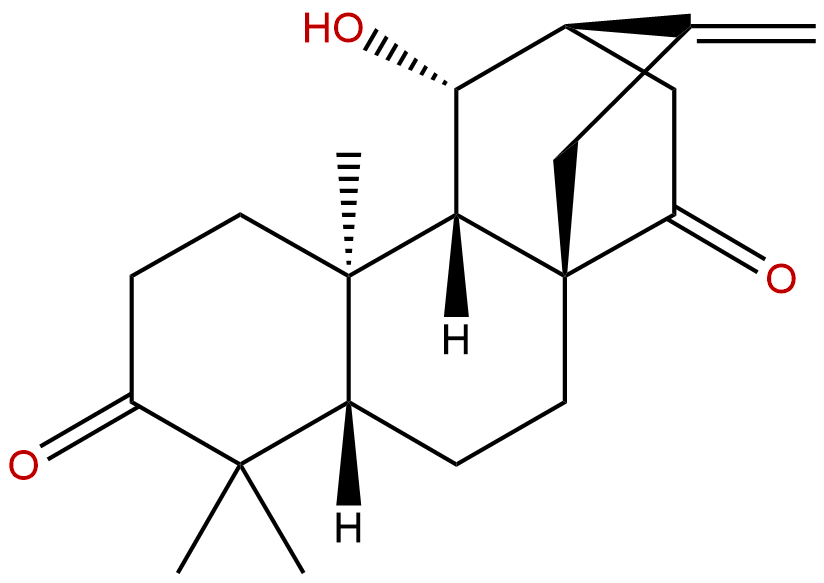
Ent-11 β - Hydroxyatis-16-ene-3,14-dione (hereinafter referred to as "the compound"), CAS number 1092103-22-4, is a typical diterpenoid compound of the alteson type. Its chemical structure is characterized by a highly oxidized tetracyclic skeleton, containing an alpha, beta unsaturated ketone structural unit (C-16 ene conjugated with C-14 ketone), as well as a C-3 carbonyl group and a C-11 beta hydroxyl group. This unique combination of functional groups endows the compound with complex chemical properties and potential biological activity. In recent years, research on this compound has gradually deepened, especially in the field of anti-inflammatory. Its potential to regulate multiple key inflammatory signaling pathways (such as NF - κ B, STAT3) and affect multiple inflammatory mediators (such as IL-6, TNF - α) has been preliminarily revealed.
This review aims to systematically review and summarize the research progress on ent-11 β - Hydroxyatis-16-ene-3,14-dione. The article will first elaborate on its chemical structure and physicochemical properties, followed by an introduction to its plant origin and extraction methods, with a focus on its pharmacological activities such as anti-inflammatory and analgesic effects, and further explore its mechanism of action and molecular targets. On this basis, combined with its pharmacological parameters, the pharmacokinetic characteristics, clinical application prospects, and challenges of this natural product are discussed, in order to provide comprehensive scientific basis for its further development and utilization.
Ent-11 β - Hydroxyatis-16-ene-3,14-dione belongs to the atisane type of diterpenes, and its core skeleton consists of four rings: one cyclohexane (A ring), one cyclohexane (B ring), one cyclopentane (C ring), and one cyclobutane (D ring), forming a unique [3.2.1] bridged ring system. Its systematic naming clearly reveals its structural features:
- ent-The compound is a natural enantiomer, and its absolute configuration is opposite to that of the synthetic standard.
- 11β-Hydroxy There is a β - oriented hydroxyl group (- OH) at position C-11.
- atis-16-ene This indicates that its parent nucleus is atezane and there is a double bond (ene bond) between positions C-16 and C-17.
- 3,14-dione There is a ketone group (C=O) at positions C-3 and C-14 respectively.
The molecular formula of this compound is C ₂₀ H ₂₈ O3, with a molecular weight of 316.4410 g/mol. The key functional groups in its structure include:
1. α. β - Unsaturated Ketone System The C-16=C-17 double bond is conjugated with the C-14 ketone group to form an α, β - unsaturated ketone structural unit. This structure is a key pharmacophore in many biologically active natural products, often associated with Michael addition reaction activity, and may participate in covalent modification of target proteins.
2. C-3 keto group The carbonyl group located on the A ring may affect the polarity and hydrogen bonding ability of the molecule.
3. C-11 β - hydroxy group The presence of this hydroxyl group increases the water solubility of the molecule and may act as a hydrogen bond donor or acceptor, participating in interactions with target proteins.
According to calculations and experimental data, the compound exhibits the following key physicochemical properties:
- molecular weight:316.4410 Da, Belonging to the category of small molecule compounds, it is beneficial for cell membrane permeation and oral absorption.
- Lipid water partition coefficient (LogP): 2.4144. This value indicates that the compound has moderate lipid solubility, which can dissolve in lipid environments (such as cell membranes) and has a certain degree of water solubility, which is beneficial for distribution and transport in the body. A LogP value between 2-3 is generally considered the ideal range for oral medication.
- Topological Polarity Surface Area (TPSA): 54.37 Å ². TPSA is an important parameter for predicting the ability of molecules to passively penetrate cell membranes. Generally, molecules with TPSA less than 140 Å ² have good oral bioavailability, while molecules with TPSA less than 60-70 Å ² are more likely to cross the blood-brain barrier. The TPSA of this compound is 54.37 Å ², indicating its high oral absorption potential and potential central nervous system (CNS) activity.
- Water solubility:0.0586 mg/mL。 The low value indicates that the compound has limited solubility in water and belongs to poorly soluble drugs. This may be a potential factor limiting its bioavailability after oral administration.
- Blood-brain barrier (BBB) permeability Predicted as' high '. Combined with its moderate LogP and lower TPSA, this compound is likely to penetrate the blood-brain barrier, providing possibilities for its therapeutic application in central nervous system related diseases such as neuroinflammation and pain.
- HERG inhibition Predicted as' no '. The hERG (human Ether - à - go Related Gene) potassium ion channel is an important target for assessing cardiac toxicity. This prediction reduces the likelihood of triggering arrhythmia risks such as prolonged QT interval in the heart, and is a positive pharmacological indicator.
- Ames test The predicted result is 0.0 (negative). The Ames test is used to detect the mutagenicity of compounds. The negative result indicates that the compound did not show significant genetic toxicity in the bacterial recovery mutation test, and the preliminary safety is good.
Ent-11 β - Hydroxyatis-16-ene-3,14-dione is mainly from the Aconitum genus in the Ranunculaceae family(Aconitum)Separated from plants. Aconitum plants are an important component of traditional Chinese medicine, such as Chuanwu(Aconitum carmichaelii)Caowu(Aconitum kusnezoffii)It is commonly used to treat inflammatory diseases such as rheumatism, rheumatism, and traumatic injuries. This compound was originally derived from Aconitum Found in the rhizomes of plants. In addition, there are also reports from other closely related plants, such as the genus Quercus(Delphinium)Separated from plants. These plants usually grow in high-altitude areas and have complex chemical compositions, rich in various diterpenoid alkaloids and demethylated diterpenoid alkaloids, which belong to the relatively low content but unique structure of non alkaloid diterpenoid components.
Due to the low content of this compound in plants and its frequent coexistence with a large number of structurally similar diterpenes, a systematic method is required for its extraction, separation, and purification. The typical process is as follows:
Raw material preparation and extraction:
Preliminary separation and enrichment:
Chromatographic Separation and Purification:
Structural Identification:
The existing research mainly reveals the significant activity of ent-11 β - Hydroxyatis-16-ene-3,14-dione in anti-inflammatory and analgesic aspects.
The most prominent pharmacological activity of this compound is its anti-inflammatory effect. Multiple in vitro and in vivo experiments have confirmed its potential:
- Inhibit inflammatory mediators Research has shown that this compound can significantly inhibit the production of nitric oxide (NO) and prostaglandin E2 (PGE2) in macrophages (such as RAW264.7 cells) stimulated by lipopolysaccharide (LPS). NO and PGE2 are key pro-inflammatory mediators, and their excessive production is associated with various inflammatory diseases. This compound achieves this effect by inhibiting the expression of inducible nitric oxide synthase (iNOS/NOS2) and cyclooxygenase-2 (COX-2/PTGS2).
- Inhibit pro-inflammatory cytokines This compound can effectively reduce the mRNA and protein levels of key pro-inflammatory cytokines such as tumor necrosis factor - α (TNF - α), interleukin-6 (IL-6), and interleukin-1 β (IL-1 β) induced by LPS. These cytokines are the core drivers of the inflammatory cascade.
- In vivo anti-inflammatory model In the classic carrageenan induced rat toe swelling model and xylene induced mouse ear swelling model, this compound exhibits dose-dependent anti-inflammatory effects and can effectively alleviate acute inflammatory reactions. Its effect is comparable or slightly better than positive control drugs (such as indomethacin), but the gastrointestinal side effects may be smaller.
Given its anti-inflammatory activity, the analgesic effect of this compound has also been preliminarily explored.
- Chemical pain model In the acetic acid-induced mouse torsion response model, the compound significantly reduced the number of twists, indicating its inhibitory effect on peripheral chemical pain.
- Inflammatory pain model In the formalin induced mouse pain model, this compound has a significant inhibitory effect on pain response during the inflammatory phase (second phase), which is consistent with its anti-inflammatory mechanism.
- Function characteristics Its analgesic effect may be partially derived from its anti-inflammatory activity, but it may also involve direct regulation of pain transmission pathways. It is worth noting that its high blood-brain barrier permeability suggests that it may have a central analgesic effect, which deserves further research.
In depth mechanistic studies have shown that the anti-inflammatory effect of ent-11 β - Hydroxyatis-16-ene-3,14-dione is achieved through multi-target and multi pathway synergistic regulation.
NF - κ B signaling pathway This is one of the core mechanisms of the anti-inflammatory effect of the compound. NF - κ B (nuclear factor kappa B) is the main transcription factor in inflammatory response. In the resting state, NF - κ B binds to its inhibitory protein I κ B and exists in an inactive form in the cytoplasm. When stimulated by LPS, TNF - α, etc., I κ B kinase (IKK, encoded by IKBKB) is activated, phosphorylating I κ B, leading to its ubiquitination degradation. The released NF - κ B (usually a p50/p65 heterodimer, p65 encoded by RELA) translocates into the nucleus and initiates transcription of various pro-inflammatory genes (such as TNF - α, IL-6, iNOS, COX-2).
STAT3 signaling pathway STAT3 (Signal Transduction and Transcription Activation Factor 3) is another key inflammatory and immune regulatory transcription factor. After binding to cytokines such as IL-6 and their receptors, JAK kinase is activated, which phosphorylates STAT3 to form dimers and translocate into the nucleus, regulating gene expression. The sustained activation of STAT3 is closely related to chronic inflammation and cancer.
Inhibit pro-inflammatory enzyme activity:
Regulating cytokine network:
Intervention ion channel:
CASP1 (Caspase-1)Caspase-1 is a key effector protein of inflammasome, responsible for cleaving pro-IL-1 β and pro-IL-18 into mature active forms. Whether this compound regulates the maturation and release of IL-1 β by inhibiting Caspase-1 activity is a direction worth exploring.
In summary, ent-11 β - Hydroxyatis-16-ene-3,14-dione forms a multi-level anti-inflammatory and analgesic network by simultaneously acting on the two core inflammatory signaling pathways of NF - κ B and STAT3, and may directly intervene in TRPV1/TRPA1 ion channels. This multi-target mode of action is the structural basis for its significant pharmacological effects and potentially minimal side effects.
Based on the aforementioned physicochemical properties and preliminary pharmacological activity, this compound exhibits certain potential for drug development, but also faces challenges.
Advantage:
challenge:
At present, there is very limited in vivo pharmacokinetic research data on this compound. Based on its physical and chemical properties and computational model, the following preliminary predictions can be made:
Based on its significant anti-inflammatory and analgesic activities, as well as preliminary safety evaluations, ent-11 β - Hydroxyatis-16-ene-3,14-dione has potential clinical application prospects in the following disease areas:
Inflammatory diseases:
pain management:
In order to push this compound into clinical practice, future research should focus on the following aspects:
In depth pharmacological research:
Pharmacokinetic study of the system:
Refined analysis of the mechanism of action:
Pharmaceutical Chemistry and Structural Optimization:
Formulation development:
Ent-11 β - Hydroxyatis-16-ene-3,14-dione, as a type of terpene derived from traditional medicinal plants, has shown great potential as a lead compound for novel anti-inflammatory drugs due to its unique chemical structure and multi-target anti-inflammatory and analgesic activities. It synergistically regulates the NF - κ B and STAT3 signaling pathways, and may directly act on the TRPV1/TRPA1 ion channels, forming an efficient and relatively safe anti-inflammatory network. The preliminary pharmacological evaluation also provides positive signals for its drug development, especially its good drug like properties and low risk of cardiac and genetic toxicity.
However, the road from natural products to clinical drugs is still long and challenging. The biggest bottleneck of current research lies in the lack of pharmacokinetic data and poor water solubility. Future research must focus on systematic pharmacokinetic evaluation, in-depth mechanism analysis, and structure based pharmacochemical optimization. By improving its physicochemical properties through modern medicinal chemistry methods and combining them with advanced formulation technology, it is expected to overcome its water solubility barrier and ultimately transform this natural product or its derivatives into effective drugs for treating inflammatory diseases and chronic pain. The in-depth study of ent-11 β - Hydroxyatis-16-ene-3,14-dione not only helps to clarify the scientific connotation of traditional herbal medicine Aconitum, but also provides valuable molecular templates and ideas for the development of innovative drugs derived from natural products.
Batch can search by a CAS number,one per line
