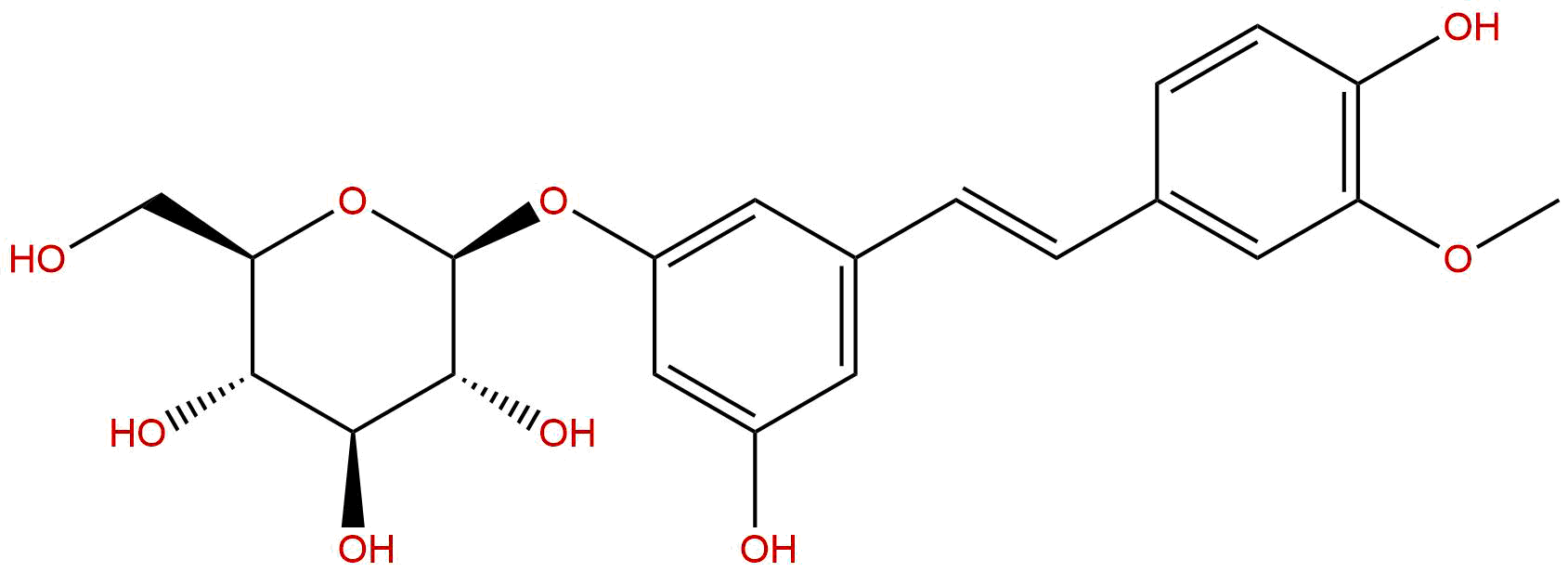


Storage conditions:Short-term storage at 2~8℃, long-term storage at -20 ~ -80℃
Isorhaponticin (CAS number: 32727-29-0) is an important natural product belonging to the class of glycosidic stilbene compounds. Due to its unique structure and diverse biological activities, it has received widespread attention in the fields of pharmacology and natural product chemistry. As one of the hotspots in the pharmacological research of natural products, isoflavones are mainly used in traditional medicine for their laxative effect. Modern research has revealed that their mechanism of action involves multiple intestinal ion channels and transporters, demonstrating good pharmacological activity and safety. This article aims to systematically review the chemical structure, plant origin, pharmacological activity, and mechanism of action of isoquercetin, and explore its clinical application prospects and future research directions based on pharmacological evaluation and pharmacokinetic data, providing theoretical basis and practical guidance for the drug development of this compound.
Isoflavonol is a stilbene glycoside with a molecular formula of C21H2O9 and a molecular weight of 420.4140. Its structural characteristics include the combination of a stilbene core structure and a glycosidic group, which gives it high polarity and good water solubility. Its LogP value is 0.6394, indicating that the molecule has moderate lipid solubility, which is beneficial for absorption and distribution in the body. The topological polar surface area (TPSA) is 149.0700, indicating the presence of many polar groups on its molecular surface, which may affect its membrane permeability. The water solubility index is 3.1191, indicating good solubility in aqueous phase, which is beneficial for formulation development. The low permeability of the blood-brain barrier suggests that its main target may be limited to peripheral tissues, reducing potential toxicity to the central nervous system. The negative result of hERG channel inhibition experiment indicates a low risk of cardiac toxicity. The Ames mutagenicity test showed a value of 0.0, indicating a low risk of genotoxicity and good safety.
Yitu Dahuang glycoside is mainly found in various traditional Chinese medicinal materials, especially in Rheum spp., which are abundant in content. Rhubarb, as a traditional Chinese medicine, is widely used in clinical treatments such as diarrhea, clearing heat and detoxifying. One of its active ingredients is isoflavones. In addition, isoflavones have also been reported in other plants containing stilbene glycosides.
The common methods for extracting isoflavones include traditional solvent extraction and modern ultrasound assisted extraction, microwave-assisted extraction, etc. Generally, ethanol or methanol is used as the extraction solvent, and after reflux or ultrasound assisted extraction, combined with liquid-liquid distribution, column chromatography and other separation and purification techniques, high-purity isoquercetin is obtained. In recent years, the application of supercritical fluid extraction and membrane separation technology has further improved extraction efficiency and purity, reduced solvent usage, and is in line with the concept of green chemistry.
The main pharmacological activity of isoflavones is focused on its laxative effect. In vitro and in vivo studies have shown that isoflavones can promote intestinal peristalsis, regulate intestinal water and electrolyte balance, and thus exert a laxative effect. In addition, some studies have found that it has auxiliary effects such as anti-inflammatory and antioxidant properties, which may have potential therapeutic value for intestinal inflammatory diseases.
In in vivo animal experiments, isoflavones can significantly shorten the time of fecal excretion, increase the moisture content of intestinal contents, and improve constipation symptoms. In vitro cell experiments revealed its regulatory effects on ion channels and transporters in intestinal epithelial cells, providing a molecular basis for its diarrhea mechanism.
The laxative effect of isoflavones involves various intestinal related ion channels and transporters, mainly including:
Through multi-target synergistic effects, isoflavones can effectively regulate the intestinal environment, promote intestinal fluid secretion and peristalsis, and thus exert a laxative effect.
The physicochemical properties of isoflavones show that they have good water solubility and moderate lipid solubility, which is beneficial for oral absorption. Its high TPSA value and low blood-brain barrier penetration suggest that it mainly acts locally in the intestine, reducing the risk of central nervous system side effects. The negative inhibition of hERG channel and the negative Ames test further support its safety.
In terms of pharmacokinetics, although the in vivo metabolic and kinetic data of the system are currently limited, previous studies have shown that after oral administration, the concentration of isoflavones in the intestinal tract is relatively high, and some components can be metabolized by the intestinal microbiota to produce active metabolites that participate in diarrhea. Its bioavailability is influenced by the glycosidic structure, and enzymatic hydrolysis and transporter mediated absorption processes will be the focus of future research.
As a natural laxative active ingredient, Yitu Dahuang glycoside has a clear pharmacological mechanism of action and good safety, and has good clinical development potential. Its application prospects are broad in constipation, intestinal dysfunction, and related digestive system diseases. In the future, modern pharmaceutical formulation technology can be combined to develop oral sustained-release or enteric coated formulations to improve targeting and efficacy.
In addition, the multi-target mechanism of action of isoflavones provides a theoretical basis for its adjuvant therapy in diseases such as intestinal inflammation and irritable bowel syndrome. By combining modern molecular biology and medicinal chemistry methods, in-depth research on its metabolic pathways, target interactions, and structural optimization will promote its translation into clinical drugs.
In summary, as a natural stilbene glycoside with unique structure and significant laxative activity, isoquercetin exhibits good pharmacological activity and safety. The mechanism of multi-target regulation of intestinal ion channels and transporters provides important ideas for the development of new laxatives. In the future, efforts should be made to strengthen its pharmacokinetic and clinical evaluation research, combined with modern drug design and formulation technology, to promote the widespread application of isoflavones in clinical practice and benefit more patients with digestive system diseases.
