


Synonym name: Quercetin 3-beta-galactoside-2"-gallate
Catalogue No.: BP0036
Cas No.: 53209-27-1
Formula: C28H24O16
Mol Weight: 616.484
Botanical Source:
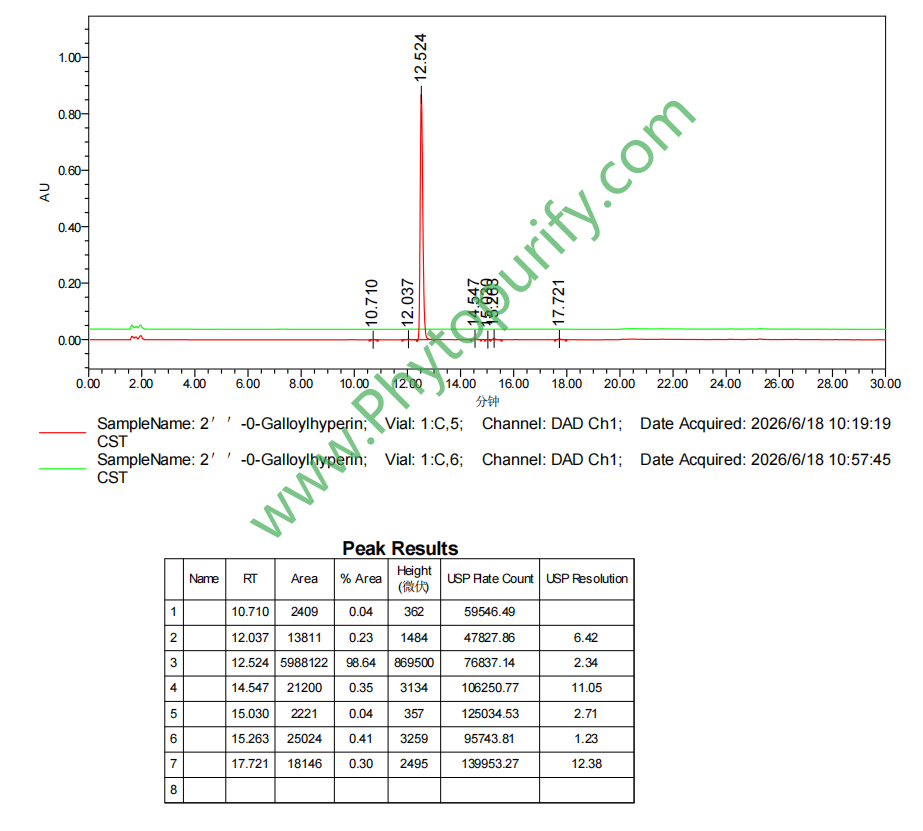
Purity: 95%~99%
Analysis Method: HPLC-DAD or/and HPLC-ELSD
Identification Method: Mass, NMR
Packing: Brown vial or HDPE plastic bottle
Can be supplied from milligrams to grams.
For Reference Standard and R&D, Not for Human Use Directly.
Inquire for bulk scale.
HPLC of 2"-O-Galloylhyperin
Storage conditions:Short-term storage at 2~8℃, long-term storage at -20 ~ -80℃
291.6800
-1.5000
-2.5000
No
Unknown
Unknown
Unknown
Unknown
Unknown
Unknown
Unknown
2 '' - O-galloylhyperin is a naturally occurring flavonoid glycoside that has attracted widespread attention in the field of natural product pharmacology in recent years due to its unique structure and diverse biological activities. This compound belongs to a derivative of flavonoids and has significant potential for antioxidant, anti-inflammatory, and cellular function regulation. Especially in the prevention and treatment of endothelial dysfunction related diseases, 2 '' - O-galloyl hyperoside has shown good pharmacological activity and therapeutic prospects. As the pathological basis of various cardiovascular diseases, endothelial dysfunction involves complex processes such as oxidative stress, inflammatory response, and abnormal cell signaling. The regulation of its key molecular targets has become a current research hotspot.
This article will provide a systematic review of the chemical structure and physicochemical properties, plant sources, and extraction methods of 2 '' - O-galloyl hyperoside. Combining the latest pharmacological activity research, we will explore its mechanism of action and molecular targets, evaluate its pharmacological properties and pharmacokinetic characteristics, and look forward to its potential and development direction in clinical applications, providing theoretical basis and reference for subsequent research and new drug development.
The molecular formula of 2 '' - O-galloyl hyperoside is C30H26O16, with a molecular weight of 624.48. Its structural characteristic is to connect a galloyl group (galloyl) through an ester bond on the 2 '' hydroxyl group of quercetin (also known as quercetin-3-O - β - D-glucopyranoside), forming a derivative of galloylation. This esterification modification endows it with strong hydrophilicity and rich hydrogen bonding ability. Its physicochemical properties show a LogP value of about -1.5, indicating good water solubility. The polar surface area (TPSA) is as high as 291.68 Å ², and the number of hydrogen bond acceptors is as high as 16, suggesting that the molecule has certain limitations in the permeability of the cell membrane.
The typical flavonoid core structure (C6-C3-C6) in the molecular structure endows it with basic antioxidant activity, while the introduction of gallic acid groups enhances its ability to bind to protein targets, possibly regulating biological functions through multi-point hydrogen bonding and hydrophobic interactions. In addition, the compound is not easily able to penetrate the blood-brain barrier (BBB), which has certain advantages for targeting peripheral vascular system diseases and reducing the risk of central nervous system side effects.
2 '' - O-galloyl hyperoside is mainly found in various traditional medicinal plants, especially in plants rich in quercetin flavonoids, such as Hypericum spp., Saxifragaceae plants, and some Rosaceae plants. Its content is greatly affected by plant species, growth environment, harvesting time, and processing methods.
Common extraction methods include:
Solvent extraction Ethanol, water, or their mixed solvents are used for reflux or ultrasound assisted extraction, with ethanol content generally controlled between 50% -70% to ensure effective extraction of polar and non-polar components.
Liquid phase separation The crude extract was purified by liquid-liquid distribution, silica gel column chromatography, and reverse phase high performance liquid chromatography (RP-HPLC) to obtain high-purity 2 '' - O-galloyl hyperoside.
Modern Separation Technology Emerging methods such as supercritical fluid extraction and membrane separation technology have also been attempted to be applied to the extraction and purification of this compound, improving extraction efficiency and purity.
During the extraction process, attention should be paid to avoiding high temperature and strong acid-base conditions to prevent hydrolysis of gallic acid ester bonds or damage to the flavonoid skeleton, ensuring the stability and activity of the compound.
2 '' - O-galloyl hyperoside has shown extensive pharmacological activity in various in vitro and in vivo models, particularly in regulating pathological processes related to endothelial dysfunction.
Antioxidant effect
This compound can effectively eliminate excess reactive oxygen species (ROS) and alleviate oxidative stress damage to endothelial cells. Its antioxidant mechanism mainly relies on the electron donor ability of the flavonoid core structure and the free radical capture function of the gallic acid group, promoting the expression of intracellular antioxidant enzymes (such as enzymes regulated by NFE2L2) and enhancing the cell's own antioxidant defense system.
anti-inflammatory activity
2 '' - O-galloyl hyperoside can inhibit the release of inflammatory factors such as IL-6 and TNF - α, regulate the STAT3 signaling pathway, alleviate the damage of inflammatory response to vascular endothelium, and improve vascular permeability and function.
Regulating vascular function
By affecting the expression and activity of molecules such as protein kinase C α (PRKCA) and matrix metalloproteinase 2 (MMP2), 2 '' - O-galloyl hyperoside promotes the repair and remodeling of vascular endothelial cells, inhibits vascular wall inflammation and fibrosis processes, and improves vascular elasticity.
Sugar metabolism and enzyme inhibition
The compound has a certain inhibitory effect on aldose reductase (AKR1B1), which is helpful to alleviate the endothelial injury associated with diabetes. In addition, its regulation of protein tyrosine phosphatase 1B (PTPN1) may improve insulin signaling and indirectly protect vascular function.
Neuroprotective potential
Although 2 '' - O-galloyl hyperoside is not easily able to pass through the blood-brain barrier, its antioxidant and anti-inflammatory effects may indirectly have a protective effect on the nervous system by improving the peripheral vascular environment.
The mechanism of action of 2 '' - O-galloyl hyperoside involves multiple signaling pathways and key targets, including:
APP (amyloid precursor protein)
This protein plays a complex role in regulating endothelial cell function, and 2 '' - O-galloyl hyperoside may alleviate vascular inflammation by regulating the expression and processing of APP, affecting cell adhesion and signal transduction.
PTPN1 (protein tyrosine phosphatase 1B)
As a negative regulator of the insulin signaling pathway, inhibition of PTPN1 helps improve insulin sensitivity and vascular function. 2 '' - O-galloyl hyperoside inhibits its activity by binding to PTPN1, promoting endothelial cell metabolic homeostasis.
STAT3 (Signal Transduction and Transcription Activation Factor 3)
STAT3 is involved in inflammatory response and cell survival signaling. 2 '' - O-galloyl hyperoside inhibits STAT3 phosphorylation, reduces pro-inflammatory gene expression, and alleviates endothelial inflammation.
PRKCA (protein kinase C alpha)
PRKCA plays a key role in regulating vascular tone and cell proliferation, and 2 '' - O-galloyl hyperoside regulates PRKCA activity, promoting vasodilation and repair.
AKR1B1 (aldose reductase)
AKR1B1 catalyzes the reduction of glucose to sorbitol, which is an important enzyme in the complications of diabetes. 2 '' - O-galloyl hyperoside inhibits the activity of this enzyme and alleviates diabetes related endothelial damage.
MMP2 (Matrix Metalloproteinase 2)
MMP2 mediates extracellular matrix degradation, participates in vascular remodeling and inflammation. 2 '' - O-galloyl hyperoside inhibits MMP2 activity and prevents damage to vascular wall structure.
NFE2L2 (nuclear factor erythroid 2 related factor 2)
NFE2L2 is the main regulator of cellular antioxidant response. 2 '' - O-galloyl hyperoside activates NFE2L2 signaling, enhances antioxidant enzyme expression, and protects endothelial cells from oxidative damage.
BCHE (butyrylcholinesterase)
BCHE plays a role in neurotransmitter metabolism and inflammation, and 2 '' - O-galloyl hyperoside may affect vascular and neural regulation by regulating BCHE activity.
P4HB (protein disulfide isomerase)
Participating in protein folding and stress response, 2 '' - O-galloyl hyperoside regulates P4HB function and helps maintain endothelial cell protein homeostasis.
XDH (xanthine dehydrogenase)
XDH generates superoxide anions during oxidative stress, and 2 '' - O-galloyl hyperoside inhibits XDH activity, reducing oxidative stress levels.
In summary, 2 '' - O-galloyl hyperoside works synergistically through multiple targets and pathways to regulate oxidative stress, inflammatory response, and metabolic abnormalities in endothelial cells, exerting a protective effect on vascular function.
From the perspective of medicinal properties, 2 '' - O-galloyl hyperoside has certain advantages and challenges:
Molecular weight and polarity
The molecular weight of 624.48 is relatively large, with a TPSA of 291.68 and a high number of hydrogen bond receptors, indicating its strong polarity, which may limit oral absorption and cell membrane penetration ability.
Fat solubility (LogP)
LogP is -1.5, indicating good water solubility but insufficient lipid solubility, which may affect distribution and transmembrane transport.
Blood-brain barrier permeability
Predicting difficulty in crossing the blood-brain barrier, suitable for targeting the peripheral vascular system, and reducing the risk of central nervous system toxicity.
Toxicity assessment
At present, safety data on liver toxicity, cardiac toxicity, and hERG channel inhibition are not clear, and further in vivo and in vitro toxicological studies are needed to verify them.
pharmacokinetics
Due to the lack of systematic pharmacokinetic data in vivo, it is speculated that its oral bioavailability may be low, and the metabolic pathways in vivo may involve esterase hydrolysis and modification of liver metabolic enzymes. In the future, pharmacokinetic studies are needed to clarify its absorption, distribution, metabolism, and excretion characteristics, providing a basis for dosage form design and administration regimens.
Drug interactions
As a natural product with multi-target effects, 2 '' - O-galloyl hyperoside may interact with various enzymes and transporters, posing potential drug interaction risks that require systematic evaluation.
2 '' - O-galloyl hyperoside has shown great potential in the prevention and treatment of endothelial dysfunction and related cardiovascular diseases. Its multi-target and multi-mechanism characteristics enable it not only to alleviate oxidative stress and inflammation, but also to regulate vascular remodeling and metabolic abnormalities, providing new ideas for the treatment of hypertension, atherosclerosis, diabetes vascular complications, etc.
Future clinical translation needs to focus on the following aspects:
Formulation optimization and administration route
Given its physicochemical properties, develop nanocarriers, liposomes, or other novel drug delivery systems to enhance oral bioavailability and targeting.
Safety and Toxicology Research
Systematically evaluate the safety of long-term medication, especially liver and cardiac toxicity, and clarify the risk benefit ratio of its clinical use.
Clinical trial design
Conduct early clinical trials to validate its efficacy and safety in patients with endothelial dysfunction, combined with biomarker monitoring of treatment efficacy.
Combination therapy strategy
Explore the combination application with existing cardiovascular drugs to achieve synergistic effects, reduce monotherapy dosage and side effects.
Structural modification and derivative development
Design and synthesize structurally optimized derivatives based on the 2 '' - O-galloyl hyperoside skeleton to enhance drug activity and pharmacokinetic properties.
As a natural flavonoid glycoside with unique structure and multiple biological activities, 2 '' - O-galloyl hyperoside has shown broad research and application prospects in the prevention and treatment of endothelial dysfunction and related cardiovascular diseases. Its multi-target regulatory mechanism provides a new perspective for understanding the role of natural products in complex diseases. In the future, through systematic pharmacological, toxicological, and clinical research, combined with modern drug design and delivery technologies, it is expected to promote the clinical translation of 2 '' - O-galloyl hyperoside and its derivatives, becoming a new natural drug resource for the prevention and treatment of cardiovascular diseases.
