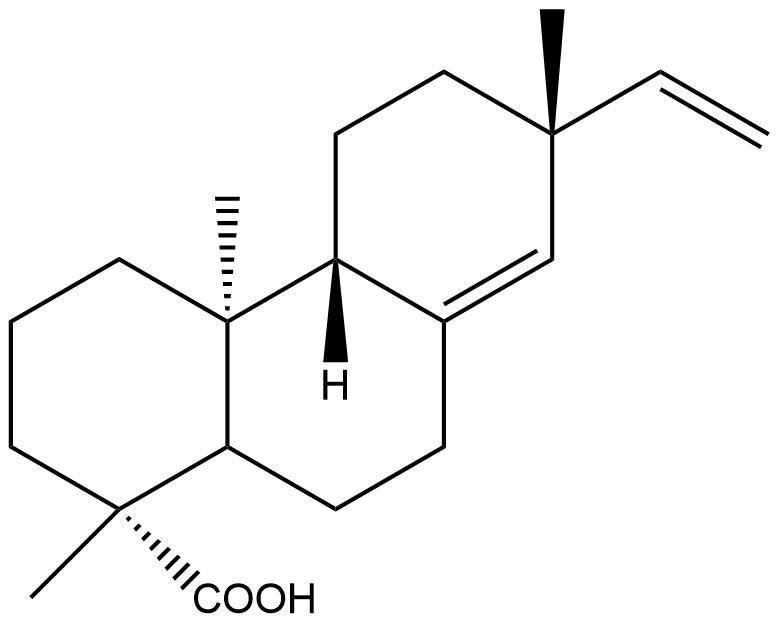


Product name: Continentalic acid
Synonym name: Pimaradienoic acid
Catalogue No.: BP2057
Cas No.: 19889-23-7
Formula: C20H30O2
Mol Weight: 302.458
Botanical Source: Acanthoppanax gracilistylus W. W. Smith.
Type of Compound: Diterpenoids
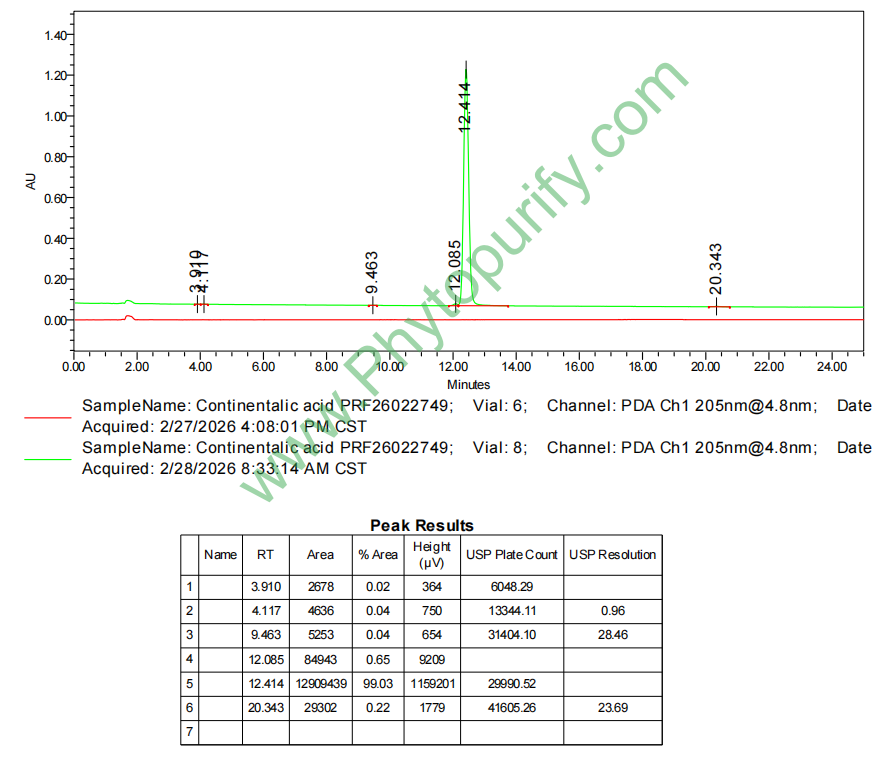
Purity: 95%~99%
Analysis Method: HPLC-DAD or/and HPLC-ELSD
Identification Method: Mass, NMR
Packing: Brown vial or HDPE plastic bottle
Storage: Store in a well closed container, protected from air and light. Put into refrigerate or freeze for long term storage.
Whenever possible, you should prepare and use solutions on the same day. However, if you need to make up stock solutions in advance, we recommend that you store the solution as aliquots in tightly sealed vials at -20℃. Generally, these will be useable for up to two weeks.
The product could be supplied from milligrams to grams
Inquire for bulk scale.
For Reference Standard and R&D, Not for Human Use Directly.
Description:
Continentalic acid and kaurenoic acid are quality control markers in Aralia continentalis. Continentalic acid has anti-inflammatory, anti-cancer, and anti-bacterial activities, it shows moderate cytotoxicity against A-549 (lung), THP-1 (leukemia) and MCF-7 (breast) cell lines; it has minimum inhibitory concentrations (MICs) of approximately 8-16 microg/mL against S. aureus, including the MSSA and MRSA standard strains.
References:
Indian J Pharm Sci. 2015 Nov-Dec;77(6):792-5.
In vitro Cytotoxicity of Methanol Extract from Aerial Parts of Aralia cachemirica and Purified Continentalic Acid.
The present study was designed to evaluate the in vitro cytotoxic effect of methanol extract of aerial parts including stems, leaves and twigs of Aralia cachemirica and purified Continentalic acidisolated from this extract against a panel of human cancer cell lines of varied tissues.
METHODS AND RESULTS:
Percentage of growth inhibition was evaluated by sulphorhodamine B assay. Purified Continentalic acid showed moderate cytotoxicity against all the cell lines used. In contrast, the extract exhibited significant concentration dependant cytotoxicity against A-549 (lung), THP-1 (leukemia) and MCF-7 (breast) cell lines.
CONCLUSIONS:
This work highlights cytotoxic potential of this extract, which can further be explored for different constituents for their possible use autonomously or in combined manner in cancer therapy. The detailed analysis of their cytotoxicity has been presented in this paper.
Arch Pharm Res. 2009 Sep;32(9):1237-43.
Anti-inflammatory activity of the constituents of the roots of Aralia continentalis.
METHODS AND RESULTS:
To assess the anti-inflammatory activity of the constituents of the roots of Aralia continentalis, ent-pimara-8(14),15-diene-19-oic acid (Continentalic acid, pimaradienoic acid, compound I), 7beta-hydroxy-ent-pimara-8(14),15-diene-19-oic acid (compound II), 7-oxo-ent-pimara-8(14),15-diene-19-oic acid (compound III), 15alpha,16alpha-epoxy-17-hydroxy-ent-kauran-19-oic acid (compound IV) and ent-kaura-16-en-19-oic acid (kaurenoic acid, compound V), their inhibitory effects against cyclooxygenase-2 (COX-2)-catalyzed PGE(2) and inducible nitric oxide synthase (iNOS)-catalyzed NO production by lipopolysaccharide-treated RAW 264.7 cells were examined.
CONCLUSIONS:
Taken together, the results of this study suggest that some constituents of A. continentalis, especially compounds I, III and V, exert significant anti-inflammatory activity, which suggests that these constituents contribute, at least in part, to the anti-inflammatory action of the roots of A. continentalis.
Phytother Res. 2006 Jun;20(6):511-4.
Continentalic acid from Aralia continentalis shows activity against methicillin-resistant Staphylococcus aureus.
METHODS AND RESULTS:
In a continuing search for compounds with antibacterial activity against methicillin-resistant Staphylococcus aureus (MRSA), a chloroform extract of roots of Aralia continentalis was found to contain Continentalic acid (CA, C(20)H(30)O(2)), a diterpenic acid. This compound exhibited potent activity against standard methicillin-susceptible Staphylococcus aureus (MSSA) as well as clinical isolates of methicillin-resistant Staphylococcus aureus (MRSA). It was determined that Continentalic acid had minimum inhibitory concentrations (MICs) of approximately 8-16 microg/mL against S. aureus, including the MSSA and MRSA standard strains.
CONCLUSIONS:
Therefore, the results obtained in this study suggest that Continentalic acid might have potential as an adjunct in the treatment of antibiotic-resistant bacteria.
HPLC of Continentalic acid
Storage conditions:Short-term storage at 2~8℃, long-term storage at -20 ~ -80℃
37.3000
5.1443
3.3952
.0115
6.8811
19.9776
High
93.0238
4.3807
No
Yes
No
No
No
No
0.0
No
No
Yes
Yes
Continental acid (CAS number: 19889-23-7) is a natural product derived from the Aralia intercontinental plant in the Araliaceae family. In recent years, it has attracted much attention due to its significant antibacterial and potential anti-tumor activities. As a diterpenoid compound with a unique structure, Changbai Araliaceae not only exhibits good inhibitory effects on various strains of Staphylococcus aureus, but also has a minimum inhibitory concentration (MIC) in the range of 8-16 μ g/mL for methicillin-resistant (MSSA) and methicillin-resistant (MRSA) strains, demonstrating its potential as a candidate molecule for antibacterial drugs. In addition, with the in-depth study of its molecular mechanism of action, the regulatory effect of Changbai Araliaceae on malignant tumor related targets such as liver cancer has gradually been revealed, providing new ideas for its anti-tumor drug development.
This article aims to systematically review the chemical structure and physicochemical properties, plant sources and extraction methods, pharmacological activity and mechanism of action, pharmacological evaluation and pharmacokinetic characteristics of Aralia elata acid, and explore its clinical application prospects in depth, providing theoretical basis and research direction for subsequent drug development and clinical translation.
The molecular formula of Changbai Aralia acid is C2H030O3, with a molecular weight of 302.4580 Da. Its structure belongs to the class of diterpenoid acidic compounds, with typical terpenoid skeletons and carboxylic acid functional groups. The chemical structure contains multiple unsaturated bonds and lipophilic groups, giving it high hydrophobicity. The LogP value is 5.1443, indicating that it has strong lipid solubility, which is conducive to penetrating cell membranes, but low water solubility (0.0115 mg/mL), which may have a certain impact on its bioavailability. The topological polar surface area (TPSA) is 37.3 Å ², indicating its low polarity and favorable permeability of the cell membrane.
In addition, Changbai Aralia acid has a high blood-brain barrier permeability, indicating its potential application in central nervous system related diseases. The negative result of hERG channel inhibition experiment indicates a low risk of cardiac toxicity. The Ames test result is 0, indicating no significant genetic toxicity and meeting the basic requirements for safety evaluation.
In summary, the physicochemical properties of Changbai Aralia acid indicate that it has good membrane penetration and low risk of toxic side effects. However, its low water solubility may limit its oral absorption, and its bioavailability needs to be optimized through drug formulation technology.
Changbai Araliaceae mainly comes from the Aralia Continentalis plant in the Araliaceae family. This plant is used in traditional medicine in East Asia to treat symptoms such as rheumatism, inflammation, and enhance immunity. The roots and rhizomes of Aralia Continentalis are the main accumulation sites of acid in Changbai Aralia elata.
The extraction method usually uses organic solvent extraction combined with column chromatography separation technology. The specific steps include:
In recent years, modern extraction techniques such as ultrasound assisted extraction (UAE) and microwave-assisted extraction (MAE) have also been applied to improve extraction efficiency and purity. In addition, HPLC、 Mass spectrometry and nuclear magnetic resonance (NMR) analysis methods are widely used for qualitative and quantitative analysis of tartaric acid in Changbai Aralia elata.
Changbai Araliaceae exhibits significant antibacterial activity against Staphylococcus aureus, especially against methicillin-resistant (MSSA) and methicillin-resistant (MRSA) strains, with MIC values of approximately 8-16 μ g/mL. This activity makes it a potential candidate drug for combating drug-resistant bacterial infections. Its antibacterial mechanism may involve cell membrane disruption, protein synthesis inhibition, and metabolic interference, but the specific target of action still needs further clarification.
In solid tumor models such as liver cancer, Changbai acid exhibits certain cytotoxicity and proliferation inhibition effects. In vitro experiments have shown that it can induce apoptosis in liver cancer cells, inhibit cell migration and invasion, indicating its potential for anti metastasis. Some studies suggest that Changbai Aralia acid may exert anti-tumor effects by regulating multiple signaling pathways, including inhibiting key pathways such as STAT3, PI3K/AKT, and NF - κ B, thereby affecting the survival and proliferation of tumor cells.
In addition to antibacterial and anti-tumor activities, Changbai Aralia acid also exhibits certain anti-inflammatory, antioxidant, and immune regulatory effects, which may synergistically promote its therapeutic effect. Its anti-inflammatory effect is related to inhibiting the expression of inflammatory factors and regulating immune cell function.
The molecular mechanism of action of Changbai Araliaceae involves multiple key targets, especially its significant regulatory role in liver cancer-related signaling pathways. The main targets include:
The multiple regulation of these targets gives Changbai Araliaceae the advantage of multi-target and multi pathway synergistic effects in anti-tumor therapy, reflecting the multi-target pharmacological characteristics of natural products.
The pharmacological evaluation of Changbai Aralia acid shows that it has good potential for drug development:
In terms of pharmacokinetics, current research is relatively limited. Preliminary in vivo experiments have shown that oral administration of Changbai Aralia acid has a certain bioavailability, but its half-life is short, suggesting the need to extend the in vivo action time through drug carriers or sustained-release formulations. Its metabolic pathway may involve liver oxidation and binding reactions, but specific metabolic enzymes and metabolites are yet to be systematically studied.
As a natural product, Changbai Aralia acid has shown broad clinical application prospects due to its significant antibacterial and anti-tumor activities. Its inhibitory effect on MRSA provides a new drug candidate molecule for solving drug-resistant bacterial infections, especially in the context of increasingly severe antibiotic resistance.
In the field of tumor therapy, Changbai Araliaceae has demonstrated potential anti-tumor effects by regulating liver cancer-related signaling pathways through multiple targets. In the future, modern drug design technology can be combined to optimize its structure and pharmacokinetic properties, and develop it into a new type of anti-tumor drug. In addition, its good safety and blood-brain barrier penetration ability provide possibilities for the study of neurological diseases.
However, the clinical research on Changbai Araliaceae is still in its infancy and lacks systematic clinical trial data. Future research should focus on its in vivo pharmacokinetics, toxicological evaluation, and clinical efficacy verification. At the same time, combining advanced formulation technologies such as nanocarriers and drug co crystallization to enhance their water solubility and bioavailability is the key to achieving clinical translation.
As an important active ingredient in Aralia Continentalis, Changbai Araliaceae has become a hot topic in natural product pharmacology research due to its unique chemical structure and diverse pharmacological activities. It has shown great potential in multiple fields such as antibacterial and anti-tumor applications, especially in the multi-target mechanism of action in drug-resistant bacterial infections and liver cancer treatment, providing valuable natural molecular templates for new drug development.
In the future, it is necessary to strengthen the systematic pharmacology and pharmacokinetic research of Changbai Aralia acid, combined with modern drug design and formulation technology, to promote its clinical application. I believe that with the deepening of research, Changbai Aralia acid is expected to become an important breakthrough in the development of natural product drugs and contribute new therapeutic methods to human health.
