| Catalog No | Package | Original Price | Price | Inventory | Quantity | Operating |
|---|---|---|---|---|---|---|
| BP4733-5mg | 5mg | $450.00 | Sign in |
|


Storage conditions:Short-term storage at 2~8℃, long-term storage at -20 ~ -80℃
Natural products, as important resources for new drug discovery, exhibit unique pharmacological activities in multiple fields such as anti-inflammatory, anti-tumor, and anti infection. Multiflorin B is a class of kaempferol glycosides with significant biological activity, originally isolated from the roots of the fern Neocheirapteris palmatopodata. In recent years, with the deepening of research on the pharmacological activity of natural products, Rosalind B has gradually attracted attention due to its excellent anti-inflammatory effect. Especially in regulating the production of nitric oxide (NO) and the expression of inflammatory mediators, it has shown significant inhibitory effects, providing a theoretical basis for its development as a potential anti-inflammatory drug.
The purpose of this review is to systematically summarize the chemical structure and physicochemical properties, plant sources and extraction methods, pharmacological activity and mechanism of action, pharmacological evaluation and pharmacokinetic characteristics of Rosa rugosa B, and explore its potential and challenges for future clinical applications in combination with its molecular targets and related diseases. It is expected to provide reference for the in-depth research and drug development of this natural product.
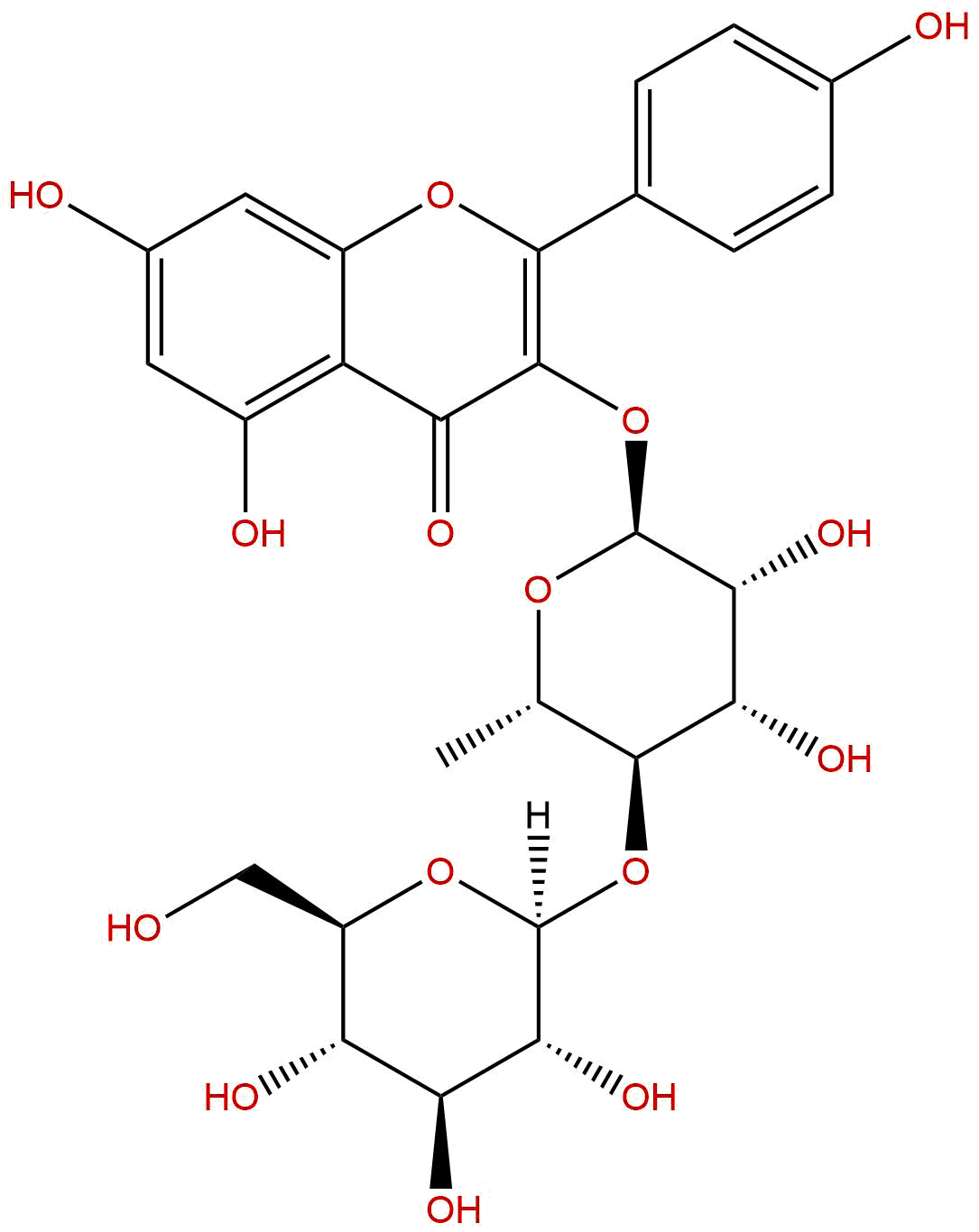
Rose glycoside B is a flavonoid compound of kaempferol glycoside, with a molecular formula of C27H30O15 and a molecular weight of 594.5220. The core of its structure is the kaempferol skeleton, which connects multiple sugar groups to form glycoside structures. The LogP value of Rosin B is -0.3350, indicating its strong hydrophilicity and good water solubility (2.8044), which has a certain impact on its absorption and distribution in vivo. Its topological polar surface area (TPSA) is 249.2 Å ², and a larger polar surface area is usually associated with lower cell membrane permeability, which is also consistent with its low blood-brain barrier penetration ability.
Rosin B does not inhibit hERG channels and shows a lower risk of cardiac toxicity. The Ames test result is 1.2, indicating a low risk of genetic toxicity. The overall physicochemical properties indicate that Rosaroside B has a good safety basis in drug development, but its high polarity may limit oral absorption and distribution in the central nervous system.
Rosin B is mainly extracted from the roots of the fern Neocheirapteris palmatopedata. Neocheirapteris palmatopedata belongs to fern plants, distributed in some parts of Asia, and its roots contain abundant flavonoid glycosides. In traditional Chinese medicine literature, fern roots are often used for anti-inflammatory and antipyretic treatment, while modern research has confirmed the presence of their active ingredients through chemical separation techniques.
The extraction method usually uses ethanol or methanol as solvents, and obtains crude extracts through reflux extraction or ultrasound assisted extraction. Subsequently, liquid-liquid partitioning, column chromatography (such as silica gel column, C18 reverse phase column), and high-performance liquid chromatography (HPLC) techniques were used for separation and purification. The purity detection of Rosin B relies heavily on HPLC-UV and mass spectrometry techniques. In recent years, the introduction of supercritical fluid extraction and membrane separation technology is expected to improve extraction efficiency and purity, and reduce production costs.
The pharmacological activity research of Rose Glycoside B mainly focuses on its anti-inflammatory effect. In vitro experiments have shown that Rose Glycoside B can inhibit the production of nitric oxide (NO) at a concentration of 20 μ g/ml, with an inhibition rate of 52%. As an important mediator in the inflammatory response, the excessive production of NO is closely related to various inflammatory diseases. The inhibitory effect of Roseglycoside B on NO demonstrates its potential anti-inflammatory effect.
In addition, Rosalind B has regulatory effects on various inflammation related targets, including IL-6, TNF, STAT3, CASP1, TRPV1, TRPA1, PTGS1, PTGS2, NOS2, and NFKB1. These targets play a crucial role in inflammation signaling, cell apoptosis, and pain perception. Rosaroside B can effectively alleviate inflammation and related symptoms by regulating the expression or activity of these molecules.
Although animal model studies are relatively limited, there is preliminary data supporting the protective effect of rosmarin B in inflammatory disease models, such as reducing pathological manifestations such as arthritis and enteritis. More systematic in vivo pharmacological studies and toxicological evaluations are needed in the future to clarify the safe dosage range and treatment window.
The anti-inflammatory mechanism of Rose Glycoside B involves multiple signaling pathways and molecular targets. Its main targets include:
In summary, Rose Glycoside B exhibits broad-spectrum anti-inflammatory activity by synergistically regulating the generation and release of inflammatory mediators through multiple targets and pathways, inhibiting inflammatory signal transduction.
The pharmacological evaluation of Rosin B shows that it has certain potential for drug development. The molecular weight of 594.5220 is slightly higher than the Lipinski rule recommendation of 500 or less, but its good water solubility and low fat solubility (LogP-0.3350) are beneficial for in vivo distribution. A higher TPSA (249.2) suggests limited cell membrane penetration ability, which may affect oral absorption and bioavailability.
The low penetration ability of the blood-brain barrier indicates that rosmarin B is not easily able to enter the central nervous system, reducing the risk of central side effects. HERG channel inhibition is negative, indicating a low risk of cardiac toxicity. The Ames test results showed a low risk of genetic toxicity and good safety.
At present, there is a lack of systematic pharmacokinetic (PK) data, and it is speculated that its high polarity may lead to slow oral absorption and limited bioavailability. The metabolic pathway may mainly involve glycoside hydrolysis and corresponding metabolism through the liver enzyme system, and further research is needed on its metabolites and clearance methods.
In the future, in vivo pharmacokinetic studies need to be conducted to clarify its absorption, distribution, metabolism, and excretion (ADME) characteristics, optimize the dosing regimen and formulation design, and improve its clinical feasibility.
Rose glycoside B demonstrates its potential as a novel anti-inflammatory drug due to its significant anti-inflammatory activity and good safety. Its multi-target regulatory mechanism is suitable for treating various inflammation related diseases, such as rheumatoid arthritis, inflammatory bowel disease, chronic obstructive pulmonary disease, etc. In addition, the regulation of TRPV1 and TRPA1 by Rosin B suggests that it may play an auxiliary role in the management of inflammatory pain.
However, the current research on Rosin B is still in its early stages and lacks systematic in vivo pharmacological, toxicological, and preclinical study data. Future research should focus on its pharmacokinetic characteristics, formulation optimization, in vivo effective dosage, and long-term safety evaluation. Meanwhile, by combining modern drug design techniques such as structural modification and nanocarrier delivery, it is expected to enhance its bioavailability and targeting.
In addition, given its low blood-brain barrier penetration ability, rosmarin B is more suitable for the treatment of peripheral inflammatory diseases. Future clinical trial design should be based on its pharmacological characteristics, selecting appropriate indications and routes of administration.
Rose glycoside B, as a natural product of kaempferol glycosides derived from Neocheirapteris palmatopedata, has shown broad prospects for drug development due to its significant anti-inflammatory activity and multi-target mechanism of action. Its good safety and physicochemical properties lay the foundation for further pharmacological research and clinical translation. Although research is still in its early stages, with the advancement of modern drug development technology, rosmarin B is expected to become an important candidate drug in the anti-inflammatory field.
Future research should focus on systematic pharmacokinetic and toxicological evaluation, in-depth analysis of its molecular mechanism of action, optimization of dosing regimens, and conduct preclinical and clinical studies to promote the transition of Rosin B from laboratory to clinical application, bringing new treatment options for patients with inflammatory diseases.
