
| Catalog No | Package | Original Price | Price | Inventory | Quantity | Operating |
|---|---|---|---|---|---|---|
| BP1379-20mg | 20mg | $35.00 | Sign in |
|


Product name: Tetrandrine
Synonym name:
Catalogue No.: BP1379
Cas No.: 518-34-3
Formula: C38H42N2O6
Mol Weight: 622.762
Botanical Source: Stephaniae Tetrandrae Radix
Physical Description:
Type of Compound: Alkaloids
Purity: 95%~99%
Analysis Method: HPLC-DAD or/and HPLC-ELSD
Identification Method: Mass, NMR
Packing: Brown vial or HDPE plastic bottle
Storage: Store in a well closed container, protected from air and light. Put into refrigerate or freeze for long term storage.
Whenever possible, you should prepare and use solutions on the same day. However, if you need to make up stock solutions in advance, we recommend that you store the solution as aliquots in tightly sealed vials at -20℃. Generally, these will be useable for up to two weeks.
The product could be supplied from milligrams to grams
Inquire for bulk scale.
Description:
Tetrandrine is a calcium channel blocker, which shows antitumor, antifibrotic, anti-oxidant, anti-inflammatory and immunosuppressive activity. It suppressed Wnt/β-catenin signaling transduction, the migration of DU145 and PC-3 cells, EOMA cell growth through the ROS/Akt pathway and inhibited inward rectifying potassium current in cultured bovine aortic endothelial cells.
References:
Asian J Androl. 2015 Feb 6.
Tetrandrine suppresses proliferation, induces apoptosis, and inhibits migration and invasion in human prostate cancer cells.
Tetrandrine (TET), a traditional Chinese medicine, exerts remarkable anticancer activity on various cancer cells. However, little is known about the effect of TET on human prostate cancer cells, and the mechanism of function of TET on prostate cancer has not yet been elucidated.
METHODS AND RESULTS:
To investigate the effects of TET on the suppression of proliferation, induction of apoptosis, and inhibition of migration and invasion in human prostate cancer cell lines, DU145 and PC-3. Inhibition of growth was determined by 3-(4,5-dimethylthiazol-2-yl)-2,5-diphenyltetrazolium bromide assay and clone formation assay, and flow cytometry analysis was performed to detect the induction of apoptosis. Activation of poly (ADP-ribose) polymerase, caspase-3, Akt, phospho-Akt, Bcl-2, and Bax was analyzed by Western blotting. Wound healing assay and transwell migration assay were used to evaluate the effect of TET on migration and invasion of cancer cells. TET inhibited the growth of DU145 and PC-3 cells in a dose- and time-dependent manner. Cell cloning was inhibited in the presence of TET in DU145 and PC-3 cells. TET suppressed the migration of DU145 and PC-3 cells. Transwell invasion assay showed that TET significantly weakened invasion capacity of DU145 and PC-3 cells. TET exhibited strong inhibitory effect on proliferation, migration, and invasion of prostate cancer cells. In addition, TET induced apoptosis in a dose-dependent manner by activating the caspase cascade and inhibiting phosphoinositide 3-kinase-Akt signal pathway.
CONCLUSIONS:
The accumulating evidence suggests that TET could be a potential therapeutic candidate against prostate cancer in a clinical setting.
Acta Pharmacol Sin. 2000 Dec;21(12):1115-8.
Tetrandrine inhibits inward rectifying potassium current in cultured bovine aortic endothelial cells.
To study the effect of Tetrandrine (Tet) on inward rectifying potassium current in cultured bovine aortic endothelial cells.
METHODS AND RESULTS:
Inward rectifying potassium current (IRK) was observed by the whole cell patch-clamp technique. IRK was inhibited by Tet in a concentration-dependent manner and recovered to normal after wash with drug-free external solution. IRK was reduced from (582 +/- 48) pA to (221 +/- 40) pA at a holding potential of -70 mV by Tet 30 mumol/L. IC50 was 2.8 mumol/L.
CONCLUSIONS:
Tet inhibited inward rectifying potassium current in cultured bovine aortic endothelial cells.
J Gastroenterol Hepatol. 2007 Jan;22(1):99-111.Antifibrotic effects of tetrandrine on hepatic stellate cells and rats with liver fibrosis.
Tetrandrine (TET), a traditional Chinese medicine, exerts remarkable anticancer activity on various cancer cells. However, little is known about the effect of TET on human prostate cancer cells, and the mechanism of function of TET on prostate cancer has not yet been elucidated.
METHODS AND RESULTS:
Anti-inflammation strategies are one of the proposed therapeutic approaches to hepatic fibrosis. Tetrandrine (C(38)H(42)O(8)N(2), molecular weight: 622; Tet), an alkaloid isolated from the Chinese medicinal herb Stephania tetrandra, has been shown to exert anti-inflammatory activity in pulmonary diseases. The purpose of the present study was to investigate the in vitro and in vivo effects of Tet on hepatic fibrosis.
METHODS AND RESULTS:
A cell line of rat hepatic stellate cells (HSC-T6) was stimulated with transforming growth factor-beta1 (TGF-beta1) or tumor necrosis factor-alpha (TNF-alpha). The inhibitory effects of Tet on the nuclear factor kappaB (NFkappaB) signaling cascade and molecular markers including intercellular adhesion molecule-1 (ICAM-1) and alpha-smooth muscle actin (alpha-SMA) secretion were assessed. Fibrosis was induced by dimethylnitrosamine (DMN) administration in rats for 4 weeks. Fibrotic rats were randomly assigned to one of the four groups: vehicle (0.7% carboxyl methyl cellulose, CMC), Tet (1 mg/kg), Tet (5 mg/kg), or silymarin (50 mg/kg), each given by gavage twice daily for 3 weeks starting after 1 week of DMN administration. At the end of the study, liver tissues were scored for fibrosis and analyzed for molecular markers of fibrosis. Tetrandrine (0.5-5.0 micromol/L) concentration-dependently inhibited NFkappaB transcriptional activity induced by TNF-alpha, including IkappaBalpha phosphorylation and mRNA expressions of ICAM-1 in HSC-T6 cells. In addition, Tet also inhibited TGF-beta1-induced alpha-SMA secretion and collagen deposition in HSC-T6 cells. Fibrosis scores of livers from DMN-treated rats with high-dose Tet (1.3 +/- 0.3) were significantly reduced in comparison with DMN-treated rats receiving saline (2.0 +/- 0.2). Hepatic collagen content of DMN rats was significantly reduced by either Tet or silymarin treatment.
CONCLUSIONS:
Double-staining results showed that alpha-SMA- and NFkappaB-positive cells were decreased in the fibrotic livers by Tet and silymarin treatment. In addition, mRNA expression of ICAM-1, alpha-SMA, and TGF-beta1 was attenuated by Tet treatment. Moreover, levels of plasma aspartate aminotransferase and alanine aminotransferase activities were reduced by Tet and silymarin treatment.
HPLC of Tetrandrine
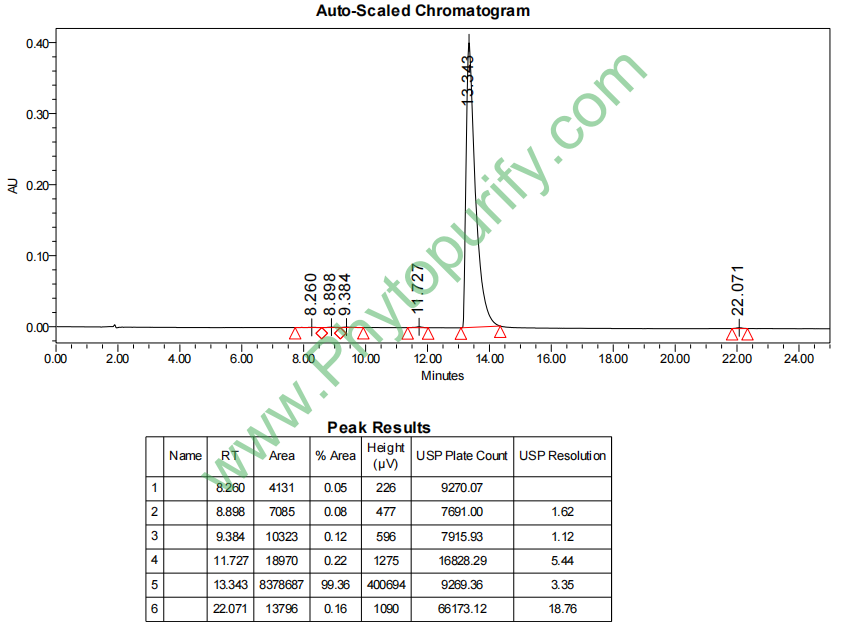
Storage conditions:Short-term storage at 2~8℃, long-term storage at -20 ~ -80℃
Tetrandrine (CAS number: 518-34-3) is a biphenyl isoquinoline alkaloid derived from the traditional Chinese medicine plant Stephania tetrandra S. Moore. As one of the important active ingredients in traditional Chinese medicine, Hanfangjijia has attracted widespread attention in recent years due to its multi-target and multi pathway pharmacological activities, especially its potential applications in anti-tumor, anti-inflammatory, anti fibrotic, and cardiovascular disease fields. Its unique calcium channel blocking effect has shown significant effects in regulating intracellular calcium ion homeostasis, thereby affecting various signaling pathways and cellular functions. This article provides a systematic review of the chemical structure and physicochemical properties, plant sources and extraction methods, pharmacological activity research, mechanism of action and molecular targets, drug efficacy evaluation and pharmacokinetics, as well as clinical application prospects of Hanfangjijia. The aim is to provide theoretical support and research ideas for its further drug development and clinical applications.
Hanfangjisu is a diphenylisoquinoline alkaloid with a molecular formula of C38H42N2O6 and a molecular weight of 622.7620. Its structural features include two phenylisoquinoline units connected by carbon carbon bonds, forming a complex polycyclic skeleton. This molecule has high hydrophobicity with a LogP value of 6.0783, indicating strong lipid solubility and extremely low water solubility (0.0017 mg/mL), which has a significant impact on its absorption and distribution in vivo. The topological polar surface area (TPSA) is 61.86 Å ², reflecting its molecular polarity and the number of hydrogen bond donors/acceptors, indirectly affecting its bioavailability and cell membrane penetration. Hanfangjijia has a high ability to penetrate the blood-brain barrier, indicating its potential application value in central nervous system diseases. In addition, Hanfangjijia exhibits hERG channel inhibitory activity, indicating that its cardiac electrophysiological safety needs to be carefully evaluated. The Ames test result is 0.0, indicating no significant mutagenicity and a good safety basis.
Hanfangjisu mainly exists in the rhizomes of Stephania tetrandra S. Moore, a perennial vine of the genus Stephania in the family Stephania, widely distributed in southern China. In traditional Chinese medicine, the roots and stems of Hanfangji are commonly used to treat diseases such as rheumatism, arthritis, and edema. In modern research, the extraction of Hanfangjijia is usually carried out using organic solvent extraction combined with column chromatography separation technology.
Common extraction methods include:
The extracted and purified Hanfangjijia is a yellow crystalline powder, and its purity is usually confirmed by HPLC or mass spectrometry.
Hanfangjijia has become a hot topic in natural product pharmacology research due to its multi-target and multifunctional pharmacological activities. Its main pharmacological effects include:
Tetrandrine shows a broad spectrum of anti-tumor activity, covering lung cancer, liver cancer, breast cancer, colorectal cancer and other solid tumors and hematological malignancies. Its anti-tumor mechanism involves inducing tumor cell apoptosis, inhibiting cell proliferation, blocking tumor angiogenesis, and inhibiting metastasis. Both in vitro cell experiments and animal models have confirmed that tetracycline can significantly reduce tumor volume and the number of metastatic lesions.
Hanfangjijia exhibits good anti-inflammatory activity by inhibiting the release of inflammatory mediators and regulating immune cell function. It has significant inhibitory effects on various inflammatory models, especially showing potential therapeutic value in chronic inflammatory diseases.
In disease models such as liver fibrosis and pulmonary fibrosis, Hanfangjijia has shown good anti fibrotic potential by inhibiting fibroblast activation and collagen deposition, reducing fibrosis progression.
As a voltage-gated calcium channel blocker, tetracycline can dilate blood vessels, lower blood pressure, improve myocardial ischemia, and has anti arrhythmic and protective effects on myocardial cells.
The pharmacological basis of Hanfangjijia lies in its regulation of various molecular targets, especially in the field of anti-tumor. The main mechanisms of action include:
Hanfangjijia can effectively inhibit voltage-gated calcium ion channels (ICa) and Ca2+activated potassium ion channels, regulate intracellular calcium ion concentration, and affect cell signaling, proliferation, and apoptosis processes. This effect is the basis of its various pharmacological effects.
Hanfangjijia inhibits inflammatory signaling pathways such as NF - κ B and MAPK, reduces the release of inflammatory factors such as TNF - α and IL-6, regulates immune cell activity, and alleviates inflammatory reactions.
By inhibiting the TGF - β/Smad signaling pathway, the activation of fibroblasts and collagen synthesis are blocked, reducing tissue fibrosis.
The pharmacological evaluation of Han Fang Ji Jia Su shows that it has certain advantages and challenges:
To overcome the problems of poor water solubility and low bioavailability, new formulation technologies such as nanocarriers, liposomes, and solid dispersions have been widely studied to improve their efficacy and safety.
Hanfangjijia, with its multi-target and multi mechanism pharmacological properties, has shown broad clinical application prospects in the fields of anti-tumor, anti-inflammatory, anti fibrotic, and cardiovascular diseases. At present, Hanfangjijia is mainly in the preclinical research and early clinical trial stage, and the future development focus includes:
Hanfangjijia, as a natural product with unique structure and multiple pharmacological activities, has shown great potential for drug development. Its application prospects in multiple fields such as anti-tumor, anti-inflammatory, anti fibrosis, and cardiovascular disease are broad, but it also faces challenges such as poor water solubility, low bioavailability, and cardiac toxicity. Future research should focus on in-depth analysis of its mechanism of action, innovation in drug formulation technology, and improvement of safety evaluation, in order to promote the clinical application of Hanfangjijia and benefit more patients. Through interdisciplinary collaboration, Hanfangjijia is expected to become an important member in the development of natural product drugs, promoting the rational utilization and modernization of natural drug resources.
