


Product name: Fangchinoline
Synonym name: Hanfangchin B; 12-O-Methylatherospermoline; Menisidine
Catalogue No.: BP0582
Cas No.: 436-77-1
Formula: C37H40N2O6
Mol Weight: 608.735
Botanical Source: Alkaloid from Root of Cyclea peltata, Triclisia subcordata and Stephania hernandifolia, the tubers of Stephania tetrandra, and from the bark of Daphnandra sp. Dt-7 (Menispermaceae, Atherospermacaceae).
Physical Description: Powder
Type of Compound: Alkaloids
Purity: 95%~99%
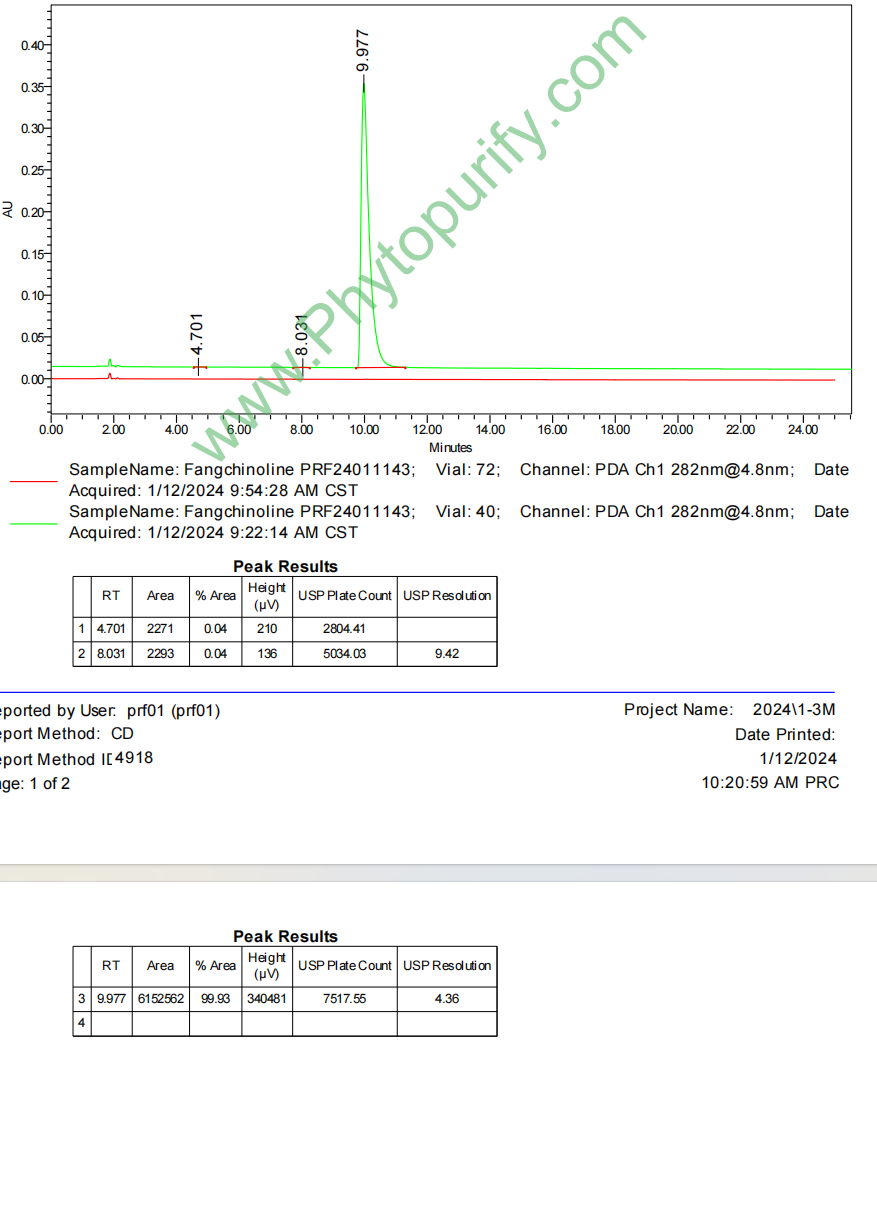
Analysis Method: HPLC-DAD or/and HPLC-ELSD
Identification Method: Mass, NMR
Packing: Brown vial or HDPE plastic bottle
Storage: Store in a well closed container, protected from air and light. Put into refrigerate or freeze for long term storage.
Whenever possible, you should prepare and use solutions on the same day. However, if you need to make up stock solutions in advance, we recommend that you store the solution as aliquots in tightly sealed vials at -20℃. Generally, these will be useable for up to two weeks.
The product could be supplied from milligrams to grams, up to kilograms
Inquire for bulk scale.
Descriptions:
Fangchinoline and tetrandrine are the major alkaloids from Stephania tetrandrae S. they shows anti-inflammatory effects on mouse ear edema induced by croton oil, the biochemical mechanisms of fangchinoline and tetrandrine on anti-inflammation are significantly different even though they are similar in chemical structure.[1]
Fangchinoline and tetrandrine have vasodilating and hypotensive effects on the rat aorta and the stroke-prone spontaneously hypertensive rat.[2]
Fangchinoline is a highly specific agent inducing autophagic cell death via p53/sestrin2/AMPK signalling in hepatocellular carcinoma cells with a novel mechanism, which elucidates the potential of fangchinoline to potentiate programmed cell death in cancer cells.[3]
Fangchinoline is a nonspecific Ca(2+) channel blocker, it reduces both FBS- and PDGF-BB-induced RASMCs proliferation by perturbing cell cycle progression; this antiproliferative effect of FAN is dependent on the MAP kinase pathway, but cannot be limited to its Ca(2+) modulation.[4]
Fangchinoline (Fan) has anti-tumorigenic activity in vivo, including reduction of tumor volume and pro-apoptotic and anti-proliferative effects in a PC3 nude mouse xenograft, it inhibits human prostate cancer cell lines (PC3) cell proliferation in a dose- and time-dependent manner, the anti-proliferative effect is associated with an increase in the G1/S phase of PC3 cells, suggests that Fan is an effective anti-proliferative agent that modulates cell growth regulators in prostate cancer cells.[5]
Fangchinoline can enhance the cytotoxicity of multidrug resistance-related drugs via modulation of P-glycoprotein.[6]
Fangchinoline has effective antioxidant and radical scavenging activity, also has protective effects on hydrogen peroxide-induced oxidative neuronal cell damage in cultured rat cerebellar granule cells.[7]
Fangchinoline can inhibit human immunodeficiency virus type 1 replication by interfering with gp160 proteolytic processing.[8]
References:
[1] Choi H S, Kim H S, Min K R, et al. J Ethnopharmacol, 2000, 69(2):173-9.
[2] Kim H S, Zhang Y H, Oh K W, et al. J Ethnopharmacol, 1997, 58(2):117-23.
[3] Ning Wang ?, Weidong Pan ?, Zhu M, et al. Brit J Pharmacol, 2011, 164(2b):731–42.
[4] Zhang Y H, Fang L H, Ku B S. Biochem Pharmacol, 2003, 66(9):1853-60.
[5] Choi S U, Park S H, Kim K H, et al. Anti-cancer drugs, 1998, 9(3):255-61.
[6] Wang CD, Huang JG, Gao X, et al.Biosci Biotech Bioch, 2010, 74(3):488-93.
[7] Gül?in I, Elias R, Gepdiremen A, et al. J Enzyme Inhib Med Ch, 2010, 25(25):44-53.
[8] Koh S B, Ban J Y, Lee B Y, et al. Planta Med, 2003, 69(6):506-12.
[9] Wan Z, Lu Y, Liao Q, et al. Plos One, 2012, 7(6):286-286.
Lu X G, Zhang R X, Feng F, et al. J Chromatogr Sci, 2015, 53(8):1-5.
HPLC of Fangchinoline
Storage conditions:Short-term storage at 2~8℃, long-term storage at -20 ~ -80℃
72.8600
5.7761
5.1081
.0028
5.3374
19.8315
Low
92.2640
5.7411
No
No
Yes
Yes
No
No
0.6
Yes
No
No
No
Natural products have always been an important source of innovative drug discovery, among which alkaloid compounds have attracted much attention for their structural diversity and significant biological activity. Hanfangchin B, also known as tetrandrine or demethylated tetrandrine, is a bisbenzylisoquinoline alkaloid with significant research value. Its CAS number is 436-77-1, mainly isolated from the dried roots of the traditional Chinese medicine Stephania tetrandra S. Moore. As a traditional Chinese medicine, Fangji has the effects of dispelling wind, relieving pain, promoting diuresis, and reducing swelling. Modern pharmacological studies on its active ingredients have revealed its broader potential for application.
Han Fang Ji Yi Su, as one of the main active ingredients in Fang Ji, has become a research hotspot in recent years due to its multi-target and multi pathway pharmacological effects. Preliminary studies have shown that the compound exhibits significant activity in multiple fields such as neuroprotection, anti-tumor, anti-inflammatory, antioxidant, and antiviral (such as HIV-1). Its unique bisbenzylisoquinoline skeleton is considered the structural basis for its various biological effects. Although the research on its homolog Tetrandrine is more extensive, Tetrandrine is gradually attracting the attention of researchers in pharmacology, medicinal chemistry, and oncology due to its potential superior activity or different mechanisms of action in certain aspects. This article aims to systematically review the chemical structure, plant origin, pharmacological activity, mechanism of action, and medicinal properties of Hanfangjiyi, and to provide prospects for its future research and application.
Hanfangjiyi is a typical bisbenzylisoquinoline alkaloid. Its systematic chemical name is (1 β) - berbaman, which is substituted by methyl at positions 2 and 2 ', methoxy at positions 6, 6', and 12, and hydroxyl at position 7. Its molecular formula is C ∝₇ H ₄₀ N ₂ O ₆, and its molecular weight is 608.7350.
Structurally, Hanfangjiyi is composed of two isoquinoline units connected by a benzene ring benzene ring bond (i.e., bisbenzyl), forming a rigid, complex three-dimensional structure with a chiral center (C1 position in β configuration). Compared with Hanfangjisu, Hanfangjisu has a hydroxyl group at the C7 position instead of a methoxy group. This subtle structural difference leads to differences in their physicochemical properties and biological activities.
Its physical and chemical properties are as follows:
- fat-soluble The calculated lipid water partition coefficient (LogP) is 5.7761, indicating that Hanfangjiyi has high lipophilicity, which is beneficial for its penetration of cell membranes, but may also lead to poor water solubility.
- solubility The extremely low water solubility of about 0.0028 mg/mL poses a challenge for its formulation development. It is usually necessary to use organic solvents, cyclodextrin inclusion, or nano formulations to improve its bioavailability.
- Polar Surface Area The topological polar surface area (TPSA) is 72.8600 Å ², which is relatively moderate, but the high LogP value remains the main factor determining its dissolution and absorption behavior.
- spectral characteristics In the ultraviolet spectrum, the isoquinoline structure gives it characteristic absorption in the 280-320 nm region. Nuclear magnetic resonance hydrogen and carbon spectra can clearly distinguish the signals of multiple methoxy, aromatic hydrogen, and methylene groups in its molecules, which is an important means of structural identification and purity analysis.
Its rigid and aromatic ring rich structure enables it to bind to biomolecules such as proteins and DNA through various means such as π - π stacking, hydrophobic interactions, and hydrogen bonding, which is the structural basis for its multi-target pharmacological activity.
Hanfangjiyi mainly comes from the dried roots of Stephania tetrandra S. Moore, a plant in the family Menispermaceae. Fenfangji is mainly distributed in the southern region of the Yangtze River Basin in China and is one of the authentic sources of traditional Chinese medicine "fangji". In addition to Fenfangji, there have also been reports of isolation in plants of the same genus such as Stephania venosa, but the content is relatively low.
In plants, the coexistence of alkaloids such as Hanfangjiyi and Hanfangjijia is an important secondary metabolite. Its biosynthetic pathway originates from tyrosine, which undergoes multiple enzymatic reactions to generate benzyl isoquinoline precursor, which is then subjected to oxidative coupling reactions to form a bisbenzylisoquinoline skeleton, and finally undergoes modifications such as hydroxylation and methylation.
The laboratory and industrial extraction and separation methods are mainly based on the properties of its alkaloids:
1. Extract Solvent extraction method is usually used. Reflux or ultrasonically extract the dried root powder using polar organic solvents such as methanol, ethanol, or acidified ethanol/water mixture. The acid water percolation method is also commonly used, which utilizes the characteristic of alkaloids and acid salts dissolving in water for preliminary extraction.
2. Enrichment and Separation After concentration, the extract is adjusted to alkaline with a base (such as ammonia water) to allow the alkaloids to precipitate freely. Then, extraction is carried out with medium polarity organic solvents such as chloroform and dichloromethane to obtain the total alkaloids. Subsequently, column chromatography technology was used for separation and purification.
- Conventional column chromatography Silica gel is often used as the stationary phase for separation using gradient elution systems such as chloroform methanol ammonia water.
- High performance liquid chromatography method The most effective method for obtaining high-purity tetrandrine is preparative HPLC, which uses a reverse phase C18 column with methanol water or acetonitrile water (often with a small amount of buffer salts such as triethylamine added) as the mobile phase to achieve efficient separation of tetrandrine and its structural analogues (especially tetrandrine).
3. appraisal The isolated monomer compounds were structurally confirmed by modern spectroscopic techniques such as melting point determination, optical rotation determination, mass spectrometry (MS), nuclear magnetic resonance (NMR, including ¹ H-NMR and ¹ ³ C-NMR, as well as 2D NMR such as COSY, HSQC, HMBC), infrared spectroscopy (IR), etc.
In recent years, green extraction technologies such as supercritical CO ₂ extraction have also been applied research, aiming to improve extraction efficiency and reduce the use of organic solvents.
Numerous in vitro and in vivo studies have confirmed that Hanfangjiyi has broad and significant pharmacological activities.
1. Neuroprotective activity
This is one of the most distinctive activities of Hanfangjiyi Su. In various neural injury models, Hanfangjiyi has shown protective effects:
- Anti glutamate excitotoxicity In the cortical neuron culture model, Hanfangjiyi can significantly inhibit glutamate induced intracellular calcium overload and neuronal death, and its effect is comparable or better than the classical NMDA receptor antagonist MK-801.
- anti-oxidative stress It can eliminate free radicals, alleviate oxidative damage induced by β - amyloid (A β) or hydrogen peroxide (H ₂ O ₂), and improve the survival rate of nerve cells.
- anti-apoptotic By regulating the Bcl-2/Bax protein ratio, the activation of caspase-3 is inhibited, thereby blocking the neuronal apoptosis pathway.
- In vivo model In mice with cerebral ischemia-reperfusion injury and Alzheimer's disease (AD) models, administration of Hanfangjisu can improve learning and memory impairment, reduce cerebral infarction area, and neuronal loss.
2. Antitumor activity
Hanfangjiyi has shown growth inhibition and pro apoptotic effects on various tumor cell lines.
- Broad spectrum anti-tumor cell proliferation: Research shows that it has inhibitory effects on liver cancer (such as HepG2, SMMC-7721), lung cancer (such as A549), breast cancer (such as MCF-7), leukemia (such as K562) and other cells in a concentration and time-dependent manner.
- Inducing cell cycle arrest Tumor cells can be blocked in the G0/G1 or G2/M phase to prevent them from entering the division cycle.
- Inducing cell apoptosis Inducing tumor cell apoptosis by activating the caspase cascade through the mitochondrial pathway (reducing mitochondrial membrane potential, releasing cytochrome c) and death receptor pathway.
- Anti metastasis and anti angiogenesis It can inhibit the migration and invasion ability of tumor cells, and downregulate the expression of vascular endothelial growth factor (VEGF), indicating its potential for anti metastasis and anti angiogenesis.
3. Anti inflammatory and immune regulatory activity
Hanfangjiyi can inhibit the production of nitric oxide (NO), prostaglandin E2 (PGE2), as well as pro-inflammatory cytokines such as tumor necrosis factor - α (TNF - α) and interleukin-6 (IL-6) induced by stimuli such as lipopolysaccharide (LPS) in macrophages. Its anti-inflammatory mechanism is closely related to the inhibition of the activation of nuclear factor kappa B (NF - κ B) and mitogen activated protein kinase (MAPK) signaling pathways.
4. Antiviral activity
Early research reports suggest that Hanfangjiyi has certain inhibitory activity against human immunodeficiency virus type 1 (HIV-1), possibly by interfering with virus cell fusion or early replication events. In addition, it has been reported to have inhibitory effects on other viruses such as respiratory syncytial virus (RSV).
5. Other activities
It also includes antioxidant and anti fibrotic activities (such as liver fibrosis and pulmonary fibrosis). Its antioxidant effect is not limited to neuroprotection, but can also protect other tissue cells from oxidative damage.
The multiple pharmacological activities of Hanfangjiyi stem from its interactions with multiple key molecular targets within cells, mainly involving ion channels, signal transduction pathways, and transcription factors.
1. Calcium channel antagonism
This is one of the core mechanisms of its neuroprotective effect. Hanfangjiyi can non selectively block voltage-gated calcium channels (VGCC) and receptor gated calcium channels (such as NMDA receptor channels), effectively inhibiting the influx of extracellular calcium ions, thereby preventing intracellular calcium overload caused by glutamate excitotoxicity, ischemia and hypoxia, which is a key link in neuronal death.
2. Regulation of signaling pathways
- NF - κ B pathway In inflammation and tumor cells, Hanfangjiyi can inhibit the phosphorylation and degradation of I κ B α, prevent the nuclear translocation of NF - κ B p65 subunit, and thereby downregulate the expression of downstream pro-inflammatory factors (TNF - α, IL-6, COX-2) and anti apoptotic proteins.
- MAPK pathway It can inhibit the phosphorylation activation of ERK, JNK, and p38 MAPK induced by LPS or growth factors, which is closely related to cell proliferation, inflammatory response, and apoptosis.
- PI3K/Akt pathway In tumor research, Hanfangjiyi can inhibit the phosphorylation activation of Akt, thereby promoting apoptosis and inhibiting its downstream pro survival signals.
- STAT3 pathway In certain tumor models, it can inhibit the phosphorylation and dimerization of STAT3, blocking its oncogenic signaling.
3. Regulation of cell apoptosis pathway
By upregulating pro apoptotic proteins Bax and Bad and downregulating anti apoptotic proteins Bcl-2 and Bcl xL, mitochondrial membrane potential collapse is induced, cytochrome c is released, and caspase-9 and caspase-3 are activated to execute the cell apoptosis program. At the same time, it can also promote apoptosis by regulating the death receptor (such as Fas) pathway.
4. Regulation of autophagy
Recent studies have found that bisbenzylisoquinoline alkaloids may affect cellular autophagy processes. Hanfangjiyi may induce protective autophagy in some cases, while inhibiting abnormal autophagy flow in other cases. Its specific role is context dependent and is a potential research direction.
5. Direct interaction targets
In addition to the aforementioned pathways, research is also searching for protein targets to which they directly bind. For example, its structure has potential complementarity with binding pockets of certain protein kinases or transcription factors, but the exact, high affinity direct molecular targets still need to be further elucidated through chemical biology methods such as affinity fishing and molecular docking binding point mutation verification.
Although Hanfangjiyi has a wide range of pharmacological activities, its pharmacological development faces a series of challenges, mainly based on its physicochemical properties and preliminary ADMET (absorption, distribution, metabolism, excretion, toxicity) evaluation.
1. Analysis of pharmacological parameters
- Absorption and permeability A high LogP value (5.78) indicates good membrane permeability, but its extremely low water solubility (0.0028 mg/mL) severely limits its dissolution and absorption in the gastrointestinal tract, which may lead to low oral bioavailability.
- distribution Its high lipid solubility and moderate TPSA make it easy to distribute to various tissues, but its calculation predicts its Low blood-brain barrier (BBB) permeability This seems to contradict the central nervous system protective effect observed in the experiment, which may suggest that it can enter the brain under pathological conditions (such as BBB opening during cerebral ischemia) or through active transport mechanisms, but the specific mechanism needs to be further studied.
- Metabolism As an isoquinoline alkaloid containing methoxy and hydroxyl groups, it is likely to undergo extensive phase I metabolism (such as demethylation and hydroxylation) and phase II binding reactions (such as glucuronidation and sulfation) in the liver. The cytochrome P450 enzyme system, especially CYP3A4, may be involved in its metabolism.
- excretion It is expected that its metabolites will mainly be excreted through bile and kidneys.
- Toxicity Warning:
- HERG inhibition The predictive model suggests that it may inhibit hERG potassium channels, which potentially suggests The risk of prolonged QT interval and induced arrhythmia in the heart, is a known serious adverse reaction of this type of alkaloid (including tetracycline) and must be rigorously evaluated through experiments in subsequent development.
- Genotoxicity The Ames test result is 0.6 (usually expressed as mutation rate, subject to specific experimental judgment), indicating that its mutagenic risk may be low, but a complete genetic toxicity test combination is still needed to confirm.
2. Current status of pharmacokinetic research
At present, there are relatively few reports on the pharmacokinetic studies of the Hanfangjisu system, which is far less comprehensive than Hanfangjisu. Limited animal studies have shown that:
- Oral absorption After oral administration, absorption is slow and incomplete, and bioavailability may not be high.
- Distribution in the body After administration, it is widely distributed in tissues such as the liver, lungs, and kidneys, but the concentration in the brain is relatively low.
- eliminate The half-life of elimination in the body may be relatively long, and there is a possibility of tissue accumulation.
3. Formulation strategy
In order to overcome the problems of poor water solubility and low bioavailability, researchers are exploring various new drug delivery systems:
- Cyclodextrin inclusion complex Using hydroxypropyl - β - cyclodextrin and other substances to increase its solubility and stability.
- nano-formulation Including liposomes, nanoparticles, micelles, etc., they can enhance solubility and achieve targeted delivery (such as tumor targeting), and may improve their BBB permeability.
- Prodrug strategy Derive its phenolic hydroxyl or secondary amino group to prepare a more water-soluble prodrug, and release the original drug through enzymatic interpretation in vivo.
The multi-target pharmacological properties of Hanfangjiyi provide a theoretical basis for its application in various disease fields, but its clinical application still has a long way to go.
1. Potential clinical application directions
- Neurological disorders As a neuroprotective agent, in Ischemic stroke, Alzheimer's disease, Parkinson's disease It has potential in the treatment of neurodegenerative diseases and brain injuries. Its calcium antagonistic and antioxidant properties are particularly in line with the pathological mechanisms of these diseases.
- neoadjuvant therapy As an anti-tumor drug or chemotherapy sensitizer, it is particularly suitable for those who are resistant to traditional chemotherapy or as part of a combination therapy regimen. Its anti angiogenic and anti metastatic properties are also worth exploring in tumor treatment.
- Chronic inflammatory diseases Such as rheumatoid arthritis, inflammatory bowel disease, chronic hepatitis, etc., their anti-inflammatory and immune regulatory effects may bring benefits.
- Anti fibrotic diseases May play a role in the treatment of liver, lung, and kidney fibrosis.
2. Challenges faced
- Clear targets and selectivity Further clarification is needed on its most critical disease-related targets, and attempts should be made to improve selectivity and reduce toxicity caused by off target effects (such as cardiac toxicity) through structural modifications.
- Optimization of drug properties of the system The solubility, bioavailability, BBB penetration, and potential hERG toxicity issues must be addressed through systematic drug chemical modifications (such as synthetic derivatives) or advanced formulation technologies.
- In depth preclinical and clinical research It is necessary to complete standardized GLP toxicology evaluations (acute toxicity, long-term toxicity, reproductive toxicity, etc.) and conduct sufficient pharmacological and pharmacokinetic studies on reliable animal models of diseases to provide a basis for clinical trials.
3. Future research prospects
- Research on Structure Modification and Structure Activity Relationship (SAR)Systematically study the relationship between its chemical structure (such as the number and position of C7 hydroxyl and methoxy groups, chiral center) and various pharmacological activities and toxicity, guiding the design of derivatives with higher activity, lower toxicity, and better drug properties.
- Combination therapy research Exploring its synergistic effect with existing clinical drugs such as chemotherapy drugs and neuroprotective agents may reduce their respective doses, minimize toxic side effects, and improve efficacy.
- Development of a new delivery system Continue to develop intelligent nano delivery systems to achieve precise drug delivery such as brain targeting and tumor targeting, maximizing chemotherapy efficacy while minimizing systemic exposure.
- Deep exploration of the mechanism of action Using proteomics, metabolomics, and chemical biology techniques, comprehensively reveal its functional network and direct targets of action.
Hanfangjiyi, as a bisbenzylisoquinoline alkaloid derived from traditional Chinese medicine, is a typical representative of modern natural product drug research. Its rich pharmacological activity, especially in the fields of neuroprotection and anti-tumor, highlights the value of exploring modern therapeutic drugs from traditional medicinal plants. Its multi-target mechanism of action is both an advantage in treating complex diseases and a challenge to its selectivity.
The current research has preliminarily outlined the biological activity profile and action pathway of Hanfangjiyi, but there are still many gaps that need to be filled in precise molecular target identification, systematic drug evaluation, and in-depth preclinical development. Its inherent poor water solubility and potential cardiac toxicity are the main obstacles on its path to new drug development. Future research should focus on systematically optimizing and evaluating it through interdisciplinary strategies, including medicinal chemistry, pharmacy, pharmacology, and toxicology.
In short, Hanfangjiyi is a highly promising lead compound for development. With a deeper understanding of its mechanism of action and the application of novel drug delivery technologies, it is expected to overcome existing bottlenecks and develop it into a new type of drug for treating major diseases such as neurological disorders and tumors, thus fulfilling its promise of transforming from ancient Chinese medicine to modern drugs.
