| Catalog No | Package | Original Price | Price | Inventory | Quantity | Operating |
|---|---|---|---|---|---|---|
| BP2311-5mg | 5mg | $250.00 | Sign in |
|


Storage conditions:Short-term storage at 2~8℃, long-term storage at -20 ~ -80℃
133.5200
.7915
-1.5447
4.9521
1.1612
.5353
Low
81.8076
3.6269
Yes
No
No
No
Yes
No
0.0
Yes
Yes
Yes
Yes
Natural products, as an important source of drug discovery, play an indispensable role in the long history of human struggle against diseases. From classic aspirin to complex paclitaxel, the chemical diversity inherent in nature provides endless inspiration for modern drug development. Among numerous natural products with biological activity, phenolic acid compounds have attracted much attention due to their extensive pharmacological activities. Among them, 5-O-Feruloylshikimic acid (5-O-FSA), as a structurally unique natural phenolic acid derivative, has gradually entered the field of researchers in recent years.
5-O-Ferulic acid is a compound formed by the ester bond between Ferulic acid and Shikimic acid. Ferulic acid is a widely present hydroxycinnamic acid in the plant kingdom, which has various biological activities such as antioxidant, anti-inflammatory, and antiplatelet aggregation; Shikimic acid is a key intermediate in the biosynthesis pathways of various aromatic amino acids and many secondary metabolites, and is also an important precursor for the synthesis of the anti influenza drug Oseltamivir. The combination of the two endows 5-O-feruloyl shikimic acid with unique chemical properties and potential biological functions.
The most notable pharmacological activity of this compound is its antiplatelet aggregation effect. Platelets play a central role in the occurrence and development of cardiovascular diseases such as hemostasis, thrombosis and atherosclerosis. Abnormal platelet activation and aggregation are key pathological processes leading to thrombotic diseases such as myocardial infarction and ischemic stroke. Therefore, the search for safe and effective antiplatelet drugs has always been a hot topic in the development of cardiovascular drugs. 5-O-feruloyl shikimic acid exhibits multi-target and multi pathway antiplatelet aggregation potential by acting on multiple targets closely related to platelet function, such as cyclooxygenase (PTGS1/PTGS2), platelet membrane glycoprotein (ITGA2B/ITGB3), P2Y12 receptor (P2RY12/P2Y12), and thromboxane A2 receptor (TBXA2R), providing a solid theoretical basis for its development as a novel antithrombotic drug.
This article aims to provide a systematic professional review of 5-O-feruloyl shikimic acid, covering its chemical structure and physicochemical properties, plant sources and extraction methods, pharmacological activity research, mechanism of action and molecular targets, pharmacological evaluation and pharmacokinetic characteristics, and prospects for its clinical application, in order to provide reference for the in-depth research and development of this natural product.
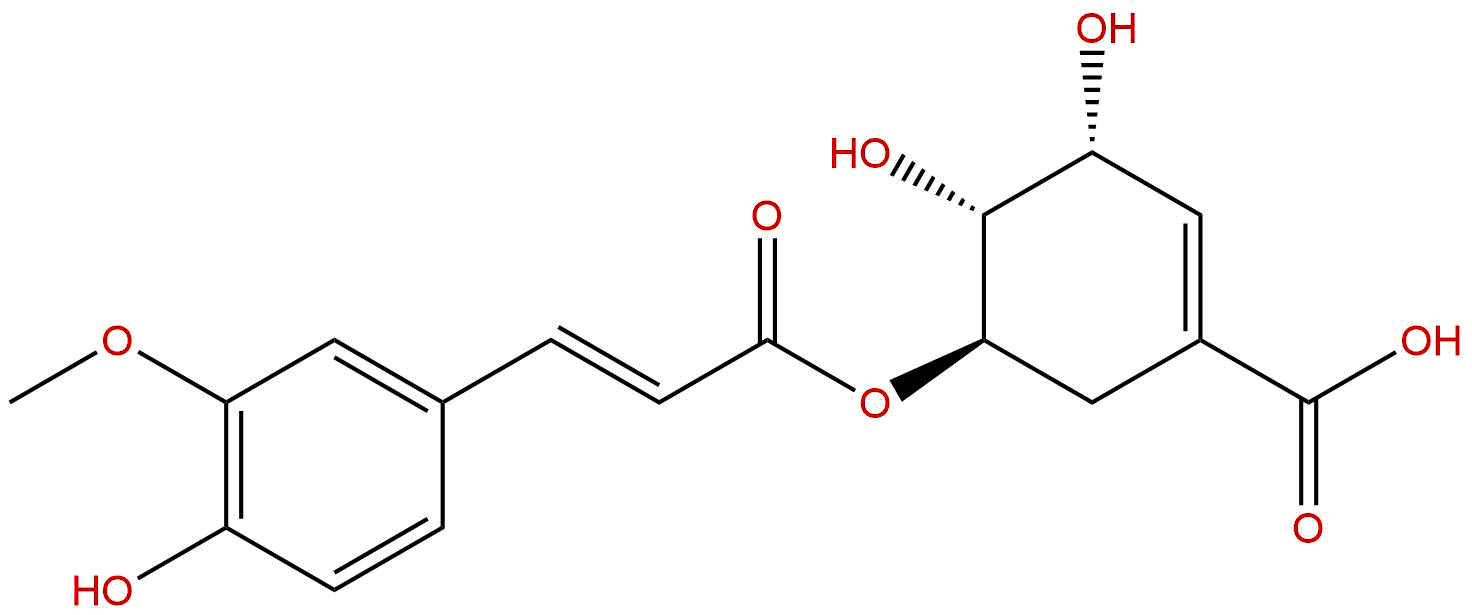
The chemical structure of 5-O-feruloyl shikimic acid is the basis of its biological activity. Structurally, it belongs to phenolic ester compounds, which are connected by an ester bond between a ferulic acid molecule and the 5-hydroxy group of shikimic acid.
Chemical structure analysis The core skeleton of this compound consists of two parts. The first part is shikimic acid (3R, 4S, 5R) -3,4,5-trihydroxy-1-cyclohexene-1-carboxylic acid), which is a multifunctional molecule containing a six membered ring, one double bond, three hydroxyl groups, and one carboxyl group. The second part is ferulic acid (4-hydroxy-3-methoxycinnamic acid), characterized by hydroxyl and methoxy groups attached to the benzene ring, and α, β - unsaturated carboxylic acids as side chains. In 5-O-feruloyl shikimic acid, the carboxyl group of ferulic acid undergoes esterification with the hydroxyl group at the 5-position of shikimic acid, forming a stable ester bond. This structural combination gives the molecule the phenolic hydroxyl, methoxy, conjugated double bond of ferulic acid, as well as the polyol and carboxylic acid structures of shikimic acid, forming a unique molecular conformation and electronic distribution.
Molecular formula and molecular weight Its molecular formula is C ₁₇ H ₁₈ O ₉, and its molecular weight is 350.3230 g/mol. This molecular weight falls within the ideal range for small molecule drugs, which facilitates their interaction with biological targets.
Physicochemical properties:
- Lipid water partition coefficient (LogP)The LogP value of this compound is 0.7915. LogP is an important parameter for measuring the lipophilicity or hydrophilicity of compounds. The LogP value of 0.7915 indicates that 5-O-feruloyl shikimic acid has a certain hydrophilicity, but also retains a certain lipophilicity. This moderate lipophilic hydrophilic balance (i.e., "drug like" characteristics) facilitates its dissolution, absorption, and transmembrane transport in the body.
- Topological Polarity Surface Area (TPSA)The TPSA value is 133.5200 Å ². TPSA reflects the total surface area of polar atoms (such as oxygen and nitrogen) and their connected hydrogen atoms in a molecule, and is closely related to the oral absorption and blood-brain barrier penetration ability of compounds. Generally, molecules with TPSA greater than 140 Å ² have poor oral absorption. The TPSA value of 133.52 Å ² is within the critical range, indicating that its oral bioavailability may be limited, but there is still room for improvement through appropriate formulation methods or structural modifications.
- Water solubility The water solubility value is 4.9521 (possibly measured in logS or mg/mL). This value indicates good water solubility, thanks to the presence of multiple hydroxyl and carboxyl groups in the molecule. Good water solubility is an advantage in drug development, which facilitates its dissolution and distribution in aqueous physiological environments.
- Blood-brain barrier (BBB) penetrability Evaluated as' low '. The high TPSA value and the abundance of polar groups in the molecule limit its ability to penetrate the blood-brain barrier through passive diffusion. This may be an advantageous feature for antiplatelet drugs that primarily act on the peripheral vascular system, as they can reduce central nervous system related side effects.
- HERG inhibition and Ames test The hERG inhibition assessment is' no ', indicating that the compound does not pose a significant risk of cardiac toxicity in preliminary predictions (i.e., the risk of prolonging QT interval is low). The Ames test result is 0.0, indicating no significant mutagenicity. These two preliminary toxicological assessments provide positive early evidence for its safety.
5-O-feruloyl shikimic acid, as a natural product, mainly exists in certain specific plants. Its discovery and extraction are closely related to chemical research on traditional medicinal plants.
Plant-based Currently, the main sources of 5-O-feruloyl shikimic acid are known to include:
1. Chuanxiong(Ligusticum chuanxiong)Chuanxiong is a plant of the genus Ligusticum in the Umbelliferae family, and is a commonly used blood activating and stasis removing medicine in traditional Chinese medicine clinical practice. Modern research has shown that Chuanxiong contains various phthalates, phenolic acids, and alkaloids. 5-O-feruloyl shikimic acid is an important phenolic acid active ingredient in Ligusticum chuanxiong, which is consistent with its traditional effects of anti platelet aggregation and improving blood circulation.
2. Angelica sinensis(Angelica sinensis)Danggui, also a member of the Umbelliferae family, is a famous medicinal herb known for its ability to nourish blood and promote blood circulation. Researchers have also isolated and identified 5-O-feruloyl shikimic acid in Angelica sinensis, which may be one of the substance bases for Angelica sinensis to exert its pharmacological activity.
3. Other plants In addition to the two main sources mentioned above, this compound may also be present in other plants, such as certain ferns or Asteraceae plants, but the content is usually low.
Extraction and Separation Methods Given that the content of 5-O-feruloyl shikimic acid in plants is usually low and often coexists with phenolic acid compounds with similar structures, its extraction and purification require a series of modern chromatographic techniques. The typical extraction process is as follows:
1. Raw material pretreatment Crush dry plant materials (such as the rhizomes of Ligusticum chuanxiong or Angelica sinensis), sieve them, and obtain a uniform powder.
2. Solvent extraction The commonly used extraction solvent is a mixture of highly polar organic solvents and water, such as methanol water, ethanol water, or acetone water. Usually, cold soaking, percolation, or reflux extraction methods are used. For example, extract repeatedly with 70% ethanol at room temperature or heating conditions, and combine the extraction solutions.
3. Coarse separation The extract is concentrated under reduced pressure to obtain a paste. Disperse the extract in water and perform liquid-liquid extraction using solvents of different polarities such as petroleum ether, ethyl acetate, and n-butanol to remove lipid soluble impurities (such as chlorophyll and oil) and strongly polar impurities (such as sugars). 5-O-feruloyl shikimic acid is usually enriched in the ethyl acetate or n-butanol extraction sites due to its equipolarity.
4. Chromatographic purification This is a crucial step in obtaining high-purity compounds. Common chromatographic methods include:
- Silica gel column chromatography Gradient elution using solvent systems such as chloroform methanol water or ethyl acetate methanol water is a commonly used method for preliminary separation.
- Reverse phase column chromatography (such as ODS)Using methanol water or acetonitrile water systems for elution is more effective in separating phenolic acid compounds with moderate polarity.
- Preparation type high-performance liquid chromatography (Pre HPLC)As the final purification step, using high-resolution preparative HPLC and optimized mobile phase (such as acetonitrile-0.1% formic acid water) for isocratic or gradient elution on a C18 reverse phase column, 5-O-feruloyl shikimic acid monomer with a purity of over 98% can be obtained.
5. Structural Identification The purified compound was structurally confirmed by techniques such as nuclear magnetic resonance spectroscopy (NMR, including ¹ H-NMR, ¹ ³ C-NMR, 2D-NMR), mass spectrometry (MS, such as HR-ESI-MS), as well as ultraviolet spectroscopy (UV) and infrared spectroscopy (IR).
The pharmacological activity research of 5-O-feruloyl shikimic acid mainly focuses on its effects on the cardiovascular system, especially on platelet function. In addition, its potential anti-inflammatory and antioxidant activities have also received attention.
Antiplatelet aggregation activity This is the most core and highly anticipated pharmacological effect of 5-O-feruloyl shikimic acid. Multiple in vitro and in vivo experiments have confirmed its strong anti platelet aggregation ability.
- in vitro experiment In vitro, the aggregation rate of platelet rich plasma (PRP) or washed platelets under various inducers (such as adenosine diphosphate (ADP), arachidonic acid (AA), collagen, thrombin, adrenaline, etc.) was measured using turbidity or resistance methods. Research has shown that 5-O-feruloyl shikimic acid can significantly inhibit platelet aggregation induced by ADP, AA, and collagen in a concentration dependent manner. Its inhibitory effect on AA induced aggregation is particularly prominent, suggesting that its mechanism of action may be closely related to its impact on the arachidonic acid metabolism pathway.
- in vivo experiments In animal models, such as arteriovenous bypass thrombosis models in rats or mice, FeCl ∝ - induced carotid artery thrombosis models, or pulmonary thromboembolism models, oral or intravenous injection of 5-O-feruloyl shikimic acid can significantly prolong thrombus formation time, reduce thrombus weight, or improve animal survival rate. These in vivo results further confirm its potential as an antithrombotic drug.
anti-inflammatory activity Platelet activation is closely related to inflammatory response. 5-O-feruloyl shikimic acid exhibits certain anti-inflammatory effects while inhibiting platelet aggregation. For example, in a macrophage model stimulated by lipopolysaccharide (LPS), the compound can inhibit the production of pro-inflammatory factors such as tumor necrosis factor - α (TNF - α), interleukin-6 (IL-6), and nitric oxide (NO). This anti-inflammatory activity may synergize with its antiplatelet aggregation effect to jointly exert cardiovascular protection.
antioxidant activity Ferulic acid itself is a famous antioxidant. 5-O-feruloyl shikimic acid inherits the phenolic hydroxyl structure of ferulic acid, and therefore also has the ability to scavenge free radicals (such as DPPH free radicals, ABTS free radicals) and chelate metal ions. Oxidative stress is one of the important triggers for platelet activation and thrombosis, therefore its antioxidant activity may indirectly contribute to its antiplatelet effect.
The mechanism of action of 5-O-feruloyl shikimic acid against platelet aggregation is multi-target and multi pathway, which is in sharp contrast to traditional single target antiplatelet drugs such as aspirin and clopidogrel. Its target network covers multiple key links of platelet activation.
Inhibition of arachidonic acid (AA) metabolic pathway This is one of its most core mechanisms of action.
Interference with ADP receptor signaling pathway:
The ultimate common pathway affecting platelet adhesion and aggregation:
Adjusting other signaling molecules:
In summary, 5-O-feruloyl shikimic acid forms a synergistic antiplatelet network by simultaneously acting on multiple key targets such as the COX/TXA ₂ pathway, ADP/P2Y12 pathway, integrin α IIb β 3, and PDE3A. This multi-target mode of action theoretically gives it a stronger antiplatelet effect and may reduce drug resistance or side effects caused by single target inhibition.
To develop natural products into clinical drugs, in addition to clear pharmacological activity, they must also have good drug properties and acceptable pharmacokinetic (PK) characteristics.
Drugability assessment Based on the aforementioned physicochemical properties, 5-O-feruloyl shikimic acid exhibits certain potential for medicinal properties, but also faces challenges.
- Advantage Moderate molecular weight (350 Da), in accordance with the Lipinski Five Rules (MW<500). The LogP value (0.79) is moderate and has good water solubility. Preliminary toxicological assessment (hERG negative, Ames negative) indicates a low safety risk. The multi-target mechanism of action is its unique advantage as an antithrombotic drug.
- challenge The TPSA value (133.5 Å ²) is relatively high, approaching the critical value for oral absorption, indicating a possible issue of low oral bioavailability. The molecule contains multiple phenolic hydroxyl and carboxyl groups, which are prone to undergo II phase metabolic reactions such as glucuronic acid or sulfuric acid binding in the body, leading to rapid clearance. In addition, ester bonds may be hydrolyzed by esterases in the gastrointestinal tract or blood, affecting their stability.
Pharmacokinetic characteristics At present, there is insufficient systematic pharmacokinetic research on 5-O-feruloyl shikimic acid, but based on its structural characteristics and studies of similar compounds, its PK characteristics can be inferred
- absorb Oral absorption may be poor and incomplete. The high TPSA and polar groups limit its passive diffusion through intestinal epithelial cells. It may be mainly mediated by transporters on small intestinal epithelial cells, such as monocarboxylate transporters (MCTs), to facilitate active transport or promote diffusion absorption. After absorption, it may undergo first pass metabolism.
- distribution Due to its strong hydrophilicity, its distribution volume may be small and mainly distributed in extracellular fluid. The plasma protein binding rate is still unclear. The blood-brain barrier has low penetrability, making it primarily act on peripheral tissues.
- Metabolism Metabolism is its main clearance pathway. The main metabolic reactions may include: ① hydrolysis of ester bonds to produce ferulic acid and shikimic acid; ② Glucuronidation and sulfation of phenolic hydroxyl groups; ③ Demethylation of methoxy groups; ④ Reduction of conjugated double bonds. These metabolites may still have some biological activity.
- excretion Metabolites and small amounts of prototype drugs are mainly excreted through urine and bile.
Improvement strategy In order to improve its pharmacological properties, future research may consider the following strategies:
- Prodrug design Esterification or salt modification of carboxyl or phenolic hydroxyl groups to enhance lipid solubility and oral absorption.
- Structural modification Introducing specific functional groups to reduce TPSA or improve metabolic stability while maintaining the core pharmacophore.
- New formulations Adopting technologies such as nanoliposomes, phospholipid complexes, and solid dispersions to enhance their solubility and oral bioavailability.
5-O-feruloyl shikimic acid, as a natural product with multi-target antiplatelet aggregation activity, has shown promising clinical application prospects in the prevention and treatment of cardiovascular diseases.
Potential clinical applications:
1. Treatment and Prevention of Thrombotic Diseases Can be used for the treatment or prevention of acute coronary syndrome (myocardial infarction, unstable angina), ischemic stroke, peripheral arterial disease, etc. Its multi-target mechanism of action may be more effective than single target drugs such as aspirin, and may reduce the risk of treatment failure in patients with aspirin or clopidogrel resistance.
2. Combination application with existing antiplatelet drugs Due to its mechanism of action partially overlapping but different from aspirin (inhibiting COX-1) and clopidogrel (inhibiting P2Y12), it can theoretically be developed as a combination therapy to achieve stronger antithrombotic effects and reduce their respective doses, thereby reducing the risk of bleeding.
3. Anti inflammatory and cardiovascular protection Since it has both anti-inflammatory and antioxidant activities, it may play a role in the early intervention of atherosclerosis and the stabilization of plaque, not only for the end thrombotic events.
Research Prospects and Challenges:
1. In depth mechanism research It is necessary to use techniques such as molecular docking, surface plasmon resonance (SPR), and cellular thermal transition analysis (CETSA) to further clarify its direct binding mode, binding constant, and structure-activity relationship with key targets such as COX-1, P2Y12, and TBXA2R.
2. Systematic pharmacokinetic study A comprehensive and systematic in vivo pharmacokinetic study must be conducted, including oral bioavailability, tissue distribution, metabolic pathways, excretion patterns, and identification of metabolic product activity, to provide a basis for clinical dosing regimen design.
3. toxicological evaluation Further toxicology research is needed, including long-term toxicity, reproductive toxicity, genetic toxicity, and effects on bleeding time, gastrointestinal mucosa, etc., to comprehensively evaluate its safety.
4. Structure Activity Relationship (SAR) Study Using 5-O-feruloyl shikimic acid as the lead compound, a series of structurally similar compounds were synthesized to systematically study the effects of shikimic acid parent nucleus, ferulic acid moiety, and ester linkage on activity, in order to search for candidate drugs with stronger activity, higher selectivity, and better pharmacokinetic properties.
5. clinical translation After completing sufficient preclinical research, rigorous clinical trials need to be designed to verify their effectiveness, safety, and tolerability in humans, ultimately achieving the transition from laboratory to clinical use.
5-O-feruloyl shikimic acid, as a natural phenolic ester compound derived from traditional Chinese medicine for promoting blood circulation and removing blood stasis (such as Chuanxiong and Danggui), has shown great research value and application potential in the fields of antiplatelet aggregation and cardiovascular protection due to its unique chemical structure and multi-target pharmacological mechanism. It forms a synergistic antiplatelet network by simultaneously acting on multiple key targets such as the arachidonic acid metabolism pathway, ADP receptor signaling pathway, and integrins, which may give it advantages over traditional single target drugs in dealing with complex cardiovascular diseases. Although there are challenges in developing drug properties, especially in terms of oral bioavailability, these issues are expected to be resolved through the intervention of modern medicinal chemistry methods and formulation technologies.
The in-depth study of 5-O-feruloyl shikimic acid not only helps to clarify the modern pharmacological connotation of traditional Chinese medicine, but also provides valuable lead compounds for the development of new, safe, and effective antithrombotic drugs derived from natural products. In the future, with further clarification of its mechanism of action, pharmacokinetic characteristics, and structure-activity relationship, 5-O-feruloyl shikimic acid and its derivatives are expected to play an important role in the precise treatment of cardiovascular diseases and contribute to human health. From natural products to innovative drugs, this path is full of challenges, but also contains infinite hope.
Batch can search by a CAS number,one per line
