| Catalog No | Package | Original Price | Price | Inventory | Quantity | Operating |
|---|---|---|---|---|---|---|
| BP5087-5mg | 5mg | $750.00 | Sign in |
|


Storage conditions:Short-term storage at 2~8℃, long-term storage at -20 ~ -80℃
Natural products, as important resources for drug discovery, have always held a central position in the development of new drugs. Furancoumarin compounds have become one of the hotspots in natural product pharmacology research due to their wide range of biological activities and unique chemical structures. Oxyphylldanin methanol (CAS number: 52939-12-5) is a typical derivative of furan coumarin, mainly found in the traditional Chinese medicine Angelica dahurica. In recent years, with the development of molecular pharmacology and medicinal chemistry technology, the multiple biological activities and mechanisms of action of oxidized resveratrol methanol ester have gradually been revealed, demonstrating its potential application value in multiple fields such as anti-cancer, anti-inflammatory, antioxidant, antiarrhythmic, and antiviral.
The purpose of this review is to systematically summarize the chemical structure and physicochemical properties, plant sources, and extraction methods of oxytetracycline methyl ester, with a focus on its pharmacological activity and mechanism of action. The pharmacokinetic characteristics of the ester are discussed in combination with its pharmacological parameters. Finally, the clinical application prospects are discussed, providing theoretical basis and research direction for subsequent basic research and drug development.
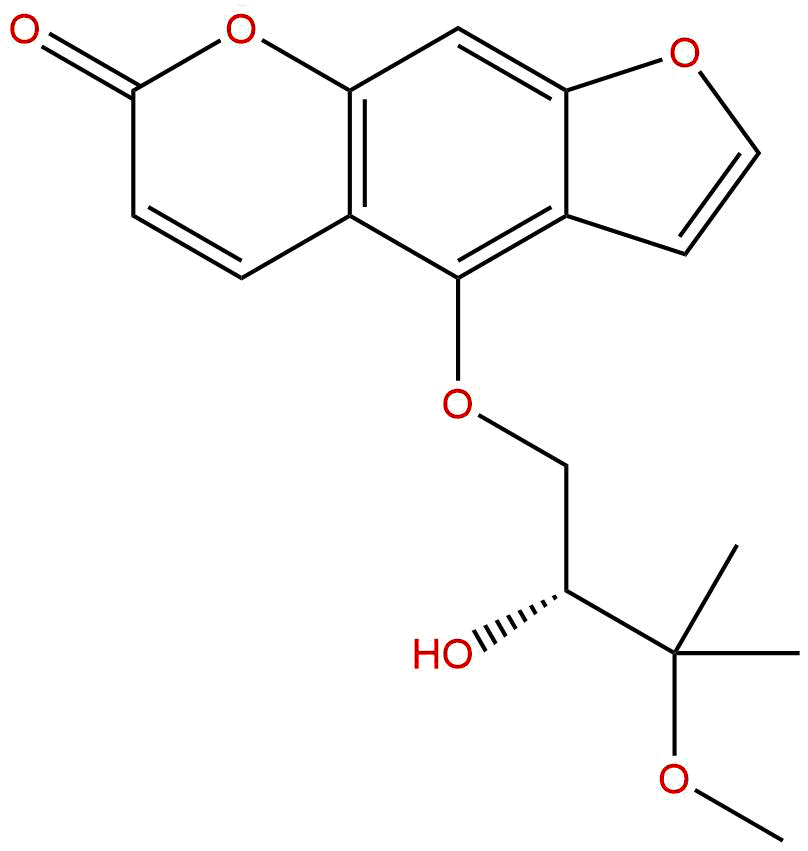
Pre oxidized berberine methanol ester belongs to the class of furan coumarin compounds, with a molecular formula of C18H18O5 and a molecular weight of 318.3250. Its structural feature is that a furan ring is connected to the core skeleton of coumarin, and a methanol ester group is introduced into the molecule, giving it strong lipophilicity and moderate polarity. The LogP value of this compound is 2.2362, indicating that it has moderate lipid solubility, which is beneficial for cell membrane penetration and oral absorption. Its topological polar surface area (TPSA) is 82.0400, indicating polarity characteristics suitable for binding with biomolecules.
The water solubility of oxytetracycline methanol ester is relatively low (0.0371 mg/mL), but its high blood-brain barrier permeability gives it the potential for central nervous system pharmacological activity. Importantly, the compound did not significantly inhibit hERG channels, indicating a low risk of cardiac toxicity. The Ames test result is 0.9, indicating that its genotoxicity risk is low and has a good safety basis.
Oxidized tetrahydropalmatine methyl ester is mainly found in Angelica dahurica, a traditional Chinese medicinal herb in the Umbelliferae family. It is widely distributed in Northeast China, North China, and the Korean Peninsula. The roots of this plant are the main medicinal parts and contain abundant furan coumarin compounds.
The commonly used methods for extracting methanol esters of oxidized berberine include solvent extraction, ultrasound assisted extraction, and column chromatography separation. Ethanol or methanol are generally used as extraction solvents, combined with ultrasound assisted technology to improve extraction efficiency. The extract was concentrated, separated, and purified by silica gel column chromatography, and finally analyzed qualitatively and quantitatively by high performance liquid chromatography (HPLC). In recent years, the introduction of supercritical fluid extraction and molecular imprinting techniques has further improved the extraction purity and yield of methanol esters of oxidized berberine.
Pre oxidized resveratrol methanol ester exhibits significant inhibitory effects in various tumor cell lines. Its anti-cancer mechanism is mainly achieved by inducing cell cycle arrest and promoting cell apoptosis. Related studies have shown that this compound can regulate the PI3K/AKT signaling pathway, inhibit NF - κ B activity, and reduce the proliferation ability of tumor cells. In addition, oxytetracycline methyl ester also regulates the MAPK pathway, affecting the expression of cell survival and apoptosis related proteins, and enhancing cell sensitivity to chemotherapy drugs.
Pre oxidized resveratrol methanol ester has significant anti-inflammatory effects, which can inhibit the expression of pro-inflammatory factors such as TNF - α and IL-6, and alleviate inflammatory reactions. The mechanism involves the inhibition of ROS (reactive oxygen species) generation, reducing oxidative stress damage to cells. By regulating the MAPK and NF - κ B signaling pathways, oxidized resveratrol methanol ester effectively reduces the release of inflammatory mediators, demonstrating good anti-inflammatory potential.
This compound has a regulatory effect on cardiac electrophysiology, especially in inhibiting hKv1.5 current (IC50 of 76 nM), indicating its potential application in the treatment of arrhythmia. The hKv1.5 channel is an important component of atrial specific currents, and its blockade helps regulate the action potential of atrial muscles, prevent and treat arrhythmias such as atrial fibrillation.
Pre oxidized berberine methanol ester exhibits broad-spectrum antiviral activity, targeting various virus related proteins including MPO, UL42, UL54, ICP27, TK, gD, CCR5, CXCR4, HIV1-PR, and INT. These targets cover the processes of virus replication, transcription, and invasion, indicating that oxytetracycline methyl ester may inhibit virus infection through multi-target synergistic effects, especially showing potential advantages in combating HIV and herpes viruses.
The pharmacological activity of oxytetracycline methanol ester depends on its regulation of multiple cellular signaling pathways and molecular targets. Its main mechanism of action includes:
Inhibition of PI3K/AKT/NF - κ B signaling pathway By inhibiting the activity of PI3K kinase and blocking the phosphorylation of AKT, the nuclear translocation of NF - κ B is inhibited, reducing the expression of pro-inflammatory and anti apoptotic genes and promoting cell apoptosis.
MAPK pathway regulation Oxidation of resveratrol methanol ester can regulate the activity of MAPK family members such as ERK, JNK, and p38, affecting cell proliferation, differentiation, and stress response.
ROS generation inhibition By clearing excess reactive oxygen species, reducing oxidative stress, protecting cells from damage, and enhancing the antioxidant defense system.
HKv1.5 channel blockade Directly acting on atrial specific potassium channels, regulating the action potential of myocardial cells, and exerting anti arrhythmic effects.
Diversity of antiviral targets Oxidized berberine methyl ester can interfere with viral DNA polymerase (UL54), viral protein expression regulatory factor (ICP27), viral enzyme (HIV1-PR), and viral invasion receptors (CCR5, CXCR4), blocking multiple stages of the viral life cycle.
Pre oxidized berberine methanol ester has good pharmacological parameters. Its molecular weight of 318.3250 conforms to Lipinski's rule, and its LogP value of 2.2362 shows moderate lipid solubility, which is beneficial for oral absorption. The TPSA is 82.0400, indicating that the molecular polarity is moderate and may have good membrane permeability. Low water solubility suggests the need to consider solubility enhancement strategies in drug formulation design.
The high permeability of the blood-brain barrier provides the possibility for developing drugs for central nervous system related diseases. The hERG channel showed no significant inhibition, reducing the risk of cardiac toxicity. The Ames test results showed a low risk of genotoxicity and good safety.
In terms of pharmacokinetics, although specific in vivo metabolic and excretion data are not yet sufficient, its oral activity and high blood-brain barrier permeability suggest that the compound has good bioavailability and distribution characteristics in vivo. Further pharmacokinetic studies in vivo are needed in the future, including a systematic evaluation of absorption, distribution, metabolism, and excretion (ADME) characteristics.
Pre oxidized resveratrol methanol ester has demonstrated broad clinical application potential due to its multi-target and multi pathway pharmacological activities. Its anti-cancer activity makes it a powerful candidate molecule for adjuvant therapy of tumors, especially in regulating the tumor cell cycle and inducing apoptosis, with unique advantages. The anti-inflammatory and antioxidant effects provide new ideas for the treatment of chronic inflammatory diseases and neurodegenerative diseases.
Antiarrhythmic activity brings new therapeutic strategies to the field of cardiovascular diseases, especially for common arrhythmias such as atrial fibrillation. The antiviral activity provides a new chemical framework and mechanism of action for the development of drugs against HIV and other viral infections.
Future research should focus on the in vivo pharmacokinetics, safety evaluation, and preclinical animal model validation of oxytetracycline methanol ester, and optimize its structure with modern drug design techniques to improve its bioavailability and targeting. In addition, based on its multi-target characteristics, research on combination therapy will be conducted to explore its potential in the comprehensive treatment of multiple diseases.
As a derivative of furan coumarin derived from the traditional medicinal plant Angelica dahurica, oxytetracycline methyl ester has become a hot topic in natural product pharmacology research due to its unique chemical structure and diverse biological activities. Its significant activities in anti-cancer, anti-inflammatory, antioxidant, antiarrhythmic, and antiviral aspects, combined with good pharmacological parameters, demonstrate broad prospects for drug development.
In the future, it is necessary to strengthen the in-depth analysis of its molecular mechanism, improve in vivo pharmacokinetics and safety research, and promote its translation into clinical applications. Oxidation of tetrahydropalmatine methyl ester not only enriches the pharmacological knowledge system of furan coumarin natural products, but also provides valuable chemical and biological basis for the development of new multifunctional drugs.
