Introduction/Overview
Coumarin compounds are a class of benzo [a] - pyranone derivatives widely found in nature, which have attracted much attention due to their diverse chemical structures and extensive biological activities. Ruixiangsu (7,8-dihydroxycoumarin), as one of its members, has been extensively reported for its anti-inflammatory and anti-tumor pharmacological effects. Daphnetin dimethyl ether (DME), also known as 7,8-dimethoxycoumarin, is a methylated derivative of Daphnetin, with a CAS number of 2445-80-9. Compared to its parent nucleus, methylation modification not only changes its physicochemical properties, but also significantly expands its biological activity spectrum. Research has shown that resveratrol dimethyl ether is an orally effective multi-target protein kinase inhibitor, exhibiting inhibitory activity against epidermal growth factor receptor (EGFR), protein kinase A (PKA), and protein kinase C (PKC). It has shown great potential in inducing tumor cell apoptosis and autophagy, regulating inflammatory responses, and combating malaria, especially becoming a hot topic in the research of diseases such as rheumatoid arthritis and cancer. This article aims to provide a systematic review of the chemical properties, plant sources, pharmacological activities, mechanisms of action, and medicinal properties of daphnetin dimethyl ether, and to explore its clinical application prospects.
Chemical structure and physicochemical properties
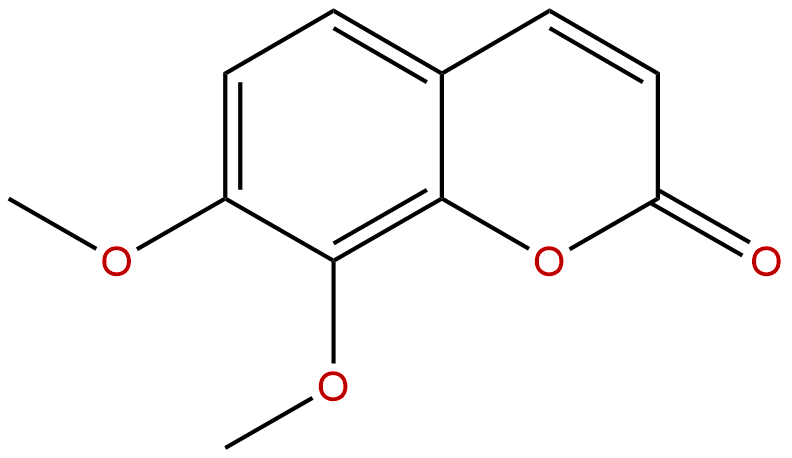
The molecular formula of Ruixiangsu dimethyl ether is C11H10O4, with a molecular weight of 206.1970. Its chemical structure is based on the coumarin parent nucleus (benzo [a] - pyranone), with one methoxy group (- OCH3) attached to each of the 7th and 8th positions of the benzene ring, which is a key structural feature that distinguishes it from resveratrol (7,8-dihydroxy).
This structure determines its fundamental physicochemical properties. The calculated lipid water partition coefficient (LogP) is 1.7010, indicating that the compound has moderate lipophilicity, which is beneficial for transmembrane transport and absorption. Its topological polar surface area (TPSA) is 48.6700 Å ², which is relatively small, further indicating its good membrane permeability. The water solubility data (0.1794 mg/mL) indicates that it belongs to the category of slightly soluble to poorly soluble, which may need to be considered in formulation development. It is worth noting that the predictive model shows a high blood-brain barrier permeability, which provides the possibility for its application in central nervous system related diseases such as certain tumors or inflammations. In addition, preliminary pharmacological risk assessment showed no significant inhibitory effect on hERG potassium channels (indicating a low potential risk of cardiac toxicity), and the Ames test result was 0.9 (usually considered negative if less than 2), indicating a low risk of mutagenicity and laying a preliminary safety foundation for its further development.
Plant sources and extraction methods
Resveratrol dimethyl ether is mainly derived from the Thymelaeaceae genus in the family Thymelaeaceae Daphne)Plants. This genus of plants is commonly used in traditional medicine to treat inflammation, pain, and tumor diseases, and its active ingredient base includes various coumarin compounds.
Organic solvent extraction is commonly used to extract daphnetin dimethyl ether from plant materials. After crushing dry plant roots, stem bark, or whole plants, polar solvents such as methanol, ethanol, or acetone can be used for extraction or reflux extraction. After vacuum concentration, the crude extract is preliminarily separated using its solubility differences (such as distribution in solvent systems of different polarities) or chromatographic techniques. Further purification usually relies on column chromatography techniques such as silica gel column chromatography, reverse phase C18 column chromatography, etc., using mixed solvents such as petroleum ether ethyl acetate and chloroform methanol for gradient elution. High performance liquid chromatography (HPLC) is a key step in obtaining high-purity rosmarin dimethyl ether monomer. By optimizing the mobile phase (usually methanol water or acetonitrile water system) and detection wavelength (coumarins usually have strong UV absorption around 254 nm or 300 nm), precise separation and preparation can be achieved. With the development of synthetic chemistry, obtaining daphnetin dimethyl ether through chemical synthesis has become a reliable source, providing stable material support for pharmacological research and application.
Pharmacological activity research
Numerous in vitro and in vivo studies have confirmed that resveratrol dimethyl ether has multiple pharmacological activities.
1. Antitumor activity: Ruixiangsu dimethyl ether exhibits growth inhibition and cytotoxicity on various tumor cells. Its anti-tumor effect is mainly achieved by inducing cell apoptosis and autophagy. Research has shown that it can trigger excessive production of reactive oxygen species (ROS), leading to a decrease in mitochondrial membrane potential, which in turn activates the Caspase cascade reaction and induces cell apoptosis. At the same time, it can induce protective autophagy in cells by regulating the AMPK/Akt/mTOR signaling pathway, which may also promote cell death or synergize with apoptosis in specific situations. In models such as prostate cancer, its anti proliferative effect is particularly significant.
2. Anti inflammatory and immune regulatory activity: Ruixiangsu dimethyl ether has a clear anti-inflammatory effect. In various acute and chronic inflammation models, it can effectively inhibit the production and release of pro-inflammatory mediators such as tumor necrosis factor - α (TNF - α) and interleukin-1 β (IL-1 β). At the same time, it can also reduce the levels of reactive oxygen species (ROS) and malondialdehyde (MDA), the end product of lipid peroxidation, and alleviate oxidative stress damage. These effects are closely related to their inhibition of related kinases (such as PKC) and transcription factors (such as NF - κ B) activity.
3. Anti malaria activity: Research has confirmed that resveratrol dimethyl ether has malaria killing activity, providing a lead compound for the development of new antimalarial drugs. Its mechanism of action may involve interfering with the metabolism or signal transduction processes of malaria parasites.
4. Other activities: In addition, there are studies reporting that it has certain potential in pain relief, anticoagulation, and other aspects, which are associated with its basic anti-inflammatory and signaling regulatory effects.
Mechanism of action and molecular targets
The pharmacological effects of resveratrol dimethyl ether stem from its multi-target properties, and its mechanism of action network is complex and refined.
1. Core function: Protein kinase inhibition Ruixiangsu dimethyl ether has been identified as a multi kinase inhibitor. Its inhibitory activity against EGFR (IC50~7.67 μ M), PKA (IC50~9.33 μ M), and PKC (IC50~25.01 μ M) is the molecular basis for its anti-tumor and anti-inflammatory effects. Inhibition of EGFR can block downstream survival and proliferation pathways such as MAPK/ERK and PI3K/Akt; Inhibition of PKA and PKC can widely affect intracellular phosphorylation events, regulating various physiological and pathological processes including inflammation, cell cycle, and apoptosis.
2. Multi target regulatory network in prostate cancer: Based on the provided target information, the mechanism of action of resveratrol dimethyl ether in prostate cancer is particularly prominent, forming a multi-target regulatory network:
* Inducing apoptosis and inhibiting survival: Promote apoptosis by upregulating pro apoptotic proteins or inhibiting anti apoptotic proteins such as Bcl-2. Meanwhile, inhibiting the activation of STAT3 can downregulate the expression of genes related to cell proliferation, survival, and angiogenesis mediated by it.
* Regulating stress and metabolism: By activating AMPK and inhibiting the Akt/mTOR pathway, it regulates cellular energy metabolism and induces autophagy. Its potential regulation of NFE2L2 (Nrf2) may affect cellular oxidative stress response. Inhibiting HIF1A may interfere with the adaptive ability of tumor cells in hypoxic environments.
* Affects drug sensitivity and hormone response: The potential role of ABCB1 (P-gp) may reverse multidrug resistance in tumors. The regulation of ESR2 (estrogen receptor beta) may affect hormone dependent growth in prostate cancer.
* Direct injury and inflammation: Inhibition of TOP1 (topoisomerase I) may lead to DNA damage. Inhibiting CASP1 (Caspase-1) may interfere with the cell apoptosis pathway and interact with the inflammatory microenvironment.
3. Anti inflammatory mechanism: Mainly by inhibiting the PKC/NF - κ B signaling axis, the transcription and expression of downstream inflammatory factors such as TNF - α and IL-1 β are reduced. Its antioxidant effect (reducing ROS and MDA) is also related to pathways such as inhibiting inflammasome activation.
4. Integration of signaling pathways: The core function of resveratrol dimethyl ether can be integrated into the central regulatory pathway of AMPK/Akt/mTOR. Activating AMPK (energy receptor) and inhibiting Akt (survival signaling hub), thereby inhibiting mTOR (synthetic metabolic master switch), is the key intersection point for inducing autophagy, inhibiting proliferation, and promoting apoptosis simultaneously.
Evaluation of drug properties and pharmacokinetics
Based on its physicochemical parameters and preliminary biological data, daphnetin dimethyl ether exhibits certain potential as a drug.
Analysis of pharmacological parameters: The molecular weight of 206.2 complies with the "Five Rules for Classified Drugs". Moderate LogP values (1.7) and small TPSA are beneficial for oral absorption and cell infiltration. High blood-brain barrier permeability prediction is its characteristic. The negative results of hERG and Ames have preliminarily ruled out the risk of severe cardiac toxicity and genetic toxicity, but further experimental verification is needed. The main challenge lies in its low water solubility, which may affect the bioavailability of the formulation. In the future, improvements may be needed through technologies such as salt formation, solid dispersion, and nano formulations.
Prospects for pharmacokinetic research: At present, there are insufficient reports on the pharmacokinetic studies of the Rui Xiang Su dimethyl ether system, but speculation can be made based on its structure. As a derivative of coumarin, it may be absorbed in the gastrointestinal tract after oral administration, but its bioavailability needs to be determined due to first pass effects. In the body, the methoxy groups at positions 7 and 8 may undergo demethylation metabolism, converting into active metabolites such as resveratrol, which may be part of their in vivo mechanism of action. Methoxy may also undergo glucuronidation or sulfation binding reactions, increasing water solubility for excretion through the kidneys or bile. A comprehensive study of ADME (absorption, distribution, metabolism, excretion), including its plasma protein binding rate, tissue distribution characteristics, major metabolic enzymes (such as CYP450 isoenzymes), and excretion pathways, is a necessary step for its preclinical development.
Clinical application prospects and prospects
The multi-target pharmacological properties of resveratrol dimethyl ether provide broad prospects for its application in various disease fields.
1. Tumor treatment: Especially in the treatment of multi-target resistant prostate cancer, its ability to simultaneously act on multiple key targets such as BCL2, STAT3, ABCB1, Akt/mTOR, demonstrates the potential to overcome the limitations of single target drugs. It can be explored as a single drug or in combination with existing chemotherapy drugs and endocrine therapy drugs to enhance efficacy and reverse drug resistance. Its high permeability to the blood-brain barrier also makes it uniquely valuable in the treatment of brain tumors or brain metastases.
2. Inflammatory and autoimmune diseases: Its potent anti-inflammatory and immune regulatory effects support its application research in diseases such as rheumatoid arthritis and inflammatory bowel disease. Its ability to inhibit cytokines such as TNF - α and IL-1 β is similar to that of existing biologics, but as a small molecule drug, it may have advantages such as convenient oral administration and lower cost.
3. Combination therapy and drug development strategy:
* Structural optimization: Using daphnetin dimethyl ether as the lead compound, structural modifications (such as modifying methoxy groups, splicing other pharmacophores) are carried out to improve its kinase inhibition selectivity, water solubility, or metabolic stability.
* Formulation innovation: Develop novel delivery systems such as nanoparticles, liposomes, and cyclodextrin inclusion complexes to improve their solubility and targeting, and reduce potential side effects.
* Combination therapy: Explore a combination therapy with conventional chemotherapy drugs, targeted drugs, or immune checkpoint inhibitors, utilizing their multiple mechanisms to synergistically enhance efficacy.
Challenges faced: Future research needs to clarify the contribution weights of its main targets in vivo and clarify the specific network of its "multi-target" effects in specific diseases. Comprehensive preclinical safety evaluation (acute toxicity, chronic toxicity, reproductive toxicity, etc.) and standardized pharmacokinetic studies are the necessary steps to promote its clinical translation. In addition, it is crucial to clarify its therapeutic window (the range between effective dose and toxic dose).
Conclusion
Ruixiangsu dimethyl ether, as a multi-target coumarin derivative derived from plants, exhibits significant activity in multiple pharmacological fields such as anti-tumor, anti-inflammatory, and antimalarial effects due to its unique 7,8-dimethoxy structure. The core of its mechanism of action is to inhibit various protein kinases such as EGFR, PKA, PKC, and network induce tumor cell apoptosis and autophagy, and inhibit inflammatory response by regulating key signaling pathways such as AMPK/Akt/mTOR. Although it has advantages such as moderate lipid solubility and good permeability in drug development, problems such as poor water solubility still need to be addressed in the field of formulation. Currently, research on its application in diseases such as prostate cancer and rheumatoid arthritis is continuously deepening. In the future, through systematic pharmacological, pharmacokinetic, and toxicological studies, combined with rational structural optimization and dosage form design, resveratrol dimethyl ether is expected to develop from a potential natural product molecule into a new candidate drug for treating various refractory diseases, demonstrating the sustained vitality of natural products in innovative drug development.