Introduction/Overview
Osteoarthritis (OA), as a chronic degenerative joint disease characterized by cartilage degeneration, synovitis, and osteophyte formation, is one of the main causes of disability worldwide and imposes a heavy burden on the social healthcare system. Traditional treatment strategies, such as nonsteroidal anti-inflammatory drugs (NSAIDs) and analgesics, can alleviate symptoms, but long-term use often accompanies adverse reactions in the gastrointestinal, cardiovascular, and renal tracts, and cannot effectively delay disease progression. Therefore, developing drugs that combine symptom improvement and disease modification has become an important research direction in the field of OA treatment. In this context, diacerein (also known as diacerein, CAS number: 13739-02-1) derived from natural products has attracted widespread attention due to its unique anti-inflammatory mechanism and potential cartilage protective effects. Diacetylene is an orally effective anthraquinone derivative, whose core pharmacological effect is to inhibit the activation of interleukin-1 β (IL-1 β), a pro-inflammatory cytokine that plays a key role in the pathological process of osteoarthritis. This article aims to systematically review the chemical properties, plant sources, pharmacological activities, multi-target mechanisms of action, pharmacological characteristics, and clinical application prospects of diacerein, in order to provide a comprehensive scientific perspective for the in-depth research and rational application of this natural product derivative.
Chemical structure and physicochemical properties
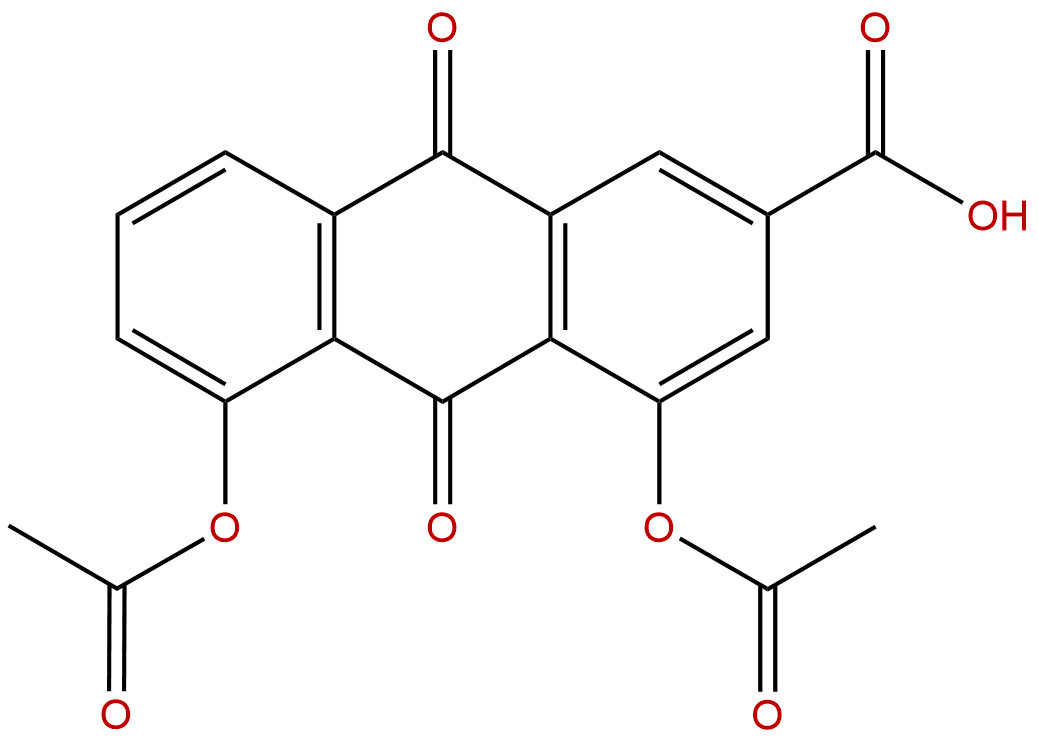
The chemical name of diacetylene is 4,5-diacetoxy-9,10-dioxo-9,10-dihydroanthracene-2-carboxylic acid, with a molecular formula of C19H12O8 and a molecular weight of 368.2970. Its structural parent nucleus is anthraquinone, which is a semi synthetic derivative obtained by structural modification (acetylation) of natural anthraquinone compounds (such as emodin). This modification aims to improve its solubility and pharmacokinetic properties.
In terms of physical and chemical properties, the lipid water partition coefficient (LogP) of diacetylene is 2.3253, indicating that it has a certain degree of lipophilicity, but not highly hydrophobic. Its topological polar surface area (TPSA) is 124.0400 Å ², reflecting the presence of multiple polar oxygen atoms (carboxyl, acetoxy, quinone carbonyl) in the molecule. The water solubility data is 0.1372 mg/mL, which belongs to the category of slightly soluble to poorly soluble. This poses a challenge to the bioavailability of its oral formulations and typically requires appropriate formulation techniques (such as micronization) to improve dissolution and absorption. The predicted blood-brain barrier permeability is' low ', indicating limited distribution of the central nervous system, which may reduce potential central side effects for drugs that primarily act on peripheral joints. In addition, key pharmacological warning parameters show that hERG channel inhibition is' no ', indicating a low potential risk of arrhythmia; The Ames test result is 0.6 (usually expressed as mutation rate, which needs to be judged based on specific experimental systems, but the value is close to the negative control), indicating that its genetic toxicity risk may be low, but it needs to be evaluated in conjunction with more comprehensive toxicological data.
Plant sources and extraction methods
Diacetamine is not a single component directly extracted from plants, but a derivative prepared by chemical semi synthetic methods using natural anthraquinone compounds as lead compounds. Its most direct and important natural precursor substance is Emodin. Emodin is widely present in various medicinal plants, such as the Polygonaceae plant Rheum palmatum(Rheum palmatum L.)、 Tanggu Extra Large Yellow(Rheum tanguticum Maxim. ex Balf. and Polygonum multiflorum(Polygonum multiflorum The rhizome of Thunb. and the plant Cassia in the Rhamnaceae family(Cassia obtusifolia L. The seeds, etc. These plants are commonly used in traditional medicine for diarrhea, clearing heat, promoting blood circulation, and removing blood stasis.
The extraction of emodin is usually carried out using organic solvents (such as ethanol, methanol) reflux extraction method, and then separated and purified by column chromatography and other techniques. After obtaining high-purity emodin, it is structurally modified through chemical synthesis steps by introducing acetyl groups on the 4th and 5th phenolic hydroxyl groups of the emodin nucleus, thereby obtaining diacetylene. This acetylation modification not only changes the physicochemical properties of the compound, but more importantly, it makes diacetylene itself a prodrug. After oral administration, diacetylene rapidly deacetylates in the body (mainly in the intestine and liver) and converts into its active metabolite, emodin (also known as Rhein metabolite). Therefore, the pharmacological effects of diacetylene are mainly exerted through its active metabolite emodin. This prodrug design may improve the oral absorption or tolerance of the original form of emodin to some extent.
Pharmacological activity research
Numerous preclinical and clinical studies have confirmed that diacerein (through its active metabolite emodin) has multiple pharmacological activities, centered around anti-inflammatory, cartilage protection, and pain relief.
- anti-inflammatory activity Diacetamol has shown significant anti-inflammatory effects in various inflammatory models. For example, in a mouse model of asthma, it can effectively alleviate bronchospasm and control airway inflammation, reduce inflammatory cell infiltration and release of pro-inflammatory cytokines. In OA related synovitis and systemic inflammation models, diacetylene can significantly reduce the levels of inflammatory markers.
- Cartilage protection and disease modification effects This is the core potential of using diacetylene for OA research. Research has shown that it can inhibit the degradation of extracellular matrix in chondrocytes, such as type II collagen and proteoglycans. This is mainly achieved by inhibiting the expression and activity of matrix metalloproteinases (such as MMP-1, MMP-3, MMP-13) and aggrecanase (ADAMTS). Meanwhile, it can also promote the synthesis of proteoglycans by chondrocytes, which helps maintain cartilage homeostasis.
- Analgesic effect Clinical studies have confirmed that diacerein can effectively alleviate joint pain and improve joint function in OA patients. Its analgesic effect is not simply the analgesic effect, but is related to its ability to reduce intra-articular inflammation, decrease the production of nociceptive stimuli, and possibly regulate pain signaling pathways.
- Effect on subchondral bone In recent years, studies have suggested that diacetylene may affect the remodeling of subchondral bone and slow down the hardening or abnormal changes of subchondral bone during OA by regulating the activity of osteoclasts and osteoblasts.
- anti-oxidative stress Diacetamol and its metabolite emodin have the ability to scavenge free radicals and enhance the endogenous antioxidant defense system, which helps alleviate oxidative stress damage to chondrocytes in OA joints.
Mechanism of action and molecular targets
The mechanism of action of diacerein is complex, involving synergistic regulation of multiple targets and pathways. Its core is to inhibit the generation and signaling of IL-1 β, and extend to downstream processes such as inflammation, catabolism, and cell survival. The relevant target network is as follows:
-
Core target: IL-1 β pathway The most classic mechanism of action of diacerein is to inhibit the maturation and activation of IL-1 β. It does not directly inhibit IL-1 β itself, but rather through inhibition IL-1 converting enzyme (ICE, also known as Caspase-1) The production and activity of pro-IL-1 β prevent it from being cleaved into mature IL-1 β with strong pro-inflammatory activity. IL-1 β is a key cytokine driving OA cartilage degradation, synovitis, and pain.
-
Key signaling pathways and targets:
- NF - κ B signaling pathway IL-1 β and other factors activate the NF - κ B pathway, promoting the expression of a large number of inflammatory mediators and matrix degrading enzymes. Diacetamol can inhibit NF - κ B subunits RELA (p65) The nuclear translocation and DNA binding activity of COX-2, iNOS, MMPs, as well as the expression of IL-6, TNF - α and other genes are downregulated.PTGES Prostaglandin E synthase, as a key enzyme that produces the painful and pro-inflammatory mediator PGE2, is also regulated by NF - κ B expression, which can be inhibited by diacetylene.
- MAPK signaling pathway Diacetamol can inhibit the phosphorylation of p38 MAPK, JNK, and ERK induced by IL-1 β, which are involved in the regulation of inflammatory response and matrix degradation.
- AMPK signaling pathway Activate AMPK (by PRKAA1 Iso subunit composition is an important mechanism by which diacerein exerts anti-inflammatory and metabolic regulatory effects. AMPK activation can inhibit NF - κ B and MAPK pathways, while upregulating them NFE2L2 (Nrf2)Nrf2 is a key transcription factor in antioxidant response, and its activation can induce the expression of antioxidant enzymes such as heme oxygenase-1 (HO-1), alleviating oxidative stress.
- PI3K/Akt pathway Diacetamol can regulate this pathway, affecting cell survival and inflammatory response. It may indirectly affect downstream NF - κ B by inhibiting Akt overactivation.
- Wnt/β - catenin pathway In OA, abnormal activation of Wnt signaling promotes chondrocyte hypertrophy and catabolism. Research has shown that diacerein can inhibit Wnt/β - catenin signaling, which helps maintain stable chondrocyte phenotype.
-
Specific effect molecular targets:
- Catabolic enzyme: Direct or indirect inhibition MMP1、 MMP3, MMP13, and ALOX5 Expression and activity of 5-lipoxygenase, involved in leukotriene synthesis.
- Cell apoptosis and autophagy Double Vinegar can upregulate anti apoptotic proteins BCL2 The expression of IL-1 β and the inhibition of Caspase-3 activation can reduce chondrocyte apoptosis induced by factors such as IL-1 β. At the same time, it can promote protective autophagy, help chondrocytes clear damaged organelles, and maintain internal environment stability.
- Inflammasome By inhibiting CASP1 The assembly of Caspase-1 and NLRP3 inflammasomes reduces the maturation of IL-1 β and IL-18 from the source.
- pattern recognition receptor A study suggests that diacetylene may interfere with TLR4 Signal transduction of Toll like receptor 4 inhibits its mediated natural immune inflammatory response.
In summary, diacerein targets multiple pathological processes such as inflammation, oxidative stress, catabolism, and cell death through an interwoven network, demonstrating the advantages of natural product multi-target effects.
Evaluation of drug properties and pharmacokinetics
As an oral medication, the pharmacological characteristics and pharmacokinetic behavior of diacetylene are crucial for its efficacy and safety.
-
Absorption, distribution, metabolism, excretion (ADME):
- absorb After oral administration, diacetylene is rapidly but incompletely absorbed in the gastrointestinal tract (with an absolute bioavailability of approximately 35-56%). Its micro solubility is the main factor limiting absorption. Food can slow down its absorption rate, but has little effect on total absorption (AUC).
- distribution After absorption, it is widely distributed in tissues throughout the body, including synovial fluid and cartilage. Due to its low blood-brain barrier permeability, its distribution in the central nervous system is limited. High plasma protein binding rate (>99%).
- Metabolism Diacetamol is a typical prodrug. It is mainly deacetylated rapidly and almost completely (>90%) by esterases in the intestinal wall and liver, converting into its active metabolite, emodin. Emodin can further undergo glucuronidation or sulfation binding reactions in the liver, generating inactive metabolites.
- excretion Metabolites are mainly excreted through the kidneys and urine, with a small amount excreted through bile and feces. The elimination half-life of the original form of diacetylene and its active metabolite emodin is relatively short (about 1 hour for diacetylene and 4-5 hours for emodin), so it needs to be administered twice a day to maintain effective blood drug concentration.
-
Clinical pharmacokinetics In OA patients, there was no significant accumulation of diacetylene and emodin after repeated administration. The pharmacokinetic parameters show a linear relationship within the therapeutic dose range.
-
safety evaluation:
- Common adverse reactions The most prominent adverse reactions are gastrointestinal reactions, such as diarrhea, abdominal pain, and soft stools, with a high incidence rate (up to 30-40%). This is mainly related to the stimulating effect of emodin on intestinal smooth muscle and its laxative properties. Usually occurring in the early stages of treatment, most patients can tolerate it over time or alleviate it by adjusting the dosage (such as starting at a low dose).
- Serious adverse reactions Rare, but liver function needs to be monitored. There have been case reports of elevated liver enzymes and even acute hepatitis. The preliminary negative results of hERG inhibition and Ames test support its relatively low risk of cardiotoxicity and genotoxicity, but complete non clinical and clinical data support is still needed.
- Drug interactions Due to its high protein binding rate, it may compete with other high protein binding drugs such as warfarin and should be used with caution.
Clinical application prospects and prospects
Diacetamol has been approved for the treatment of OA in multiple countries around the world, mainly in Europe, Latin America, and some Asian countries. Its clinical application prospects and future development directions are reflected in the following aspects:
- The position in the treatment of osteoarthritis Diacetamol is classified as a "symptomatic slow acting drug" (SYSADOA), which combines pain relief, functional improvement, and potential disease modifying effects. Compared with simple analgesics or NSAIDs, its advantage lies in the possibility of delaying the progression of joint structural damage, and the relatively lower risk of gastrointestinal ulcers and cardiovascular disease (compared to traditional NSAIDs). For OA patients who require long-term treatment, are intolerant to NSAIDs, or have contraindications, diacetylene is an important choice.
- Expand the exploration of indications Based on its multiple pharmacological effects of anti-inflammatory, antioxidant, and anti fibrotic, the application of diacetylene in other diseases such as rheumatoid arthritis, pulmonary fibrosis, renal fibrosis, metabolic syndrome related inflammation, etc. is being explored. Its effectiveness in asthma models suggests potential value for respiratory inflammatory diseases.
- Combination therapy strategy Future research can explore the synergistic effects of diacerein in combination with other OA treatment drugs (such as glucosamine sulfate, chondroitin sulfate, duloxetine, etc.) or novel biologics, in order to achieve better efficacy and safety.
- Optimization of formulation technology Developing new drug delivery systems is an important direction to address its poor water solubility and gastrointestinal side effects. For example, enteric coated formulations, sustained-release formulations, nanoparticle or liposome encapsulation, etc., aim to improve bioavailability, reduce dosing frequency, and minimize direct irritation to the gastrointestinal tract.
- Deep exploration of mechanism of action and biomarkers Using systems biology and computational pharmacology methods, further elucidate the key nodes in its multi-target network. Finding biomarkers (such as specific inflammatory cytokine profiles and gene polymorphisms) that can predict the response to diacetylene treatment can help achieve personalized and precise treatment of OA.
- Confirmation of Long term Disease Modification Effects Although basic research and some clinical studies support its potential for disease modification, more rigorously designed, long-term follow-up clinical trials with imaging (such as MRI to evaluate cartilage volume) and biomarkers as endpoints are still needed to confirm its delaying effect on OA structural progression.
Conclusion
As a semi synthetic derivative derived from natural anthraquinone emodin, diacerein exhibits dual value in the treatment of osteoarthritis, including symptom improvement and potential disease modification, due to its unique network pharmacological mechanism of inhibiting IL-1 β activation as the core and widely acting on multiple signaling pathways such as NF - κ B, AMPK, MAPK, etc. The prodrug design, clear active metabolites, and relatively controllable safety profile have laid the foundation for its clinical application. Despite challenges such as gastrointestinal adverse reactions, the treatment window is expected to be further expanded through dose optimization, patient education, and the development of new formulations. In the future, with more refined analysis of its molecular action network, expansion of indications, and exploration of personalized treatment strategies, diacetylene, a natural product derived drug, is expected to continue to play an important role in the treatment of chronic inflammatory diseases, especially in the comprehensive management system of osteoarthritis, and provide a successful example for discovering and optimizing lead compounds from traditional medicinal plants.