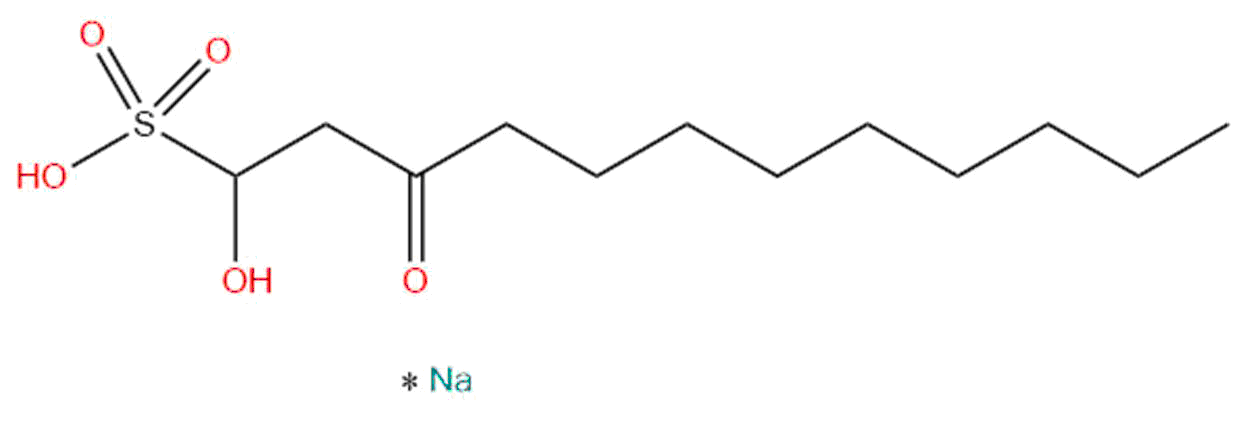


Synonym name: Sodium New Houttuyfonate; Sodium Neohouttuyfonate
Catalogue No.: BP1319
Cas No.: 83766-73-8
Formula: C12H23NaO5S
Mol Weight: 302.36
Botanical Source:
Purity: 95%~99%
Analysis Method: HPLC-DAD or/and HPLC-ELSD
Identification Method: Mass, NMR
Packing: Brown vial or HDPE plastic bottle
Can be supplied from milligrams to grams.
For Reference Standard and R&D, Not for Human Use Directly.
Inquire for bulk scale.
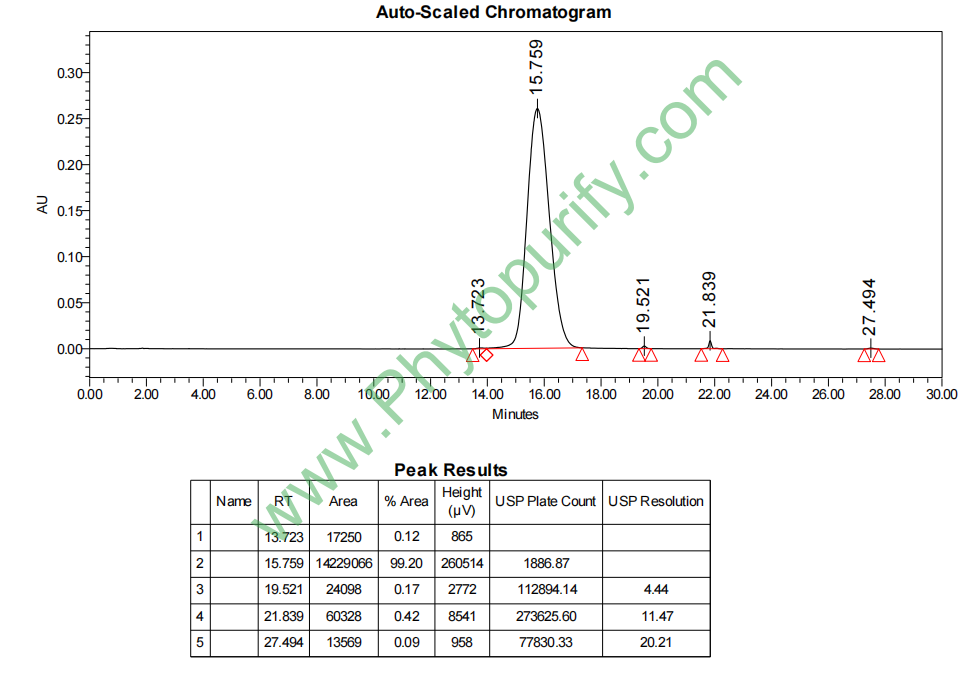
HPLC of Sodium Houttuyfonate
Storage conditions:Short-term storage at 2~8℃, long-term storage at -20 ~ -80℃
91.6700
1.3675
-.8336
3.3989
.3538
1.5779
Low
76.3194
3.0714
Yes
No
No
No
No
No
0.9
No
No
No
No
Sodium Houttuyfonate (SH), also known as sodium bisulfite of decanoyl acetaldehyde, with a CAS number of 83766-73-8, is a synthetic derivative of decanoyl acetaldehyde (Houttuynia cordata Thunb., commonly known as Houttuynia cordata Thunb.), the main active ingredient in traditional medicinal plants. Houttuynia cordata, as a traditional Chinese medicine with a long history in China, has been recorded in classics such as the Compendium of Materia Medica. It is commonly used for clearing heat and detoxifying, eliminating carbuncles and pus, and is commonly used in modern clinical practice to treat respiratory infections, inflammatory diseases, etc. Natural decanoyl acetaldehyde has unstable properties and is prone to polymerization failure, while sodium houttuynia cordata obtained through chemical modification has significantly improved water solubility and chemical stability, making it more suitable for drug development and application.
In recent years, with the increasing threat of new and recurrent infectious diseases, especially the frequent spread and mutation of influenza viruses, the development of new, efficient, and multi-target antiviral drugs has become an urgent need in the global public health field. Sodium Houttuynia cordata has attracted much attention due to its broad-spectrum antibacterial, antiviral, and anti-inflammatory activities. Numerous studies have shown that it exhibits significant inhibitory effects on multiple influenza virus strains in both in vitro and in vivo models. Its effects are not limited to directly targeting viral proteins, but also involve deep regulation of host immune and inflammatory pathways, reflecting the characteristics of multi pathway and multi-target intervention. This article aims to systematically review the chemical properties and pharmacological activities of sodium houttuyfonate, especially its anti influenza mechanism, molecular targets, drug properties, and clinical application prospects, in order to provide comprehensive scientific references for the in-depth research and development of this compound.
The chemical structure of sodium Houttuynia cordata can be regarded as the addition product of decanoyl acetaldehyde (CH3 (CH ₂) ₈ COCH ₂ CHO) and sodium bisulfite (NaHSO3), forming a stable sulfonic acid salt form. Its molecular formula is C ₁₂ H ₂ ∝ NaO ₅ S, and its molecular weight is 280.3860. This modification is a crucial pharmaceutical improvement: the active aldehyde group in natural decanoyl acetaldehyde molecules is prone to self condensation or reaction with other nucleophiles, resulting in loss of activity; After addition with sodium bisulfite, the formed α - hydroxysulfonate structure greatly enhances the water solubility and chemical stability of the molecule, while retaining its basic pharmacological active skeleton.
From the analysis of physical and chemical properties, the calculated lipid water partition coefficient (LogP) is 1.3675, indicating that the molecule has a certain degree of lipophilicity, but overall leans towards amphiphilic properties. Its topological polar surface area (TPSA) is 91.6700 Å ², reflecting the large proportion of polar moieties (sulfonic acid groups, hydroxyl groups) in the molecule. The water solubility value is 3.3989 (usually referring to logS or related indicators, the larger the value, the worse the solubility. The specific scale needs to be combined with the context, but usually indicates good water solubility), which confirms its excellent water solubility characteristics as a sodium salt. These physicochemical parameters collectively determine the distribution, absorption, and metabolic characteristics of sodium houttuynia cordata in the body, providing the possibility for its oral or injection administration.
The direct plant source of sodium houttuynia cordata Thunb. is Houttuynia cordata Thunb. This plant is widely distributed in East Asia and Southeast Asia, and its whole plant is used as medicine. Fresh Houttuynia cordata contains volatile oil, and its main antibacterial and antiviral component is believed to be decanoyl acetaldehyde. However, the content of naturally extracted decanoyl acetaldehyde is low and extremely unstable.
Therefore, the sodium houttuynia cordata used in drugs is mainly prepared through chemical synthesis or semi synthesis methods. The classic synthetic route is to use methyl nonanone (or decanoic acid derivatives) as the starting material, undergo a series of reactions to generate decanoyl acetaldehyde intermediate, then undergo addition reaction with sodium bisulfite aqueous solution, and finally crystallize and purify to obtain pure sodium houttuyfonate. This process is mature and can achieve large-scale production, ensuring drug quality and stability. Although it originates from natural product structures, modern production processes have made it a standard chemical drug entity.
Sodium Houttuynia cordata has a wide range of pharmacological activities, including antibacterial, antiviral, anti-inflammatory, and immune regulatory aspects. Among them, its anti influenza virus activity has been a research focus in recent years.
The mechanism of action of Houttuynia cordata sodium against influenza is complex, showing the characteristics of multi-target and multi pathway synergy, which can be divided into direct antiviral effect and indirect host directed effect.
Directly acting on the virus:
Regulating host cell signaling pathways (core mechanism):
In summary, the mode of action of Sodium Houttuynia cordata is not simply a "virus killer", but rather achieves a dual effect of "strengthening the body and eliminating evil" by moderately enhancing the host cell's defense capabilities (such as NRF2 and interferon pathways), while inhibiting harmful overreactions caused by viruses (such as p38/JNK mediated inflammatory storms).
Based on its physical and chemical properties and relevant experimental data, the preliminary evaluation of the pharmacological properties of sodium houttuynia cordata is as follows:
Overall, sodium Houttuynia cordata exhibits good potential for medicinal properties: moderate molecular weight, good water solubility, and positive preliminary safety signals. However, its complete pharmacokinetic characteristics, metabolic fate in the human body, and interactions with other drugs still need to be elucidated through more systematic and rigorous preclinical and clinical studies.
Sodium Houttuynia cordata is currently used in clinical practice in China in the form of injections, oral preparations, etc. It is mainly used as an adjuvant therapy for bacterial or viral inflammatory diseases such as respiratory infections, bronchitis, pneumonia, etc. Based on its unique anti influenza virus mechanism, its clinical application prospects are as follows:
The challenges faced mainly include: although the mechanism of action network has been preliminarily mapped, the most precise direct molecular targets (such as interaction sites with specific viral proteins or host proteins) still need to be further identified; Large scale, randomized double-blind clinical trials are needed to confirm its efficacy and safety advantages in treating influenza; As a derivative of natural products, its chemical composition is clear, but the quality control standards still need to be in line with international standards to promote international application.
Sodium Houttuynia cordata is a successful example derived from the traditional Chinese medicine Houttuynia cordata. It overcomes the stability problem of natural ingredients through chemical modification and has developed into a modern medicine with a clear chemical structure. Its anti influenza pharmacological activity is outstanding, and its mechanism of action is profound. It exerts its effects through a dual pathway of directly inhibiting the virus and indirectly regulating host defense and inflammatory response. The core involves precise regulation of the NRF2, MAPK (p38/JNK), and interferon signaling pathways. The preliminary pharmacological evaluation shows that it has good water solubility and safety potential.
In the future, with the further deepening of molecular target research, the accumulation of high-quality clinical evidence, and the application of new formulation technologies, sodium houttuynia cordata is expected to evolve from a widely used anti infective adjuvant drug to an important treatment option for viral respiratory infectious diseases such as influenza, especially in clinical situations where both antiviral and anti-inflammatory needs are met. Its research and development process also fully reflects the value of drug development that draws inspiration from traditional medical wisdom and applies modern scientific technology for innovation and validation.
